
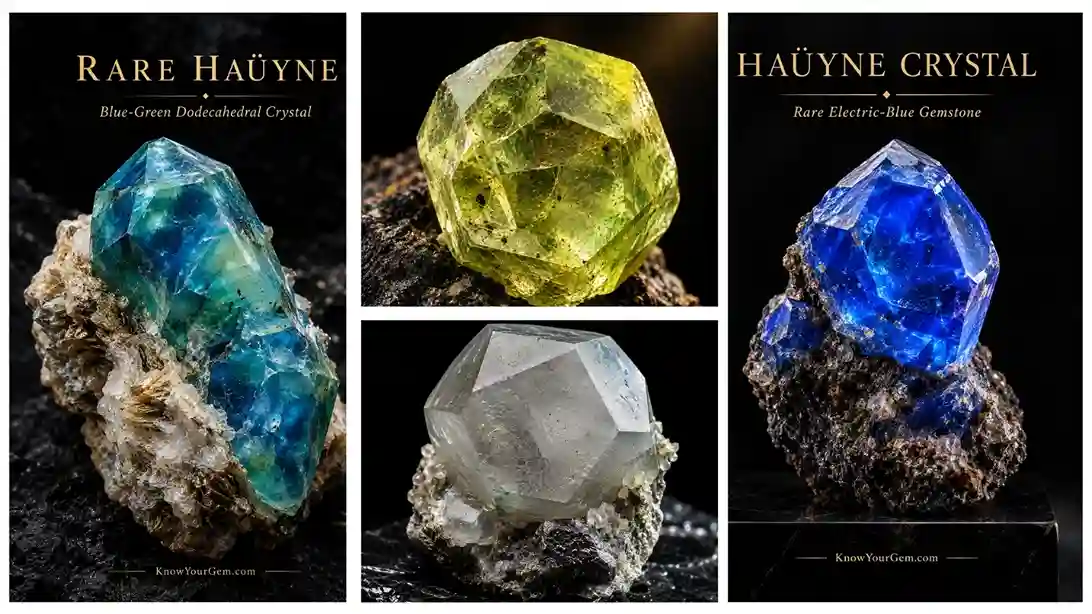

Hauyne (usually said ah-WEEN) is a rare blue mineral from the sodalite group, and only a small share of it is clear enough to cut as a gemstone. Faceted stones are typically under two carats, they chip more easily than most people expect, and published prices run from a few hundred dollars per carat to figures dealers describe as far higher for the best material.
Quick Answer:
- Understand: What is it: a sulfate-bearing (baylissite), feldspathoid mineral, Na 3 Ca (Si 3 Al 3)O 12 (SO 4).
- Color: Most well known in bright blue, but also available in white, gray, green, yellow and pink.
- Hardness: 5.5-6 on Mohs scale, cleaves [cleaves means it cuts easily.
- Main source: Eifel, Germany, plus gem material reported from Afg, Tanz, Myanmar.
- Price: No averagesavailable ranges for published prices from hundreds to well over a thousand dollars per carat.
- Best for: Collectors jewellery & protected jewelry rather than several day rings.
What Is Hauyne?
Hauyne is a tectosilicate, a mineral that has a three-dimensional framework of silicon-oxygens and aluminum-oxygens. It is one of the feldspathoids, minerals which are similar to feldspars but crystallise from magma that lacks enough silica for feldspar to form. Hauyne is in that group in the sodalite family along with sodalite, nosean and lazurite.
The name is in memory of René Just Haüy, a French mineralogist sometimes considered the father of modern crystallography, and the mineral was described in 1807. You will see the spellings hauyne, haüyne and hauynite. All three mean the same species. An older name, azure spar, still appears in historical references.
Too many folks think hauyne is the same as lapis lazuli. They are connected, but lapis is a stone with predominantly lazurite, and lesser amounts of hauyne, sodalite and calcite. Hauyne is one mineral. Lapis earns its value as an opaque to translucent stone, while hauyne earns it when a crystal is transparent enough to facet.
That is where the rarity comes from. Most crystals are under 5 mm across, and plenty are cloudy, cracked or pale. A clean, transparent, well-colored crystal that survives cutting is the exception.
Crystal Structure and Composition:
Hauyne crystallizes in the cubic system, hextetrahedral class, space group P43n. Put into common language this means that the build up of the atom is symmetrical in all three directions hence the fact that the stone is singly refractive and shows no pleochroism. Rotate it and the color remains constant.
The framework is open and cage-like, which explains the low density. Sodium and calcium ions sit inside the cages alongside sulfate groups (SO₄). The sulfate is the chemical dividing line from sodalite, which holds chlorine in that position instead. Analyses show hauyne can also carry some potassium, water and chlorine.
The blue was associated with the sulfur species in the framework. The one published story is sulfur radical anions ( S3-) being a similar sort of chromophore as lazurite and ultramarine is for the blue, this appears in many repeated versions, however not exactly the same.
Crystals usually grow as dodecahedra or pseudo-octahedra, and twinning is common. Hauyne also forms rounded grains and masses.
Cleavage runs along {110} planes, the directions in which the crystal prefers to split. Sources disagree on how strong it is. Mindat-based references and the Gem Society say distinct, while some retailers and encyclopedias say perfect. That disagreement matters when we get to cutting and wear.
Geologically, sodalite-group minerals crystallize from silica-poor magma. Hauyne therefore turns up in alkaline volcanic rocks such as phonolites and other nepheline-bearing rocks. Some occurrences are in metamorphosed carbonate rocks, but volcanic settings give the best-known crystals.
Where Is Hauyne Found?
Hauyne appears in a limited number of alkaline volcanic and related settings. Only a handful of those localities have ever produced material worth faceting.
Hauyne from Germany:
Germany is the reference point. The classic gem material comes from the Eifel volcanic district in Rhineland-Palatinate, and the place names dealers repeat most are Mayen, Niedermendig and the Laacher See area.
One German dealer traces the deposits to an eruption roughly 11,000 years ago. Collectors historically picked crystals out of pumice in local pits, and the same source says private access to those pits is now restricted.
If that is accurate, it goes a long way toward explaining why new supply of fine German stones is so thin. Dealers generally describe the Eifel as a long-established source, not an active commercial mine.
German hauyne runs small. One dealer reports that faceted German stones usually weigh under 0.20 carat and that anything above half a carat is very rare. The Gem Rock Auctions guide mentions a 19.74-carat cut hauyne that held a Guinness World Record listing as of March 2020. Take that as a curiosity and not a size anyone should expect.
Other Localities:
Gem-quality material has been documented elsewhere. Tanzania produced yellow-green stones in 2003, and the Gem Society notes they have a lower refractive index and higher specific gravity than other hauyne.
Blue gem-quality stones from Afghanistan were documented in 2006, and Badakhshan, the region also known for lapis, shows up constantly in listings. Myanmar is also reported as a source.
Origin claims deserve some skepticism. Anyone can type “German” into a listing, and Afghan stones are common online with properties close to German ones. The eye can’t separate them. Even a laboratory may be limited in what it can conclude about the origin of a species this rare.
Hauyne Colors:
Blue is the reason most people look at hauyne. The best stones show a saturated blue that sometimes leans toward violet. Weaker material looks pale, gray or slightly greenish, and it sells for much less.
Green hauyne exists mostly as small faceted stones from newer sources like Afghanistan and Tanzania. Yellow and yellow-green material came out of the Tanzanian find and is sold mainly to collectors. White, gray and colorless crystals are common in ordinary specimens but rarely cut. Pink is listed in mineral references and almost never seen in the gem trade.
Transparency changes what a color is worth. A deep blue crystal that is opaque or full of cloudy patches will usually become a cabochon or stay a specimen. A transparent blue crystal without visible cracks is the material that can be faceted, and that pairing is the rare one.
Photos add another layer of trouble. Marketplace images are often edited or shot under strong light, and hauyne can look different from one lighting condition to the next. Ask for video in natural daylight before paying real money.
Physical and Optical Properties:
| Crystal system | Cubic (isometric) |
| Mohs hardness | 5.5-6 (some sources give 5-6) |
| Cleavage | Distinct on {110}; some sources say perfect |
| Fracture | Uneven to conchoidal, brittle |
| Luster | Vitreous to greasy |
| Transparency | Transparent to translucent |
| Refractive index | About 1.494-1.509, singly refractive |
| Specific gravity | About 2.4-2.5 |
| Pleochroism | None |
Not every institution has the same figures to publish. For example, refractive index is given as 1.494 to 1.505, up to 1.509.
Specific gravity varies from about 2.42 to 2.50 between institutions and locations tested and also Tanzanian stones are outside the German value range. However a page that states one exact value for all hauyne pages over-simplified.
Here is what those numbers mean in the hand. At 5.5-6, hauyne is softer than quartz, so ordinary grit can scratch it over time. Sapphire, at 9, is in another league entirely.
The larger concern is brittleness combined with cleavage. In my sourcing experience, this is the trap: the stone feels sturdy, then it chips when it strikes something at the wrong angle. Hardness alone tells you very little about how a cleavable stone will behave.
The refractive index is low, so that hauyne does not sparkle like sapphire or spinel. Its value is in color and cleanliness, not fire.
The low specific gravity means it feels very light in the hand and appears visually larger for its weight, which is also something that distinguishes it from sapphire and spinel as they are much heavier than hauyne.
Hauyne Fluorescence:
Hauyne glows under longwave ultraviolet. Tisserant has noted orange to pink glow, with many sources reporting reddisch-orange to purplish-pink, though others note that response varies by specimen and location, some stones display little or no response.
Treat fluorescence as a clue and not as proof. Other materials can glow in similar colors, and a stone that doesn’t react hasn’t been ruled out. It earns its place alongside other tests, not in place of them.
How to Identify Hauyne?
No single test is decisive. Identification adds up: body color and luster, singly refraction under polarized light (occasionally feeble anomalous effects from inclusions) a singly refractive index of about 1.50, a specific gravity of about 2.4 to 2.5, UV response if any, internal features as seen under high magnification, and to the geological origin if rough or still embedded in matrix.
Glass is the classic trap. It overlaps hauyne in refractive index, specific gravity and hardness, and it can be made in any color, so quick readings can fail to separate the two. A spectroscope reading or a laboratory report is the safer route for expensive stones. Visual identification alone is never conclusive.
Hauyne Crystal, Faceted Stone or Cabochon?
Sellers use the word “hauyne” for three quite different products, and the differences drive price. Crystal specimens are natural crystals or matrix pieces sold to mineral collectors.
Value depends on crystal form, color, size and condition. Classic Eifel specimens with crystals on volcanic rock are prized, yet a specimen can be beautiful and contain almost no cuttable material.
Faceted gemstones come from clean, transparent rough and are the rarest category. With most crystals under 5 mm and heavy losses in cutting, finished stones stay small.
One dealer reports typical yields of 5-10 percent of rough weight, against 20-35 percent for many gem minerals. Rounds and ovals are common, and finished German stones are often well under a carat.
Cabochons come from translucent material that can’t be faceted. A smooth dome hides cloudiness and included patches better than facets can, and it removes the sharp edges where chips tend to begin. Cabochons, freeforms and beads are all common in Afghan material.
S rehard is laborious. Heart-shaped cuts called cleavage are when you are grinding the stone, it can snap, due to the softness of the stone require delicate polishing.
A lapidary has to weigh weight retention against color against fracture risk. Facet designs tend to stay simple, because a low refractive index gains little from elaborate faceting. Good cutters concentrate on depth, saturation and a clean outline. Small chips at the girdle or corners are common in finished stones, so inspect under magnification.
Hauyne in Jewelry:
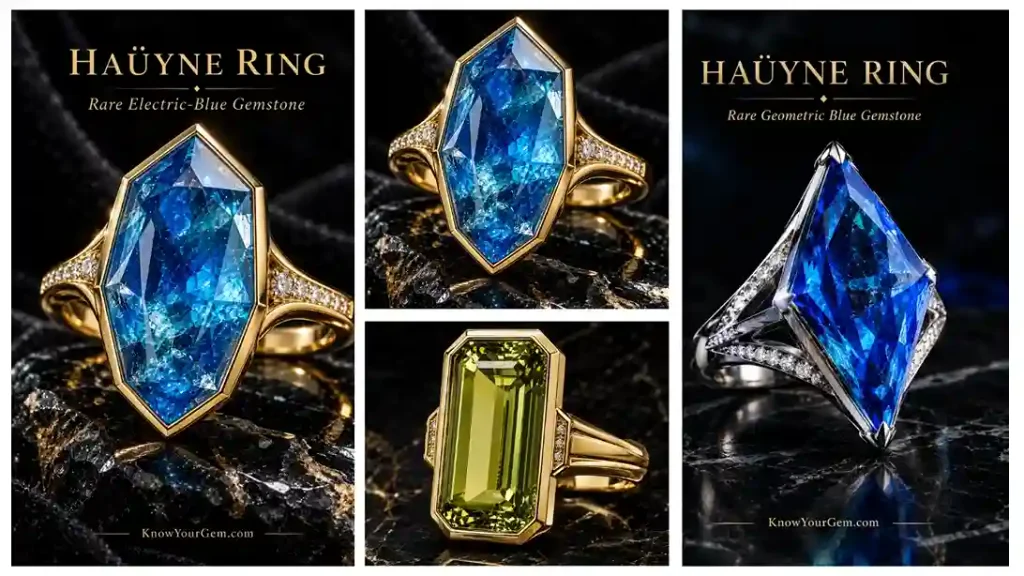
Hauyne may also be worn in jewelry that is designed around the stone (edges or corners can chip if they are unprotected).
Rings are the most susceptible jewelry – they take a beating all the time, and it only takes a hit from the wrong angle to chip or crack. Choose a bezel or haloes for rings to protect edges and corners, and wear them occasionally. Prongs expose corners.
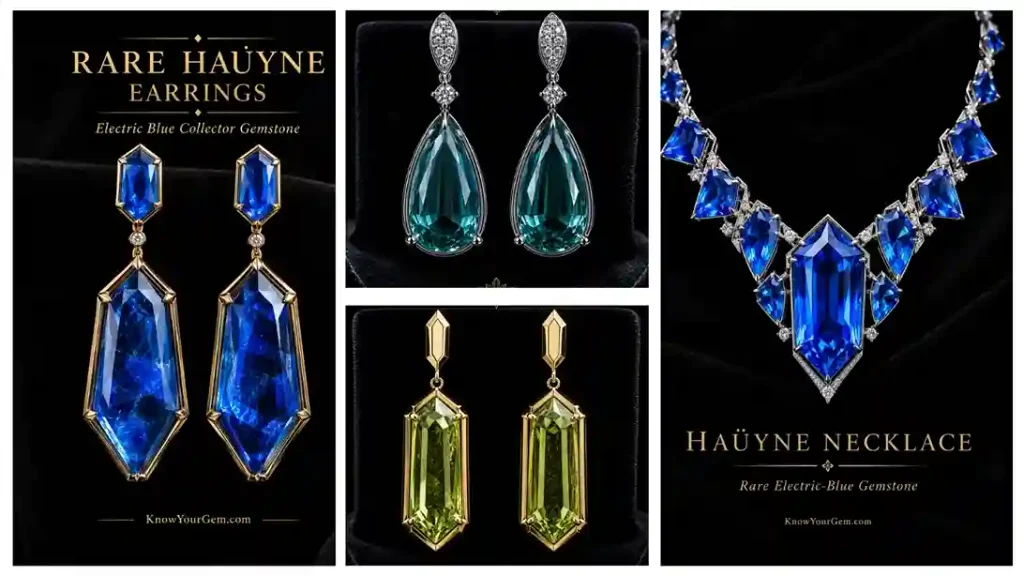
Pendants and earrings are the better fit, because they sit away from most impacts. Hauyne earrings in a protective design make sense for the stone.
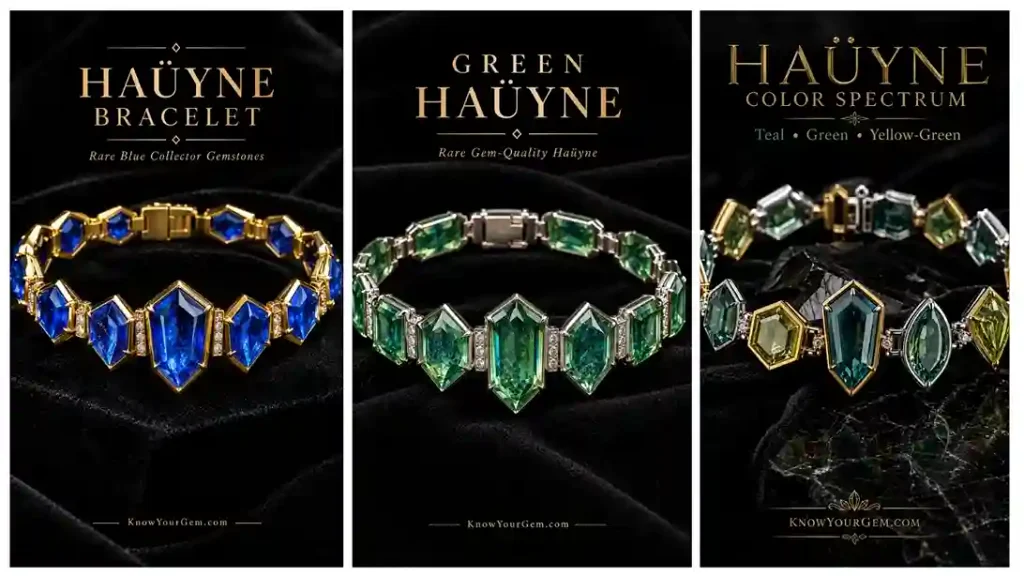
Bracelets are risky for regular use, since wrists hit desks, doors and counters. Beads and cabochons are possible, but beads can chip where they rub against each other, and translucent cabochons are far more common than clear faceted stones.
Plenty of buyers simply keep hauyne as a collector stone, or set it in a piece that lives in a jewelry box between special occasions. That is a sensible way to own something this delicate.
Caring for hauyne: clean in the same manner as lapis, with a soft toothbrush and warm water with soap. Do not use ultrasonic cleaners, steam or strong chemical solvents. Strong acids will damage the hauyne. Keep away from other hard stones and remove for sports, gardening and house work.
Treatments, Synthetics and Imitations:
The only treatment reported in the sources I found is fracture filling. Paraffin wax has been used to seal cracks in some faceted stones, and it isn’t always disclosed. Wax can soften or melt with heat, so avoid hot water, hot lights and a parked car in the sun. Ask the seller directly.
Scientists have synthesized hauyne and lazurite for research. According to the Gem Society, there is no known jewelry use for the lab-created material, so a synthetic sold as a jewelry stone would be unusual. Any such claim still needs documentation.
The more realistic risk is misidentification. Blue glass, other blue minerals and sodalite can all be sold under the wrong name. Look at how the seller identified the stone, not only at what the label says.
Hauyne Price:
There is no reliable universal price. A mineral specimen, a cabochon and a faceted gem can differ enormously in value, even at similar weights. Anyone quoting one “price per carat” for all hauyne is skipping the parts that matter.
The figures below come from published dealer and guide sources. They are not a live market feed, and they cover different years and different material, so use them as reference points only.
| Gem Rock Auctions guide | Typical faceted stones | Roughly $850-$2,500 per carat | 2023 |
| Gem Rock Auctions guide | Bright blue cabochons | Roughly $1,000-$3,000 per carat | 2023 |
| GemologyOnline forum, dealer comment | Top stones under 2 ct, wholesale | $2,000-$3,000 per carat | 2010 |
| German gem dealer blog | Best-quality stones | Up to $20,000 per carat | 2022 |
The top figure is one dealer’s claim about best-quality stones and not a typical retail price. The lower ranges are closer to what an ordinary faceted stone might cost. Auction listings show a wide spread, and small Afghan stones often sell far below fine German ones.
Color drives the price first, with vivid saturated blue at the top and pale or gray stones well below. Transparency and clarity come next, because eye-clean transparent stones are unusual and cracks, cloudy zones and inclusions cut value. Size matters more than usual here.
Anything above half a carat is rare in German material, so price per carat can climb with weight. Cut counts as well, and a well-made small stone can outsell a larger, poorly cut one.
Documented origin can add a premium, but an undocumented claim carries little weight. Wax filling, fractures and repairs reduce value. And because the collector market is small, demand is uneven. Rarity alone doesn’t create buyers.
I don’t treat hauyne as an investment. The buyer pool is narrow, resale can be slow, and no standard price list exists. It works best as a stone you buy because you want it, and faceted pieces are the only form I’d consider even as an alternative to better-known collector gems.
The Biggest Buyer Misconception:
Many buyers believe a deep blue color means a good, valuable stone, and that a “German” label confirms it.Color is only one aspect.
A vibrant bluish colored stone that is chipped, filled or misidentified can go for a lot less than the published listing shot, and an origin claim in the absence of paperwork is just that – a claim. Rarity, clarity, cut, cleavage, inclusions, treatment, ethical sourcing and paper work all influence a stones value.
This is important because hauyne is soft, it cleaves and it can be filled or confused with glass and other blue matrix. A buyer who judges color first can miss the problems that count most. Check identity, condition, treatment, documentation and price, and let the color come last.
How to Buy Hauyne?
Hauyne can be bought from mineral dealers, gem dealers, and most of the online auction sites. Starting with specialist suppliers of individual rare gemstones and minerals is unlikely to be misleading. Whatever it is from find out what the supplier is offering, a specimen, a cab, a faceted stone or a strand of beads?
Before you pay, check these points:
- Is it actually hauyne, and how did the seller identify it?
- Is it natural, not glass or a simulant?
- What are the carat weight and dimensions?
- Does the photo or video show the actual stone in natural light?
- Are chips, cracks or inclusions visible?
- Has it been filled with wax or otherwise treated?
- Is the origin documented or only stated?
- For an expensive stone, is there a laboratory report?
- What is the return policy?
Certification is a matter of scale. For a small, low-cost stone, a report may not be worth the fee. For an expensive one, it can matter a great deal, since identification and treatment disclosure are the main risks.
A recognized gemological laboratory can confirm the species and note fillings. Origin statements on reports for rare species may be limited, so read exactly what the report says.
Different buyers should weigh things differently. Buyers should value quality, documentation and locality, and a carefully documented German specimen may be more valuable than a bigger unlabelled one.
Those purchasing jewelry should select a protective setting and enquire whether the jeweler has set “soft, cleavable stones”. Budget buyers can look at small Afghan faceted stones, cabochons or beads, accepting that they won’t match top German quality, and should still confirm identification.
Hauyne vs Similar Blue Stones:
| Hauyne | 5.5-6 | About 1.50 | Singly refractive |
| Lazurite | 5-5.5 | About 1.50-1.52 | Usually translucent to opaque |
| Sodalite | 5.5-6 | About 1.48 | Usually translucent to opaque |
| Blue spinel | 8 | About 1.72 | Singly refractive, much denser |
| Blue sapphire | 9 Mohs | About 1.76-1.77 | Doubly refractive, much denser |
Sapphire and spinel are harder, more strong, and has a much higher brilliance, and are far better for everyday wear. Hauyne is also doubly refracting as well as pleochroic, which sapphire is not.
Actually, it is sodalite which is of similar composition. Sodalite is very common, inexpensive and largely opaque to translucent (translucent to transparent facetable sodalite is a little odd).
Lazurite is usually opaque to translucent as well, and lapis lazuli, the rock formed from it, is often inlaid with gold pyrite particles and white calcite.
Selected for its transparency in gemstone quality with a user-friendly RI of about 1.50, similar to that of hauyne. Awaiting confirmatory studies.
Hauyne Meaning and Claimed Benefits:
Hauyne also has little documented cultural or spiritual history compared with older gemstones. It was first scientifically described in 1807 and has been primarily known by mineral collectors. Contemporary crystal sellers may relate it to tranquil, communication or intuition in relation to its color; being a blue stone.
Those are belief-based associations, not established properties. Nothing in the scientific literature shows that hauyne treats any condition. If you value the stone for its symbolism, that is a personal choice, but it shouldn’t stand in for medical care.
Frequently Asked Questions:
1. How do you pronounce hauyne?
Usually ah-WEEN. Some sources give ah-WEE-nyte for the variant name hauynite, and some dealers say “hoween.” Regional habits differ.
2. Is hauyne rare?
Yes, especially transparent blue faceted stones. Crystals are mostly small and cutting yields are low.
3. Is hauyne the same as lapis lazuli?
No. Lapis is a rock, consisting mainly of lazurite. Hauyne is a different mineral, in the same group, that can be found as an inclusion.
4. How hard is hauyne?
It rates 5.5-6 on the Mohs scale and has distinct cleavage. It scratches and chips more easily than sapphire, spinel or quartz.
5. Can I wear hauyne every day?
Not really advisable. Better for pendants or earrings, not so good for rings; if wearing a ring, a setting on the ring (bezel or halo) is advisable.
6. Is hauyne treated?
Paraffin wax filling has been reported on some faceted stones. Ask sellers to disclose it.
7. How much is hauyne worth per carat?
It depends on quality and type. Published ranges run from hundreds to thousands of dollars per carat, with much higher claims for the best German stones.
8. Is hauyne a good investment?
It’s a collector’s stone with a narrow market, and I wouldn’t buy it expecting returns.
Always verify these gemstones with trusted labs like GIA, IGS, and SSEF for authenticity.
Gemstone expert and Enthusiast KamilHussain!

Welcome to KnowYourGem.com! your ultimate destination for uncovering the fascinating world of gems and their secrets! I'm Kamil Hussain, a passionate blogger with a Master’s degree in Economics, dedicated to bringing you insightful, well researched content that blends the beauty of gemstones with the art of storytelling. With a keen analytical mind and a love for discovering hidden treasures, I created this platform to help you explore the brilliance, history, and value of every gem.

