

Overview:
The unqualified designation is commonly used in the trade for chrysoberyl Cat’s Eye, or cymophane, even though many chatoyant of quartz, glass, and other minerals are commercially sold under this broad category. Cat’s Eye Stone is a strip of light that appears to move across the stone’s surface as it is rotated in a single light source.
Because of that distinction. A moving line demonstrates chatoyancy not chrysoberyl not natural origin not value. We cover the mineralogy, types, factors influencing price, and identification checks which enable you to buy with confidence.
Quick answer: Carved chrysoberyl Cat’s Eye is a natural cabochon made of chrysoberyl that has parallel internal inclusions that form a narrow, straight, movable band of light.
Quartz Cat’s Eye and fibre optic glass have similar optical effects but are dissimilar in composition, optical properties, hardness and value. Identification requires testing rather than visual inspection.
What Is Cat’s Eye Stone?
Miners of Cat’s Eye said they sell Cat’s Eye in the mineralogical form first – what is creating the eye? they don’t look at colour, transparency, cut, or price until we understand what it is.
Cat’s Eye Chrysoberyl is a gemstone variety of the aluminum beryllium oxide mineral species. Its mineral formula is BeAl2O4. It has an orthorhombic crystal structure and is rated 8.5 on Mohs scale of mineral hardness.
The eye is silk: Thin, parallel, needle-like strands or hollow tubes within the stone. Light will be reflected by these strands in a band. If the stone is cut as a cabochon with the strands parallel to the base, the light is reflected from the strands in a moving line.
What is Cat’s Eye Stone Made Of?
A genuine chrysoberyl Cat’s Eye stone has the host material being chrysoberyl; beryllium, aluminum and oxygen. The chatoyancy of a genuine chrysoberyl Cat’s Eye stone does not come from a coating or surface treatment, but is the result of inclusions. Several other stones are described as Cat’s Eyes stone in many listings, but it describes an optical effect, not a mineral.
Is Cat’s Eye The Same As Chrysoberyl?
Not quite. Chrysoberyl is the species; Cat’s Eye stone is one of the varieties of that species. A chrysoberyl might be a transparent gemstone with multiple facets, a colour change alexandrite, or chatoyance based on the Cat’s Eye. In the same way, not every Cat’s Eye is chrysoberyl.
The ore name for chatoyant chrysoberyl in mineralogical terms was originally cymophane. It is also referred to as Lehsunia or Vaidurya by South Asian astrologers.
What Does Cat’s Eye Stone Look Like?
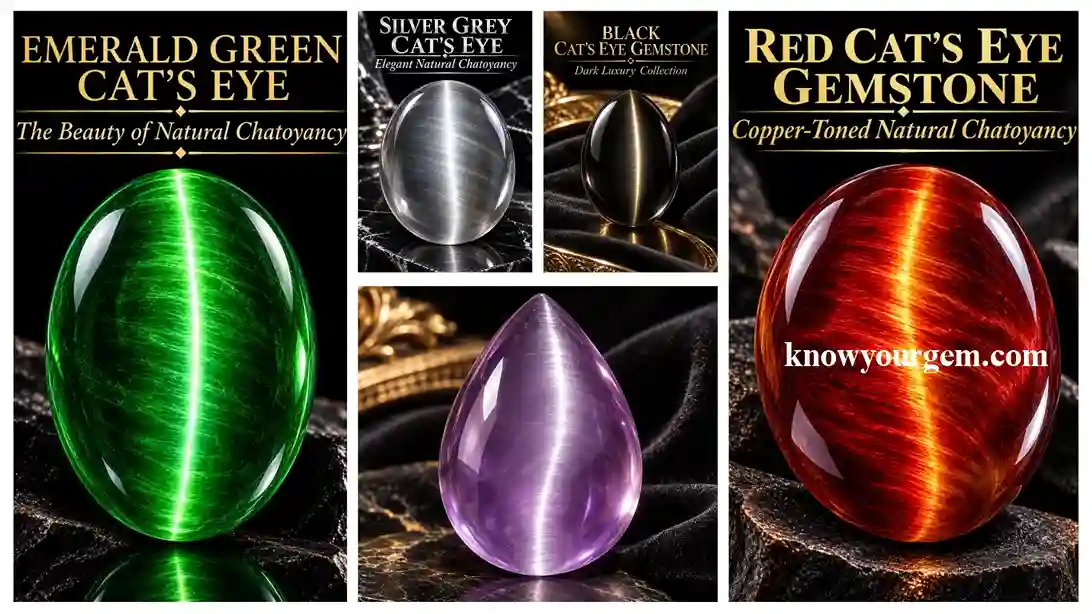
Fine chrysoberyl Cat’s Eye stone. The cut body of chrysoberyl generally is translucent and ranges in colour from yellow and honey to golden-brown and greenish-yellow. The finest stones are characterized by a thin, straight, bright line in the center of the cabochon.
Rotated and the band seems to flux open, close and sail around the dome. The best effect is what is called milk and honey: a milky band separates and honey-coloured body, imparting a fine depth and life to the eye in the sunlight.
What Makes The Eye Move Across The Gemstone?
There are three requirements to have chatoyancy: Sufficient reflective inclusions, parallel orientation of inclusions and a cabochon orientation needed. The band appears perpendicular to the inclusion direction and moves when the orientation of the stone or the light is altered.
Cutting is what makes or breaks many stones. Great rough can still turn into a dull, broad, poor off center, or broken eye if the lapidary cuts it the wrong way. Dome height, symmetry, base proportions, and polish can make a difference.
Cat’s Eye Stone Properties and Gemological Characteristics:
The specifications below are for chrysoberyl Cat’s Eye stone and do not represent all gems offered under the generic Cat’s Eye designation.
| Mineral | Chrysoberyl |
| Chemical formula | BeAl2O4 |
| Crystal system | Orthorhombic |
| Mohs hardness | 8.5 |
| Refractive index is | About 1.746–1.756 |
| Specific gravity is | About 3.70–3.78 |
| Optical character | Biaxial positive |
| Optical phenomenon | Chatoyancy |
| Typical cut | Cabochon |
| Common colours | Yellow, honey, golden brown, greenish yellow |
| Major sources | Sri Lanka, Brazil, India, Madagascar, Tanzania, Australia |
Composition, Hardness And Optical Properties Cat’s Eye Stone:
Chrysoberyl is an oxide mineral consisting of beryllium, aluminum, and oxygen. It is not included in the Beryl family to which the emerald, aquamarine, and other members also belong, although it has a similar name.
8.5 Mohs the chrysoberyl hardness When compared with other stones, you can get a better idea of how hard chrysoberyl is. Chrysoberyl has a Mohs hardness of 8.5; it is hard enough to scratch quartz and topaz, and many other well-known gemstones.
It has a high refractive index of 1.746 – 1.756, as well as a specific gravity of 3.70 to 3.78. An orthorhombic mineral that is biaxial in optical properties. Pleochroism may sometimes be seen with a slight change of colour when viewing the crystal from various angles.
Chatoyancy And The Milk-And-Honey Effect:
The name chatoyancy is derived from the French cat, or cat’s eye. With a chatoyant gemstone, light is reflected from numerous parallel inclusions within the stone, producing a band of concentrated light. The effect can be particularly intense with chrysoberyl, where the silk inclusions are usually numerous and aligned.
Formation And Cabochon Cutting:
Chrysoberyl is found in some pegmatites rich in beryllium and also in certain metamorphic rocks, and its hardness helps it withstand weathering to be deposited in river gravels.
A cabochon is a polished, domed cut without facets. The domed shape is for gathering reflected light from the parallel inclusions into a band visible to the naked eye.
If a heavily chatoyant stone were faceted, the cat’s eye effect would tend to be diminished or erased, hence the general tendency for Cat’s Eye to be cut en cabochon.
Cat’s Eye Stone Colours and Different Types:
Colour and material identity are unrelated. A yellow, green, black, blue, white or pink Cat’s Eye may be: chrysoberyl; quartz; any other chatoyant mineral; colour-dyed material; or colourless glass.
| Yellow / honey | Often chrysoberyl | Classic premium colour; verify species and eye quality |
| Golden brown | Often chrysoberyl | Means that it can showcase strong milk-and-honey contrast |
| Green | Chrysoberyl or quartz | It generally showcases green chrysoberyl exists, but green quartz is also common |
| Black / dark grey | Often quartz or other minerals | It doesn’t automatically called chrysoberyl. So you should request species identification |
| Blue | Sometimes tinted with dye, Quartz, glass or fibre-optic material | It displays the natural blue of a chrysoberyl, Cat’s Eye and is not a commercial product. |
| White / pale | Quartz, glass, or other materials | Identity and treatment disclosure matter most |
| Pink | May be dyed quartz, glass or synthetic material | Laboratory confirmation is critical. |
| Alexandrite Cat’s Eye | Cat’s Eye Chrysoberyl with colour change and chatoyancy Rare and extremely sought after | Seek assurance from a specimen only of known origin and quality. |
Yellow, Honey And Golden Cat’s Eye:
Yellow and honey coloured stones are the most traditional form of the form. Where the chrysoberyl cat’s eye is of high quality, the body tone is warm, and the eye is sharp, complete, centred, and with a contrasting milk and honey appearance.
A stone with a dull, broad, or interrupted band may still be natural chrysoberyl, but it will usually be worth less than a smaller stone with a superior eye.
Green, Black, Blue, White And Pink Cat’s Eye:
Green Cat’s Eye may be chrysoberyl, though green quartz Cat’s Eye is common as well. Black or very dark material is frequently quartz or another mineral and not chrysoberyl. Since colour alone does not identify the species, buyers should request written confirmation of the identity of the material.
Blue Cat’s Eye often dyed quartz, coloured glass or fibre-optic glass. Natural blue chrysoberyl Cat’s Eye is not a standard commercial variety. White and pink Cat’s Eye materials are also commonly quartz, glass, or synthetic fibre-optic material rather than chrysoberyl.
Alexandrite Cat’s Eye:
Alexandrite Cat’s Eye Alexandrite Cat’s Eye is a very rare material that can display two phenomena: it has a colour change, as well as chatoyancy. With two phenomenon, it can be very collectible material but also very difficult to authenticate.
Cat’s Eye Stone Price: How Much Is It Worth?
Cat’s Eye stone price ranges widely as the term applies to quite different substances: Quartz cat’s eye or fibre-optic glass bead can be just a few dollars; high quality natural chrysoberyl Cat’s Eye can be thousands of dollars per carat.
Date indicator guide for natural chrysoberyl Cat’s Eye (USD per carat) following is obtained from published trade sources and current retail ask-price evidence. Updated November 2026. It is not a guaranteed price list. Retail asking prices are usually higher than completed transaction prices.
| Commercial | Broader, dull, uneven, or poorly centred eye; Common colour | Approximately $50–$250/ct |
| Good | Clear, visible eye; acceptable colour and cut | Roughly $200–$600 per carat |
| Fine | Sharp, straight, well-centred eye; attractive honey or golden colour | Roughly $600–$2,500 per carat |
| Exceptional | Razor-sharp, complete, centred eye; strong milk-and-honey contrast; excellent cut | Roughly $2,500–$6,000+ per carat |
Trade published prices indicate good quality 5–10 cts. Chrysoberyl Cat’s Eyes are around USD 2,200–3,000 per carat with good quality extra fine material up to around USD 5,000 per carat.
Prices for larger stones are not so common and can be negotiated on a stone-to-stone basis. The present guides and listings show similar ranges, but asking prices can differ by dealer, certification, size and origin assertion.
What determines Cat’s Eye gemstone value?
The value sequence is eye, colour, transparency, cut, size, documentation. A bit or stringer with a razor-sharp, centered, complete band will generally be more valuable than a larger piece with a weak or broken eye.
- Visual Accommodation: The strip must be narrow, bright, straight, and well below the lines.
- Position and continuity of eye: The safest is a centered eye that extends from one end of the flat to the other.
- Colour of body: Honey, attractive greenish-yellow and golden yellow.
- Transparency & Milk-and-Honey Contrast: The best stones have a good balance of transparency with contrast within the stone.
- quality: We live in the surface of inclusion, correct orientation, dome shape, symmetry, and polish decide whether the rough material can fully reach the target quality and value.
- Weight: Larger fine stones are more rare but weight is no substitute for a poor eye.
- Natural origin and disclosure: The most buyer confidence exists for untreated natural chrysoberyl with a trustworthy disclosure
How to Identify a Real Cat’s Eye Stone?
Although general visual assessments can be made at home, there is no way to tell if a stone is a natural chrysoberyl.
How To Check Cat’s Eye At Home:
One light source to cover the whole stone. Turn the stone slowly: the band should create a contiguous line across the whole dome in one smooth movement. Multiple light sources can lead to extra bands and make a poor stone appear better than it is.
Verify the cut and get the actual type and natural-or-synthetic status in writing.
Why Appearance Is Not Proof?
Other true chatoyant materials are quartz cat’s eye and tiger’s eye and fibre optic glass. Fibre optic glass can be a bundle of glass fibres that produces a highly reflective band (often in strong blue, green, pink or white colours). Natural chrysoberyl is more variable in transparency, colour and internal pattern.
Laboratory Testing:
Authentic chrysoberyl Cat’s Eye would display the optical and physical properties of chrysoberyl: high double refraction, high specific gravity, 8.5 Mohs hardness and the proper inclusion-based chatoyancy. These tests can only be performed with the proper gemological equipment and expertise.
Common tests are refractive index, specific gravity, microscopic, polariscope, spectral and others as needed. A standard laboratory report should state the species, whether it is natural or laboratory grown and any discernible treatments.
Where Does Cat’s Eye Stone Come From?
Sri Lanka is one of the most significant historical and commercial source of fine cat’s-eye chrysoberyl from the gem-bearing secondary gravel deposits. India, Madagascar and Tanzania are well-documented sources (localities as well quality may differ).
Brazil is another major source, especially Minas Gerais, where the Santana and Americana valleys have produced substantial chrysoberyl material.
Chrysoberyl has been documented from Anakie in Queensland, Australia. Australian material is less commonly associated with the international fine Cat’s Eye trade than Sri Lankan or Brazilian material, but the occurrence is real.
Does Origin Affect Value?
Origin is indicative of the desirability, but the Seller’s statement is not evidence. Origin determination by an independent laboratory (if offered) is more conclusive.
Cat’s Eye Meaning, Astrology and Traditional Benefits:
Typically the properties of Cat’s Eye relate to protection, concentration, awareness and removing evil forces. In South Asian astrological practice, chrysoberyl Cat’s Eye is known as Lehsunia or Vaidurya and is related to Ketu.
These are believed spiritual or cultural associations and are not scientifically proven to be actual gemstone or material characteristics. There is no scientific proof that wearing a Cat’s Eye will influence luck, harm, comfort or healing, or correlate to known astrological phenomena.
Cat’s Eye And Ketu:
In Vedic astrology, Ketu signifies detachment, spiritualism, and lessons of karma. Cat’s Eye is commonly considered to represent the effect of Ketu, although some practitioners see it differently.
Who Can Wear Cat’s Eye?
Anyone can use Cat’s Eye to be fashionable. If it is part of your tradition you should talk to your tradition’s practitioner and not assume there is a one-size-fits-all rule.
Traditional Benefits And Uses:
Pregnancy & Cat’s Eye Conventional wisdom about Cat’s Eye emphasizes its uses to bring protection, concentration, and spiritual insight. This information is belief-based, not evidence-based.
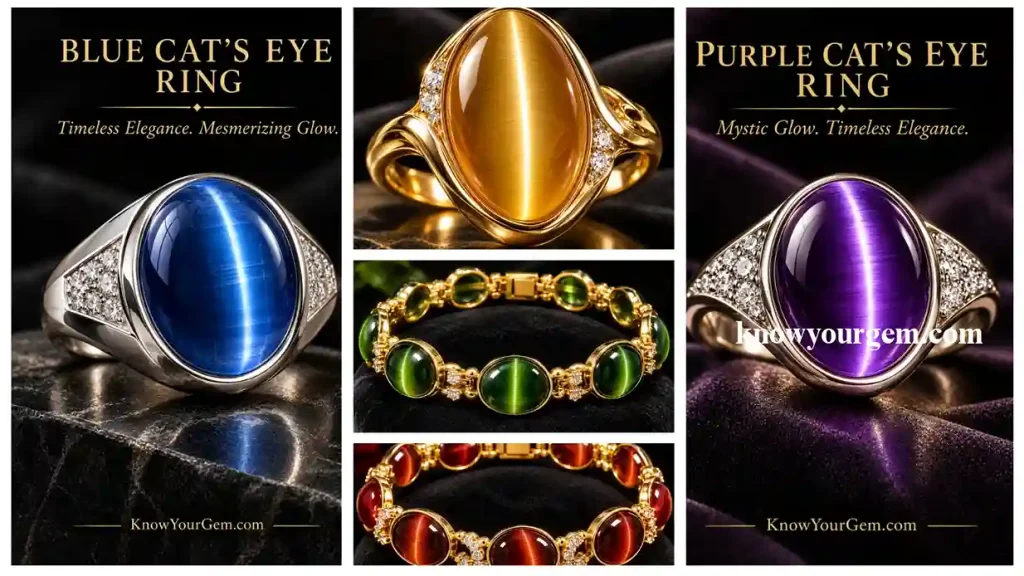
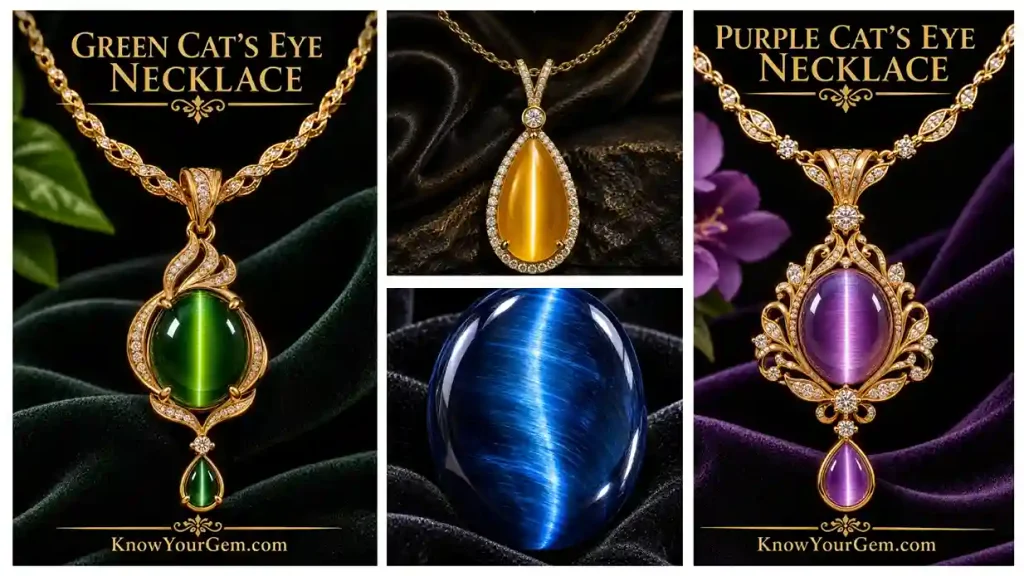
It can be used in rings, pendants, bracelets, necklaces, and as collector specimens.
How to Wear, Care for and Buy Cat’s Eye Stone?
Wearability wear as a Ring, Pendant, Bracelets, Necklace. Being a hard, tough stone, chrysoberyl makes an excellent choice for daily wear but a protective setting makes sense if it is to be worn as a ring on a daily basis.
Choosing And Wearing Jewellery:
Protect a ring that sits low on the finger with a bezel or a protective prong setting. A ring that sits high on the finger should be set high in the band of the ring. Protect the eye when wearing a ring with a bezel or protective prong setting.
Cleaning And Care:
Clean with warm water and mild soap; use a soft brush. Dry with soft cloth. Do not use harsh chemicals or abrasive cleaners and do not ultrasonic clean unless directed.
Chrysoberyl is a sturdy and water resistant material but it should not be soaked for too long in water, particularly if the stones have been treated, it is part of glued set, or has a delicate setting. Jewellery with Cat’s Eye should be stored separately from diamond, ruby and sapphire.
Is the Ordinary chrysoberyl Cat’s Eye a Dangerous Jewellery stone? The ordinary chrysoberyl Cat’s Eye is not known to be dangerous, while used for jewellery purposes. Remember that any claimed astrological consequences are assumptions, not factual facts.
How To Buy A Genuine Cat’s Eye?
Check species, natural/synthetic origin, disclosure of enhancement, eye quality, colour, transparency, cut and documentation. Don’t rely solely on a carat weight or photographs to determine investment value.
An approved lab report confirms the status (Species, Natural or Laboratory grown, detectable treatment) of the product. It is required for any purchase with a value greater than.
Cat’s Eye vs Other Gemstones:
Tiger’s eye is a form of chatoyant quartz, chrysoberyl Cat’s Eye is a separate mineral which is harder and typically more valuable. They both exhibit a moving band, but are mineralogically and optically different and Chrysoberyl Cat’s Eye is usually more valuable. Chroma-gem-a
Cat’s Eye can be paired with yellow sapphire, emerald or blue sapphire in its setting, provided that each stone is safe and protected. The astrological compatibility is entirely based on tradition, not on proven scientific data.
Biggest Buyer Misconception:
What buyers think: A moving line of light indicates a desirable Cat’s Eye chrysoberyl.
Actually it is the truth: Chatoyancy is an optical effect seen in some other minerals and can also be artificially produced in glass moving band of chatoyancy alone is not evidence of a gemstone’s identity, provenance, treatment or value.
This difference is important because buyers may pay chrysoberyl prices for the quartz, treated or fibre-optic glass. Before buying, three things should be separated: What is the mineral? Is it natural? How good is the eye?
Buyer Checklist:
- Identify the exact mineral species, preferably in writing.
- Inquire if it is mucilaged, artificial, imitation, or manufactured.
- Examine the eye under one focused light source.
- Ensure sharpness, straightness, continuity and center.
- Evaluate colour, clarity and milk-and-honey contrast.
- Evaluate the cabochon’s orientation, symmetry, dome and polish.
- Factor in price and optical quality, not weight only.
- Seek trustworthy evidence of any source, processing or authenticity assertion.
- Order a reputable laboratory report for a substantial purchase.
Sources:
FAQs:
1. How much is a Cat’s Eye stone worth?
It depends on species and quality. Cheap Quartz or Glass Cat’s Eyes are readily available; but expensive natural Grade A chrysoberyl Cat’s Eyes command prices of hundreds to thousands of US dollars per carat.
2. Is Cat’s Eye the same as tiger’s eye?
No. The quartz “tiger’s eye” material that is available on the market is all chatoyant; genuine chrysoberyl Cat’s Eye is a different (and far more durable) gemstone that is typically a lot more costly.
3. How can I tell if a Cat’s Eye stone is real chrysoberyl?
Identify with pointed, straight, well-centred moving band, but identify with test. Appearance alone can be used to identify quartz or glass as chrysoberyl.
4. Is Cat’s Eye stone water safe?
Chrysoberyl is tough and will withstand brief immersion in water but is best avoided for long soakings, strong acids, and unnecessary ultrasonic cleansings, particularly in the case of a treated or set stone.
5. Does Cat’s Eye stone really work for astrology?
Astrological effects are faith and culture matters, not validated scientific consequences. Purchase for these reasons that are meaningful you, but evaluate the gem on its valid quality.
6. Can Cat’s Eye be worn every day?
Yes, however, chrysoberyl Cat’s Eye is a hard durable stone, but the setting, treatments and wear conditions must also be taken into account.
This content is written by Gemstone Expert and Enthusiast KamilHussain.

Welcome to KnowYourGem.com! your ultimate destination for uncovering the fascinating world of gems and their secrets! I'm Kamil Hussain, a passionate blogger with a Master’s degree in Economics, dedicated to bringing you insightful, well researched content that blends the beauty of gemstones with the art of storytelling. With a keen analytical mind and a love for discovering hidden treasures, I created this platform to help you explore the brilliance, history, and value of every gem.

