

Abstract:
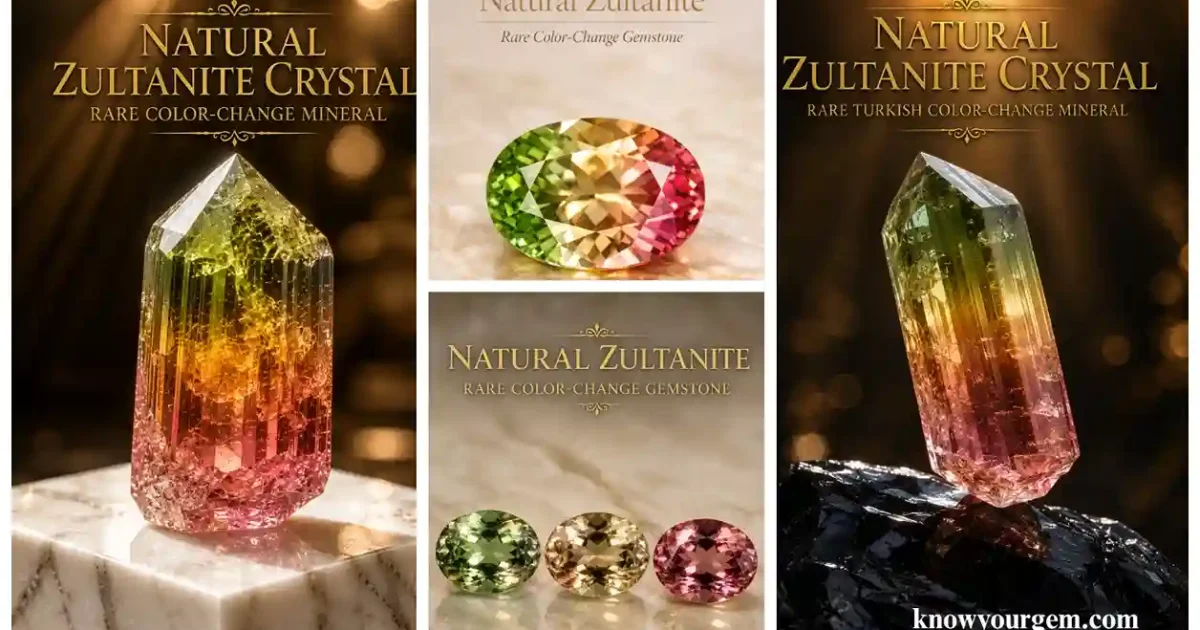
Zultanite™ Diapason™ from southwest Turkey. Changes color throughout the day from bright kiwi / khaki green to raspberry, champagne and mulberry with incandescent lights.
What makes diaspore so unique? It is one of the few gemstones that shows true color change and also the least expensive of all of the color change gemstones when compared to alexandrite.
Quick answer: Zultanite is a variety of the mineral diaspor (AlO(OH)). Its hardness is around 6.5-7 on the Mohs scale, and it has cleavage.
It is softer than sapphire and requires a setting if used as a ring, and is not suitable for rings due to its cleavage and softness, and is better suited to pendants and earrings. It is generally untreated. Get a report with a stone and view in two different lights before buying.
Knowyourgem has worked with gemstones for more than 5 years. If you’re comparing color-change stones, our guide to alexandrite engagement rings covers the better-known one.
What Is Zultanite?
Its official name is “Zultanite,” which is the proprietary trade name of the mineral called diaspore. Diaspore is a mineral made of aluminum oxide hydroxide that was named by the French mineralogist, René Just Haüy, in 1801.
It is derived from a Greek term meaning “to scatter” because its crystals are cleaved when heated. For nearly two centuries, diaspore was mainly a collector’s mineral because clean, facetable crystals were very rare.
Until then, any gem that was cut was merely a gimmick, until a deposit of gem-quality material was discovered in the Ilbir Mountains near Milas, in Muğla Province, Turkey. A company applied for a trademark “zultanite” around 2005 as a brand name for it.
Confirm the year, trademark owner, and what is covered by the trademark, with source. The name refers to the sultans of the Ottoman Empire, but it’s a made-up name with no historical use.
That matters when you shop.“Zultanite” and “gem diaspore” describe the same material, and a lab report will say diaspore, not zultanite. A seller’s “authenticity card” using the brand name tells you about the seller, not about the stone.
Is zultanite a mineral or a gemstone?
Both, depending on how you look. Diaspore is the mineral. Zultanite is the name for the cut, gem-quality version, mostly from one Turkish deposit. Diaspore also occurs in other places, but facet-grade material is scarce outside Turkey, and I’d treat any other “zultanite” claim with suspicion.
Why Does Zultanite Change Color?
It appears to be changing color because of the way that its trace elements absorb light. Normally listed as the primary causes for the change of color are chromium and iron, and each type of light highlights some color wavelengths more than others.
The daylight spectrum contains many blue-green rays, so the stone looks green. The spectrum of an incandescent light contains many red-yellow rays, which gives the same stone a pink or champagne tint.
The majority of fluorescent and LED light is found between both spectra, and this is what you are likely to see dull variants of green, gold, and soft pink. That’s why a stone can look green in the shop, pink at the dinner table and something else again in the office.
Strength varies a lot from stone to stone. Some show a dramatic green-to-pink switch. Others only drift from olive to a dull tan. Your source said it was among the most dramatic effects in nature and rivaled alexandrite, and the best stones are striking, but I’d treat that as a best case, not the norm.
Color change vs pleochroism:
They’re different effects, and people mix them up. Color change depends on the light source. Color variation varies the light source. Pleochroic variation varies the tilt of the object.
Zultanite shows both. It’s strongly pleochroic, with greenish, yellowish-brown and pink-red tones depending on direction, and a good cutter orients the stone to get the best result.That’s one reason a cut stone can look so different from its rough.
Zultanite Properties:
The table gives typical values. Sources differ a little, and individual stones vary.
| Mineral | Diaspore |
| Formula | AlO(OH) |
| Crystal system | Orthorhombic |
| Mohs hardness | About 6.5–7 |
| Refractive index | About 1.68–1.75 |
| Specific gravity | About 3.3–3.5 |
| Cleavage | Perfect in one direction |
| Luster | Vitreous (glassy) |
| Transparency | Transparent to translucent |
| Pleochroism | Strong (trichroic) |
| Typical treatment | Generally sold untreated |
Hardness is the number to remember. At 6.5 to 7 it’s softer than sapphire, spinel and topaz, and about level with the dust in the air, so it will pick up fine scratches over time. The cleavage matters even more. You could cut yourself on any flattish stone if it pops on a knock no matter what Mohs rating it has.
What do the inclusions look like?
Larger natural zultanite usually contains tiny needles or fiber, tiny pockets of fluid and cleavage cracks known as feathers to jewelers.
Blemished stones will be priced lower since they are imperfections to the naked eye. Clearest eye-clean stones have no inclusions at all. Actual blemishes as well! Surface low to moderate size cracks are delicate and also can harm or chip, so you see these as faint gas bubbles or swirl marks.
Where Does Zultanite Come From?
Zultanite is almost exclusively found in this one locality, in the ILbir Mountains near the town of Milas in southwest Turkey. It occurs in metamorphosed aluminum (Al)-rich rocks, with the deposit situated within the Menderes Massif. Zultanite can be associated with corundum, margarite, among other minerals.
Mining there is small-scale. Crystals are recovered in limited amounts, and only a fraction are clean enough to facet. Many are kept as mineral specimens. I haven’t included an annual production figure, since I couldn’t find a number I’d trust. Treat any exact “carats per year” claim as marketing.
Does single-source origin make it valuable? It makes supply limited, and that helps the price. But “only one mine” isn’t a guarantee of anything, and it shouldn’t replace checking the stone itself.
How Much Is Zultanite Worth?
It’s priced well below fine alexandrite and well above common stones like amethyst. There’s no standard price index, and prices can’t be reduced to one figure per carat, because two stones of the same weight can differ a lot in color change, clarity and cut. Your source gave per-carat tiers, but I couldn’t support them, so I left them out.
What drives value, in roughly this order:
- Intensity of the color change: The more distinct the green-to-pink change, the more desirable. A faint, dull change will reduce the value.
- Saturation and tone: Bright, neutral to medium tones work best than dull, washed-out tints or darks.
- Brighter: Eye-clean stones cost more but are the better option for wearing.
- Cut: A good cut is carefully rounded for the best color and thinly cleaves to optimize it.
- Size: Bigger clean stones are more difficult to find, so price per carat increases with weight.
- Documentation: A lab report confirms the species and adds confidence.
The table shows where each type usually sits in the market. It’s a guide to relative position, not a price quote.
| Small, weak color change | Low | Plentiful, limited novelty |
| Eye-clean, moderate change | Low to moderate | Clean stone, visible shift |
| Vivid change, well cut, 1–3 ct | Moderate to higher | Strong effect and good color |
| Larger clean stone with strong change | Higher | Scarcity of size and quality |
I wouldn’t buy zultanite as an investment. Your source calls it a collector’s stone, and I’d go further and say it’s a stone you buy because you like watching it change. A little stone with a brilliant change is always better than a large one with a boring one.
How Can You Tell Real Zultanite from Fake?
Beginning with what the seller tells you it is, then work from that to see what you can determine. A real stone shows a color change between daylight and incandescent light, though the strength varies. A fake often shows no change at all, or a change that’s too neat.
Imitations usually fall into two groups.
- Color-change synthetic sapphire: It’s much harder (9), and it’s the standard simulant for alexandrite. Its color change can look similar, but it has a different refractive index and lacks diaspore’s cleavage.
- Color-change glass: You will also often notice that under the loupe, rounded bubbles or swirl marks are visible, as well as a good, even color that is just a little too perfect.
At the workbench, the gemologist continues to compare the stones for other characteristics with the refractometer, polariscope, dichroscope and lens.
Diaspore has double refraction and is intensely pleochroic, qualities that are not shared by glass or most simulants. A refractive index and specific gravity within the diaspore range back up the identification, though no single test settles it.
Don’t rely on a seller’s own card. For anything expensive, ask for an independent report from a lab such as GIA. It will name the stone as diaspore. Verify the report number on the lab’s own site. Synthetic diaspore has been made for research, but I’m not aware of it being sold as a gem, and anyone offering “lab-created zultanite” should explain what they mean.
What Is the Biggest Buyer Misconception About Zultanite?
Many buyers believe zultanite is a mineral of its own that’s always untreated, always dramatic and always a good investment. All three are shaky.
It’s diaspore under a brand name. It’s generally sold untreated, but you should still ask, because a trade name doesn’t guarantee anything. And the color change varies a lot between stones. Photos make it worse, since a photo is taken under one light and rarely shows the shift.
That matters because the color change is the whole point of buying one. See it with your own eyes, in two lights, or ask for a video that shows both, with the light source named. And save your premium on a rarity story. Buy a gem that consistently changes, eye-clean, and is mounted so it can’t be jarred.
Is Zultanite Good for Jewelry?
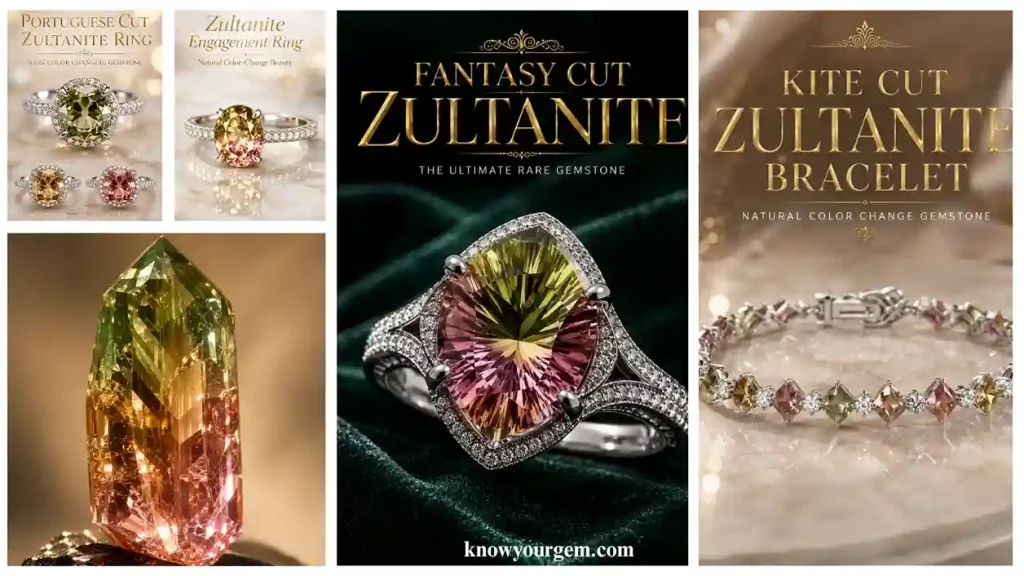
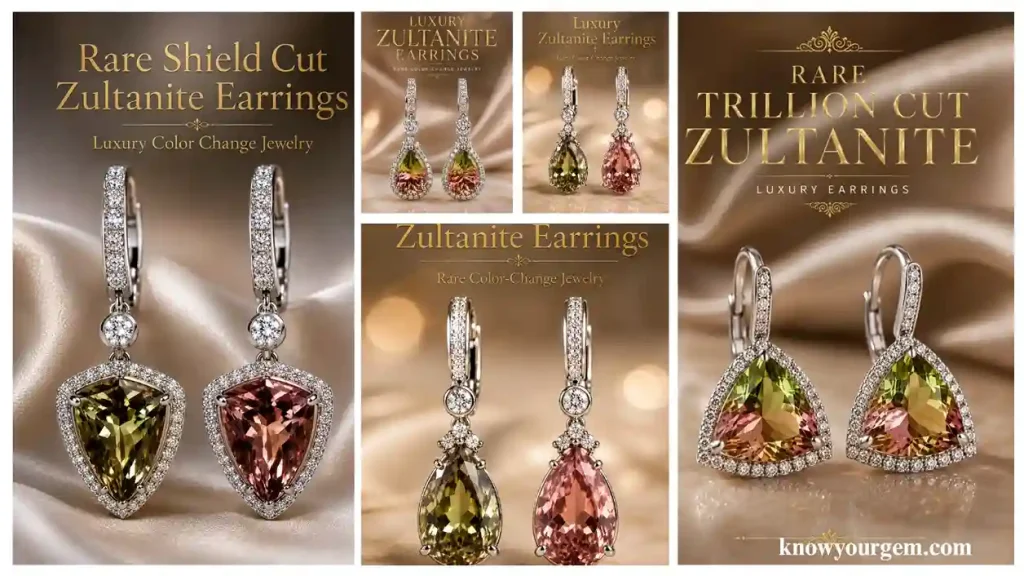
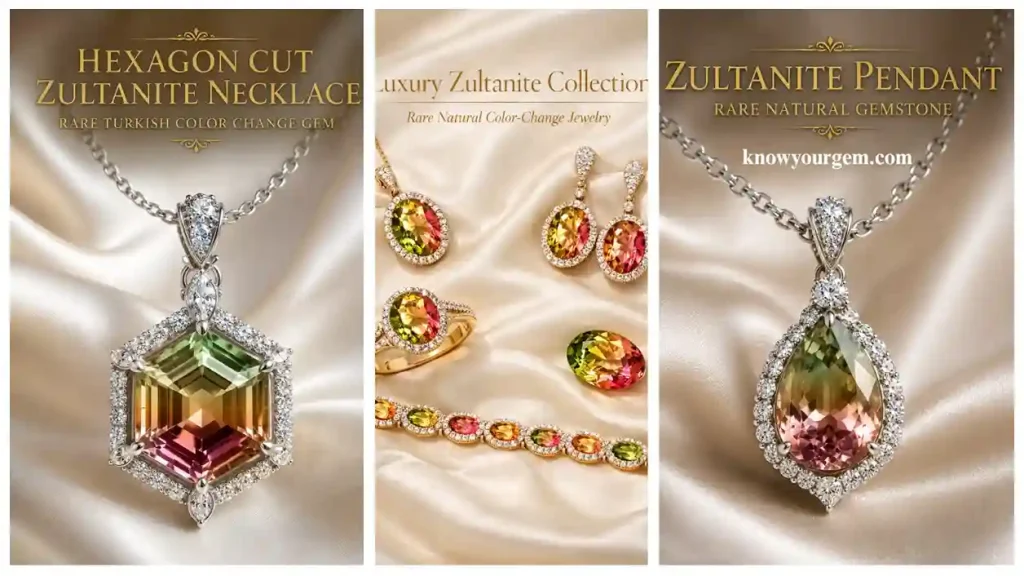
For pendants, necklaces and earrings, yes. For rings, be careful. At 6.5 to 7 with perfect cleavage, a ring takes knocks that a pendant never sees. A bezel or halo setting protects the edges, and a low profile helps. It isn’t the right choice for someone who’s hard on their hands.
| Pendant or necklace | Excellent | Little impact |
| Earrings | Excellent | Little impact |
| Ring | With care | Knocks and scratches; needs a protective setting |
| Bracelet | Low | Constant knocks |
| Engagement ring | Possible, with care | Needs regular checks and gentle habits |
Cuts matter too. Faceted ovals, cushions and rounds usually show the color change best. Cabochons give a softer, more diffuse shift, and they’re often used for included material. The finest color Zultanite is faceted so the good color is the face up, so it will cost weight, don’t be disappointed if a fine stone appears to be small.
With pairs of diamonds, you get a little extra bling and a halo helps to hold the stone in place. Just ensure that the setting truly wraps around the stone’s edges.
How Does Zultanite Compare with Similar Stones?
| Mineral | Diaspore | Chrysoberyl | Corundum | Sodalite variety |
| Mohs hardness | About 6.5–7 | 8.5 | 9 | About 5.5–6 |
| Typical change | Green to pink or champagne | Green to red or purple-red | Often blue or violet to purple | Pale to violet under UV |
| Trigger | Light source | Light source | Light source | UV light |
| Price | Moderate | Fine stones are costly | Varies | Low to moderate |
| Ring suitability | With care | Good | Excellent | Poor |
Alexandrite is harder, better in a ring and much more expensive in fine quality. Zultanite is the affordable way to get a strong color change. It’s also not a “poor man’s alexandrite”, since the two are different minerals with different colors.
Color-change sapphire is the most durable of this group and a popular alexandrite substitute. Hackmanite is a very different type of effect.
It glows greenish under UV and then loses the glow, unlike Zultanite, which changes based on the light source and varies with every change of light. Tanzanite, which is also softer than sapphire, is almost always heat-treated, though zultanite usually is not.
How Do You Care for Zultanite?
Wash it with a soft brush and a mild soap (mild dish or jewelry soap) in warm water. Wipe the stone dry with a soft cloth. Don’t put a stone with cleavage in an ultrasonic or steam cleaner. The heat and vibration will result in the stone cracking or splitting along the cleaved plane.
Keep it safely away from a hard stone such as sapphire, diamond and topaz that could scratch it. Remove rings before sporting activities or hard manual tasks. Have the setting checked once a year.
Will the color fade? In normal wear it’s generally stable, and I’m not aware of heat or irradiation being used on it. But I wouldn’t promise it never changes. Don’t allow it to sit in harsh heat and enquire the dealer with regards to the exact stone.
What About the Meaning and Healing Claims?
Everything in this section is tradition and belief, not proven effect. Buyers often link zultanite with transformation and adaptability, because it visibly changes. Some crystal traditions tie it to the heart and solar plexus chakras for confidence and clarity. These meanings are modern, and they grew up around the stone’s behavior.
None of it is scientifically proven, and none of it replaces medical care. If a stone that changes with the light is a good reminder of change for you, that’s reason enough to own one. Just don’t pay extra for a healing claim.
Buyer Checklist:
- Watch the color change yourself, with daylight and incandescent light, or on the video with both labeled.
- Note down your stone as natural diaspore, not glass or color-change sapphire.
- Inquire about the processing,” though most is untreated.
- Please ensure it is eye-clean or the price reflects visible inclusions.
- Query the place of quarrying and ask how the seller can confirm this.
- Opt for a ring’s protectioned setting, or buy a pendant or earrings.
- For costly stones, get an independent lab report and cross check the number.
- Get the return policy before you pay.
Key Takeaways:
- Zultanite is a trade name for gem diaspore from Turkey’s Ilbir Mountains.
- It rates about 6.5 to 7 and has cleavage, so rings need a protective setting.
- The color change varies from stone to stone, so judge it in two lights.
- It’s generally sold untreated, and imitations include glass and color-change sapphire.
- Meanings are cultural beliefs. I wouldn’t treat it as an investment.
Sources:
Gemological Institute of America (GIA), the International Gem Society, Mindat and Gem-A for diaspore properties, identification and the Turkish deposit.
FAQs:
1. What is zultanite?
A trade name for gem-quality diaspore from the Ilbir Mountains in Turkey, known for changing from green in daylight to pink or champagne in incandescent light.
2. Is zultanite natural?
Yes. It’s a natural mineral, and it’s generally sold untreated. Ask the seller to confirm.
3. Why does zultanite change color?
Trace elements like chromium and iron react to different light sources, so the stone appears pink in warm light and green in daylight.
4. Is zultanite rarer than alexandrite?
Zultanite comes from a single area, but fine alexandrite is generally far more valuable. They’re different minerals.
5. Is zultanite good for an engagement ring?
Yes, providing it is held at 6.5 to 7 and is protected and checked regularly. It will need more regular checking than sapphire or diamond at 6.5 to 7 with cleavage.
6. Can zultanite be lab-created?
Synthetic diaspore has been made for research, but I’m not aware of it being sold as a gem. Be wary of “lab-created zultanite”.
7. Does zultanite fade?
Normally not in everyday wear, though you should avoid strong heat and ask the seller about the specific stone.
8. How is zultanite different from hackmanite?
Zultanite changes with the light source and repeats every time. Hackmanite changes under UV light and fades afterward.
This content is published by Gemstone Expert and Enthusiast KamilHussain.

Welcome to KnowYourGem.com! your ultimate destination for uncovering the fascinating world of gems and their secrets! I'm Kamil Hussain, a passionate blogger with a Master’s degree in Economics, dedicated to bringing you insightful, well researched content that blends the beauty of gemstones with the art of storytelling. With a keen analytical mind and a love for discovering hidden treasures, I created this platform to help you explore the brilliance, history, and value of every gem.

