


Black gemstones encompass a broad spectrum of minerals and organic from the hardest substance on the earth to fossilized wood which is barely harder than a fingernail. They are ranged from investment grade natural black diamonds and command thousands of dollar per carat, to mass market black onyx sells for pocket change. Their value hinges on the natural color origin, hardness, certification, and rarity. No other category in gemology spans an extreme economic range within a single aesthetic family. Black zircon are the most recommending gemstones in modern jewelry currently.
Meaning classification,value of black gemstones:
Black gemstones are most meaningful and most versatile they hold great meaning, classification, which makes black gemstones valuable:
Quick scoop on black gemstones:
Gems swallow light with having their inky-dark opacity; black gemstones get this from iron, graphite, carbon flecks, or manganese packing their crystals. Nature locks in the color sometime; treatments like heat, radiation, or dye can boost it other times. Since, natural black command top prices that certify them to beat fakes.
Why black gemstones are killing it in Jewelry and investments:
Black gemstones have shifted from niche to mainstream over the past two decades, that blend killer aesthetics, deep cultural roots, and smart economics.
Man, aesthetically, black gemstones are total chameleons, nothing else contrast so sharply with yellow gold’s cozy warmth, rose gold’s soft blush, white gold’s soft blush, white gold’s icy cool, or blackened metal’s rough edge. Drop a black diamond in yellow gold, and bam pure electric tension. Tuck it into platinum pavé, and you’ve got sleek, effortless elegance.
Commercially, the rise of “anti traditional” engagement rings have been huge couples love black diamonds as bold alternatives, with the market growing strong through the 2010s and 2020s culturally, they are powerhouses; solemn authority in European heraldry, protective talisman in West African and Native American lore, and crystal healing staples like black tourmaline or obsidian against negativity. Think to keep raw/tumbled demand steady, fashion or not.
And the range, Unreal. Grab a $50 black onyx cab in silver for everyday wear, or chase a certified natural black diamond for $50+. No color family matches that accessibility.
Complete List of black gemstones with key properties:
It is must to know each stone inside out, its chemistry, hardness, treatment realities, price spread, and investment potential. This knowledge helps you to nail smart buying calls.
Black diamond:
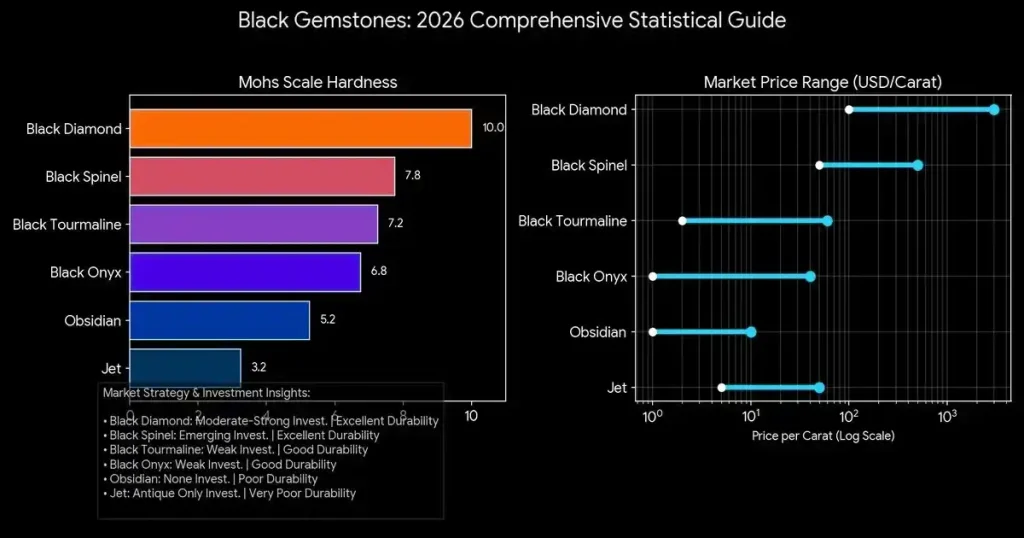
Black diamond tops the chat as the most valuable black gem and the hardest natural on Earth, hitting 10 on the mohs scale, valuable black gem and the hardest natural material on the Earth, hitting 10 on the Mohs scale. Chemically, it is pure carbon in a cubic crystal structure, just like colorless diamonds, but dense graphite inclusions scattered through the lattice turn it opaque black. Gem dealers call natural black diamonds “carbonado,” a Portuguese word meaning charcoal that Brazilian miners coined back in the 1700s.
The trade splits sharply between natural and treated stones. Since, natural blacks form with their color baked in by geological forces. Treated versions start as low grade, heavily included, or off color rough that gets irradiated and heat treated to the fake look. GIA reports spell in out clearly; natural stone get labeled “fancy black” with “natural color origin,” whether treated one carat stones retail for $100 to $400 or more, with having brilliant specimens large, well formed, naturally lustrous pulling serious auction prices.
For jewelry, black diamond crushes the competition. An it is 10 on the mosh scale of hardness means daily wear won’t scratch it perfect for engagement rings, wedding bands, and setting facing constant contact. Investment wise, stick to the GIA certified natural blacks only.
| Black Diamond Quick Stats | Details |
| Moh Scale | Black diamond is 10 on the mohs scale of hardness |
| Price/Carat | Treated stone can command $100 per carat while untreated natural one holds prices like $3,000 |
| Jewelry Durability | Excellent |
| Investment Rank | Moderate strong (natural only) |
Black onyx:
Black onyx chalcedony, a microcrystalline quartz with having silicon dioxide chemistry. Its microscopic structure gives it waxy to glassy luster and smooth texture that beautifully into cabochons, beads and carvings.
Almost all black onyx you can see in dyed. Naturally black chalcedony exists but runs rare. Most black onyx worldwide even in fine jewelry stores start as gray, white, or banded chalcedony soaked in a sugar and sulfuric acid bath, a trick that Roman news. Which embeds carbon throughout the porous structure and locks in stable color. Since the industry accepts this treatment fully, doesn’t consider it fraud when it has disclosed properly, and it doesn’t hurt the stone’s durability hurt the stone’s durability or wearability.
Black onyx is 6.5 to 7 on the mohs scale of hardness means that it is tough enough to resist scratches from most daily surfaces but vulnerable to the sand, quartz dust, and anything that is harder. For rings, use a bezel setting to, protect the edges; prong setting leave the girdle that is exposed to side impacts.Black onyx carries zero investment value. Since, chalcedony deposits suitable for dye span every continent, and suppliers process it at industrial scale. Per carat prices run $1 to 40 which is totally hinges on quality, cut precision, and setting context. So, the stone is purely a jewelry and decorative material, and it excels there tough, eye catching, versatile, and budget friendly.
| Black Onyx Quick Stats | Details |
| Mohs scale | It is 6.5–7 on the mohs scale of hardness |
| Price/Carat | Its price range is from $1–$40 |
| Jewelry Durability | Good (bezel setting recommended) |
| Investment Rank | Weak |
Black Spinel:
Black spinel quietly ranks among the most underpriced gems in fine jewelry. This magnesium aluminum oxide mineral like (MgAl₂O₄) crystallizes in the cubic system, their clean forming octahedral crystal with having naturally high glassy to near diamond luster. Since, iron and chromium swapped into the crystal lattice that create the black color, and most gem grade specimens need no treatment a huge plus as buyers get savvier about treatment disclosure.
Spinel hits 7.5 to 8 on the mohs, scale of hardness that makes it rock solid for rings and bracelets. It lacks cleavage planes, so it resists fracturing better than similarly hard stones when you bang it accidentlly. Top black spinel comes from Myanmar’s Mogok region and certain Sri Lanka deposits; Mogok stone earn reputations for an exceptional clarity and luster, that command geographic premiums when you can document origin.
Pre-carat prices stretch from roughly $50 for commercial grade material to $500+ for fine, deeply saturated, highly lustrous gem quality stones in larger sizes. The investment angle is genuinely emerging; as designers and informed buyers increasingly swap it in treated black diamond and black sapphire, demand at fine quality climbs against limited natural supply. It hasn’t built the auction track record or collector base for a “strong” investment tag yet, but it is the most compelling growth story in black gems.
| Black Spinel Quick Stats | Details |
| Mohs Scale | It is 7.5–8 on the mohs scale of hardness |
| Price/Carat | Its price range from $50 from $500 per carat |
| Jewelry Durability | Excellent |
| Investment Rank | Emerging |
Black Tourmaline:
Black tourmaline, or schorl in mineralogy circles, dominate the tourmaline family which is one of the most chemically tangled silicate groups around. Since, high iron content in its boron aluminum silicate crystals drives the black hue that runs genuinely natural virtually every specimen sold no dye, irradiation, or heat tweaks needed or commonly applied.
The black tourmaline market splits oddly. At the raw and tumbled end, it trades as metaphysical and decorative stock, which is sold by weight or piece at $2 to $20, fueled entirely by crystal healing crowds who link it to protection against bad vibes and electromagnetic noise. At the faceted stones that command $20 to $60 per carat or more modest pricing but realistic step pup from the raw market.
Its durability makes it tough enough for most jewelry. So, it has perfect cleavage can cause cracks along axis from impacts, use protective settings for rings like, Pendant earring, and bracelet work reliably.
Investment value , Negligible. Since, the raw material’s abundance and the metaphysical market’s price insensitivity to gem quality both kill any investment case but as a natural, untreated, affordable black gem for everyday jewelry, it is one of the most honest picks out there.
| Black Tourmaline | Details |
| Mohs Scale | Black Tourmaline owns 7-7.5 on the mohs scale of hardness means that it is durable enough for daily wear. |
| Price/Carat | Its price range is $2–$60 |
| Jewelry Durability | Good |
| Investment Rank | Weak |
Obsidian:
Obsidian is not technically considered as a gemstone in mineralogy terms but it is naturally occurring volcanic glass formed when silica lava cools quickly for atoms to organize into crystals. It has no defined crystal structure, no fixed chemistry, and no cleavage. Magnetite micrcocrystals have suspended in the glass matrix that give it the black look.
While having 5-5-5 mohs scale of hardness it falls below the safe zone for ring use. Common household dust packs quartz particles (Mohs 7) that will scratch obsidian’s surface during normal wear. If fractures with having a sharp conchoidal break the same property prehistoric toolmakers who loved which also means a dropped ring or sideways knock a polished obsidian cab.
Obsidian works perfectly for pendants, earrings, and display pieces where abrasion and impact risks drop. Rainbow obsidian, included bubbles and microscopic inclusions are lined up in parallel plans command modest premiums. None holds investment value. Price per carat rarely to $10 for standard black obsidian; specially varieties hit $20 to $50.
The major difference between black onyx and obsidian trips up to retail buyers constantly. Onyx is a true mineral with having crystalline structure; obsidian is glass. Onyx runs harder, tougher in jewelry, and widely dyed. Since, Obsidian runs softer, more fragile, always naturally colored, and totally unsuitable for high contact jewelry settings.
| Obsidian Stats | Details |
| Mohs Scale | Obsidian is 5–5.5 on the mohs scale of hardness |
| Price/Carat | The stone can command price from $1–$10 |
| Jewelry Durability | Poor (pendants/earrings only) |
| Investment Rank | None |
Jet:
Jet is fossilized wood specifically, a lignite coal form created when Araucaria teers compress over millions of years. Since, true whitby jet, mined from North Yorkshire cliffs in England, sets the standard: dense, deeply black, lightweight, and capable of taking the high polish Victorian jewelers exploited brilliantly. Spanish jet from Asturias runs brittle and less more deeply colored, generally considered inferior to Whitby stock.
Jet is 2.5 to 4 on the Mohs scale you can scratch it moderate fingernail pressure. This fragility rules it out completely for modern rings or bracelets. It suits pendants or brooches in protective settings that avoid regular contact, just as Victorian jewelers used it. Since, Queen Victoria sparked a sustained contact, just as Victorian jewelry after Price Albert’s death in 1861 by adopting Whiteby jet pieces. This historical link drives jet’s collector value today.
Modern jet carvings, beads, and cabs hold minimal commercial weight beyond historical curiosity. Antique Victorian jet pieces particularly carved cameos, mourning brooches, and articulated necklaces from documented English workshops pull collector value based entirely on provenance, craftsmanship, and historical context rather than the material’s intrinsic worth.
| Jet Stats | Details |
| Mohs Scale | Jet is 2.5 to 4 on the mohs scale of hardness |
| Price/Carat | Its price range is from $5–$50 (modern); much higher for antique Victorian |
| Jewelry Durability | Very poor |
| Investment Rank | Antique pieces only |
Which black gemstone has the highest value?
Natural black diamond is the most valuable gemstone per carat, it is followed by fine black spinal in the emerging mid tier, and black onyx as the most commercially available, lowest value option. Thus this ranking holds across retail, wholesale, and auction contexts.
The five tier value hierarchy from the highest to the lowest runs: natural certified black diamond (roughly comparable, though for different reasons, since commercial black onyx and jet, and finally obsidian and raw tourmaline at the commodity level.
For investment grade buyers, the critical additional context is that all black gemstone that include the finest natural black diamonds exist within a broader colored gemstone market where Imperial Topaz, fine unheated Burmese ruby, Kashmir sapphire, and Colombian emerald occupy substantially higher investment carbonado specimens; they don’t dominate them.
Black gemstones vs.Imperial Topaz: Which holds real investment promise?
If you are eyeing black gemstones as an investment, pitting black beauties like onyx or spinel against Imperial Topaz is a smart reality check. This ultra rare topaz kind is mined almost solely from Brazil’s Ouro Preto region in Minas Gerais sets a gold standard for why geography, collector passion, and auction track records matter more than color trends.
Imperial Topaz shines as a benchmark benchmark because its market dances to a vary rhythm than black gemstones. First off, rarity the price game. Supply is locked to one spot on the map, that drives steady upward pressure year after year no matter what’s hot in fashion. Since black gems are everywhere; onyx from Turkey or India, tourmaline from Africa, obsidian from the U.S or Mexico. Even natural Carbonado black diamonds don’t match that single source.
Second, collectors provide a deep demand. Muesums, estates, and high end investors chase Imperial Topaz for the long haul, buffering it from whims. Since, black gemstones lean on jewelry trends, if goth vibes fade, so do onyx prices. Topaz collectors though upgrading suites, not chasing fads.
Third, auctions tell the tale. Since top Imperial pieces consistently smash estimates at Christie’s, Sotheby’s, or Bonhams, that prove the market rock solid faith. Black diamonds score big sales now and then, but they lack that reliable “above estimate steak.
Price comparison at a glance:
Given below is the stack up per carat for investment grade stones like fine color, minimal/no treatment, 1-5+ ct sizes. Data reflects 2026 retail/auction averages form GIA graded sources.
| Black Gemstones | Price Range per carat | Key Investment Notes |
| Imperial Topaz | Price range from $1,000 to $15,000 plus | Untreated vivid orange gold imperial comes from single source rarity fuels like 10-20% annual appreciation. |
| Natural Black Diamond | Price range fro $1,500 to $3,000 | Diamond from Cardonado rare but volatile; overlaps low end Topaz but lacks consistency. |
| Treated Black Diamond | Price range $100 to $400 | It is affordable but disclosure kills resalce; fashion driven. |
| Fine Black Spinel | Price range from $50 to $500 | Durable, untreated options rising, but multi-source supply caps growth. |
| Black Onyx | $1 – $40 | Plentiful, often dyed; great for jewelry, poor for capital preservation. |
The takeaway:
For pure growth and stability, Imperial Topaz and similar rare benchmark crushes black gemstones at the same budget. Black gemstones dazzle in designs, but they won’t match Topaz’s collector fueled climb. Prioritize certified, untreated pieces from ethical sources your portfolio wallet will thank you.
Are black gemstones a good 2026 investment?
Selectively yes, mostly no, because few rare types black gemstones hold investment; most like fashion onyx dyed stones depreciate right after purchase.
Key value drivers:
- Certification is essential: Since, GIA, AGL, or Gübelin reports confirm species, treatments, and natural color that are crucial for resale. No investment.
- Proven origin boosts value: Stone like black spinel from Myanmar Mogok can command premium prices as supply drops and collectors catch on. Congolese/Brazilian black diamonds draw niche interest.
- Natural color trumps treated: Irradiated diamonds or dyed onyx are jewelry only not investments. Since, natural versions command separate premium markets.
- Demand fluctuates with fashion: Black onyx tourmaline surges in “dark aesthetic” trends but softens late. Since, certified natural blacks offer some insulation via collectors.
Investment picks:
- Top choice: Natural black diamonds with having GIA “natural color” cert that is proven appreciation track record.
- Emerging: Since, Mogok black Spinel, high upside for patient collectors.
- Skip: Since treated blacks, onyx, obsidian, jet buy for wear, not wealth.
Benchmark against Imperial Topaz for better scarcity and auction results. Hierarchy; Natural black diamond with having fine black spinel everything else.
Are black gemstones a good investment in 2026?
Selectively yes, but mostly no, because the black gemstones category contains a small subset of genuinely investment viable materials and a large volume of fashion and decorative materials that depreciate immediately post purchase.
How to spot genuine black gemstones:
The black gemstones market overflows with fakes: synthetics as naturals, undisclosed treatments, glass as minerals, and cheap substitutes. Spot the real ones to protect your money and resale value.
Common treatments to know:
- Black diamonds: Irradiation + heat turns colorless rough black gemstones. Stable and hard like naturals, but far cheaper. GIA reports flag it clearly.
- Black onyx: Sugar-acid dyeing is standard, raw chalcedony gets soaked in sugar, then acid-carbonized black. Disclosed? Fine for jewelry. Undisclosed? Misrepresentation.
- Tourmaline/diamonds: Fracture-filling with glass/resin hides cracks but weakens durability (avoid ultrasonics). Must be disclosed; kills diamond grading.
Lab certs are non-negotiable:
More than $300-$500 per carat commanding stones are verified by GIA, AGL, or Gübelin reports. Although these sources confirm species, natural, color, treatment, and for 4Cs verify number online to beat fakes.
Pricing red flags:
- Since natural diamonds under $800/ct without GIA color cert mostly likely treated.
- Vague sellers dodging natural vs, treated or using AAA/investment grade’ without docs.
- Uniform black with having no texture/variation under loupe probably dyed glass mineral.
How to identify genuine black gemstones:
The black gemstones retail market contain a significant volume of misrepresented material synthetic stones sold, treated without treatment disclosure, glass imitations sold as mineral gems, and inferior species substituted for more valuable ones. While recognizing what to look for that protects both the purchase price and any future resale value.
Best black gemstones for rings & everyday wear:
Selecting black gemstones are about their look as well as hardness, toughness, and how they handle cleaners and knocks. Use these practical alongside budget and style.
Most durable everyday options:
- Black diamond is 10 on the mohs scale of hardness. Means that it can be the top pick for daily wear rings, including engagement rings. It resists scratches from almost everything except another diamond.
- Black spinel is 7.5-8 on the mohs scale of hardness, it is great alternative hard, no cleavage, naturally black, and very durable for everyday rings.
- Black tourmaline is 7-7.5 on the mohs scale of hardness and it works in rings but only in protective bezel settings. Avoid prong settings because it can crack along its long axis if hit sharply.
Luxury jewelry choices:
- GIA certified natural diamond, is the only true luxury and investment grade gem. Best in platinum or 18k white gold to showcase contrast and add strength.
- Fine black spinel; Understated luxury bright vitreous luster and natural color, perfect for those who want untreated, elegant black stones.
- Treated black diamonds are good for bold aesthetics at the lower prices, but not an investment; always buy them purely for style with that in mind.
Budget friendly stones:
- Black onyx: it is the go to affordable black gem means hard enough for most jewelry, polishes to a deep matter or glossy black, and is easy to buy in any shape or size. It is best in cabochon cuts with having bezel settings for rings and pendants.
- Black tourmaline beads / rough: It is main budget choice for metaphysical and wellness jewelry.
- Obsidian: It is good for pendants and earrings, but never for rings or bracelets too fragile.
For men’s black jewelry:
Rings & bracelets:
- Dominant: Black onyx in a large, smooth oval or round cabochons are best.
- Premium upgrade: Black spinel in high polish, round faceted stones give onyx like weight with much better luster and hardness.
Spiritual meaning and symbolism of black Gemstones:
Black gemstones are black colorful minerals they own symbolism which is remarkably consistent across cultures and drive realistic buying behavior, even when gem quantity is low.
Protection across cultures:
Black gemstones are linked to protection in traditions worldwide:
- European heraldry, West African charms, Native American ceremonies, and South Asian folk medicine all black with warding off harm.
- Inn some beliefs, black absorbs and neutralizes negative energy; in others, it forms a barrier that evil forces can’t cross; in still others, and it represents deep earth and stability.
- Whatever the exact idea, the result is the same; people see black stones as protectors.
Grounding and emotional calm:
Modern black gemstones healing emphasizes grounding energy:
- Black tourmaline, black obsidian, and jet are said to anchor anxious or scattered minds into the present moment.
- This belief loosely connects to the root chakra concept from South Asian traditions, that are popularized in Western metaphysics.
- There’s no science proof, but strong consumer belief drives a steady market these black gemstones, regardless of clarity or polish.
Symbolism in major traditions:
- Chinese Feng Sshui: Black belongs to the water element, that is tied to the north, career, and wisdom. While placing black stone in the career area of a home or office is a standard recommendation.
- Japanese aesthetics: Matte black stones fit wabi-sabi, quite imperfect, understated beauty.
- Victorian England: Black jet was the official mourning gem, culturally approved and so popular it built a whole industry in Whitby.
Why symbolism matters:
- Buyers purchase black tourmaline or obsidian for protection don’t they don’t care about clarity grade.
- Symbolism is not separate from value but it is one of its main foundations, especially for gifts, metaphysical markets, and spiritual jewelry.

Final thoughts: Should we buy black gemstones in 2026?
For Jewelry:
Black gemstones are a stylish selection in 2026 for all budgets. Since they look striking against any metal and hold cultural meaning that makes them great gifts.
- Best for rings & daily wear: Black diamond is most durable and , prestigious and black spinel is hard, natural, affordable.
- Best for pendants & earrings: Black onyx is affordable and versatile.
- Avoid for rings/bracelets: Obsidian and jet is too soft and fragile.
Engagement ring options:
- Black diamond is prestige and durable
- Black spinel is natural and budget friendly
- Black onyx like bezel set is stylish and affordable.
For investment:
- Natural black diamonds (GIA-certified): The only black gemstones with having proven investment value are black diamond.
- Fine black spinel (especially Mogok origin): An emerging option for collectors willing to wait.
- Other black gems: Best enjoyed as jewelry, not investments.
The Imperial Topaz benchmark:
Imperial Topaz is the true investment grade colored stone. It is uncommon, more in demand, and performs better at auctions than any black gemstone. Since, black stones are about aesthetics and accessibility, not rarity driven value.
Roll Off:
Black gemstones are rewarding if you recognize what you are buying.
- Verify origin and treatments of black gemstones with having certification.
- Match hardness to how you will wear the stone.
- Buy them for beauty and meaning no as a guaranteed investment.
Done right, black gemstones deliver exactly what they promise; since, bold style, with having wide price options, and plenty of character.
Recommendations:
Black gemstones are most brilliant, sophisticated and versatile selection for jewelry, these black gemstones are actually high demanded in a market because of their deep mysterious hues and symbolic meaning like protection, strengthen, and elegance. There is the most famous option included black diamonds, which are generally known for their rarity and resilience; black onyx, are typically known their durability; and black pearls, which are offering a unique and realistic luster though require gentle care. And other notable gemstone for several styles and budgets. When you are going to select a gemstone, must consider hardness, rarity and symbolic significance to pull out the brilliant gem which complements your personal style and needs. Proper care and setting of these gemstones will be ensuring these striking striking gems are maintaining their allure over time.
FAQS:
1. Which gemstone is black?
Black Onyx gemstone is associated with chalcedony which is generally known for its sleek black color and protective properties. Thus, this gemstone can be a wonderful choice for a jewelry because of having an elegant appearance and affordability. Therefore, Black Onyx gemstone is believed believed to absorb and transform negative energy, it is also offering a sense of strength and stability to the wearer.
2. what is the most powerful black gemstone?
Black tourmaline is often considered one of the most powerful and strengthen black gemstones because they have a strong protective background and properties. Therefore this gems is most likely believed to absorb negative energy, protect you against electromagnetic radiation, and also encourages a sense of grounding and security. So, Black tourmaline can be a brilliant choice for those who seeking be energetic ,getting protection and emotional stability.
4. What is the rarest black stone?
The rarest black stone is black opal. Black opals are commonly known for their dark body color with a vibrant flashes of color, and also known as play of color in the gem world. Thus, these gems are considered for one of the most beautiful, rarest and most valuable, because of the sought after for their unique beauty and rarity in the gemstone world.
5. What’s the most expensive gem?
According to our various researches the most costly or the most expensive in the world is Pink Star diamond,it has been sold out for $71.2 million auction which has broken the world gem’s selling record.Thus,this rare and flawless, beautiful Pink diamond weight 59.60 carat and is also considered one of the most valuable gemstones ever sold.Therefore its vibrating and mesmerizing color, clarity and size making it a high coveted and prestigious gemstones around the world of Luxury Jewelry.
6. What’s the most valuable black gemstone?
Natural black diamonds take the crown. Since certified stones with having a “fancy black, natural color” designation can be sold for $1,500-$3,000 per carat, and rare carbonado diamonds can go much higher at auction . Whether treated black diamonds are far less valuable, they are beautiful for jewelry but not considered as investment grade. For perspective, Imperial Topaz actually surpasses black diamonds in value, with having fine specimens can reach $15,000 plus per cart.
7. Are black diamonds real or treated?
Both are realistic diamonds, the difference lies in how they get their color.
Natural black diamonds: They are formed more than billions of years with graphite inclusions that make them black.
Treated black diamonds: They are usually considered as lower quality stones that are irradiated or heat treated to look opaque black.
Mostly store display treated black diamond jewelry. If you are buying natural, always insist on a GIA report that confirms “natural color.”
8. Which black gemstone is best for rings?
Black diamond: It is the biggest choice for everyday wear, including engagement rings. With a mohs of 10, it is nearly indestructible.
Black spinel: A great alternative, hard, naturally colored, and more affordable it is.
Black onyx: It works for occasional wear, especially in protective settings.
Obsidian, jet, tourmaline: Too soft or fragile for rings.
9. How do black gemstones compare to Imperial Topaz in value?
Imperial topaz is considered as a higher investment tier. Since, fine stones can trade at $1,000 to $15,000 plus per carat, it is far exceeding black gemstones at the top end. Since, natural black diamonds are only black stones that come close to investment grade status, but Imperial Topaz consistently outperforms them in auctions and collector demand.
10. How can you tell if a black gemstone is natural?
The gold standard is a lab report from GIA, AGL, or Gübelin. Without one, here are some clues:
Weight: Natural black diamonds make you feel unusually heavy.
Luster: Diamonds and spinel sparkle sharply; imitations look dull.
Hardness: A steel file will not scratch diamond or spinel.
Price check: A natural “black diamond under $800 per carat without having any certification is almost certainly treated or synthetic.
11. What is the difference between black onyx and obsidian?
Black onyx: A chalcedony mineral is harder owns 6.5-7 mohs scale of hardness means usually dyed, but stable for jewelry.
Obsidian: It is volcanic glass, softer owns 5-5.5 naturally black, but fragile.
Onyx is better for rings and daily wear, obsidian is more suited to pendants or decorative pieces.
12. Are black gemstones expensive?
No, but black gemstones own different pricing structure:
Obsidian & onyx commands $1-$5 per carat but very affordable.
Black spinel and tourmaline are are moderately priced.
Natural black diamonds command price from $1,500 to $3,000 per carat, with rare stones much higher.
Must Read:
Whether you have any questions related black gemstones meaning, pricing, metaphysical properties and investment, we are always here to resolve your problems, so don't hesitate to commend below we always value our user commends. Regards "KamilHussain"

Welcome to KnowYourGem.com! your ultimate destination for uncovering the fascinating world of gems and their secrets! I'm Kamil Hussain, a passionate blogger with a Master’s degree in Economics, dedicated to bringing you insightful, well researched content that blends the beauty of gemstones with the art of storytelling. With a keen analytical mind and a love for discovering hidden treasures, I created this platform to help you explore the brilliance, history, and value of every gem.

