


Musgravite overview:
What is musgravite?
Musgravite is an ultra rare silicate mineral and gemstone from the Taaffeite family, which is known for its impressive hardness and stunning shades that rage from gray-green to violet. Although, it was first identified in n1967 in Austrilia’s Musgrave Ranges, it stands among the rarest gems on Earth, with fewer than 100 cut specimens existing worldwide.
Why musgravite is rarer than diamond?
Diamonds are mined in the millions each year, but Mugravite is found in only trace amounts. Just a handful of gem quality stones have ever been uncovered which make it nearly 1,000 times rarer than diamond. Its extreme scarcity, tough mining conditions, and limited locations elevate Musgravite to the very peak of gemstone rarity.
What is Musgravite?
Musgravite is naturally formed most elusive gemstone, it is a true rarity in the world of precious gems. Although it is classified as an oxide mineral, it belongs to the taaffeite family, so, the gem is nearly related which early finds were often mistaken for Taafeite due to its nearly identical chemistry and crystal structure.
At its core, Musgravite is a complex mixture of beryllium and aluminum oxide, it is enriched with traces of magnesium, iron, and zinc. It forms under rare metamorphic conditions, which makes its natural occurrence exceptionally limited. Although, this unique composition gives Musgravite a striking visual appeal, but locating stones of gem quality suitable for cutting is notoriously difficult, and adds to its reputation as one of the rarest and most coveted gemstones on the Earth.
Discovery & Origin of Musgravite:
Musgravite’s story began in 1967 with its discovery in Australia’s Musgrave Ranges. Mineralogist Edward Musgrave is identified the stone, and the gem was named in his honor. At first, experts, thought it was another rare Taaffeite, but closer study revealed it as a distinct mineral species.
Ethical sources remain extremely scarce worldwide. Although, small amounts still surface from the original Australian site, while production is minimal. Sri Lanka has produced some of the finest gem quality stones, especially those with rich, vivid color. Madagascar later joined the list, yielding limited but exciting finds for collectors while Trace discoveries in Greenland, Antarctica, and Tanzania have also been reported, though none have delivered significant quantities suitable for jewelry.
How rare is Musgravite?
Extreme Scarcity:
Musgravite’s value occurs in its breathtaking rarity where minimum than 100 faceted stones are believed to exist worldwide, and that figure includes all cut specimens regardless of size or quality. Although, the number of truly fine examples suitable for high end jewelry is only a fraction of this total. Most museums and private collections don’t even have one, highlighting how difficult it is to acquire even for institutions with resources.
Comparison with other rare Gems:
To put its scarcity into perspective, Musgravite once competed with painite for the title of the world’s rarest gemstone. However, new Painite finds in Myanmar have made it more valuable, with the several hundred faceted stones now known. Although, Taaffeite remains similarly rare, while slightly more specimens exist in the collections. On the other hand Alexandrite, is prized and valuable too, it is found in far greater numbers , with thousands available through dealers and auctions. In contrast Diamonds are mined in the millions each year across every continent, which makes them abundant despite marketing that emphasizes rarity.
Standing among the Rarest:
Musgravite is basically known as one of the rarest gemstones. Although, few stones are as scare, and those come close often lack the clarity, size or color for fine jewelry. When rarity, quality, and collector demands are considered, as Musgravite consistently places in the top three gemstones worldwide.
Market Dynamics:
The market reflects to this extreme rarity. Years can pass before a significant specimen surfaces at auction or through specialized dealers. When a quality stone does appear, it often sells within days to collectors who know they can never see another opportunity. This imbalance where demand far exceeds supply premium pricing and ensures Musgravite’s long term value retention.

Musgravite physical & optical Properties:
Color Range:
Musgravite is admired for its striking variety of colors. Although, can appear in translucent gray , greenish tones, or vivid purples and mauves that rival fine sapphires. Some how a greenish-gray look, while brown specimens exist but are less valuable in the gem market. The most prized examples display rich, saturated colors with an excellent transparency, and enable light to shine deep into the stone.
Causes of color:
The stone’s colors come from trace elements and tiny defects in its crystal structure. Iron plays the biggest role, higher levels create deeper greens and purples. Musgravite also shows pleochoism, means it can look vary colors depending on the viewing agnle. Cutters must carefully orient the stone to highlight the most desirable face up color.
Hardness & durability:
Musgravite is incredibly tough ranks 8 to 8.5 on the Mohs scale which makes it one of the hardest gemstones you can find.Although, it is tougher than topaz(8) and close to sapphire and ruby (9) are harder. Thus this durability makes Musgravite suitable for jewelry, while rarity usually keeps in it collector hands rather than everyday wear.
Crystal structure and its transparency:
Musgravite relates to the hexagonal crystal system, it often forms six sided prismatic shapes with pyramid like ends. Although, cut specimens usually show good to excellent transparency, letting light reveal their inner beauty. While having a refractive index of 1.71-1.73, Musgravite produces a soft brilliance less fiery than diamond but with a pleasing luster that enhances its rich body color.
Density & optical effects:
Its specific gravity is about 3.68, means slightly lighter than sapphire but heavier than Quartz, which helps gemologist distinguish it from lookalikes. Dispersion is measured at 0.020, which gives subtle flashes of spectral color that complement rather than overpower the gem’s natural colors.
Crystal Habit:
Musgravite is typically formed elongated prismatic crystals, while it well shaped examples are extremely rare. Most finds small, irregular fragments that require careful identification. Cabochon cuts showcase its hexagonal patterns, but faceting is usually chosen to make it sparkle and look clear.
Musgravite value & price per carat:
Musgravite’s price is a direct reflection of its extreme rarity and the intense demand from collectors. Although, market values swing widely depend on quality, starting around $6,000 per carat for commercial grade stones with the visible inclusions or muted color. Mid tier Musgravite with having a good color and decent clarity usually sells for $15,000–$25,000 per carat while top quality stones, with having vivid color, eye clean clarity, and a desirable size, can go well beyond $35,000 per carat. Truly exceptional gems, especially those backed by prestigious certifications, have reached even higher values.
Key pricing drivers:
- Color: Rich saturation is king because vivid purples and deep greens command premium prices, far outpacing gray or pale examples and stones free of brownish undertones are especially prized.
- Clarity: Transparency matters because eye clean gems can double the value as compared to the stones which own inclusions.
- Size: Larger stone is exponentially better because most faceted Musgravite weighs under two carats, so the larger stones skyrocket in value. Although, three carat gem can worth three to four times more per carat than a one carat of equal quality. Stones over five carats are virtually unheard of and would likely set new records.
Origin:
Ethical source plays a role in valuation. Although, SriLanka Musgravite often earns premiums we are grateful to the superior color and clarity. Australian material, while historically significant, tends to showcase less desirable hues and is low valuable. Musgravite stones sit in the middle, judge case by case.
Cut quality:
Cutting influences value, while subtly compared to other gems because rough Musgravite is most valuable, cutters usually prioritize weight retention over proportions. Still, stones with having an excellent symmetry, balanced depth and precise facet alignment earn premiums from collectors who appreciate fine craftsmanship.
Musgravite vs Taaffeite: A rare Gemstone Comparison
Chemical differences:
Musgravite and Taaffeite are nearly related and even expert collectors often mix them up. Although, both of them come from the similar mineral group and share similar structures which are made by of aluminum, beryllium, magnesium and iron, while taaffeite contains more beryllium and zinc. Although, these differences are so subtle that only advanced lab tests can spot them, that’s why many early samples were misidentified.
Rarity & market dynamics:
For decades, the two competed for the crown of “world’s rarest gemstone.” Discovery timelines and limited specimens made direct comparison tricky. Nowadays, Musgravite edges ahead in scarcity, with fewer faceted stones surfacing in the market. Still, the gap is narrow owing either gemstone is considered as a remarkable achievement.
Pricing trends:
At the highest quality levels, prices for both stones remain comparable. Exceptional specimens of either can command extraordinary sums, depend on clarity, color, and size. Market demand spikes whenever stones appear at the major auctions or through elite dealers. This pricing parity reflects their shared rarity and aesthetic appeal both can deliver striking colors and excellent transparency when cut from suitable rough.
Collector appeal:
Collectors prize both species for their rarity and an intellectual challenge they present. Distinguishing between them without lab testing adds a layer of intrigue, turning ownership into a puzzle. Historical missidentification, Taafeite later reclassified as Musgravite, and vice versa add depth to their stories which make each specimen a piece of gemological history.
The reality of ownership:
For most enthusiasts, acquiring even one of these stones is a stroke of fortune. Although, owning both is nearly impossible, which only strengthens their bond in collector consciousness. Together, Musgravite and Taaffeite stand side by side in the pantheon of gemstone scarcity, symbols of rarity at its most extreme.
Uses of Musgravite:
Collector’s Treasure:
Since musgravite is so scarce, its main role is as a collector’s stone which is often seen as an ultimate prize in gemstone acquisition. Although, serious collectors chase it with passion, while knowing that ownership places them among only few hundred people worldwide who have reached this milestone. For them, the the thrill lies not just in possession but in joining an exclusive circle defined by rarity.
Museum displays:
Museums occasionally showcase Musgravite, while most of them lack specimens due to its rarity and higher cost. When example appears, they usually come from donations rather than direct purchases. Exhibitions featuring Musgravite attract strong public interest, since various visitors have never seen or even heard of the stone before.
Luxury Jewelry:
Apart from collecting, Musgravite is occasionally used in custom luxury jewelry. Although, only few pieces worldwide feature it as the main stone, which makes each one a rare achievement in both ownership and design. Jewelers must treat the gem with an extreme care, and knowing its immense value and how impossible it is to replace.
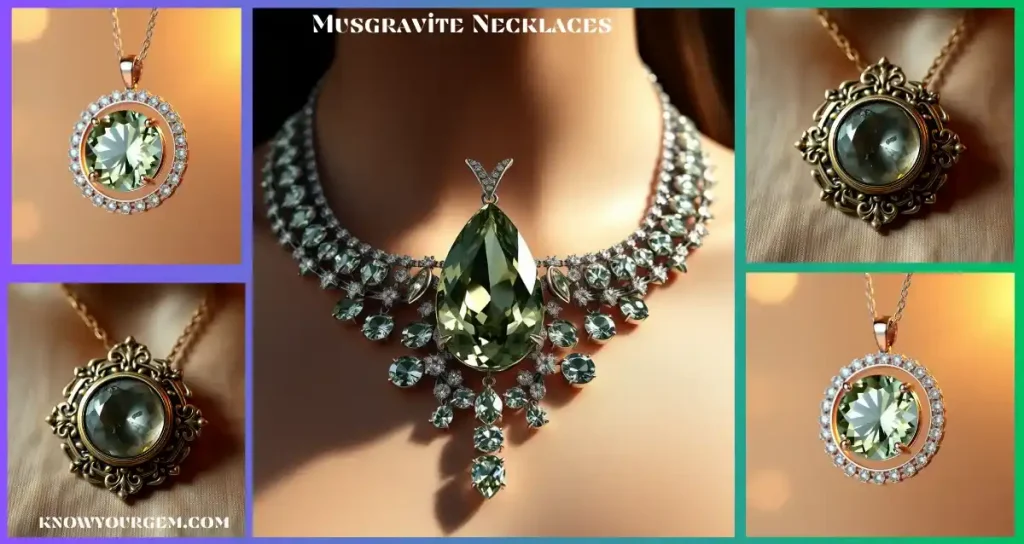
- Necklaces: Mostly unheard of, since finding multiple matching stones are nearly impossible. So, when they exist, Musgravite is usually paired with other gems.
- Solitaire Rings: The most practical design, highlights a single stone’s brilliance and color. Simple, secure settings are preferred to protect the gem while letting it shine.
- Bracelets & Multi Stone Designs: Largely theoretical, as sourcing enough stones of similar quality is virtually impossible.
Educational value:
Gemological institutes sometimes borrow Musgravite for teaching purposes. Students gain rare, hands on experience with one of the world’s scarcest minerals an opportunity many can never encounter again in their careers.

How to identify real Musgravite:
Visual clues:
Musgravite can showcase gray, green, or purple tones, often with subtle undertones. Although, in rough form, its hexagonal crystal habit can be visible, and when polished, it has a glassy (vitreous) shine. Although, it is generally identified that still, looks alone aren’t enough, so Musgravite is so similar to Taaffeite that even seasoned gemologists can struggle to tell them apart by sight.
Suspicious indicators:
Certain colors raise the possibility of Musgravite, especially greenish-gray or purplish-gray stones with saturation. Although, its moderate refractive index gives it a unique brilliance which are different from quartz (lower) and Diamond or zircon (higher). Experts can notice these subtleties, but lab testing is required for confirmation.
Certification matters:
While having rarity and value, professional certification is important. Leading labs like GIA and IGI use an advanced methods to confirm identity:
- Spectroscopic analysis: reveals how the stone absorbs and transmits light.
- Refractive index testing: measures how light bends inside the gem.
- Chemical composition checks: confirm the elemental mix that separates musgravite from look as well.
Advanced testing:
High level techniques like X-ray diffraction (examining crystal structure) and trace element spectral analysis provides definitive proof. Although, the cost of testing is minimal as compared to the stone’s value, which makes certification must for any serious transaction.
Rough vs.cut Stones:
Uncut Musgravite is even harder to identify. Although, rough pieces often lack clear optical traits and can appear as irregular fragments. Inclusions or growth patterns can offer clues, but they require expert interpretation. Since cutting rough material is expensive, misidentification can be financially devastated. So, buyers should remain cautious and always demand lab verification before investing.
Is Musgravite suitable for Jewelry?
Durability & Stability:
Musgravite is strong enough for daily wear jewelry. While ranking 8-8.5 on the Mohs scale it resist scratches and handles daily wear well. Although, its toughness resistance to chip or break which is similar as Emerald and Aquamarine. The stone is also stable under normal conditions, and showcases no sensitivity to light, heat, or household chemicals. Unlike more delicate gems, Musgravite deosn’t deman special care beyond basic cleaning.
Practical risks:
Since Musgravite is durable and tough enough for daily wear jewelry but wearing it is still risky because it is so rare and impossible to replace. Although, damage, theft, or losing the stone can be a huge loss. For that many owners keep it safe as collector’s item and only wear it on very special occasions.
Insurance challenges:
Insuring Musgravite is difficult and expensive. Although, few insurers know how to properly asses such rare gems, and premiums often run several percent of the stone’s value each year. Even with coverage, deductibles are high, leaving owners exposed to significant risk.
Best Jewelry settings:
When Musgravite is set into jewelry, protection is the priority:
- Bezel settings: Surround the stone with a continuous metal band, offering maximum security and impact resistance.
- Prong settings: At least six sturdy prongs, often in platinum, are recommended. V tip prongs protect vulnerable corners.
- Metal choice: Platinum is preferred for strength, though high karat gold can be used for aesthetics.
Recommended designs:
Experts advise against rings for everyday wear, since they face constant impact. Safer options include:
- Pendants: Rest against the body, shielded by clothing.
- Earrings: Secure when well designed, though some avoid them due to risk of backs failing
Investment potential of Musgravite:
Growing demand:
Interest in ultra rare gemstones can rise as investors look for an alternatives to the traditional assets. Although, with stock markets volatile and real estate facing cycles, tangible assets like Musgravite attract attention for wealth preservation.
Global buyer base:
Demand is no longer limited to the North America and Europe. Collectors in Asia especially China and Southeast Asia are pursuing Musgravite with an equal or greater enthusiasm. Although, middle Eastern buyers also prize extreme rarity, treating gemstones as both collectibles and safe stores of value against currency fluctuations.
Supply & scarcity:
The long term outlook is strong because supply is fixed . Decades of exploration have failed to uncover new deposits, suggesting current sources can represent all that’s accessible. As global wealth grows, more buyers enter the market, while existing stones vanish into permanent collections. This imbalance rises demand against static supply supports continued price appreciation.
Price trends:
Sales records over the past 20 years showcase steady increase, often outpacing inflation and rivaling traditional investments. Even during downturns, Musgravite prices held firm, which reflects scarcity rather than speculation. This resilience makes it attractive to the conservative investors who are seeking for stability.
Liquidity & costs
Investors should be realistic: Musgravite is illiquid. While selling requires patience and specialized auction houses, which charge commissions of 15-20%. Ownership also comes with costs authentication, insurance, and secure storage. These expenses reduce net returns but are essential for protecting value.
Dual returns:
For serious collectors, Musgravite offers two kinds of return: emotional and financial. While owing of Earth’s rarest minerals brings pride and prestige, while long term appreciation adds monetary reward. This blend of passion and profit sets gemstone investment apart from purely financial instruments.
Tax & estate planning:
Tax treatment often favors gemstones, with many regions offer a long term capital gains benefits. Estate planning is also simpler with tangible assets, as gemstones transfer efficiently to heirs and preserve value across generations.
Musgravite in popular culture:
In gaming:
Musgravite has gained surprising fame in gaming communities. In the space simulation game Elite Dangerous, it appear as one of the most valuable mineable resources. Although, players search for the gem hotpots across the galaxy while using specialized equipment, and mining it can be highly profitable. This mirrors real life, where Musgravite’s extreme rarity and value make it a prized find.
The game’s machines highlight Musgravite’s real world traits scarcity, difficulty of acquisition, and high reward. Although, players spend hours master mining techniques and tracking locations, much like gem collectors and miners do in reality.
Another title, Arcane Odyssey, features Musgravite in its magic and crafting systems. A variant called Aquatic Musgravites grant water based powers, and the community often refer to it simply as “musgraviteAO.” Guides and wikis detail how to obtain and use it, showing how the gemstone has become part of gaming vocabulary.
Awareness & cultural impact:
These appearances have enhanced Musgravite’s name recognition far beyond gemology circles. Many Gamers know the word without realizing it is real gemstone and one rarer than Games suggest. Although, discovering its realistic world existence often sparks fascination, sometimes even inspiring players to explore mineral collecting.
Musgravite’s crossover into gaming also fuels broader conversations about rarity and value. Online communities debate whether virtual items can hold a real rarity, using Musgravite as an example. Its extreme scarcity in reality provides a clear context for understanding how rarity digital economics and physical markets.
Musgravite metaphysical properties:
Spiritual meaning:
Beyond its rarity and value, the gem is often seen as a stone of clarity,wisdom, and spiritual growth. Many people believe its extreme scarcity adds to its power, linking physical rarity with spiritual significance.
Crystal meaning:
In new age and crystal healing circles, the gem is connected to the self discovery and authenticity. Although, enthusiasts say it helps people embrace their unique qualities and stay true to themselves. Its journey from deep within the Earth to the discovery is seen as a metaphor for personal growth and finding one’s true purpose.
Symbolism:
The stone is often associated with patience and perseverance. Although, its slow geology formation and the difficulty of obtaining it symbolize long term goals achieved through dedication rather than quick wins which makes it inspiring for those who are working toward big, lifelong ambitions.
Claimed healing properties:
Crystal healers attribute several benefits to the gem, including:
- Emotional balance and protection from negative energy
- Enhanced intuition and spiritual awareness (linked to the third eye and crown chakras)
- Support in processing grief, overcoming trauma, and releasing limiting beliefs
Meditation use:
Due to its rarity and beauty, the stone is valued as a meditation aid. Practitioners say holding or gazing at the stone deepens focus and insight. Whether these effects come from the stone itself or personal belief, many find the experience meaningful.
Scientific perspective:
Science doesn’t support claims of healing or energy transmission. While studies effects beyond placebo. Gemologists focus on the stone’s physical traits, its chemistry, crystal structure, and optical properties rather than metaphysical ones.
Balanced view:
For those who are looking for metaphysical aspects, this stone can be appreciated as a symbol and personal tool, not a substitute for medical or psychological care. Its beauty and rarity bring joy and inspiration, while its spiritual associations offer meaning to those who value them.
Additional information & interesting facts:
- Name Origin: The gem is unusual in the origin because its name honors both its discoverer and its discovery site, a rare dual tribute in gemology, where stones are usually named after either a person or a place, but not both.
- Mining Reality: Even after decades of searching, Musgravites have never been commercially mined. The few stones that exist are are found only as byproducts of sapphire or spinel mining, shows just how rare and unpredictable it is.
- Formation: The stone forms under intense heat and pressure in aluminum rich metamorphic rocks. These rare geological conditions take millions of years to produce which makes each stone a testament to Earth’s slow craftsmanship.
- Cultural References: In Indonesia, then gem is sometimes called batu akik musgravite, links it to agate in local gem markets. While technically incorrect, this shows how the stone has entered different cultural and linguistic contexts.
- Rare Colors: Blue musgravites are the rarest varieties, with only on e or two confirmed specimens worldwide. Whether black Musgravites also exist bit they are rarely seen outside research collections.
- Value: Musgravites consistently rank among the world’s most valuable gemstones, because their per carat price depend heavily on individual quality.
- Where It’s Found: Most known sources are limited to the Autralia, SriLanka, and Madagascar, with minor occurrences in Greenland, Antarctica, and Tanzania. No major new deposits have been discovered despite extensive surveys.
- Auctions: When Musgravites appear at the auction, they spark intense bidding and often exceed pre sale estimates.
- Speculative Ideas: The notion of a “musgravite asteroid” is purely imaginative—its formation requires Earth specific metamorphic conditions unlikely to exist in space.
- Global Market: While in English , French (Bague Musgravites), or other languages, the challenges remain the same: extreme scarcity and high cost.
Short Summary:
Musgravites represent the pinnacle of rare gemstones. Although, integrating extreme scarcity with exceptional beauty and impressive durability. Its discovery story, limited geography distribution, and tiny population of fascinated stones.
Modern Gem Alert:
- Rarity: Fewer than 100 faceted stones worldwide
- Value: $6,000–$35,000+ per carat depending on quality
- Durability: Hardness 8–8.5 (scratch resistant, but too rare for daily wear)
- Market: Appears only through elite dealers and auctions, often with GIA/IGI certification
- Collector Appeal: Considered one of the ultimate achievements in gemstone collecting
FAQS:
1. What is musgravite?
Musgravites are most rarest gemstones in the world. Although, they belong to the Taaffeite family, which they are hard and usually appears in gray-green to violet colors.
2. Where is musgravite found?
The Major source is the Musgrave Range which is located in South Australia. Although, small amounts also are found in SriLanka, Madagascar, Greenland, Tanzania, and Antarctica.
3. How to identify musgravite?
It looks like similar to Taaffeite, so you can not confirm it by sight alone. Although, Gem labs use tests like refractive index, spectroscopy, and X-ray analysis to prove it is the real stone.
4. How rare is musgravite?
It is extremely rare only handful of faceted stones exist worldwide. Even tiny Gem-quality pieces are rare than diamonds or sapphires.
5. How much is musgravite worth?
Prices can slightly be vary with the range from $6,000 to $35,000 per carat, but it totally depends on the quality. Exceptional stones can reach $40,000-$50,000 per carat at auctions.

Welcome to KnowYourGem.com! your ultimate destination for uncovering the fascinating world of gems and their secrets! I'm Kamil Hussain, a passionate blogger with a Master’s degree in Economics, dedicated to bringing you insightful, well researched content that blends the beauty of gemstones with the art of storytelling. With a keen analytical mind and a love for discovering hidden treasures, I created this platform to help you explore the brilliance, history, and value of every gem.


[…] is a rare silicate mineral containing potassium, iron, magnesium, and aluminium. It belongs to the milarite-osumilite group. It […]