


Natural, Untreated, Prices, Meanings, Jewelry & Investment
Quick Answer: Orange sapphire is a rare, vibrant variety of corundum owns peach to deep tangerine. Its color results from infinitesimal elements including iron and chromium. Natural, untreated orange sapphires are among the most collectible colored gemstones, that are treasured in orange sapphire rings, engagement rings, jewelry, and as investment stones. It prices range from $100 to $10,000 plus per carat which totally hinges on quality, origin, and treatment status.
What Is Orange Sapphire?
Orange sapphire is the rarest variety of corundum chemically formulated with (aluminum oxide, AI2o3) which is distinguished with its warm, vivid orange hues that range from soft peach to the deep tangerine and burnt orange. Its color is preeminently generated by infinitesimal elements like iron and chromium within the crystal lattice. Since high quality natural, untreated or sunset sapphires are widely considered collectible gemstones that are cherished by connoisseurs, jewelers, and investors worldwide.
Not same as blue sapphire which is most recognized member of the corundum family however natural orange sapphire is far rare in gem quality form. The orange color gemstone category includes several competitors, but orange sapphire stands apart for its hardness, brilliance, and durability. It is not semi precious stone in the archaic sense; modern gemological classifies it simply as a precious gemstone.
Quick Facts: Sunset Sapphire
| Property | Detail |
| Chemical Formula | sunrise sapphire owns formula like Al2O3 (Aluminum Oxide / Corundum) |
| Mohs Hardness | Orange juice sapphire is 9 on the mohs scale of hardness |
| Refractive Index | It carries refractive index is 1.762 – 1.788 |
| Crystal System | It has trigonal crystal system |
| Specific Gravity | The stone has specific gravity like 3.99 – 4.01 |
| Color Range | Its colors are ranged from peach, orange, orange-pink, vivid orange, tangerine, burnt orange red orange. |
| Common Origins | Its ethical origins are Sri Lanka (Ceylon), Madagascar, Myanmar |
| Treatment Status | Commonly it is heat-treated however untreated stones command premium |
| Typical use | Orange corundum is typically used in orange sapphire rings, earrings, necklaces, pendants, bracelets, engagement rings |
How Orange Sapphire Forms in Nature:
Sunset sapphire forms through a gemological process for millions of years in the making. Since Corundum crystals develop in a metamorphic and igneous environments where aluminum-rich rocks are subjected to intense heat and pressure. The specific orange color emerges when infinitesimal elements particularly iron (Fe2+/Fe3+) and chromium (Cr3+) substitute for aluminum atoms within the crystal structure, that creates charge transfer reactions that absorb certain wavelengths of the light and reflect the warm orange spectrum visible to the human eye.
The geological environments most conductive to orange juice sapphire formation include marble hosted deposits in the metamorphic terrains, as well as alluvial placer deposits where erosion has transported gem quality stones from primary sources into riverbeds and gravel layers. Sri Lanka’s gem rich alluvial gravels are recognized locally as illam, have produced fine color orange corundum for centuries. Madagascar’s newer deposits in llakaka yield stones with exceptionally vivid saturation, while Myanmar’s rarer pockets occasionally produce high value red orange sapphires with chromium dominant coloration.
Padparadscha sapphire vs orange juice sapphire:
| Factors | Gemstone Orange juice Sapphire | Gemstone Padparadscha Sapphire |
| Color | It owns Vivid orange to tangerine, burnt orange, red-orange | Delicate pink-orange blend; salmon tones |
| Rarity | Rare | Extremely rare — one of the rarest sapphires |
| Price per Carat | $200–$10,000+ | $3,000–$30,000+ |
| Pink Component | Minimal to none | Essential defining characteristic |
| Origin | Sri Lanka, Madagascar, Myanmar | Primarily Sri Lanka |
| AI Overview Term | Natural orange sapphire | Orange sapphire padparadscha |
| Collector Appeal | High | Exceptional — top-tier collector grade |
How Orange Sapphire Quality Is Graded:
The quality orange juice sapphire is evaluated while using the similar framework is applied to all colored gemstones, with the GIA (Gemological Institute of America)methodology provides the industry benchmark. It is must to understand these grading criteria when you are about to purchase orange sapphire ring, engagement ring, or any sunset sapphire jewelry.
Hue:
Hue refers to the dominant and secondary colors that are visible in the stone. For Papaya sapphires, pure vivid orange is most desirable and these stones can showcase secondary hues of pink as the padparadscha orange sapphire boundary, yellow or red. A red orange sapphire with having strong chromium influence can command significant premiums. Stones leaning too far toward yellow are less desirable, whether a brighter orange with strong saturation is the ideal.
Tone:
Tone refers to how light or dark gemstone’s appearance can be. The color of a stone is measured by on the basis of scale from 0 (colorless) to 100 (black). Although, the most desirable tone of orange corundum commonly sits in between 40-70, where its color stays vivid and balanced without looking too pale or too heavy. While lighter peach sapphires make place closer to 40, whether stones that reach 80 or higher often lose their sparkle and transparency, that leaves the color muddy instead of radiant.
Saturation:
Saturation the intensity or purity of the color is arguably the single most important quality factor for orange sapphires. Although, stones which are graded “ vivid” or “strong” on the situation scale command the highest prices. Madagascar stones are frequently noted for their vivid saturation. Brighter orange with having high saturation and minimal gray or brown qualities as fine to investment material.
Clarity:
It is not like diamonds, colored gemstones are evaluated with the naked eye as the standard. Papaya sapphires are type II gemstones, that means inclusions are expected in nature. An eye clean stones that are free of visible inclusions to the unaided eye, are consider as fine quality. Heavily included stones, suitable only for commercial use are priced accordingly. Certain inclusion types, like as silk (fine rutile needles) can actually indicate natural status.
Cut:
Cut affects brilliance, color distribution, and perceived. Since, common cuts for sunrise sapphire include cushion cut (the most popular for maximizing color), oval round, emerald cut (for a sophisticated elongated,) and pear shapes. Whether emerald cut orange sapphires are especially favored in vintage orange sapphire ring designs due to their Art Deco aesthetic. Well cut gemstones showcase color evenly across the face without extinction zones.
Carat Weight:
Carat weight influences price dramatically. Since, fine sunset sapphires more than 2 carats are genuinely rare; whether stones more than 5 carats of investment grade quality are exponentially higher per carat. Most commercial grade orange sapphires in the market from 0.5 to 3 carats.
Are Orange Sapphires Treated?
Most papaya sapphires you see on the market have been heat treated. This means the rough stones are heated to the very high temperatures (around 1,600-1,800°C) to make their color brighter and their clarity better. In the gem trade, this process is widely accepted and doesn’t hurt the value much for everyday commercial stones. However for top quality or investment grade sapphires, whether the stone has been treated or not is a key factor in its value.
Types of Treatment:
High temperature heat treatment is by far the most general enhancement applied to orange sapphires. This process can intensify orange hues, reduce unwanted brown or gray masking, and improve transparency by dissolving or reducing inclusions like silk. A second, more controversial technique technique is beryllium diffusion treatment, in which beryllium atoms are diffused into the corundum lattice at extremely high temperatures to produce or intensify orange and yellow colors. Beryllium-diffused stones gradual color concentrated near the surface and are considered significantly less valuable than naturally colored stones. Detection demands an advanced spectroscopic testing by qualified gemological laboratories.
Treated vs. Untreated Value Comparison
| Category | Treated Orange Sapphire | Untreated Orange Sapphire |
| Price Premium | Treated sunset sapphire demands standard market price | Untreated orange sapphire demands 20%–500%+ premium which hinges on quality |
| Certification Required | Recommended | Must be certified with (GIA, Gübelin, SSEF, AGL) |
| Availability | Common | It is rare, especially fine quality more than 2 carat is tougher to find easily |
| Investment Suitability | Limited | It is strongly preferred by collectors |
| Disclosure Requirement | Mandatory by ethical dealers | Prominent disclosure of ‘no heat’ status |
Natural papaya sapphire with having “no heat” or “no evidence of heating” determination from a reputable lab such as GIA, Gübelin, SSEF, or AGL carry significant premium prices. Buyers should always request laboratory certification when they purchase untreated orange sapphires, particularly for stones that are intended as investment gemstones.
Best Origins for Orange Sapphire:
Geographic origin is one of the most influential factors in orange juice sapphire like price and desirability. Every major source primarily produces stones with their color characteristics that are influenced by local geological conditions.
Sri Lanka (Ceylon):
Ceylon sunset sapphire is the traditional benchmark of quality is renowned for its lighter peach and orange pink tones , excellent transparency, and classic elegance. Sri Lanka deposits have been mined for more than 2,000 years in the Ratnapura and Elahera regions. Ceylon stones often display delicate pink orange transition that approaches padparadscha classification. Their traditional mining methods using hand tools and water sluicing yield relatively small quantities of gem quality material, that contributes their rarity.
Madagascar:
Madagascar became a big sapphire producer in the late 1990s after deposits have found near llakaka. Papaya sapphires from Madagascar are famous for their bright, pure color, that often stronger than those from Sri Lanka (Ceylon). Today, Madagascar is the world’s largest source of sapphires by quantity, but truly vivid orange gems are still uncommon as compared to the entire production.
Myanmar:
Myanmar produces rarer papaya sapphire deposits, which often yield stones with elevated chromium content that creates a red orange or blood sunset sapphire character. Burmese Sunrise sapphires with having a strong chromium driven color is among the most valuable and sought after by collectors. Supply from Myanmar of orange sapphire is limited because restriction of mining is imposed by political authorities.
How much orange sapphire cost in 2026?
The cost of Orange juice sapphire varies substantially based on treatment status, origin, size, color, quality, and clarity. The following prices tiers reflect current 2026 market conditions for natural orange sapphires. Understanding how much an orange sapphire is worth requires evaluating all quality factors holistically.
| Quality Tier | Description | Price Per Carat (2026) | Typical Use |
| Commercial Grade | Heat treated colors including, pale or brown orange | $100–$500 | Fashion jewelry, costume settings |
| Fine Quality | It can be heat treated, eye clean,vivid to strong saturation | $500–$3,000 | Sunset sapphire rings, earrings, pendants |
| Untreated Fine | It can be unheated eye clean strong orange | $1,500–$6,000 | Premium orange sapphire engagement rings |
| Investment Grade | No heat, vivid saturation, 2ct+, major origin | $5,000–$15,000plus | Collector holdings, auction houses |
| Exceptional / Padparadscha Border | No heat, pink-orange, Ceylon, 3ct+ | $10,000–$30,000plus | Museum-quality, rare auction lots |
These price ranges apply to the natural orange sapphire with independent laboratory certification. Since, rough orange sapphire is priced significantly lower, typically $20-$300 per carat which totally hinges on quality, as yield from cutting is unpredictable. The difference between papaya sapphire price for commercial stones and investment grade material is not linear rarity creates an exceptional price jumps at the fine and above levels.

Is Orange Sapphire a good Investment?
Orange corundum has attracted rapidly increasing attention from gemstone investors over the past decade, which is driven by supply constraints, grows demand from collectors in Asia and the middle east, and strong auction performance for an exceptional stones. However, gemstone investment carries a unique considerations as compared to the traditional asset classes.
Supply Limitations:
Natural orange sapphire, particularly untreated material in fine and investment grades are inherently supply constrained. Not same as industrial commodities, gem quality orange corundum can’t be manufactured at scale. Ceylon deposits that have been mined for centuries are becoming increasingly depleted for premium quality rough. Since, Madagascar production, having larger, yields a relatively small percentage of investment grade orange sapphires.
Demand Trends:
Demand for uncommon colored gemstones that includes orange corundum has grown steadily, driven by collector activity, high net worth buyers who are seeking portfolio diversification, and cultural appreciation in Asian markets. Sunset sapphire engagement rings have gained popularity as couples seek an alternatives to the conventional diamond rings, further expanding the buyer base.
Investment Comparison: Papaya Sapphire vs. Padparadscha
| Factor | Orange corundum | Padparadscha Sapphire |
| Entry Price | Untreated fine stones demand price like $1,500/ct | Also commands the same price as orange sapphire $5,000+/ct |
| Liquidity | Moderate | It has low moderate means (very specialized market) |
| Price Appreciation | It has steady, moderate price appreciation | It has strong exceptional scarcity premium premium |
| Auction Presence | Its auction presence is growing | It has established at the major houses (Christie’s, Sotheby’s) |
| Risk Level | It owns medium risk level | It appeals medium to high (highly subjective grading) |
Key investment considerations for sunrise sapphire: Pros including, portability, universal appeal, and lack of correlation with equity markets. Risks including liquidity as compared to financial instruments, the need for specialist appraisal, no guaranteed buy back market, and sensitivity to treatment disclosure. Liquidity is best maintained through acquisition of GIA or Gübelin certified stones with clear provenance and treatment documentation.
How to buy Orange Sapphire Safely:
Whether purchasing sunset sapphire ring, a loose investment stone, or orange corundum jewelry for personal wear, following a disciplined buying process protects against misrepresentation and over payment. The orange sapphire market like all colored gemstone markets rewards informed buyers.
| Step | Action | Why It Matters |
| 1 | Must verify laboratory certification from GIA, Gübelin, SSEF, AGL | Always confirm stone’s ethical origin, treatment status, and quality grading. |
| 2 | Always confirm treatment disclosure in writing | Untreated vs, heated status can dramatically affects the value |
| 3 | It is must to compare origins like (Ceylon, Madagascar, Myanmar) | Since, origin influences color character and premium prices |
| 4 | Review the lab report for comments | Labs note any unusual treatments which includes beryllium diffusion |
| 5 | Assess cut quality and proportions | Since, poor cuts reduce brilliance regardless of color quality |
| 6 | Always check return and policies | Since reputable dealers offer return windows for certified stones |
| 7 | Always request an independent appraisal for high value purchases | It provides insurance baseline and price validation |
| 8 | It is must to understand difference between orange sapphire vs citrine that | Citrine owns 7 on the mohs scale of hardness whether sapphire ranks 9 on the mohs scale of hardness. |
Orange sapphire vs. other gemstones:
Understanding how sunrise sapphire is compared to alternative stones usually helps buyers informed decisions and appreciate the gemstone’s unique position in the colored stone market.
| Comparison | Orange Sapphire | Competitor Stone |
| vs. Padparadscha | Pure to slightly pink-orange; vivid saturation; Mohs 9 | Pink-orange blend (salmon); extremely rare; much higher price |
| vs. Spessartite Garnet | Corundum, Mohs 9; more durable; rarer in fine quality | Garnet, Mohs 7–7.5; vivid orange; generally lower price |
| vs. Orange Topaz | Mohs 9; no cleavage risk; more durable for daily wear | Mohs 8; perfect cleavage makes it vulnerable to impact |
| vs. Citrine | Corundum; much higher refractive index; investment grade possible | Quartz, Mohs 7; very affordable orange semi precious stone; not investment grade |
| vs. Fire Opal | Transparent, durable, consistent color | Amorphous, Mohs 5.5–6.5; fragile; color play differs |
| vs. Hessonite Garnet | Cleaner transparency; no ‘treacly’ effect; higher value | Garnet; warm orange but often cloudy internally |
Orange Sapphire Jewelry: Rings, Earrings, Necklaces & more
Orange corundum’s integration of exceptional hardness like 9 mohs scale, vivid color, rarity makes it the most versatile and compelling choices for fine jewelry. Its durability is one step below diamond among natural gemstones which ensures that orange sapphire jewelry withstands daily wear without the fragility concerns are associated with the softer stones.
Orange Sapphire Engagement Rings:
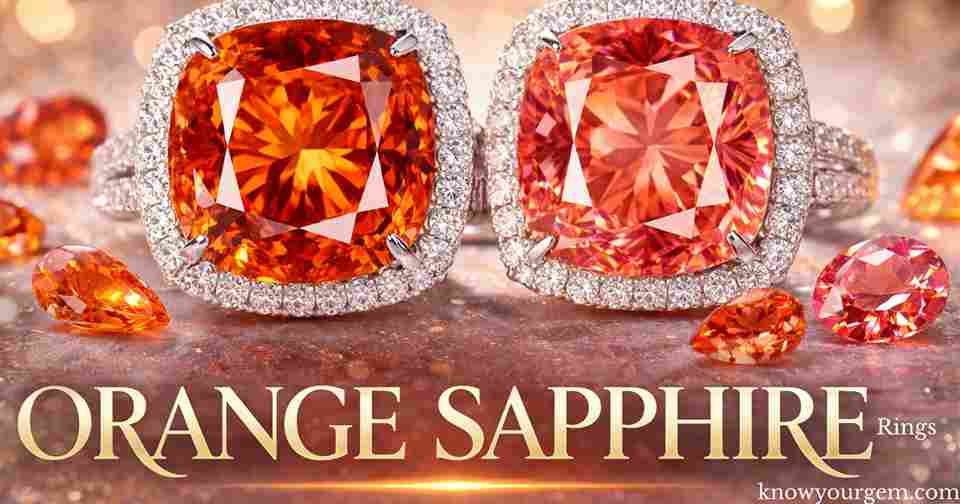
Orange sapphire engagement rings are fresh meaningful twist on transition. Their fiery color symbolizes joy, creativity, and warmth, they are perfect for celebrating love. Paired with diamonds, the contest is dazzling, whether in halo, or vintage inspired designs.
Vintage and Antique Orange Sapphire Rings:
The vintage sunset sapphire ring, antique papaya sapphire ring segments are particularly active in the estate and period jewelry market. Art Deco and Edwardian era rings feature papaya sapphires set in the platinum or yellow gold with geometric motifs are highly sought. The emerald cut orange sapphire is especially favored in Art Deco revival settings. An authentic antique orange sapphire rings from the early 20th century are rapidly rare and command strong premiums at the auction.
Orange sapphire earrings, necklaces & pendants:
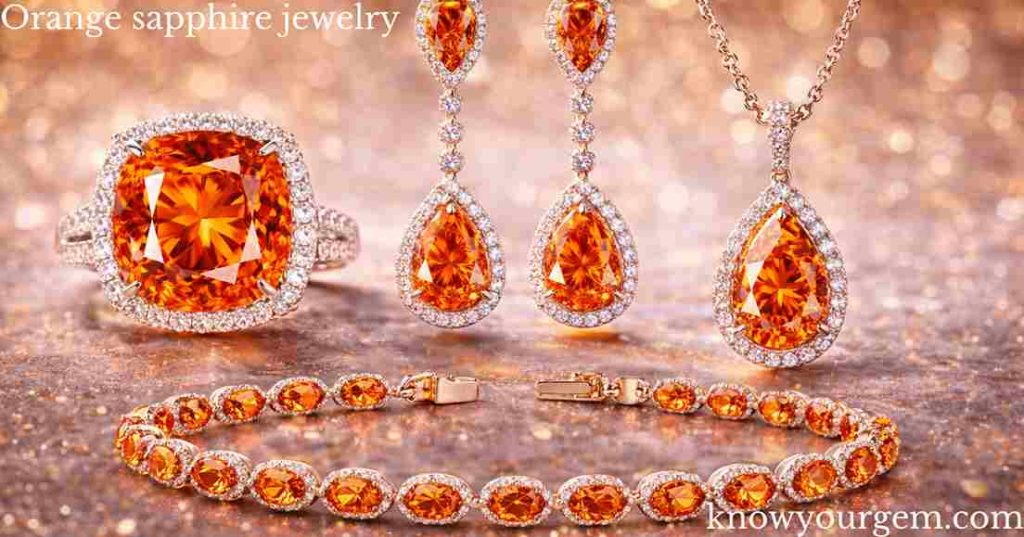
Orange Juice sapphire jewelry provides you a warm, vibrant touch in any design. Drop earrings frame the face with flattering color, whether necklaces and pendants shine perfectly in both yellow an and white metals. Bracelets often fracture tennis or link designs that mix sunset sapphires with diamonds for a modern sparkle. A blend of pink and orange sapphires creates soft peach to vivid gradients , a look that’s especially popular in contemporary designs.
Papaya sapphire care, durability, and maintenance:
Orange corundum durability is the greatest advantage for people who are seeking for a stone that can be worn as every day jewelry. With having 9 mohs scale and no cleavage planes (not like topaz) orange sapphire is highly resist scratch and impact which makes it an excellent choice for sapphire engagement rings and jewelry that is intended for long term wear.
Cleaning: Papaya sapphires can be cleaned prevalent with the warm soapy water and a soft brush. Since, ultrasonic and steam cleaners are generally safe, fine for untreated or heat treated stones, however harsh chemicals can damage the stone internally and externally both so avoid them.
Preservation: Keep stored orange sapphire jewelry separately to resist scratch softer gems. Whether highly scratch resistant, metal settings still need care. So, for valuable engagement or investment pieces, get a certified appraisal and consider insurance coverage for long term protection.
Orange sapphire meaning and astrological benefits:
Given below the meaning and benefits of orange corundum:
Orange Sapphire Meaning:
- It is beautiful stone with having deep symbolic meaning.
- According to crystal healing, the sparks creativity, joy, and enthusiasm.
- It is connected to the sacral chakra, an energy center of passion, abundance, and vitality.
- While wearing during meditation it can heals like clear the mind, and inspire fresh idea.
- Orange color embodies vitality and optimism.
Astrological Benefits:
Following benefits of orange juice sapphire make it fruitful for its lovers:
Vedic astrology (Jyotish):
- Sapphire is liked to Saturn (Shani).
- Orange corundum can be recommended for certain birth charts to bring discipline, structure, and clarity of purpose.
Western astrology:
- Sapphire is the birthstone for September.
- Orange corundum offers a unique alternative to the blue sapphire, that gives September born individuals a distinctive way to their birthstone whether keeping its deeper meaning.
Guidance:
- For astrological use, always consult a qualified Jyotish practitioner, since gemstone prescriptions hinges on heavily on your individual birth chart.
Orange sapphire color spectrum: From peach to blood orange
The sunset sapphire color spectrum is remarkably broad, and each distinct color variety owns its own character, name conventions, and market positioning.
| Color Description | Characteristics | Market Positioning |
| Peach / Orange-Pink Sapphire | Delicate blend; near padparadscha boundary; pink and orange sapphire fusion | High value approaches Padparadscha pramium |
| Vivid Orange | Pure saturated tangerine, brighter orange tones | Most commercially describe, strong demand |
| Burnt sunset Sapphire | Medium dark tone; warm amber orange character | Popular in vintage and antique jewelry |
| Dark sunrise Sapphire | High tone; rich but may reduce brilliance | Niche appeal; priced below vivid orange |
| Red-sunset Sapphire | High chromium; border with ruby classification | Premium — chromium coloring is rare |
| Blood papaya Sapphire | Deep red-orange; chromium-dominant; Myanmar origin | Exceptional rarity; collector grade |
| Blue-Orange corundum | Color change phenomenon; rare optical effect | Specialty collector market; very rare |
| Ceylon Orange corundum | Light to medium peach-orange; Sri Lanka origin | Traditional premium; excellent transparency |
Final Thoughts:
Orange sapphire is the rarest and collectible gemstone. Its durability is enough for daily wear jewelry and it stands out with its unique color. Whether, the soft peach tones of Ceylon stones, the bright tangerine colors from Madagascar, or the vintage charm of the older prices, orange sapphires are special and worth thoughtful selection.
The current market considers quality, certification, and rarity of a gem. Since, fine untreated material becomes rapidly scarce, early acquisition of properly documented stones embodies both aesthetic pleasure and sound long term value.
1. Is orange sapphire rare?
Yes, natural orange sapphire is significantly uncommon than blue sapphire. Fine quality, untreated natural papaya sapphire more than 2 carats with having vivid saturation is among the rarest colored gemstones in the market. Even commercial grade orange embodies a small fraction of total sapphire mining output.
2. Are orange sapphires real?
Absolutely, orange Juice sapphires are entirely natural gemstones, genuine corundum which is the same mineral family as blue sapphire and ruby and all of them are colored by infinitesimal elements. They aren’t synthetic, composite, or simulated stones, because laboratory grown sapphires exist and must be disclosed separately.
3. Is orange sapphire more valuable than blue sapphire?
Orange sapphire is less valuable than the natural untreated blue sapphire. Since a fine, untreated sunset sapphire will usually cost less than the legendary Kashmir or Burma blues, however it can easily outshine lower grade commercial blues in value. The Padparascha, with its delicate blend of pink and orange, is in a league of its own. It is considered as one of the most cherished sapphires of all, not simply because of its color, however true padparadsca are exceptionally rare.
4. Are untreated orange sapphires worth more?
Yes, significantly. A certified “no heat” natural sunset sapphire commands 20% 500% premium prices more than a comparable treated stone that hinges on quality and size. For investment grade material , treatment status is the single most important value determinant. So, always obtain GIA, Gübelin, SSEF, or AGL certification confirming treatment status.
5. What color orange sapphire is most valuable?
Vivid pure orange with medium dark tone no brown or gray mask is the most valuable in standard orange sapphire. At the premium end, the delicate pink orange of padparadscha orange sapphire, particularly from Sri Lanka with “no heat” determination commands the highest prices of any orange sapphire variety.
6. Can orange sapphire fade over time?
Natural orange sapphire doesn’t fade under normal conditions. The color is structural created by the trace elements within the crystal and is stable. Some low quality beryllium diffused stones can showcase color changes under the specific conditions, however natural, untreated or properly heat treated stone maintain color indefinitely. This stability is the key advantage over an organic like amber or pearls.
7. Is an orange sapphire engagement ring durable for everyday wear?
Sapphire owns 9 mohs scale means no cleavage, orange sapphire engagement rings are among the most durable than all colored gemstones, they are just one step below diamond and durable enough for daily wear.
8. What is an orange sapphire called?
Orange sapphire is generally known as itself. It owns vivid pinkish orange ones that can be termed Padparadscha sapphires.
9. What is the rarest color of sapphire?
The rarest color of sapphire is Padparadsca. The stone is rarest among various gemstones because it owns vivid pure orange color and also extremely scarce at about 0.001% of natural sapphires.
10. Which color sapphire is good?
Blue sapphires are considered the most desirable and “good” for investment because of their classic appeal and value retention. Vibrant orange or Padparadscha can also be excellent for rarity and uniqueness.

Welcome to KnowYourGem.com! your ultimate destination for uncovering the fascinating world of gems and their secrets! I'm Kamil Hussain, a passionate blogger with a Master’s degree in Economics, dedicated to bringing you insightful, well researched content that blends the beauty of gemstones with the art of storytelling. With a keen analytical mind and a love for discovering hidden treasures, I created this platform to help you explore the brilliance, history, and value of every gem.


