

Quick Insights:
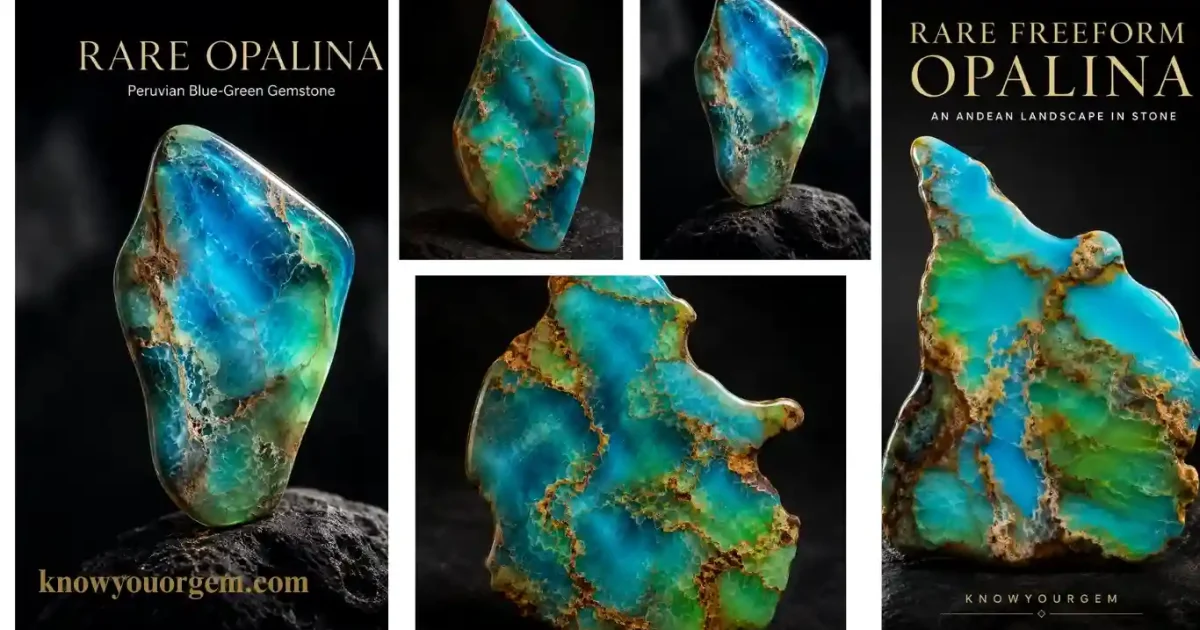
Opalina is thought to be a trade name for the regular opal from Peru. It is sold not for its flashing play-of-colors as in precious opal, but for its unctuous pastel colors, similarly to common opal. It is mostly mined near Ica in Southern Peru, and finds the pink and blue-green hues especially popular for use in cabochons, beads, and carvings.
Quick Facts About Opalina:
| Attribute | Detail |
|---|---|
| Chemical | The stone has a hydrated silica chemical composition. |
| Opal type | This is a common opal; it has no play of colors. |
| Colors | Its main hues include Pink, sky blue, blue-green, and sometimes purple. |
| Mohs scale | 5.5–6.5 |
| Specific gravity | 1.98–2.25 |
| Transparency | The stone is translucent to opaque |
| Ethical source | It is found in the Ica region, Peru (Lily/Pisco Mine) |
| Useful cuts | Cabochons, beads, carvings |
| Birthstone status | No birthstone status traditionally |
What Is Opalina Gemstone?
Opalina is just common opal from Peru, named more in terms of its soft, milky color than the more well-known “Peruvian opal”, which is the same family of material as common opal in the gemmology world.
Is Opalina a Mineral, Gemstone or Trade Name?
Opalina is kept as a trade name, not a true mineral species. It is the opal beneath the cabochons; a mineraloid of hydrous silica spheres. “Opalina” refers to a particular grade or form of that opal, as does “Andean opal” or “Peruvian opal”.
This counts for buyers, as trade names are easy to bandy around. Based on two different sellers, the stone is sold differently with different qualities, and recognizing this gem from its name is less required compared to checking lab reports or a straight photo of the stone.
Is Opalina the Same as Opal?
Yes, mineralogically. Opalina is opal, the common variety that has no internal structure to display play-of-color. The defining feature of this variety is the uniform body colour generated by trace minerals that do not diffract light.
The majority of precious opal gets its color from the ordered, microscopic structure of silica spheres, which split the incoming light into packs of color. Common opal’s silica spheres are randomly separated, so the light frequency-modulation is more uniform, and it thus glows a pinkish pastel.
Why Is Opalina Sometimes Confused With Other Materials?
It can sometimes be confused with opalite; an artificial opalescent glass that, although not the same, does have a rather similar name. It can also be mistaken for like-toned pastel Peruvian stones such as chrysocolla and blue calcite, as all three can be bought from the same shops and online.
Most of the time this is not deliberate. Sellers pick up names from their sources without checking, and the pastel semi-translucent stones photograph quite like this in ordinary shop artificial light.
Opalina Gemstone Meaning:
Opalina Meaning:
Within this metaphysical and crystal-healing group, Opalite is linked to peace, emotional improvement, and communication without intensity. These are subjective associations, not measurable ones, and also differ from source to source and seller to seller.
Spiritual healing practitioners within this system generally say that Opalina is a stone to help one manage overthinking and promote consistent self-expression.
Don’t compare its healing with scientific research because such meaning and symbolism of the stone are traditions that arose around pastel types of opal in the same way as with rose quartz or amazonite.
Symbolism and Traditional Associations:
Andean opal has far older cultural associations than those associated with modern retail usage. Prior to the European categorization of gemstones and the European connotations of the term, the indigenous population of Peru already used it in dress and ceremonial items in the context of Andean cosmology.
The stone, in this present age, is linked to the water signs of Pisces and Cancer (due to the soft, flowing coloration). Remember that these are only of modern origin.
What Does Opalina Look Like?
Color:
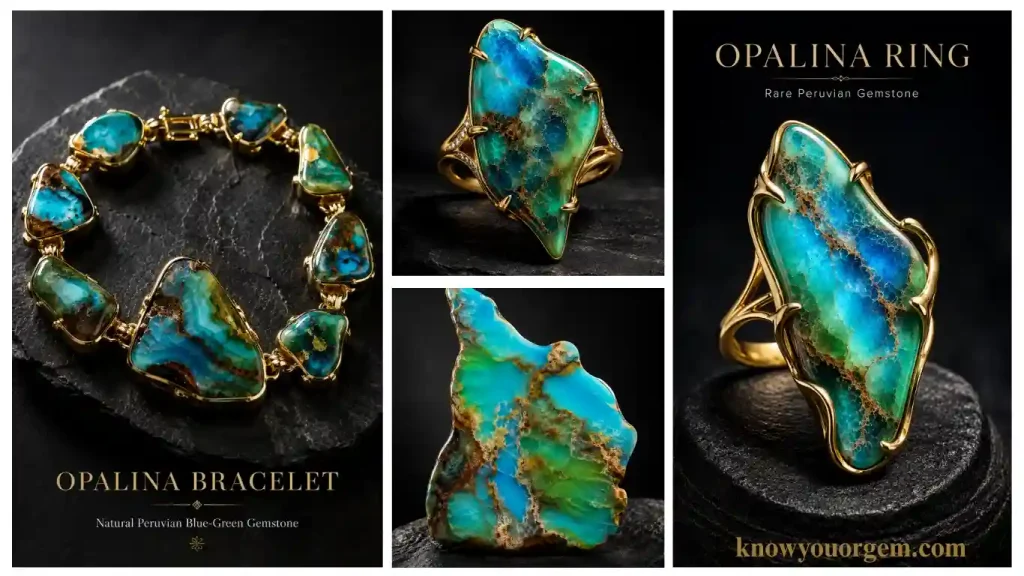
Common opal is more frequently encountered as soft pinks and sky blue, pale greens; the color arises from trace minerals, not by a structural diffraction. The pink color is derived from iron oxide, and blue and turquoise colors are derived from copper compounds and a clay mineral, palygorskite.
There may be variations in color distribution within a piece – for example, paler and deeper zones may be seen passing through the stone. Such normal variation is to be expected in common opal, but it does not indicate treatment or imitation in its own right.
Transparency:
The stone to its semi-transparent to opaque; the opacity is related back to the silica framework density and the content of various minerals. The stronger material containing more clay or oxide impurities is more opaque, but the cleaner stones are semi-transparent, gleaming when placed in the light.
Luster:
Polished Opalina has a waxy to slightly vitreous luster that is smoother than glassy like quartz. The soft, dull brilliance of Opalina can be one of the most accurate visual indicators for use in distinguishing opal from glass simulators that have a brighter, more uniform brilliance.
Patterns:
Most Opalina has dendrites, dark, tree-like or fern-like inclusion patterns. These are caused by manganese oxide crystallising within the Opalitine and are popular with collectors because they’re not easily forged and provide an interesting contrasting texture when cut.
Opalina Gemstone Properties:
| Property | Value |
|---|---|
| Formula | It chemical composition is SiO₂·nH₂O (hydrated silica) |
| Crystal structure | The stone is crystallized in Amorphous (mineraloid, no crystal lattice) |
| Scale | It rates at 5.5–6.5 on Mohs hardness |
| Specific gravity | It has a SG of 1.98–2.25 |
| Refractive index | It displays brilliance with RI of 1.44–1.46 |
| Cleavage | None |
| Fracture | Conchoidal |
| Luster | Waxy to vitreous |
| Transparency | Translucent to opaque |
| Play-of-color | Absent (common opal) |
The stone has a different chemical composition, color, and luster than precious opal.
Where Does Opalina Come From?
Peruvian Opalina
Opalina Peru is the most common and is the best recognized ethical source of producing Opalina. Most commercial material is sourced to the Lily Mine (also known as the Pisco Mine), near Ica in southern Peru. This material has been available in the trade since approximately 1993, with the arrival of blue and pink material in larger quantities.
The stone appears to be a blue-green color because of the copper hot water process that exists in the Ica area. The location is the reason why chrysocolla has made its correlation, which is drawn between the two for sale purposes.
Other Sources:
Small quantities of similar-appearing common opal are also mined in Mexico and other parts of the Andes. Although they are not marketed as frequently under the “Opalina” trade name as the Peruvian material. Prospective buyers should consider “Opalina” as shorthand for Peruvian type common opal, rather than an indicator of the precise origin, since vendors are not necessarily accurate in their description.
Opalina Gemstone Value & Price:
How Much Is Opalina Worth?
Opalina is generally an affordable stone compared to precious opal in the market. Learn how?
Opalina Price Per Carat:
Peruvian pink opal, the material marketed as Opalina which is presently sold between $1 and $25 per carat. However, with the same location, blue opal is sold between $ 5 and $ 50 per carat, and green material is priced from $2 to $30 per carat. The range of values is influenced primarily by color saturation and clarity.
Cabochon Price:
Per-piece cost in retail sells finished cabochons of Opalina for $10-$20 each. High-end Peruvian Opalina cabochons are significantly more expensive, ranging from $50-$150 plus based on size and quality. Per-piece selling is more usual in the Opalina trade than by carat, because finished cabochons are usually sold individually.
Rough Stone Price:
Rough pieces command only a small part of the cost, whereas finished cabochons command higher prices. The price of uncut stone is low because the work of cutting and polishing couldn’t be done on rough stone. It is usually sold individually or by bulk weight direct to lapidary hobbyists rather than on a per-carat basis.
Factors Affecting Value:
| Factor | Effect on Value |
|---|---|
| Color saturation | More intense, evenly spread blue or pink moves the price to the higher end of the range |
| Translucency | Balanced translucency is usually gratefully accepted, rather than dense opacity. |
| Dendritic patterning | Attractive fern-like inclusions increase the draw of the collection |
| Cutting quality | Symmetrical, polished genuine cabochons are worth paying more than rough facets. |
| Size | Larger clean pieces are valuable out of proportion. |
When a product is treated, and its disclosure to consumers is not made, it will also reduce the trust of consumers and resale price of the product.
Opal prices tend to be even more subjective than other gem prices there are no standard market charts, and one dealer will price a similar-looking stone radically differently to another. Use any one price scale as a rough guide and nothing more.
Is Opalina a Real Gemstone?
Is Opalina Natural?
Opalina that is sold in good faith is real common opal, a natural stone that is mined in Peru. The issue of naturalness arises primarily in its trade name rather than in the fact that it may be artificial.
Opalina vs Opalite:
Opalite is man-made opalescent glass, which generally isn’t real opal. However, Opalina is naturally formed common opal that comes from Pero deposits.
This way the distinction between opalite and opalina is obvious and easy to grasp. Would you like me to also simplify differences between other confusing gem names, like iolite vs sapphire or ruby.
Check by feel, or compare with new opalites: glass opalites usually feel cooler and more uniform in weight for the same size; natural Opalina shows the mineral variation and rather waxy surface typical of stone rather than glass.
Natural vs Imitation:
Due to the lower initial cost of Opalina, plain synthetic imitations are more often used instead of precious opal, but dyed and stabilized materials are available. A good trader will state if a piece is stabilized, and identifying dyed stones in a set can be problematic if the coloration is carried through a whole strand or batch.
How to Identify Opalina?
Visual Identification:
Search among pastel pink, blue, or blue-green for a soft body color and a waxy rather than glassy surface. A big identifier of this stone is that it doesn’t have play-of-color like precious opal, and the stone is most common with common characteristics.
Physical Properties:
Nonetheless, an experienced gemologist should be able to tell Opalina apart by its hardness (5.5-6.5), SG (around 1.98-2.25), and RI (around 1.44-1.46), all generally fall within the broad range of common opals. They would also distinguish against glass and dyed calcite and quartz simulants that mimic the color but not the constants.
Professional Testing:
For high-value items, a gemological lab can establish identity and alert to treatments using RI testing and specific gravity measurements, and if gross dye concentrations are seen in fractures under a microscope, then most likely the piece is dye-enhanced. This can be worth the expense on large carvings or investment-grade material, less so on everyday cab material.
Can a Photo Identify Opalina?
Good photography can showcase the original color patterns of opalina. But it isn’t for determining the value of other physical parameters like hardness, specific gravity, and the type of treatment. Identification from the photo is merely an acceptable initial guideline for a non-monetary transaction.
Opalina vs Similar Gemstones:
| Stones | System | Play-of-Color property | Mohs | Primary Color | Differentiation |
|---|---|---|---|---|---|
| Opalina (common opal) | It is Amorphous, disordered silica | No | 5.5–6.5 | Pink, blue, blue-green | Basis for comparison |
| Precious opal | It is ordered silica sphere lattice | Yes | 5.5–6.5 | Multicolour with fire | Structured spheres produce flashing colour. |
| Opalite | It is man-made glass. Alieved to be full-scale production was not possible at the time. probably artificial | No | 5,6 | Clarity (Milky blue-white) | Man-made, not a mineral. |
| Chrysocolla | It is copper silicate | No | 2–4 | Blue-green | Softer, often needs stabilization. |
| Blue calcite | It is another carbonate mineral | No | 3 | Pale-blue | Substantially softer; dents. Effervesces in acid. |
| Amazonite | It is feldspar (microcline) | No | 6–6.5 | Blue-green | Crystalline structure, visible cleavage |
Is Opalina Good for Jewelry?
Rings:
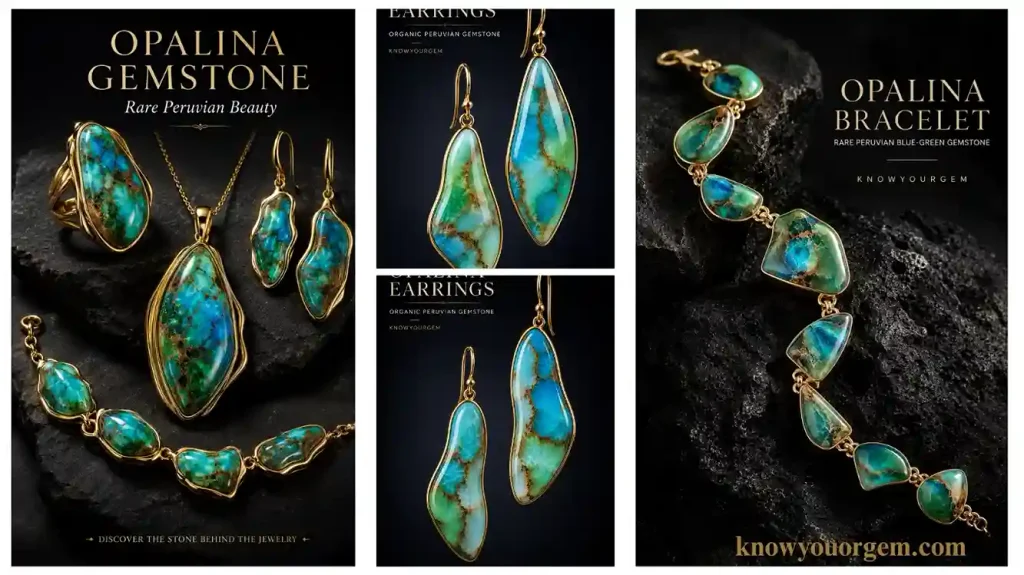
Since Opalina has a hardness of 5.5–6.5 it is more sensitive to scratches and knocks in her day-to-day life. Therefor rings with depths of protection (i.e bezels). Rings intended for everyday wear show a slightly lower profile with the cabochon sitting closer to the finger.
Necklaces:
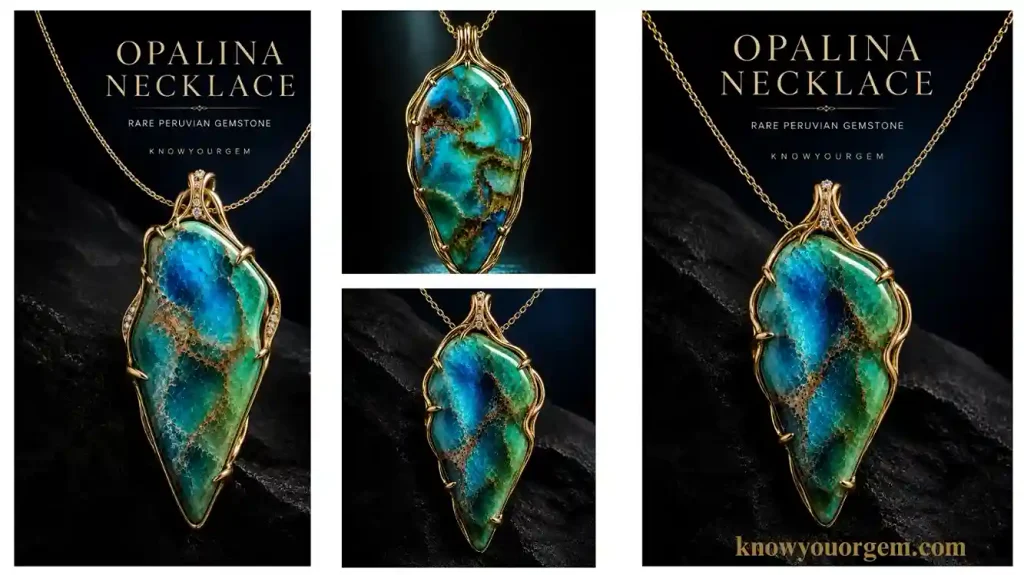
Both necklaces and pendants are suitable for Opalina, as the stone is less vulnerable to scratching when being worn away from the body than on hands. Big cabochons with dramatic dendritic patterns are especially good for pendants.
Earrings:
Opalina earrings, meanwhile, are the least risky of opalies to wear because earrings are less prone to scratches. With the light of cabochons, a pair of earrings won’t be heavy.
Bracelets:
Bracelets are more prone to impact damage than necklaces or earrings. Therefore, Opalina bead bracelets should not be worn as ‘daily gym or work jewelry’ and should be worn as occasional wear jewelry. A bezel style cuff is less vulnerable to damage than an open strand of beads.
Everyday Wear:
If used properly, Opalina can be expected to withstand the normal wear of day-to-day life. However, being a softer, less dense gemstone than quartz or sapphire, it will not tolerate abuse.
It is recommended that jewelry made with this material be removed prior to manual labor, physical activity, or swimming, although the removal will increase long-term wear considerably.
How to Care for Opalina:
Cleaning:
Each Opalina should be cleaned with a soft cloth and Warm soapy water. Never use Ultrasonic or steam cleaners; it can crack the porous nature of the opal material. You can wipe them after wear and tear, as oils and skin deposits can diminish the shine.
Water:
Opalina can be in contact with water for a short amount of time, but never more than a short immersion, as it is porous and can absorb excess moisture, as well as destabilise over several cycles. This is of particular concern for stabilized or colored material, as water can transfer the color.
Heat:
Don’t subject the stone to shock or high heat because it has amorphous silica, which can cause fractures in its internal structure by thermal shock. heat For example, leave jewelry or any opal in a hot car or in a position where it can directly interact with sunlight for too long.
Storage:
Avoid gathering with harder gemstone for preventing surface scratches. Use a soft pouch or jewelry box for storing. The stone should avoid strong sources of light because they fade its color.
Opalina and Date of Birth:
Is Opalina a Birthstone?
Opalina is not an official traditional or modern birthstone. The officially sanctioned gift for October is actually Opal, in a broad sense, predominantly the precious variety of that stone and with no specific mention of Opalina.
Gems According to Date of Birth:
Based on birthstone systems, individual gemstones are paired to particular birth months following a tradition that has been around for centuries; by commercial standard. In September, most lists without variation give Opal the October birth month, but the designation does not extend to trade-name varieties such as Opalina.
Choosing Opalina as a Personal Birth Gem:
People generally pick Opalina for its own popularity and as a substitute for the opal birthstone. Because the stone shares the same mineral name but costs less. However, precious opal is expensive and better suited for everyday fashion wear. (Personal styling choice; another official birthstone assignment nothing wrong with that either.)
How to Buy Opalina Online:
What to Check?
Request detailed, well-lit photographs that generally reveal the entire face of the stone. So, ask for measurements and weight, and do not just rely on the listing thumbnail, in case the photo is unclear or distorted. Sellers who are reluctant or unable to provide extra photographs upon request can be given an extra wary eye.
Natural vs Treated:
Confirm whether the piece has been dyed/stabilised/treated in another way. Opalina’s porosity would allow for either treatment. Treatment would not necessarily be grounds for a cull; if known, it should be identified; if not, it should be priced accordingly.
Seller Questions:
Just ask a few fair questions like, is the color natural? Do you have a return policy? If the stone doesn’t match its listing. A confident seller doesn’t hesitate to answer all these basic questions.
Red Flags:
Watch out for listings that have a bizarrely consistent, saturated color throughout a whole shipment, prices that seem far to cheap for the listed size and quality, or sellers who can’t or won’t list where they are from. Grouped images used for a variety of different listings also tend to be a warning sign.
Frequently Asked Questions:
1. Is Opalina expensive?
No. Opalina tends to be relatively inexpensive among the types of Opal. For example, cut Cabochon Opalina often ranges in price from about $10 to over $150 U.S., based on size and color quality, for the final product.
2. Does Opalina have healing properties?
Opalina is identified with tranquility and waters of emotions in the crystal-healing traditions; these ideas are ascertained beliefs and may be considered part of the description in the crystal-healing tradition.
3. Can Opalina get wet?
A brief contact with water is acceptable; however, prolonged soaking should be avoided as dye- and stabilised opals are porous.
4. Is Opalina the same as Peruvian opal?
Yes, in practice. Opalina is a commercial name for opal common opal material which is normally marketed as Peruvian opal or Andean opal.
5. How can I tell if Opalina is real?
Choose for waxy luster, hardness (5.5-6.5), and work out the natural saturation of shades as opposed to the perfect uniformity. For expensive specimens, do a gemological laboratory test as the final proof.
6. Is Opalina good for daily wear?
It can be used in everyday situations if protecting components such as bezel rings or pendants, but requires a little more maintenance than a harder gemstone such as sapphire or quartz.
For real refractive index, ethical source, specific gravity you can verify this stone with GIA, IGI, IGS, and SSEF.
KamilHussian {Enthusiast}

Welcome to KnowYourGem.com! your ultimate destination for uncovering the fascinating world of gems and their secrets! I'm Kamil Hussain, a passionate blogger with a Master’s degree in Economics, dedicated to bringing you insightful, well researched content that blends the beauty of gemstones with the art of storytelling. With a keen analytical mind and a love for discovering hidden treasures, I created this platform to help you explore the brilliance, history, and value of every gem.

