

QuickCheck:
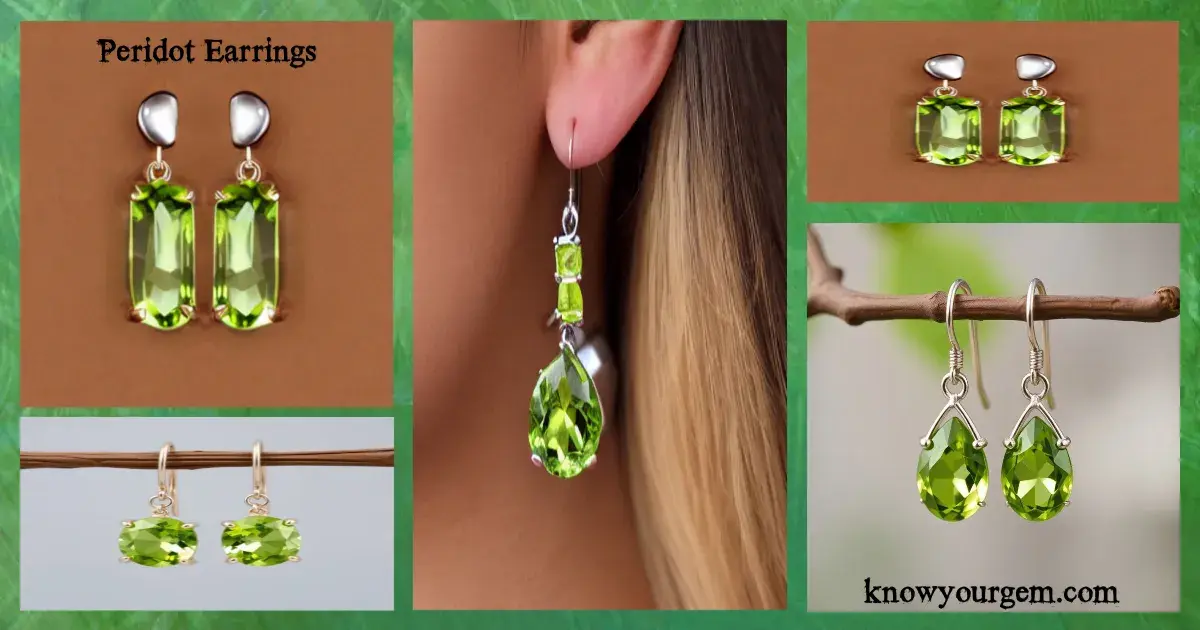
Peridot earrings display a naturally vivid green color with ancient history, and these are called approachable fine-jewelry charms.
This draft will help you to explore peridot’s identity, how the stone becomes gem-quality, what designs generally suit for occasional wear, and how the stone is treated as well as how to care for it.
What Are Peridot Earrings?
Peridot earrings commonly hold a clear yellow-green gem from the olivine family. Its color generally comes from iron, shifting from lime to olive, with having the finest stones glowing a rich grass-green.
Peridot is generally formed deep within Earth’s surface, and even the stone is also found in meteorites. Green peridot lies between those linked to space. The stone carries 6-7 Mohs hardness makes the stone suitable for earrings because it can be scratched and chipped easily.
The History and Meaning of Peridot:
Peridot has been cherished for many centuries. The ancient traders brought it from Zabargad (an island in the Red Sea, having been born from a volcano), but this mine no longer existed. In ancient times, the jewelry known as emerald may have been peridot, as the two green stones were not distinguished until the age of modern gemology.
This gemstone is generally known by the Roman name “evening emerald”, as it glows in darkness and brightens in twilight, and it was also seen in religious pieces of the European past. Currently, it is associated with safety and prosperity, with revival and growth, with vigor and energy.
It is the so-called August birthstone and is worn for the 16th anniversary. Such association is cultural and symbolic, and buyers can enjoy the emotions that peridot can bring without regarding the traditions in terms of medical or factual statements.
Why Peridot Looks Different?
Peridot displays a unique color of chemistry. However, several other stones come in many disparate colors, high-quality peridot is mined in green hue.
Its appearance depends on:
- Hue: The stone can display pure green, yellow-green or olive green.
- Saturation: Has a level of energy and boldness of the green.
- Tone: Refers to how light or dark peridot appears when held under light.
- Clarity: Means that how clearly inclusions are shown to the naked eye?
- Cut: How facets reflect light and appear body color.
- Color of Metal: Yellow gold will add softness. Contrasts can be accentuated using white metals or contrasted using yellow gold.
The most valued color is a relatively strongly saturated grass green with no apparent brownish hue. Smaller stones will tend to be more yellow-green in color naturally, while large fine stones are capable of displaying a more intense green saturation.
Where Peridot Comes From?
There are various sources of peridots, and the source does not necessarily mean good quality:
| Source | Typical significance |
|---|---|
| Pakistan | Known for attractive green material, including fine stones from mountainous deposits. |
| Arizona | United States San Carlos material is commercially important and may show yellowish-green color. |
| Myanmar | Known for fine-quality material in some production areas. |
| China | Supplies a range of qualities, including affordable commercial stones. |
| Zabargad, Egypt | Egypt Historically important, but the deposit is not currently commercially producing. |
| Hawaii | Peridot grains occur naturally, although many are too small to cut as gemstones. |
| Meteorites | Extremely uncommon extraterrestrial peridot is mainly of scientific or collector interest. |
A documented origin can contribute collector or historical interest, but should not eliminate assessment of the earrings themselves. GIA states that good peridot occurs from several localities and that locale does not necessarily dictate quality.
Peridot Quality Factors:
Color:
Check for vivid green with strong saturation, without too much influence from brown or gray. A pale yellow-green may be attractive and a good buy, particularly for a small earring, but should not be sold as being as good as a grass-green stone with strong saturation.
Observe the earrings in more than one light, where possible. Fluorescent lighting in stores may enhance the appearance of a stone compared to normal indoor lighting.
Clarity:
The highest quality peridot is generally eye-clean, but a few stones have tiny dark mineral crystal inclusions, or shiny, disk-shaped inclusions often called “lily pads”. These can be a natural identifying feature, but too many inclusions can affect transparency and brightness.
Don’t judge clarity on a product shot. It’s reasonable to ask if these are the actual earrings and to request a close up shot or video if you’re purchasing something worth a lot.
Cut:
A good cut improves brightness, color distribution, and face-up appearance. Common shapes include:
- Round.
- Oval.
- Cushion.
- Pear.
- Marquise.
- Emerald cut.
- Triangle or trillion.
Do not use stones with extreme windowing (the middle is clear and pale). Also, do not use stones with inconsistencies in the faceting because the head of one Earring will be darker than the head of the other Earring.
Carat Weight and Size:
The weight in carats reflects the weight of the earrings, that in millimeters shows how large they look from the front. Two equally weighted carat pairs can look different because of depth, shape, and setting.
| Stone size | Best use |
|---|---|
| Under 5 mm | Delicate studs and everyday accents. |
| 5–8 mm | Versatile studs, drops, and moderate statement designs. |
| Over 8 mm | Bold drops and special-occasion earrings. |
Large, very fineperidotsare not as prevalent as the smaller sizes. However, size does not necessarily promote a stone to high grade.
Matching the Pair:
For earrings, matching generally matters nearly as much as the individual stone. Compare:
- Green hue.
- Saturation.
- Tone.
- Face-up brightness.
- Shape and dimensions.
- Visible inclusions.
- Cut symmetry.
A reasonably coordinated but ’‘smaller than average” pair can look more subtle than an ’‘average size “mismatched pair.
Peridot Treatments and Disclosure:
Peridot is not usually subject to heat treatment to alter color. Though, certain stones might get colorless oil, wax, or resin treatment to fill surface-reaching fractures or cavities and boost apparent clarity or luster. AGTA mandates that any such treatments should be disclosed on the gemstone’s bill of sale.
“Natural peridot” does not necessarily imply “not treated”. Natural also often gives an indication of the gem’s origin in the earth. Information about treatment should be given elsewhere.
Ask the seller:
- Can peridot be natural or synthetic?
- Has it been treated or fracture-filled?
- Is the treatment permanent?
- Does it create special care requirements?
- Is the treatment recorded on the invoice?
FTC jewelry guidelines list treatment disclosure as necessary when the treatment is not permanent, results in special care requirements, or has significant impact on value. ftc
A treated stone is not a bad purchase. It is the lack of information about the treatment or the vague directions of care, or the money it costs because it’s assumed to be a nontreated stone.
Peridot Earring Styles:
Minimalist Studs:
Simple gold or silver studs provide a clean everyday look. They are usually easier to protect than long drops because the stone sits close to the ear and is less likely to swing into hard surfaces.
Drop and Dangle Earrings:
Basic gold or silver studs: defined, fashionable appearance. Usually not as likely to require protection against hard surfaces than long drops, because the stones sit close to the ear.
Halo Designs:
A circle of diamonds, white sapphires, or other stones may make your peridot look larger and glossier. Always verify such settings with a professional jeweler because a pair mismatched with peridot can cause jewelry.
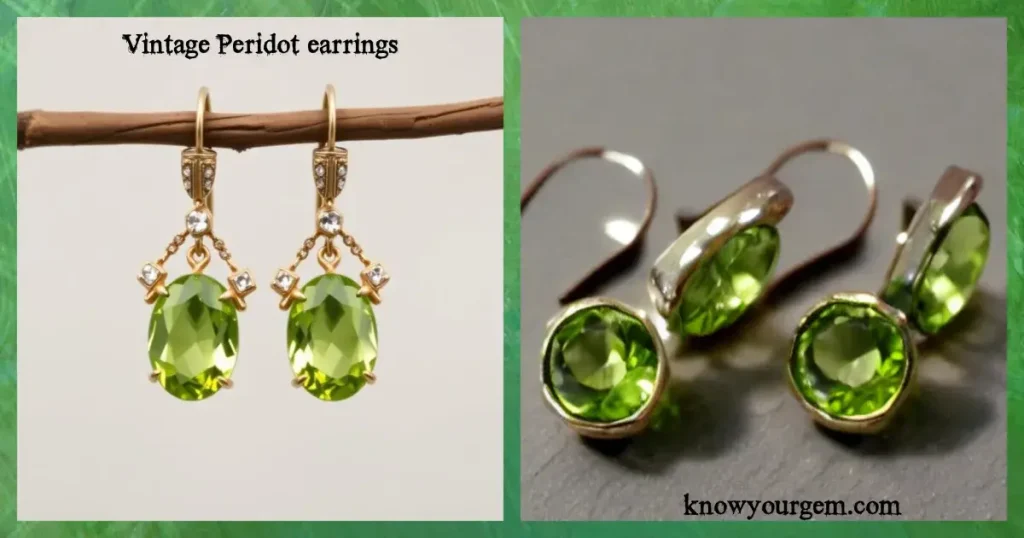
Vintage-Inspired Earrings:
Designs like Victorian, Edwardian, and Art Deco can be seen in filigree, milgrain, geometric shapes, or elaborate metalwork rings. It is essential to make sure if these designs are truly antique, vintage, or just new rings with a vintage look.
Handmade and Organic Styles:
Green peridot usually contains irregular, raw appearance that makes it appropriate for bohemian, natural-style jewelry. Rough stone doesn’t always denote authenticity; rough edges can be near to chipping, and gaps in protection can generally enable dirt to nestle in the surface. Choosing the Right Metal:
| Metal | Visual effect | Practical consideration |
|---|---|---|
| Yellow gold | Established as best for warm yellow-green tones. | Ranges from different price points and in different karats. |
| White gold | Provides a stark contrast with the vivid green of peridot. | Needs consistent rhodium applications to keep the white color. |
| Rose gold | Provides a gentle, warm contrast. | Make a yellowish peridot look warmer. |
| Sterling silver | It is a cheap alternative design that can be applied where appearance doesn’t matter. | Tends to tarnish easily. Needs to be polished regularly. |
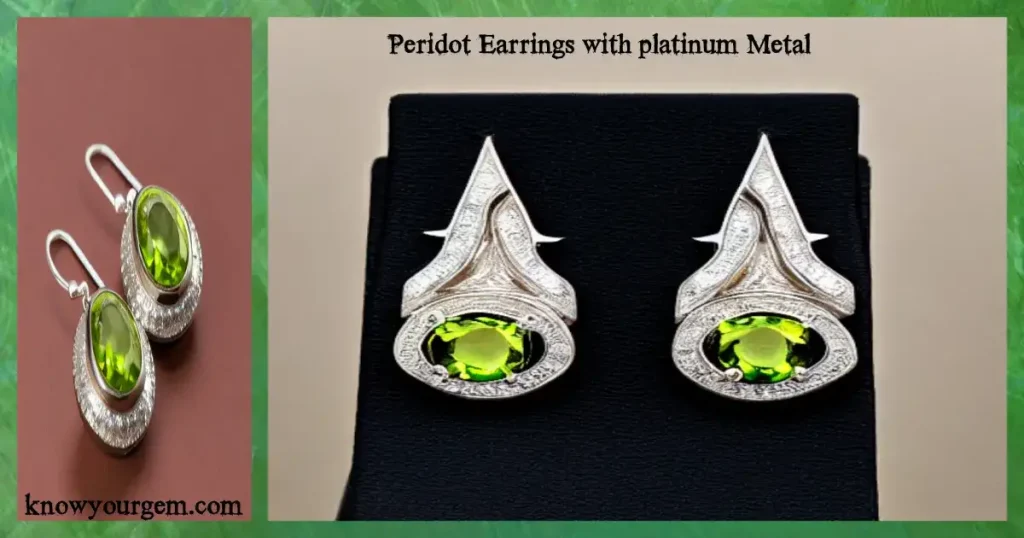
| Platinum | It is generally considered as moderate-high hardness, strong, and naturally white. | Pieces in the platinum category may be sold for higher prices. |
Where in the world does the metal balance the color of the stone and the wardrobe of the owner? Bright lime-green peridot lends itself to yellow or white metals, while more muted olive-greens may be more effective in yellow or rose.
Durability and Wear Suitability Of Peridot Earrings:
Although peridot is harder than most soft gems, it is not a tough gem. GIA warns that peridot may be chipped by hard force and is prone to thermal shock. Due to peridot’s hardness, it is a little more resistant to scratching than most soft stones.
Use this practical guide:
| Situation | Suitability |
|---|---|
| Office or light daily wear | Usually suitable with secure settings. |
| Formal events | Excellent selection, can be worn for drops, or any statement design. |
| Excessive exercise or sports | Take out the earrings to prevent impact damage or damage by snagging. |
| Swimming | Remove due to chemicals and risk of loss. PMID of consumer they have added |
| Getting in and out of bed | Prefer removal to relieve pressure and the risk of knocking. |
| Travel | Keep in separate padded storage. |
| Children’s jewelry | Select small-size protected stones. Or work with the semiprecious, and reinforced secure backs |
Exercise particular care with open-backed pear, marquise, trillion, and thin girdle stones. Rounded shapes and the use of a protective bezel or halo increase the protection from damage.
Price Guide for Peridot Earrings:
Prices are dependent on the quality of the stones, carat and cut, the quality of the metal used, the complexity of design, the brand name, the treatment which the stone has undergone, and are they are stating the cost of one or a pair.
| Category | Typical retail range | Common characteristics |
|---|---|---|
| Entry-level | US$40–US$120 | All small stones nearly in sterling silver, vermeil, or more mass-produced settings. |
| Fine jewelry | Approximately $150–$500 | Natural peridot set in silver or gold. |
| Premium | Around $600–$1,500+ | more stones or bigger stones, 14K or 18K gold, platinum, more stones or larger stones, diamond. |
Retail ranges are quite broad and not exact market pricing. Set a baseline for cost by comparing total carats, size of the gem in millimeters, weight of metal, treatments, workmanship, and return policy.
“AAA peridot” does not imply a GIA gem lab grade. According to GIA, labels like A, AA, and AAA are commercial.
How to Buy Peridot Earrings Online?
Before ordering, review the product listing using this workflow:
- Verify the specifications: style of natural and/or synthetic stone, size dimensions, total carat weight, purity of the metal and type of earring (back), and check that the weight refers to one or both earrings.
- Check the photos: Actual-item photos, same colour, facet symmetry, surface damage, and an excess of reflection might hide the inclusions.
- Ask for treatment: Make a written request for confirmation, in the form of a receipt, of any oil, wax, resin, fracture fill, coating, or other enhancement.
- Evaluate the setting: Inspect prongs, bezels, any exposed corners, posts, hinges, any solder joints, and, of course, whether the backs are secure.
- Review seller policies: Return policy, conditions of return, terms for resizing or repairing, shipping insurance, authenticity keyword claim, and any report provided.
- Document delivery: Take photos of package and earrings on arrival, especially if the item is costly or personalized.
A laboratory report is most beneficial where the earrings are expensive, the provenance is part of the purchase, or the seller makes an extraordinary rarity claim. A report on cheaply bought commercial studs can be a significant percentage of the value of the jewelry.
Peridot Earrings Myth vs Reality:
| Myth | Reality |
|---|---|
| “Un-heated” peridot is peridot that is naturally occurring. | This is always going to be rare; peridot is not known to be routinely heated to improve appearance. This claim may seem more significant than it actually is. |
| Any green stone in ancient jewelry is an emerald. | Other green stones such as Peridot may be found in old pieces because the identification procedures in the past were not as accurate. |
| Mohs hardness, which is simply the scratch hardness. | Shows that we can use peridot for rough everyday use. |
| Peridot, large peridot, always fetches high prices. | Size is an advantage, but the value is also dependent on color, clarity, cut, treatment, evidence of origin, and demand. |
| “Natural” means untreated and certified. | Natural = geology, treatment and tests of documentation stand apart. |
| Peridot ensures healing, protection, or wealth. | These are traditional beliefs personal to specific traditions and without scientific basis. |
| All Arizona, Pakistani, or Myanmar peridot are identical in quality. | There is a range of material from each locality, and individual stones need to be evaluated. |
| Use ultrasonic cleaning professionally. | GIA recommends warm, soapy water and does not recommend ultrasonic or steam cleaning for peridot. |
Peridot Earrings Care And Cleaning:
Clean peridot earrings every day with lukewarm water and mild soap, remove dust with a soft brush, then pat dry it with a soft cloth.
Avoid:
- Ultrasonic mess.
- Steam cleaners.
- Harsh chemicals.
- Abrasive polishing compounds.
- Sudden temperature changes.
- Contacting directly with perfume, hairspray, lotion, and household cleaners.
- Knocking hardly against metal, stone, or glass.
GIA indicates peridot is unaffected by light (although it can be affected by rapid/ uneven heating & acids).
Keep peridot earrings stored separately in a soft pouch or section of jewelry box. Do not claim to store it together with diamonds or other harder stones, as they can scratch softer stones easily.
Inspect the backs and the prongs periodically, and when necessary, bring the valuable and frequently worn earrings to a jeweler for inspection instead of assuming you need to have each individually cleaned by a jeweler annually.
Who Should Receive Peridot Earrings?
Peridot earrings suit:
- People born in August.
- Partners celebrating a 16th wedding anniversary.
- Graduates beginning a new stage of life.
- People who love to wear green stone jewelry without higher prices; peridot earrings can be the best choice.
- People who love to receive gifts as which hold symbolic or nature-inspired designs, peridot earrings can work well.
- For those who are looking for bright accents for neutral wardrobes, peridot earrings will work better.
Pick out those that fit the lifestyle of the gift receiver if you are serious about making a great gift. For pieces of jewelry for everyday wear, opt for small, protected studs. Those that are to be worn to dress things up can be slightly more bold design-wise, with drops that are safe. For vintage/collectors jewelry, it is best to have a documented provenance.
FAQS:
1. What are vintage peridot earrings?
They are so-called older pieces made in historic styles such as Victorian or Art Deco. Vintage-inspired designs refer to new peridot earrings.
2. Can peridot be paired with gold?
Yes. Yellow gold metal paired with peridot makes its green look cooler. However, white gold also makes it warmer, and rose gold gives it a softer glow.
3. Are peridot earrings better than diamond earrings?
Both are better overall. Peridot offers bright green color at a lower price; however, diamonds are harder and can be worn daily.
4. Can peridot necklaces and earrings be stored together?
Peridot earrings and necklaces can usually be stored in the same box, but each piece of jewelry in a soft pouch or slot to prevent contact with harder stones.
5. Are Zales peridot earrings good quality?
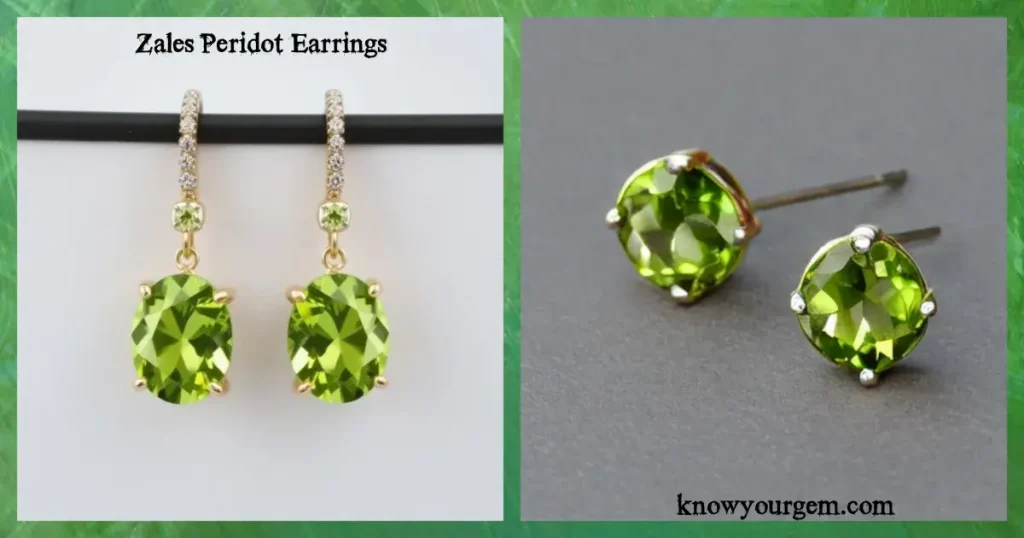
Peridot earrings from Zales in silver and gold metal styles like studs, hoops, and drops. It is essential to check stone size carat, treatments, metal purity, settings, returns, and stone matching. So users must not rely on the brand name.
6. Is peridot suitable for everyday earrings?
It may be appropriate for careful routine wear, particularly in small studs with tight backs. Wear off peridot earrings when you are playing sports or using a swimming pool, when cleaning, sleeping, or subjecting to impact or rapid changes in temperature.
Final Recommendation:
Peridot earrings: The perfect leprechaun’s choice for beautiful green hues, rich history and positive symbolism at a reasonable cost. The most desirable peridot earrings will not necessarily be large or extremely vibrant in color, it will be those with matched color distribution, an even cut, solid settings, transparent treatment disclosures and a care requirement that suits the potential owner.
This Draft is written and published by gemstone expert and enthusiast KamilHussain!

Welcome to KnowYourGem.com! your ultimate destination for uncovering the fascinating world of gems and their secrets! I'm Kamil Hussain, a passionate blogger with a Master’s degree in Economics, dedicated to bringing you insightful, well researched content that blends the beauty of gemstones with the art of storytelling. With a keen analytical mind and a love for discovering hidden treasures, I created this platform to help you explore the brilliance, history, and value of every gem.

