
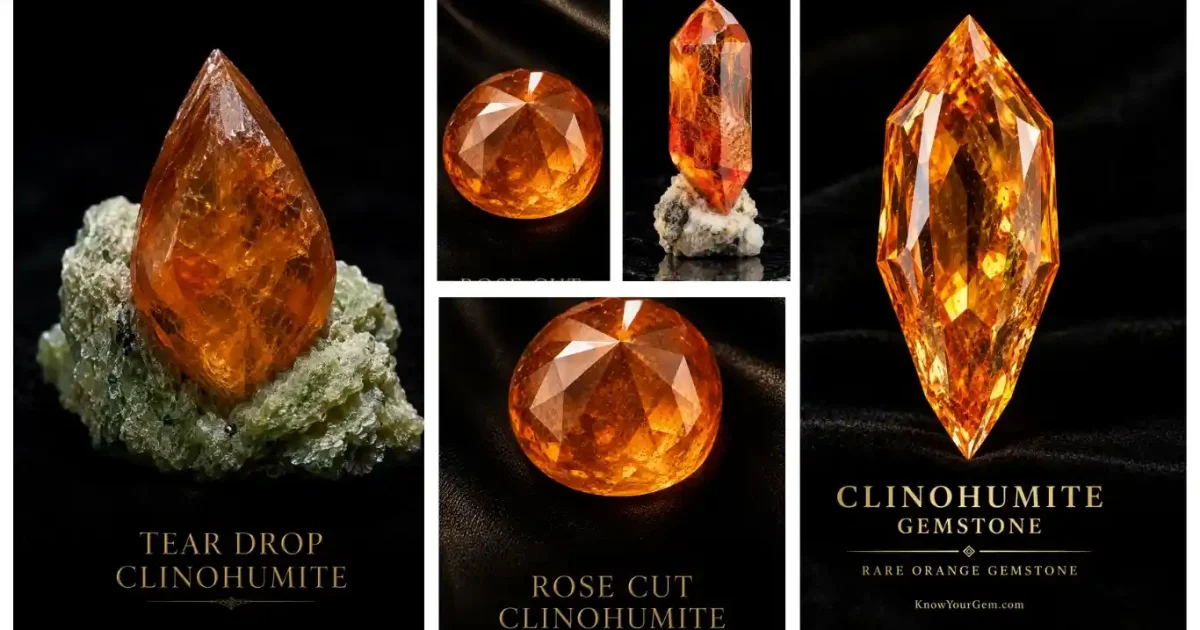

Clinohumite isn’t exactly a starter gem. Honestly, you probably won’t even stumble across it until you’re way past the usual sapphires, rubies, and garnets. But once you do? It’s hard to forget.
It flashes these incredible sunny colors, ranging from bright yellow to deep, fiery orange. If you get your hands on a really good piece.
It has this gorgeous inner glow that seems to shift whenever the light catches it. It’s an absolute stunner. Just don’t rush into buying one without doing a little homework first.
What Is Clinohumite?
Clinohumite is a magnesium-based member of the humite group, and is a nesosilicate, which means each silicate group in the mineral occurs as a separate entity.
The perfect formula for this mineral is Mg9(SiO4)4F2, but they don‘t seem to fully describe what is found in nature. Iron substitution for magnesium and hydroxyl for part of the fluorine is common. Small quantities of this stone from MN, CA, and TI are also present.
The significance of these chemical variations can be seen in the fact that they directly influence the hue, density, and optical characteristics of the gemstone. Consequently, two separate samples of clinohumite will usually show slightly different results when tested.
Structurally, the mineral is monoclinic.99 Clinohumite is the n=4 member of the humite series of minerals-a group of related minerals that share a characteristic structural motif.
The series includes:
- Norbergite, the n=1n=1n=1 member.
- Chondrodite, the n=2n=2n=2 member.
- Humite, the n=3n=3n=3 member.
- Clinohumite, the n=4n=4n=4 member.
There are many factors that could make the identification more difficult. It has been a difficult identification because the minerals are generally very similar in hardness, chemical composition and its optical properties.
Clinohumite and Hydroxylclinohumite:
Clinohumite is very similar to hydroxylclinohumite. This is a fluorine element. Hydroxylclinohumite is an element rich in hydroxyl. They have very similar structures and can be difficult to tell apart when cut.
The distinction is chemical, not visual. Only a refractometer, microscope or specific-gravity test can support a humite-group identification; none of these tests will determine which of the two it is.
Can be delineated by chemical analysis, the most consistent method. This is important when a seller is asking a premium for a verified clinohumite or attributing a specimen to a particular locality.
Earlier references and dealer descriptions noted “clinohumite”, so even older id‘s of dealer-sold material may have used the term loosely, and may have been hydroxylclinohumite. Who sells what can be a problem if one is looking at species id without lab data to back it up.
Clinohumite Properties:
| Mineral group | Humite group |
| Crystal system | Monoclinic |
| Ideal formula | Mg₉(SiO₄)₄F₂ |
| Mohs hardness | About 6 |
| Specific gravity | Approximately 3.17–3.35 |
| Refractive index | Approximately 1.62–1.73 |
| Optical character | Biaxial positive |
| Birefringence is | About 0.024–0.041 |
| Typical colors are | Yellow, orange, brown, reddish brown |
| Luster | Vitreous to resinous |
| Transparency | Transparent to translucent |
| Pleochroism | Strong, usually trichroic |
| Tenacity | Brittle |
| Cleavage | Poor |
These are reference ranges, not absolutes. The actual sample’s chemistry can affect the result.
All these properties will be of little use to a gemologist if they try to establish the identity of a stone based on a single measurement. Glass.
Clinohumite Color and Appearance:
Most common colors: yellow, orange, brown. And more unusual are the rare reddish-brown stones, particularly those originating from some of the darker occurrences.
The coloration can be equi- or zoned. Certain stones are nearer the core shinier and a dark shade, in all probability extra on the edges. Different stones show patches of yellow, orange, and brown within the similar crystal.
Yellow Clinohumite:
Yellow: golden shades from a light lemon to a darker, honey colour. The better bits have enough intensity to keep away from being ‘washed out’.
It may also display flashes of orange or brownish-yellow as the stone dances with movement. Might provide a yellow gem with what appears to be more dimension than the image.
Orange Clinohumite:
The hue most people recognize fine clinohumite as being is orange. The color can be yellowish orange, golden orange, or reddish orange.
A well coloured stone may be confused with spessartine; however, they are not the same. Testing should be undertaken, as color comparison is too unreliable.
The darker orange was always more attractive, but one should assess the saturation in a neutral source, as ‘warm’ shop lights and edited photographers can make a brownish stone seem a lot more brilliant than in daylight.
Brown and Reddish-Brown Clinohumite:
Brown is common in the wider mineral species. Some Siberian and Tanzanian material has a deep reddish-brown appearance.
There is no reason these stones should not be of high quality. A brown, transparent to good hearing, attractive pleochroic Clinohumite with a flat, clean cut may appeal to certain collectors.
Rare Pale or Pinkish Material:
Some references mention white or pinkish clinohumite. Transparent examples in these colors are unusual.
Where a seller claims a bright pink stone is clinohumite, request a report. Bright color alone in a heavily Photoshopped image should not be taken at face value.
What Causes Clinohumite’s Color?
All the coloration is due to the substitution of chemicals and traces. Titanium tends to give a dark yellow to brown coloration. Iron and/or manganese can also contribute to the total appearance.
The precise colour mechanism can be different for each deposit. For that reason, colour can hint towards chemistry but not necessarily identify the species or source.
There is one more visual effect by way of pleochroism. The stone may exhibit yellow in one direction, orange in another, and a brownish yellow in a third. The orientation of the rough while faceting can influence the face-up color.
A badly oriented stone can look dark or streaky. A well-oriented stone can look a lot brighter.
Crystal Habit and Inclusions:
The bulk of natural clinohumite occurs as tiny grains, often associated with the mineral clinohumite in an altered marble or dolomite. The more well-formed crystals are far less common, and the transparent, large enough to facet crystals are of course the least common.
However, the stones may have the same characteristics of crystals such as twinning, growth zoning, fluid inclusions, and inner cracks.
Some inclusions are flat reflective planes. Others look like tubes or bags of fluid. Their shape depends on the petrological history of how the crystal nucleated.
Inclusions are not necessarily signs of inferior quality. Very small inclusions may not really affect the beauty of the stone. Fractures that have appeared on the surface are more serious, as they can greatly weaken the stone.
Similarly, a large crystal does not necessarily mean a large finished gem. There are some areas of inclusions and fractures in the rough that are removed by the cutter before the final polish is applied, so not a lot of material is retained.
Hardness and Durability:
The Mohs scale of hardness of Clinohumite is generally about 6. This means that it is not so hard or so soft.
Gold : 7; topaz 8; sapphire and ruby 9. As you can see, these materials can scratch clinohumite. Dust from your house, which could contain small particles of quartz, can be at fault for a surface that appears to be polished.
Durability is made of tests. Hardness is one test of durability, but clinohumite is also brittle. So if hit, it may shatter or chip but not scratch.
Is Clinohumite Good for Everyday Wear?
It would depend on the design of the jewelry.
A pair of earrings or a pendant can be used with due caution. Can you wear a hallmarked silver ring all the time? These types of jewellery are safe from several abrasive surfaces as they are present away from the surface.
All pretty rings are a different story. All rings bang into tables, doors, tools, and other objects. Clinohumite can live in a ring, but I would suggest a corflute or more careful propping-up. Occasional wear is better than full-time wear.
Steer clear of tension mounting and designs that expose the girdle. Around a thin edge, a stone can easily be damaged more than around one surrounded by metal.
Optical Properties:
Clinohumite is both doubly refractive and biaxial positive. These properties allow it to be separated from dodecahedral and cubic gems such as garnet.
Refractive Index:
Published refractive index values vary considerably. General references give a broad range of approximately 1.62–1.73. Many gem-quality stones fall closer to 1.63–1.67.
A documented Tajikistan stone produced readings near 1.635 and 1.660. Another specimen may produce different results because of chemical variation.
The refractive index is helpful, but it must not be taken as an absolute fingerprint, as related humite-group minerals could be similar.
Birefringence:
Birefringence is the difference between the highest and lowest refractive index readings.
For clinohumite, published values commonly range from approximately 0.024 to 0.041. This is enough to produce visible doubling of back facets in some stones.
A gemologist on magnification may notice that the facet edges are doubled: this is an indication of doubly refractive identification, but does not specify the species.
Specific Gravity:
The specific gravity of clinohumite is normally 3.17-3.35. However, the gem-quality material is usually around 3.2.
This helps separate clinohumite from hessonite garnet, which is usually much denser. However, several related humite-group minerals have overlapping densities.
Specific gravity is therefore useful as part of a group of tests, not as a final answer on its own.
Pleochroism:
One of the most interesting properties of clinohumite is its strong pleochroism. Using a dichroscope, the colors that could be observed are yellow, orange, and brownish-yellow, respectively.
This is interesting since you can compare clinohumite and garnet. Usually, garnets are single refracting, and they show no severe pleochroism.
Fluorescence:
A reaction to orange-yellow under short-wave UV is present in some clinohumite. Long-wave fluorescence is dominantly absent or weak.
The resulting fluorescence can assist in identification but cannot prove one. Many gemstones have a similar response.
How to Identify Clinohumite?
Knowing the color of clinohumite is not enough to distinguish it:
Start With Appearance:
Look for yellow, orange, brownish material, vitreous to resinous. Check if transparency is confirmed and if sudden color change is noticeable.
These are just a few examples, and they only give a guideline. The point is that many different gems will look similar.
Measure Refractive Index:
A refractometer for indication of the stone singly or doubly refractive. Two readings would give a twice-refractive identity and no garnet.
The measured range may also narrow the possibilities, although it may not separate clinohumite from every related mineral.
Check Birefringence:
Subtract the maximum value from the minimum value. [ moderately high to highly birefringent ] is consistent with clinohumite.
Visible facet doubling under magnification can provide additional support.
Measure Specific Gravity:
Hydrostatic weighing can give another useful result. A figure close to 3.2 supports a humite-group identification.
A much higher result may suggest garnet or another denser material.
Examine Pleochroism:
Use a dichroscope or polarizing filter. Striking great yellow, orange & brownish-yellow changes support clinohumite.
This is especially effective if the only other thing you have to offer is hessonite or spessartine garnet.
Study Inclusions:
The growth zoning can be observed with a microscope; also can be observed inclusions of fluid, reflective planes, can be observed tube-shaped structures.
No single inclusion proves the identification. The features must be evaluated alongside the optical and physical tests.
Use Chemical Testing for Species Confirmation:
If the stone is expensive or valuable for particular use, it is often worth testing the chemistry.
The distinction between clinohumite and hydroxylclinohumite is due to fluorine / hydroxyl equilibrium. Laboratory-based studies can easily determine the significance of the chemistry.
A report that simply says “humite group” may be accurate but less specific than a report that confirms clinohumite.
Clinohumite Look-Alikes:
Hessonite Garnet:
Hessonite makes the most convincing visual alternative. The two stones can demonstrate the equivalent orange, honey, or ruddy brown.
Their physical properties are different:
- Hessonite is singly refractive.
- This stone is doubly refractive.
- Hessonite is denser.
- This stone shows strong pleochroism.
- Hessonite normally has no pleochroism.
A refractometer and specific-gravity test can usually separate them.
Spessartine Garnet:
Orange spessartine can have a similar appearance to clinohumite. They are generally brighter and a deeper orangish hue, although colors can be similar.
–Spessartine: Cubic; singly refractive. Clinohumite: biaxial; pleochroic.
Chondrodite:
Chondrodite is also a member of the humite group. It can be found as yellow, orange, and reddish-brown.
Its indices of refraction and density are similar with clinohumite and a simple visual check might not be sufficient; it might have to be sent to a laboratory to check its chemistry.
Humite:
Humite is the n= 3n= 3n= 3 member of the series. It is rare as a faceted gem (although it can cause confusion in mineral collections).
The crystal systems also may aid in distinguishing it from clinohumite.
Norbergite:
The normally lower refractive index readings for Norbergite than those for clinohumite can be used to distinguish the two minerals.
Faceted pieces are more likely to be traded as a mineral than as a gemstone.
Peridot:
Peridot is usually green, although the yellow-green or brownish olivine is perhaps a reason to practise caution. Peridot is somehow related to the humite minerals, but has a different typical appearance.
Less expensive and more accurate than color comparison.
Where Is Clinohumite Found?
Clinohumite is found in a variety of geological environments, although only a few localities have facetable material.
Tajikistan:
The Pamir Mountains of Tajikistan are the most famous source. The material is often yellow, orange, or brownish orange.
Some crystals occur with spinel in altered carbonate rocks. Bright orange Pamir stones are particularly popular with collectors.
Siberia:
There are reports of gem-quality material from the Taymyr region of Siberia, including the Kotuy River area.
Siberian stones are usually dark reddish brown. The inaccessibility accounts for the limited amount entering the commercial market.
Tanzania:
Clinohumite has recently been found from Mahenge in Tanzania. Most of the material is dark brown, some component of it is reddish brown.
The appearance can differ significantly from brighter Pamir material. Price should therefore be judged by the individual stone rather than by the country name alone.
Italy:
Italy is important as the type locality. Early specimens were associated with limestone ejected from the Somma-Vesuvius volcanic complex near Naples.
The Italian occurrence is mainly of scientific and mineralogical interest. It is not a major source of faceted gemstone material.
Other Locality Claims:
The following are examples of the French dealer listings which all mention Afghanistan, Vietnam, Myanamar, Sri Lanka, etc.
A mineral find does not mean a commercial gem deposit; question the seller about a rare origin how was the locality proved, and has a lab helped?
A trade route does not define where a stone was mined, as it is possible for the stone to be bought and sold within different countries.
Why Gem-Quality Clinohumite Is Rare?
The mineral itself may not be as rare as fine gem material.
The clinohumite occurs as individual crystals in metamorphosed carbonate rocks. The crystals are often dark, fractured, or cuttable.
To be considered a usable gem crystal, it must be transparent enough, colorful enough, large enough to facet, and no serious fractures. It is not easy to find a single crystal that possesses all those features.
This explains why clean stones above a few carats are unusual. The original crystal may be large, but the cutter may have to remove much of it because of cracks or opaque areas.
The word “rare” should still be used carefully. A stone can be rare in the jewelry market without being one of the rarest minerals on Earth.
Clinohumite Price and Value:
There isn’t a certain price per carat for Clinohumite at this moment. If it is selling, the price would vary according to the color, clarity, weight, cut, origin, papers, transparency, etc.
Dealer listings found for this sort of material could be anything from roughly $20 per carat for low quality material up to over $100 per carat for more lustrous examples from Tajikistan. Good eye-clean stones would be priced higher.
These are ask prices, not necessarily indicative of prices at which the stone is likely to sell. A dealer may have a lower resale price, but an especially fine collector‘s stone may command a premium when sold commercially.
Color:
Medium to strong orange stones are generally the most popular colors. However, yellow and golden stones can be very attractive too.
Very pale stones may look far less lively. Very dark stones may also be dulled in brightness when viewed face up.
Clarity:
Material clean to the eye is rare. Permissible natural inclusions might be allowed, but in the case of a rare stone.
Outer surface cracks require far more attention than seem-to-be-microscopic internal inclusions. They will impact the study as well as strength.
Size:
Larger clean stones are difficult to find. A one-carat clinohumite may be obtainable, while a clean stone above several carats is far less common.
Cut:
The cut should display the colour of the stone just enough to not appear too dark. Orientation is vital because of the presence of pleochroism.
A well-cut stone can appear lively and fire from the front. An improperly orientated stone may appear dull or have dark areas.
Origin:
There is some published Pamir material, so if priced, it may be worth a premium. Just not supported in Tajikistan should not mean a price hike.
Documentation:
A laboratory report adds confidence, particularly when the stone is expensive or sold as confirmed clinohumite rather than an unidentified humite-group mineral.
Clinohumite in Jewelry:
Rings:
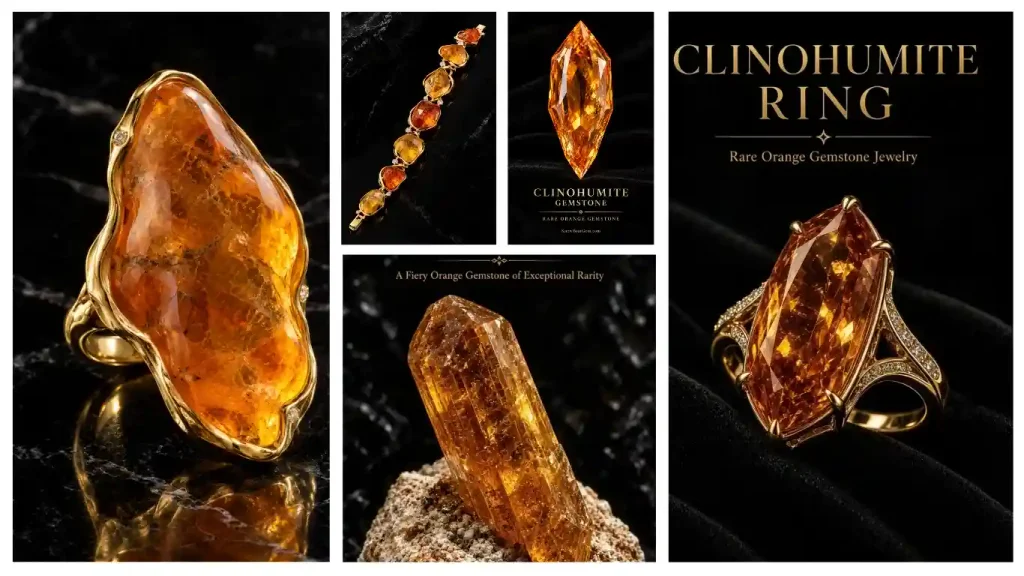
Possible clinohumite ring, but must be a protective style. A bezel setting would work because it encloses the edge of the stone. The other possibility is the protection of prongs in covering the delicate corners of the stone.
Take the ring off before playing sport, gardening, cleaning, gardening, working manually, or doing any activity that could receive a hard impact.
Earrings:
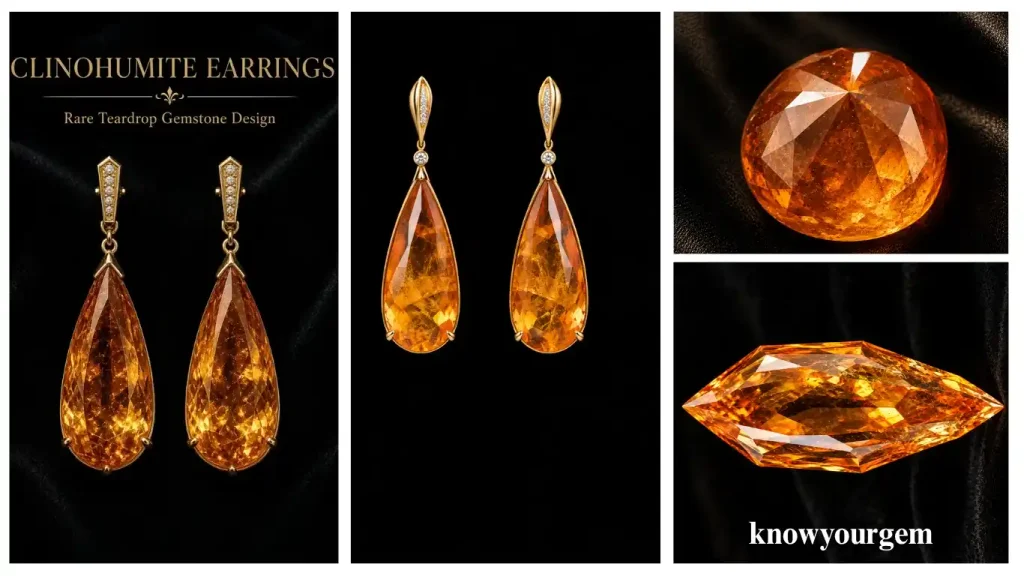
Earrings are among the safest uses for clinohumite. They receive less contact with hard surfaces and can display the gem’s color effectively.
Pendants:
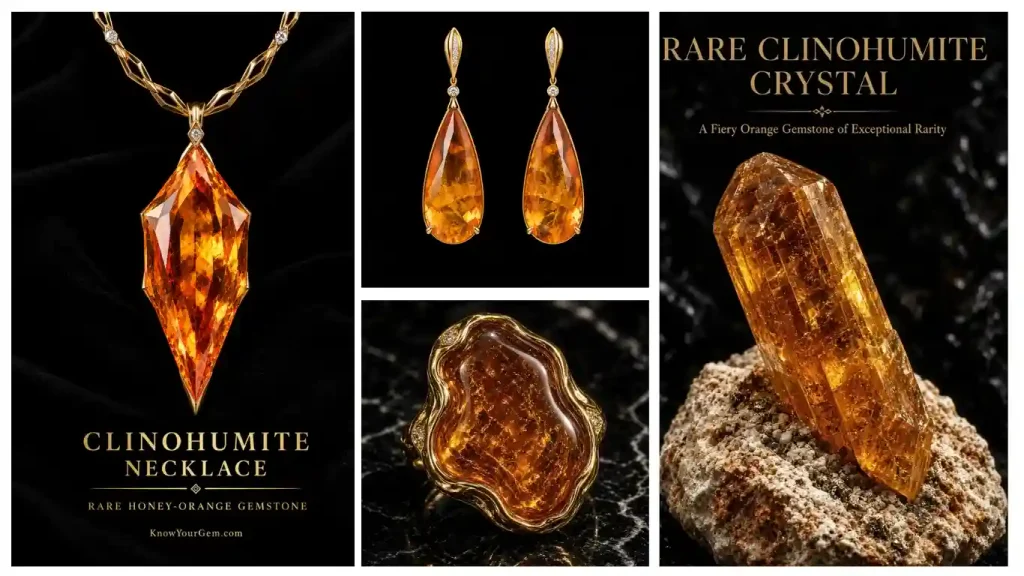
Another simple option is to go for pendants. These will present the stone very far away from most of the daily knocks, and they will even allow the use of a larger gemstone.
Furthermore, a bezel can be seen as an extra bit of protection around the girdle.
Bracelets:
Same with bracelets: They get more impact than chains or earrings. They are constantly hitting desks, doors, tables, etc.
A protected environment can lessen it – but wear is better sporadically.
Clinohumite Care and Cleaning:
Wash your Clinohumite with warm water and a soft brush using soap; then rinse and pat dry with a clean cloth.
Skip powders and chemicals. They could wear away the diamond or the metal mount or leave a scratched surface.
It is best not to ultrasonically clean unless a professional has examined each stone. It can be dangerous where fractures and fluid inclusions are present.
Steam cleaning is another no-go as well. The sudden heat may put pressure on an included or fractured gem.
Disseminated clinohumite should be stored away from harder stones, like sapphire, ruby, topaz, and quartz. A soft bag or individual jewelry slot is recommended.
Wear off the jewelry before:
- Sports.
- Gardening.
- Cleaning.
- Swimming.
- Consistently engaging in manual work.
- Using household chemicals.
Clinohumite Meaning:
In mineralogy, “clinohumite” is a scientific name. It refers to the stone’s relationship with humite and its monoclinic crystal structure.
The gem does not have a long traditional history like emerald or ruby. Modern crystal sellers have created many of the symbolic meanings now associated with it.
Orange clinohumite is commonly linked with:
- Creativity.
- Confidence.
- Motivation.
- Personal change.
- Energy.
- Emotional balance.
These associations are part of modern spiritual practice. They are not proven properties of the mineral.
Clinohumite and Crystal Healing:
Some sellers will claim that clinohumite aids in digestion, immune health, pain control, or the health of certain organs. These latter assertions lack any scientific evidence.
A pendant may be desired to have and keep the stone while meditating or to keep it as a reminder. This, however, is different from saying that the stone cures a medical condition.
Always seek out professional medical help for any ailment – and no gemstone can remedy this
How to Buy Clinohumite?
Don‘t just choose a seller for the exciting imagery, but look for one who provides sensible facts.
Ask for:
- The stone’s weight and measurements.
- Clear photographs in neutral light.
- A short video showing the gem from different angles.
- The claimed locality.
- Treatment information.
- A laboratory report, if available.
- A return period.
- Details about the identification method.
Additionally, inquire if the stone has been identified as a clinohumite or simply as a humite-group mineral.
This question can prevent overpaying for a related species. A seller who cannot explain the identification should not charge a large premium for the name.
Warning Signs:
Be cautious if a listing:
- Promises a guaranteed origin without evidence.
- Uses heavily edited photographs.
- Claims that every clinohumite is untreated.
- Gives no weight or dimensions.
- Offers a very large flawless stone at an unusually low price.
- Makes medical promises.
- Refuses independent testing.
- Uses the word “rare” without explaining the quality.
Orange color may be amplified by photograph. Ask to see the stone in daylight or neutral white light.
Is Clinohumite Treated?
There is no generally published routine treatment for clinohumite. Most in the trade refer to the Tajikistan material as unenhanced.
We haven’t even mentioned that this statement doesn’t actually help us in determining whether or not a stone has been treated in the above statement, in part because sellers should be honest about any known heating, coating, filling, irradiation, or other enhancements.
Any material that is extremely consistent of color or of surface reaching material should be questioned. For high-value gemstones, the safest solution is to have the identity confirmed through an independent test.
A detailed description might state that there isn‘t a standard treatment noted, not that all clinohumite is sure to be untreated.
Crystal Specimen or Faceted Gem?
The value of the natural crystal as a rough and the value of the cut gemstone differ.
The collector would be pleased with the crystal to have sharp faces, an appealing matrix, and/or proved locality. It could have inclusions however still be considered a valuable mineral specimen.
There are a number of factors which weigh when trying to decide the quality of a faceted gemstone, these include color, transparency, clarity, cut, size, and wearability.
The cut will mar the original shape of the crystal, but is the skill of the cutter that will bring out the best color and brilliance. Decide what sort of material you are after first before you price compare. A crystal specimen is no less collectible than a facetted stone, just in a different collecting market.
Frequently Asked Questions:
1. Is clinohumite a real gemstone?
Yes. Clinohumite is a real mineral that is facetable. Its main usage is as a collector gemstone, as transparent material is rare.
2. Is clinohumite rare?
Clinohumite at fine gem quality is uncommon. Clinohumite even occurs at many localities in minor amounts, usually as small, generally cuttable pieces.
3. What color is clinohumite?
Main colours are yellow, orange brown, reddish brown. Warm orange is often the most popular color in faceted material.v
4. What is clinohumite’s hardness?
Mohs hardness is about 6. It can be scratched by quartz and hard gems. It should be stored with other softer stones.
5. What is clinohumite worth per carat?
Prices vary widely. Lower-grade material may be listed around $20 per carat, while attractive Tajikistan stones may be listed above $100 per carat. Exceptional examples can be higher. These are dealer asking prices, not fixed market values.
6. Where is clinohumite found?
The most 4 well known sources of gem minerals are the Pamir Mountains of Tajikistan, the Taymyr region of Siberia, and Mahenge in Tanzania. Italy is the type locality.
7. Is clinohumite suitable for a ring?
It can be used in a ring in a protective setting and worn with care. Earrings and pendants are more suitable for day-to-day wear.
8. How can clinohumite be identified?
Tests may also be carried out for refraction, birefringence, specific gravity, pleochroism, microscopy, and chemical analysis. Looking at the stone is not good enough.
9. Is clinohumite the same as hydroxylclinohumite?
No. These are closely associated minerals that are chemically very different from each other, separation would probably require some analysis in the lab.
10. Does clinohumite have healing properties?
Certain crystal vendors make healing claims, though their claims haven’t been proven with scientific research. A doctor or other licensed healthcare practitioner is the right person to address medical issues.
11. Is clinohumite treated?
No routine established, the stone each needs to be disclosed an individual basis. Ask for written information at the time of purchase.
Final Thoughts:
Clinohumite is another interesting mineral for the collector looking for something other than jewelry minerals. The yellow to orange pigmentation is attractive, and the intense pleochroic nature produces many specimens with a lot of apparent color variation.
It is not an all-play gem. With a Mohs hardness of around 6, its susceptibility to cracking & fissuring into the interior of the stone demands sensible handling. Earrings & pendants are more reliable than everyday rings.
The most common problem with purchase is identification. The purchased stone, similar to clinohumite, could be hydroxylclinohumite, chondrodite, another mineral from the humite group, or could be a garnet. If the price is very high, ask for the laboratory report and for what was tested in the stone.
Buy clinohumite because of the color, the rarity, or the mineral interest. Consider the spiritual meaning as a possibility but not something proven to be a normal physiological effect when used. Price on quality of the stone, whether it is called “rare,” or whether this is a spiritual word.
This content is published by gemstone expert and enthusiast KamilHussain!

Welcome to KnowYourGem.com! your ultimate destination for uncovering the fascinating world of gems and their secrets! I'm Kamil Hussain, a passionate blogger with a Master’s degree in Economics, dedicated to bringing you insightful, well researched content that blends the beauty of gemstones with the art of storytelling. With a keen analytical mind and a love for discovering hidden treasures, I created this platform to help you explore the brilliance, history, and value of every gem.

