

Overview:
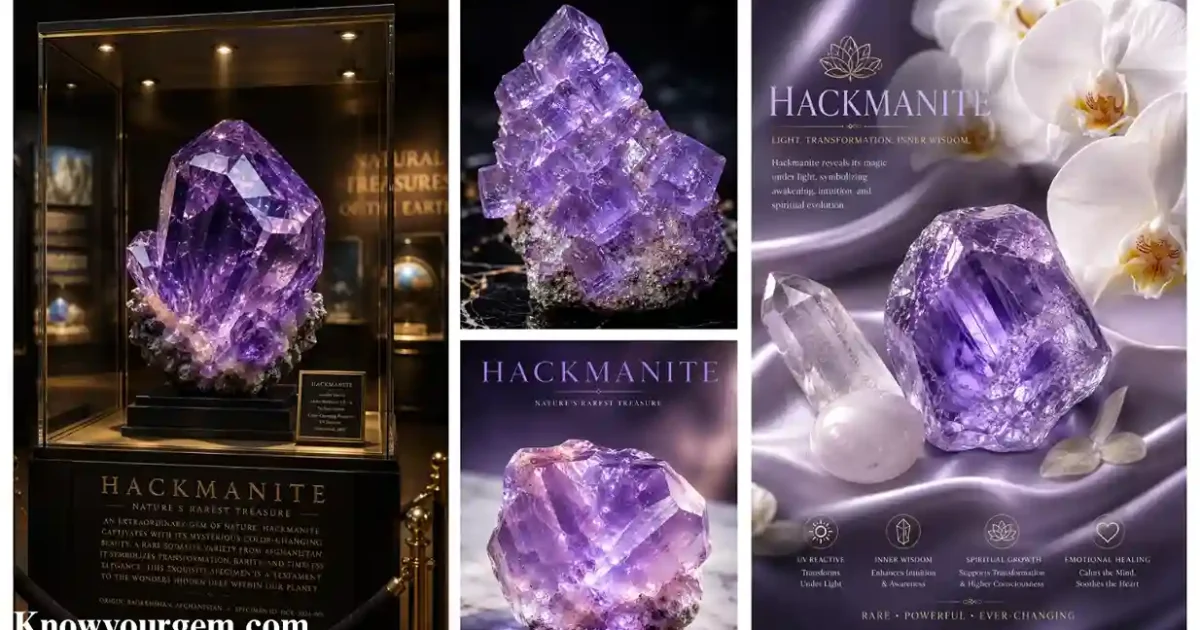
Hackmanite is a light-sensitive, sulfur-bearing variety of sodalite that exhibits color-changing properties. When subject to UV light, dark gray/white hackmanite will turn violet/pink and then wash out again to.
Hackmanite is a feldspathoid that is a sodalite (Na₈Al₆Si₆O₂₄Cl₂) with some sulfur present in its crystal lattice. Its hardness measures approximately 5.5 to 6. Under short-wave UV light, hackmanite shows an orange or pink fluorescence.
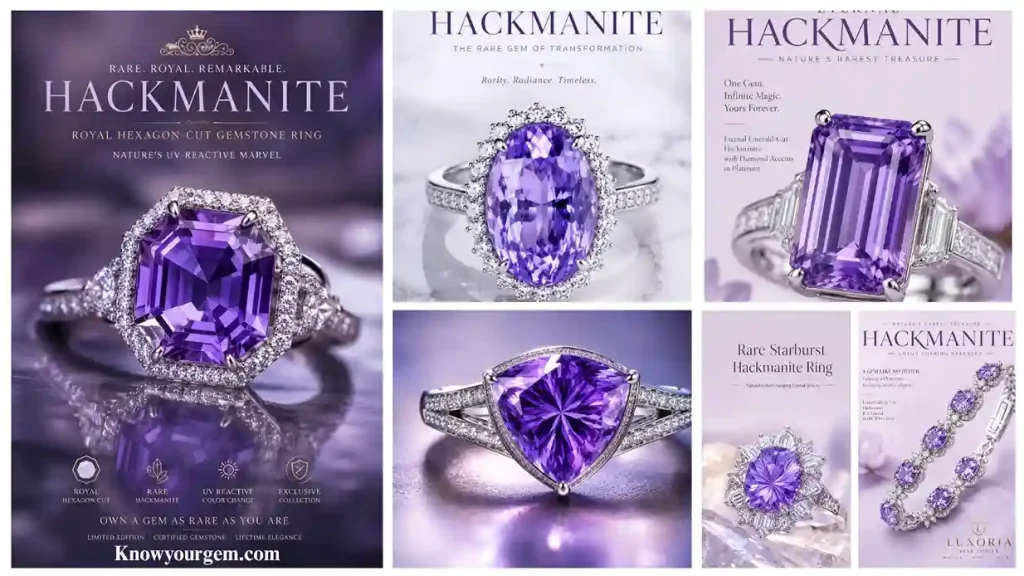
Most hackmanite used in jewelry comes from Afghanistan. Its relative softness makes it more appropriate for pendants and earrings than for rings that are worn daily. Before purchasing an expensive piece, observe the color change yourself and request a laboratory report.
We’ve been working with gemstones for more than 5 years. If this doesn’t seem to compare with more familiar stones, KnowYourGem offers identity, treatments, and certification for a number of them. Buyers are mostly asking questions like, Is this stone natural? Where does this stone come from? Does the seller have its documentation? What is its price?
What Is Hackmanite?
It’s sodalite. Well, a little more accurately, it’s a variant of sodalite, which is in turn a part of the mineral group ‘feldspathoids’ (so it’s not technically a mineral). And a little bit of sulphur is what makes it so well, sodalite.
In ordinary sodalite, chlorine sits at certain spots in the crystal. In hackmanite, sulfur takes some of those spots. The swap is tiny, yet it leaves defects in the structure, and when UV light reaches them they can trap electrons. Trapped electrons alter the stone’s light absorption characteristics, and that is the colour that you see. Release the electrons, and you lose that colour.
Is it a treatment? No. Nobody dyes, heats or irradiates a stone to make it behave this way, because the behavior comes with the mineral. That’s also why a genuine stone can repeat the cycle again and again.
The name honors Victor Axel Hackman, a Finnish geologist, and the stone was described in the early 1900s. Confirm the year, who named it and the original locality, often given as Russia’s Kola Peninsula, using Mindat.] No ancient mythology sits behind the name, unlike ruby or sapphire. This is a modern collector’s stone. I rather like that about it.
Gemstone or mineral specimen?
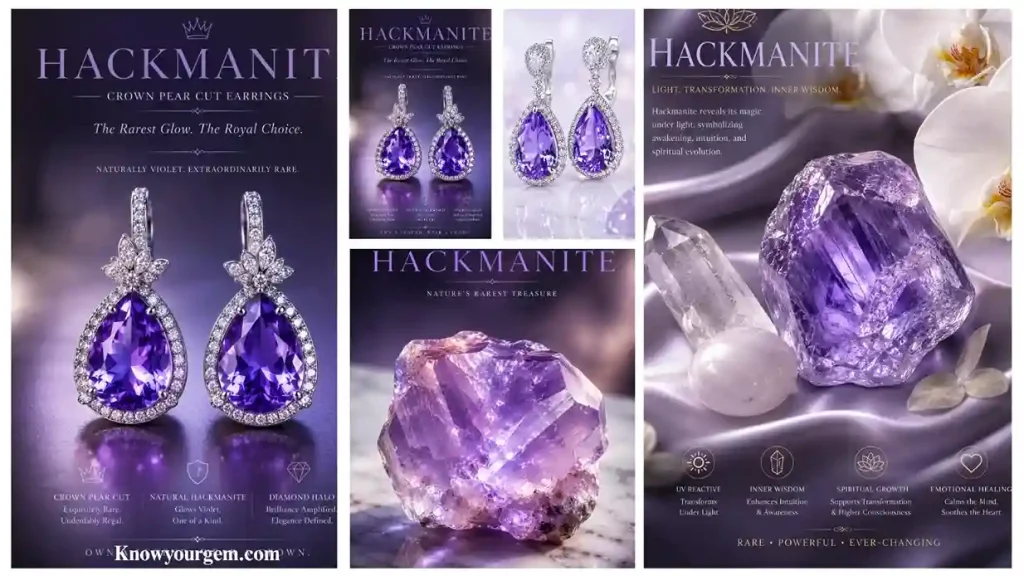
Both, depending on the piece. For a long time it was a curiosity for mineralogists, and not much more. The bigger deposits in Afghanistan altered the scenario, and cut stones now appear in jewelry.
Currently, much of the material is translucent to opaque, so for the most part cabochons and beads are much more common than faceted material. Clear, free-formed rough for faceting is very hard to come by (which is the main reason prices are so high).
How Does Hackmanite Change Color?
Short-wave UV is the usual trigger. Under it, hackmanite typically darkens to violet, pink or purple. In daylight or bright indoor light, it fades back toward white or pale gray, and if you store it in the dark the deeper color tends to last longer.
Here’s where sellers and websites tangle themselves up. Sunlight contains both UV and visible light, so it all depends on the stone, the light and the time. A stone might darken and then bleach, in quick succession, as it is the visible light doing the work. Some react slowly. Some barely react.
Your source text said sunlight darkens the stone and darkness fades it. Gemological references generally describe the reverse, so I wouldn’t repeat that claim, and I’d be wary of any page that does.
Why bother with the detail? Because the color change is the entire reason to buy one. You’ll get a dramatic reversal on the sun, and when you get the stone it will appear pale and you’ll feel cheated. Ask what light the seller used and for how long.
Tenebrescence And Fluorescence Are Different Things:
Some people confuse them all the time. Tenebrescence is a long-term color change and is slow to fade after you turn off the light. Fluorescence is a glow that instantly fades when the UV light is turned off.
Many hackmanites do both, and both trace back to the same sulfur-related defects. But a stone can glow orange under a lamp and still show only a weak color change, so one effect doesn’t prove the other.
Hackmanite Properties:
Those are averages. Values may vary very slightly by source, and every stone is different, so treat as ranges, not guarantees.
| Mineral | Sodalite (feldspathoid), sulfur-bearing variety |
| Formula | Na₈Al₆Si₆O₂₄Cl₂, with some sulfur replacing chlorine |
| Crystal system | Isometric (cubic) |
| Mohs hardness | About 5.5–6 |
| Specific gravity | About 2.3 |
| Refractive index | About 1.48 |
| Transparency | Translucent to opaque; clean transparent stones are rare |
| Luster | Vitreous to slightly greasy |
| Cleavage | Poor, but the stone can still chip |
| UV reaction | Color change upon exposure to UV light; quite a lot of stones fluoresce from orange-pink to yellow |
The hardness in your source was given as 5.5 to 6 in one spot and 5.5 to 7. I’d go with 5.5 to 6, which is how sodalite is normally described. A 7 would put it level with quartz, and it isn’t.
Specific gravity is a good tip. A point of about 2.3 will give a stone that’s larger than the listed weight, a piece that’s extremely light compared to glass or nearly any gem. Comparing beads of the same size will usually reveal the difference.
One more detail. Hackmanite is cubic, and cubic minerals don’t exhibit pleochroism so the colour does not change with rotation. A page that says it does has mixed this up with something else.
Where Does Hackmanite Come From?
Afghanistan supplies most of today’s gem-quality material, especially the Badakhshan region. Afghan stones tend to show the strongest, cleanest change on the market, so some buyers ask for them by name.
Other localities are Canada (in Ontario, at Bancroft and in Quebec at Mont Saint-Hilaire), Greenland, Myanmar and the Kola Peninsula in Russia.
Identified localities and their production: verify All material from Canada tends to be found as mineral specimens rather than as cuts, and the more modest finds are less consistent and thus less common.
Does origin matter? A little. Afghan stones have the best reputation for color change, so origin hints at what to expect. It can’t promise the effect, though, and a lab can’t always prove where a stone came from.
I’d treat a seller’s origin claim as a lead to check, not as evidence. The stone in front of you counts for more than the name of a mine.
How Much Is Hackmanite Worth?
It’s an affordable specialty stone, and there’s no standard price index for it. You can’t pin it to a clean number per carat, because two stones of the same size can differ hugely in color change, transparency and cut. Your source listed per-carat tiers, but I couldn’t support them, so I left them out.
What drives value, roughly in order of importance:
- Magnitude and consistency of the change: A strong, consistent response is the best feature. A poor, inconsistent response is worth less.
- Transparency: Facet-grade material is rare, and opaque or clouded stones are considered the lowest quality.
- Cut and polish: A nicely domed cabochon showcases the hue nicely. A faceted piece is a rarity and carries a premium when available.
- Size: Large stones of spectacular color are very difficult to find because large size and a highly noticeable color change are rarely found in combination.
- Documentation: On an expensive stone, a lab report adds confidence.
This table shows where each type usually sits in the market. Think of it as relative position, not a price quote.
| Opaque stone or weak reaction | Low | Plentiful, limited novelty |
| Translucent cabochon, moderate change | Low to moderate | Visible color change, usable cut |
| Afghan cabochon, vivid reaction | Moderate | Strong, repeatable color change |
| Transparent faceted stone, strong reaction | Higher | Rare clean material plus a strong effect |
This stone’s price can range from $50-$500 per carat. Next to sapphire or emerald, hackmanite is cheap. Its value comes from rarity and novelty, not from a deep resale market, so I wouldn’t call it an investment. Buy it because you enjoy watching it change.
How Can You Tell Real Hackmanite from Fake?
Begin with the color change, since dye can’t copy it. A real stone darkens under UV and fades afterward. If all a seller shows you is a photo of a purple stone, you haven’t learned anything yet.
Subsequently, a few checks. Most hackmanites fluoresce orange, pink or yellow by UV, but sodalite exhibits much weaker fluorescence in general; some others fluoresce as well, so this test should only be used as a strong lead, not proof. Hackmanite is exceptionally light for its size, almost startlingly so compared to glass.
And it’s soft enough that a steel point can mark it, so don’t scratch-test a stone you might buy. Leave that to a gemologist. Real material is translucent to opaque with some natural variation, and a uniform, glassy stone sold as hackmanite deserves questions.
The usual problems are dyed sodalite, glass and other violet or blue stones sold under the name. Dye can’t perform a reversible change, so a close look at the transition remains your best test. Request the seller demonstrate it to you, or on video with the lamp in view, and ask what occurs subsequently. A good stone fades back and repeats the cycle.
For anything expensive, a gemological lab can confirm what the stone is. A report won’t guarantee a dramatic color change, so you still want to see it. The synthetic hackmanite has been synthesized for research, but I don’t know whether it has appeared on the gem market.
What Is the Biggest Buyer Misconception About Hackmanite?
Many people assume any violet stone that “changes color” is hackmanite, and that every hackmanite changes dramatically. Neither is true.
The hackmanite is all over the place. Some stones are strongly changeable, and others are not. A change can be faked with lighting, or imitated by a different stone altogether, and a seller’s photo under a UV lamp tells you little because a lamp can make many stones look dramatic.
There’s also a second mix-up. Alexandrite and some sapphires change color between daylight and incandescent light, which is a matter of how they absorb light. Hackmanite’s change is a reversible reaction to UV.
If a listing says “color-change gemstone” and doesn’t say which kind, ask. A stone that changes under a lamp isn’t the same as a stone that changes between lighting conditions.
Why does this matter when you’re paying? Because the change is what you’re buying. See it happen, ideally in one continuous video with the light source named. A genuine stone that doesn’t change much is still hackmanite, but it’s a very different purchase from the one the seller described.
Hackmanite vs Amethyst vs Sodalite:Is Hackmanite Good for Jewelry?
For pendants, earrings and beads, yes. For rings, be careful.
At about 5.5 to 6, with a tendency to chip, it wants a protective setting such as a bezel, and it’s a poor choice for someone who’s rough on their hands. An everyday ring that is prong set will cause chips to go in the stone from knocks.
Not to mention that cabochons are better suited for it than facets, not least since clean rough for faceting is in such short supply. Most pieces are small-batch or handmade, since good material is limited.
Think about light as well. Bracelets and beaded necklaces spend all day in it, so the stone keeps drifting toward its pale state. If you like that shifting effect, wonderful. If you want the violet to stay, a piece worn in daylight won’t hold it.
How Do You Care for Hackmanite?
Cloth with lukewarm soapy water, then rinse and dry. Not ultrasonic or steam cleaners, vibration and heat can damage the soft stone.
Keep it apart from other tougher stones like topaz, sapphire and quartz, that can scratch it. A soft pouch or a bit of space is all it takes – and remove rings for rough work.
Light is where your source went wrong. It recommended keeping the stone in daylight so the effect “stays active”. I wouldn’t. In a dark place a stone will retain its more dark color longer, but will be bleached out in daylight. Protect your stone if you want to keep it, expose deliberately if you want it to change.
What About the Meaning and Healing Claims?
Individuals who are crystal-healing enthusiasts associate hackmanite with intuition and transformation, and usually to the third-eye or crown chakra.
It is also associated with self-awareness, because a stone that visibly transforms and refreshes makes for a good analogy of growth. These meanings are modern. They grew up around the stone’s behavior, and no ancient tradition stands behind them.
The legends of crystal-healing associations for hackmanite includes the third-eye or crown chakra, and intuition and transformation. It is also associated with self-awareness, as the change and then reversion to the original state is an obvious analogy for growth.
People compare hackmanite with amethyst because both can look purple. They’re entirely different stones.
| Mineral | Sodalite variety (sulfur-bearing) | Quartz | Sodalite |
| Mohs hardness | About 5.5–6 | About 7 | About 5.5–6 |
| Transparency | Translucent to opaque | Often transparent | Translucent to opaque |
| Color | Pale, shifts to violet or pink under UV | Stable purple | Stable, usually deep blue |
| UV behavior | Color change and glow | Can fade with strong light | Little to no reaction |
| Availability | Rare | Common | Common |
Amethyst keeps its purple, it’s often transparent, and it’s cheap even in larger sizes. Hackmanite changes, it’s softer and it’s rare. Want a dependable purple ring stone? Buy amethyst. Want the novelty of a color that comes and goes? That’s hackmanite.
Sodalite is the closer relative. Hackmanite is sodalite with sulfur in it, and the sulfur is what allows the switch to happen. Standard sodalite is prized for a steady, even blue, while hackmanite is prized for the opposite, a color that moves. Your source called them inverse qualities, and that’s a fair way to put it.
Is Hackmanite Good for Jewelry?
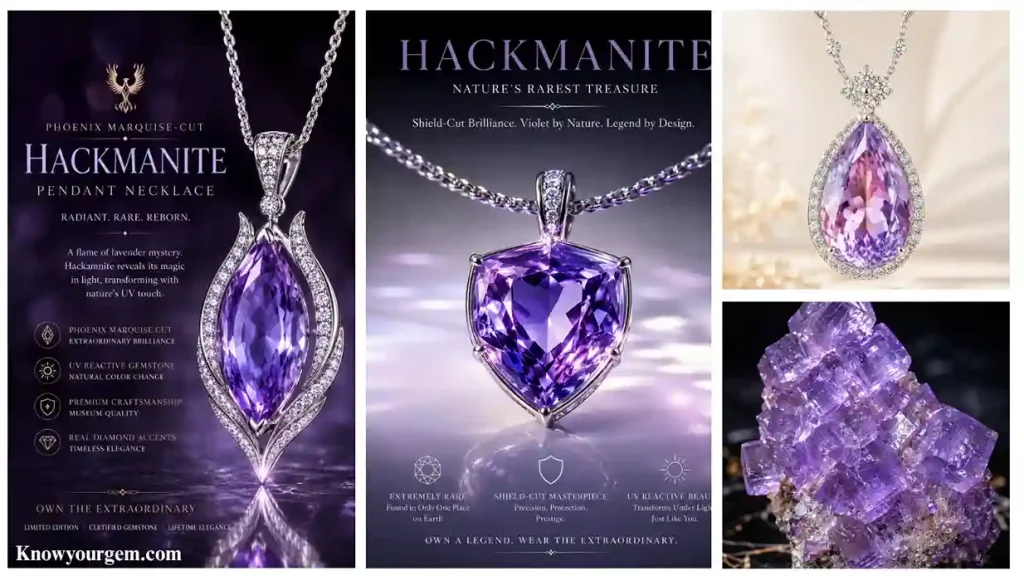
For pendants, earrings and beads, yes. For rings, be careful.
At about 5.5 to 6, with a tendency to chip, it wants a protective setting such as a bezel, and it’s a poor choice for someone who’s rough on their hands. An everyday ring that is prong set will cause chips to go in the stone from knocks.
Not to mention that cabochons are better suited for it than facets, not least since clean rough for faceting is in such short supply. Most pieces are small-batch or handmade, since good material is limited.
Think about light as well. Bracelets and beaded necklaces spend all day in it, so the stone keeps drifting toward its pale state. If you like that shifting effect, wonderful. If you want the violet to stay, a piece worn in daylight won’t hold it.
How Do You Care for Hackmanite?
Cloth with lukewarm soapy water, then rinse and dry. Not ultrasonic or steam cleaners, vibration and heat can damage the soft stone.
Keep it apart from other tougher stones like tpaz, sapphire and quartz, that can scratch it. A soft pouch or a bit of space is all it takes – and remove rings for rough work.
Light is where your source went wrong. It recommended keeping the stone in daylight so the effect “stays active”. I wouldn’t. In a dark place a stone will retain its more dark color longer, but will be bleached out in daylight. Protect your stone if you want to keep it, expose deliberately if you want it to change.
What About the Meaning and Healing Claims?
Individuals who are crystal-healing enthusiasts associate hackmanite with intuition and transformation, and usually to the third-eye or crown chakra.
It is also associated with self-awareness, because a stone that visibly transforms and refreshes makes for a good analogy of growth. These meanings are modern. They grew up around the stone’s behavior, and no ancient tradition stands behind them.
The legends of crystal-healing associations for hackmanite includes the third-eye or crown chakra, and intuition and transformation. It is also associated with self-awareness, as the change and then reversion to the original state is an obvious analogy for growth.
Buyer Checklist:
- Demo whether the stone exhibits a dramatic, repeatable change of color. (And then let it happen. )
- Inquire about the light source and the duration.
- Get it in writing – natural hackmanite and not a piece of dyed sodalite or glass.
- Find out where it was mined, and how the seller knows.
- Check transparency and cut, as clean faceting stock is hard to come by.
- Opt for a protective setting for your rings or choose a pendant or earrings.
- If you are considering a higher-priced stone, get a lab report from a gemologist.
- Get the return policy before you pay.
Frequently Asked Questions:
1. What is hackmanite?
A rare, sulfur-bearing variety of sodalite known for tenebrescence, a reversible color change triggered by light.
2. Does hackmanite really change color?
Yes. It’s a documented physical effect, not a dye. How strong it is varies from stone to stone.
3. Is hackmanite valuable?
Good material can be, but it’s still an affordable specialty stone. Strong color change, transparency and size drive the price, and there’s no standard price index.
4. Can hackmanite be worn every day?
In pendants and earrings, yes. Rings need a protective setting because of its softness.
5. How do you clean hackmanite?
Mild soapy water and a soft cloth. Avoid ultrasonic and steam cleaners.
6. What’s the difference between hackmanite and sodalite?
Hackmanite is a type of sodalite that contains sulfur. The sulfur causes hackmanite to change color when exposed to UV light and to fluoresce, unlike the stable, blue color of regular sodalite.
7. What chakra is hackmanite associated with?
This crystal quality is commonly linked to third eye chakra, and sometimes the crown chakra. Both relate to intuition and awareness in belief based practice.
8. Where is hackmanite found?
Its premium quality is majorly found in Afghanistan, Canada, and Greenland, its smaller deposits are existing in Myanmar, Pakistan, and Russia. However, Afghan material showcases the strongest color change reaction.
9. How can you tell if hackmanite is real?
Yes, it can be worn as earring, pendant and bracelet. Since daily-wear rings need to a bezel setting to protect the stone with its moderate hardness and cleavage.
10. Can hackmanite go in water?
Prolonged water exposure during cleaning is fine. But It is best to avoid prolonged soaking or ultrasonic cleaning due to its cleavage and hardness.
11. Is hackmanite good for meditation?
Yes traditionally this stone it good for meditation when it is often placed near the forehead for third eye work. Since, this a belief based practice, and its results are subjective.
Very this gem with trusted labs like GIA, IGS and IGI before buying it.
Gemstone Expert and Enthusiast KamilHussain.

Welcome to KnowYourGem.com! your ultimate destination for uncovering the fascinating world of gems and their secrets! I'm Kamil Hussain, a passionate blogger with a Master’s degree in Economics, dedicated to bringing you insightful, well researched content that blends the beauty of gemstones with the art of storytelling. With a keen analytical mind and a love for discovering hidden treasures, I created this platform to help you explore the brilliance, history, and value of every gem.


[…] Hackmanite: Color Changing […]