

Abstract:
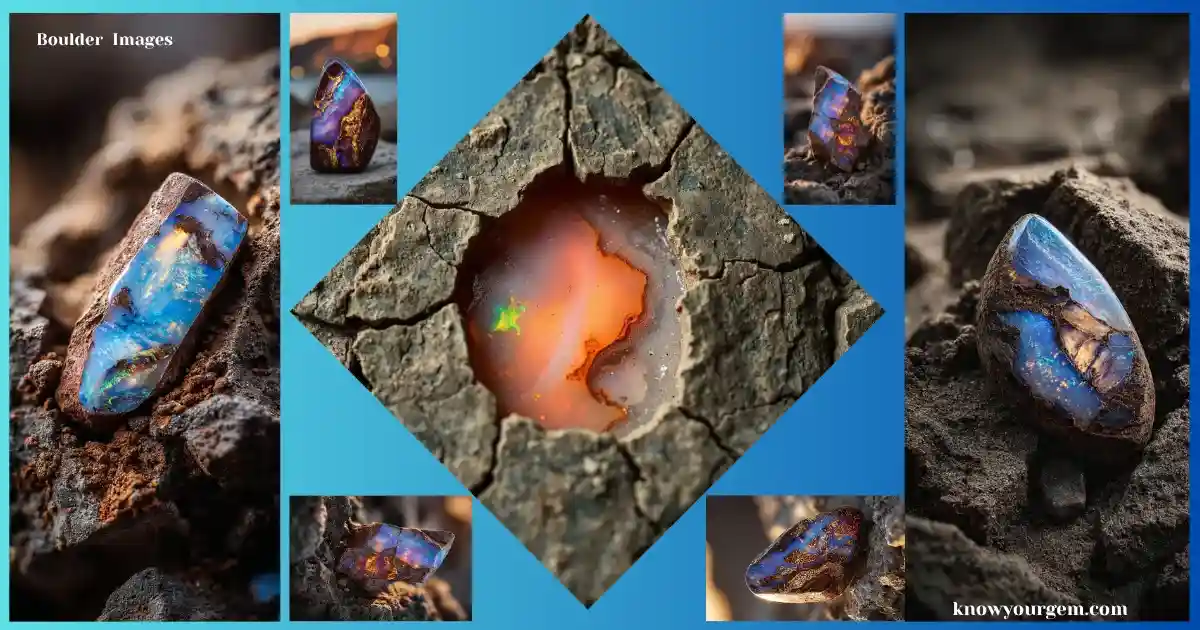
Boulder opal is natural precious opal in which part of the stone’s ironstone host has been left attached. That rock isn’t a flaw or a treatment. It’s the reason the stone looks the way it does, and it’s what makes each piece different from the next.
The short version: it’s real opal, it’s usually Australian, and it’s softer than most ring stones. The question to ask any seller is whether you’re getting a solid boulder opal or an assembled doublet or triplet.
KNOWYOURGEM has worked with opals for more than 5 years. Common questions are still raised by customers for this stone. People usually ask Is this a real opal?, Where did this stone come from? Can seller disclose its treatment status without any hesitation? What jewelry is suitable for this stone? How can we care for it? and Does seller has trusted labs reports for this stone?.

What Is Boulder Opal?
Boulder opal is found in narrow seams and patches in ironstone (and occasionally in sandstone) in Queensland, Australia. The seams are only a millimeter or two wide. Since they are so thin, a cutter cannot trim the stone without ruining the opal and must cut through the stone with the rock left on the back.
This creates a piece of work with two naturally occurring surfaces, opal on top and dark ironstone beneath. Nothing is glued. That’s what separates it from a doublet, which is built from separate pieces, and it’s why boulder opal is sold as a natural stone in its own right.
The ironstone also provides each stone with its uneven, landscape look. No two stones are shaped the same, and the veins, swirls and patchwork of the stone become part of the design. For many collectors, that’s as important as the color of the opal.
Why does it look different from other opals?
White and crystal opal sit on a light base colour, so the colours may seem dim or pastel. Boulder opal has a dark Ironstone base colour, meaning that any excess light is absorbed so the spectral colours are more defined. That’s why a boulder opal of average quality often looks punchier than a light-bodied opal of the same grade.
Alongside that, the ironstone has another trick up its sleeve. Because the colors show more clearly against a dark background, the host rock pries the spectrum rainbow forward. Even a modest color bar can pop.
Where Does Boulder Opal Come From?
Practically the only place you will find commercial boulder opal is in southwest Queensland. However, you will hear the same three names in many references to it.
- Koroit: Known for rich, swirling color patterns set in dark ironstone. Koroit opal is often boldly patterned and highly collectible.
- Yowah: Famous for “Yowah nuts”, small ironstone concretions that can hold a core of precious opal. Yowah material tends to be compact, with tight, bright color.
- Quilpie: The broader opal fields of SW Queensland, with the production of huge quantities of boulder material over a broad spectrum of quality.
Country of origin influences the worth and even the cost, so don’t hesitate to find out the particular field. If a listing simply states “Australian opal”, it gives you very little.
How Does Boulder Opal Form?
Opal begins as silica-rich waters trickle through cracks and voids of a host rock. As the water evaporates over thousands to millions of years, the silica remains, surrounded by water still present inside the silica.
When the silica spheres that form opal are perfectly ordered in neat rows, they generate a diffraction pattern that diffracts light into the rainbow colors of play of color opal.
In Queensland, silica-rich solutions moved into ironstone during long periods of weathering. That’s why the opal grew in thin seams rather than large deposits. Read Opalina stone complete identification guide.
Why Does The Host Rock Stay Attached?
The seams are too thin to stand on their own. It is deliberate that the cutters have left the dark ironstone behind. It stops the opal breaking away, and the opal has its dark bottom edge to highlight its colours. Cutting out the ironstone would make the stone less solid and would lose much of the opal’s beauty, so there is no question of it being a compromise.
What Are Yowah Nuts?
They’re small, rounded ironstone concretions, roughly walnut-sized or larger, found near Yowah. Open one up, and some have a tiny slider of the most precious opal in the world at their core. Not all nuts have opal, but those that do can have some of the most intensely coloured Australian opal.
Boulder Opal vs Other Opal Types:
The differences also matter in practice because they influence value, care and what you end up paying.
| Boulder opal | Natural opal attached to ironstone | Dark ironstone backing | Vivid color, irregular shape |
| Black Opal | Solid opal, no host rock | Dark body tone within the opal | Bright color on a dark body |
| Matrix opal | Opal spread through the host rock | Rock with flecks of opal | Dots and streaks of color |
| White or crystal opal | Solid opal | Light or transparent body | Softer, more delicate color |
| Doublet | Opal slice glued to a backing | Added dark backing | Imitates boulder or black opal |
| Triplet | Opal slice, backing and clear cap | Backing plus quartz or glass dome | Imitates boulder or black opal |
Boulder opal vs black opal:
Both types of opal can appear black in photos because they display bright colors on a dark background. The only difference is the source of the dark colour. Black Opal is a solid piece, and the dark body tone is a part of the opal. Boulder opal is displayed on the dark substrate, which is the ironstone.
Fine black opal from Lightning Ridge, New South Wales, is generally the most valuable opal type. An exceptional boulder opal can approach similar prices, but the two are different stones from different places, and a reputable seller always says which one you’re buying. You can also explore fire opal and black opal comparison guide.
Boulder opal vs matrix opal:
In matrix opal, the opal is loose in the host rock as tiny specks or thin streaks with no obvious seam, only splashes of colour throughout the stone. In boulder opal, the opal forms distinct patches or seams on or within the host rock, and those usually show stronger, cleaner colour.
Solid boulder vs doublet vs triplet:
Normal Bolder vs Doublet a solid boulder opal is a one piece natural stone: opal and ironstone – no glue, no separate parts. A doublet is a constructed stone – a thin layer of opal adhered with glue to a dark backing – often ironstone or black plastic – and tries to mimic a boulder or black opal. A triplet adds a layer of glass or quartz on top.
Doublets and triplets are legitimate products when they’re labeled and priced as such. The problem is a seller who passes one off as a solid natural. Ask for a side-view photo or video. If the stone has a clean, straight seam near the edge, it’s probably assembled.
How Do You Judge Boulder Opal Quality?
There’s no universal grading system for boulder opal like the 4Cs for diamonds. GIA points to play of color, intensity and pattern as the main value factors for precious opal, and experienced buyers add a few more. Here’s the framework I’d use.
1. Play of colour the star: When the stone is tilted you see the rainbow colours of reds, oranges, greens, blues and violet which are spreading through the stone as light is being split through tiny silica spheres. Often bright sprays of colour falling in sheets are rarer than pinfire or sparkles emerging in the form of dots. Angular colour only can be seen at certain angles.
2. Brightness: Imagine how vibrant the colors appear (fire) rather than flat and murky paint colors. A simple pattern with bright colors generally trumps a more elaborate pattern with duller colors. See how it looks under daylight and LED light as well as indoor light because Opal can be quite different.
3. Pattern: This is how the color is laid out. Terms you’ll hear in the trade include rolling flash, flagstone and harlequin, a mosaic of color blocks that’s especially scarce. Pattern is partly art, so your taste matters here.
4. Face-up coverage and cut: How much of the top is opal and how much is rock? A full opal face generally beats a thin streak in ironstone. So well-shaped cabochons and free-forms with no dead can be spotted as with best color.
5. Host rock contrast: We love the dark ironstone for making the colors of the opal really pop! But you don’t want to see mostly host rock with only a narrow stripe of opal. There should be a good balance with the host rock sitting quietly in the background.
6. Transparency, inclusions and stability: A translucent layer gives depth. First and foremost: stability – avoid cracks, crazing (networks of fine surface cracks), and sandy patches. Crazing is very serious. Because opal is not faceted like a gemstone, small inclusions can be tolerated if they do not disrupt the play-of-color.
7. Size and weight: Larger is more striking, though it has to have quality. Carat weight counts the host rock in addition to the stone, so compare the length and width of the face to fairly compare stones.
How Much Is Boulder Opal Worth?
There’s no universal price chart, because every stone is unique in pattern, color and size. Prices per carat can only be illustrative. A plain stone from a minor field and a large, vivid Koroit specimen can sit in very different price brackets.
What drives the price?
Color play, brightness, and pattern are the primary factors. A stone with good responses in those three will generally command a higher price than a bigger stone that falls short in any of those three.
The cut, the size, the country of origin follows. And whether it’s a solid or a doublet or a triplet has a huge impact on price as well because a solid boulder opal can carry a much higher price tag than a doublet. Which is why disclosure is so important.
When does a boulder opal become premium?
When you have several strong factors: full-face color play over most of the surface, strong brightness under various lights, an interesting broad or rolling pattern that can be easily seen, well-cut shape with no dead area, and the ironstone contrast that frames the stone and does not overshadow it.
Market value guide:
The table shows where each type usually sits in the market. It’s a guide to relative position, not a price quote.
| Doublet or triplet, labeled honestly | Low | Lower cost of materials | Approx $20-$150 |
| Solid boulder, modest color and pattern | Low to moderate | Natural stone, limited brightness | Around $50-$300 |
| Solid boulder, bright, good pattern | Moderate to high | Strong color, good face-up coverage | Approx $100-$500 |
| Fine Koroit or Yowah with broad, vivid color | High | Rare pattern, brightness, collector appeal | Approx $500-$3,000 |
| Exceptional collector stone | Very high | Rarity, size and documentation | Around $3,000-$8,000 |
Pricing figures can be up and down based on market structure.
When does a lab report or appraisal help?
A GIA ID report is more valuable for higher value purchases to inform the purchaser if the stone is natural, lab-grown or treated, and for which type of opal. For insurance purposes, an independent appraisal by a credentialed gemologist will provide a replacement value. For stones worth just a few hundred dollars, the price of a report may be more than the stone.
Are There Treatments, Lab-Grown Stones or Lookalikes?
Yes, and boulder opal is relatively less affected, but not immune. The majority of boulder opal is sold in an unprocessed state. But opal, in general, can be dyed, smoked, or stabilized with resin, and all of that information should be disclosed. Just ask and, if it’s valuable, get it in writing.
Lab-grown opal and plastic or glass imitations also exist. They usually show an unnaturally even, regular pattern, like a lattice or “snakeskin” texture, rather than the irregular patchwork of a natural seam. Because they won’t have a natural ironstone backing, boulder opal is harder to fake convincingly than white or crystal opal, but doublets made to look like boulder opal are common.
How Do You Buy Boulder Opal Online Without Overpaying?
The majority of boulder opal is sold over the internet, which means an opacity between the vendor and the viewer. Stones appear different online than in reality, the lighting can be ‘fixed’, and your sense of scale is distorted without a reference point. A couple of tricks will save you.
Ask for these seven things before you buy:
- Side-view photos or video: This is essential for telling a solid stone from a doublet or triplet.
- Video in different lighting: At minimum daylight and artificial light, because play of color can look strong in one and flat in another.
- Exact dimensions and weight: Face dimensions are a better guide to size than carat weight, since the weight includes host rock.
- Treatment disclosure: Buyers should always ask if the stone has been smoked, dyed, or stabilized.
- Solid or assembled, in writing: A clear statement that it’s a natural solid boulder opal.
- Return policy: Reputable dealers or sellers must offer a return window which is set for 7 to 14 days.
- Origin details: Ideally, the specific field, such as Koroit, Yowah or Quilpie, not just “Queensland” or “Australia”.
Red flags in a listing:
- No side-profile photo or video.
- Studio lighting that makes every stone look vivid.
- “Black opal look” language with no mention that it’s a doublet or boulder opal.
- A price far below comparable stones, with no explanation.
- Words like “enhanced” or “stabilized” with no detail on the treatment.
- A seller who won’t give dimensions or weight.
Is Boulder Opal Good for Rings?
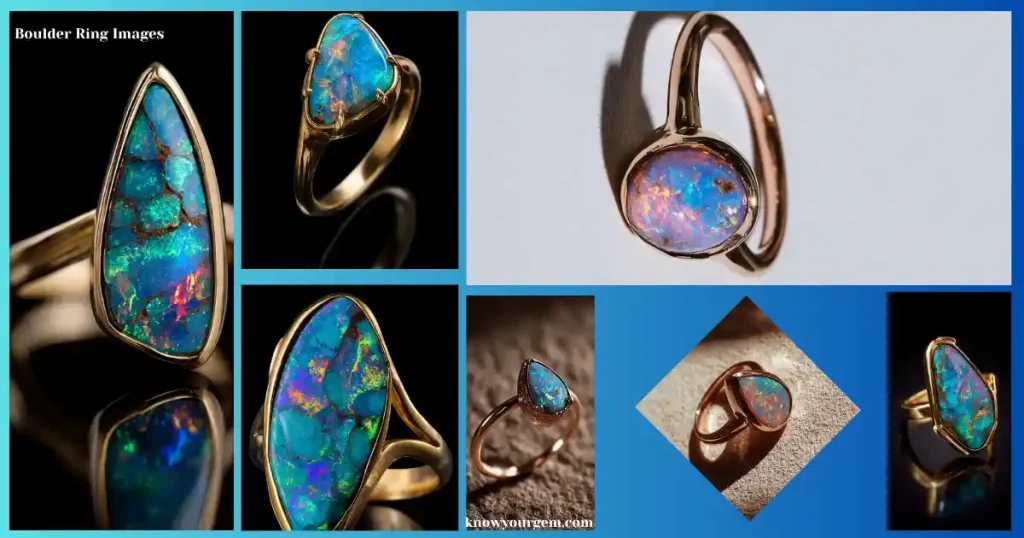
Yes, with a little patience and, of course, the proper environment. Boulder opal has a Mohs hardness of about 5.5–6.5 (so softer than sapphire, diamond or most other ring stones) so it can scratch more easily and require a little extra love. It’s not a great stone if you’re rough on your hands.
The ironstone backing is a little bit beneficial. It provides some support for the stone and may prevent a little bit of chipping on the edge of the opal layer. In rings, select a deep bezel or halo that surrounds the stone from the sides; do not select a high prong setting.
Boulder opal engagement ring if the recipient of the ring knows she is going to have her boulder opal repolished a few times over the years, then this is a great choice.
Better uses if durability is your priority:
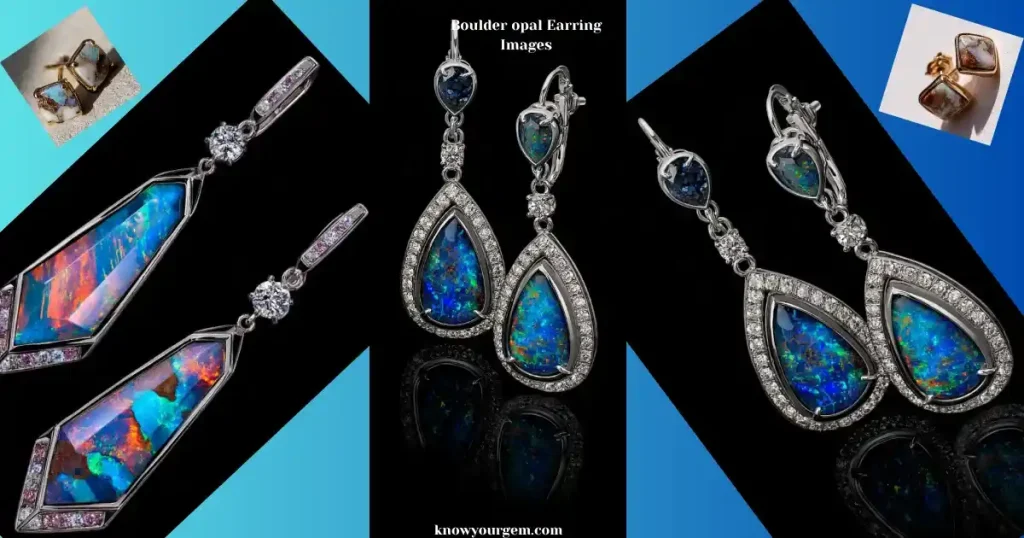
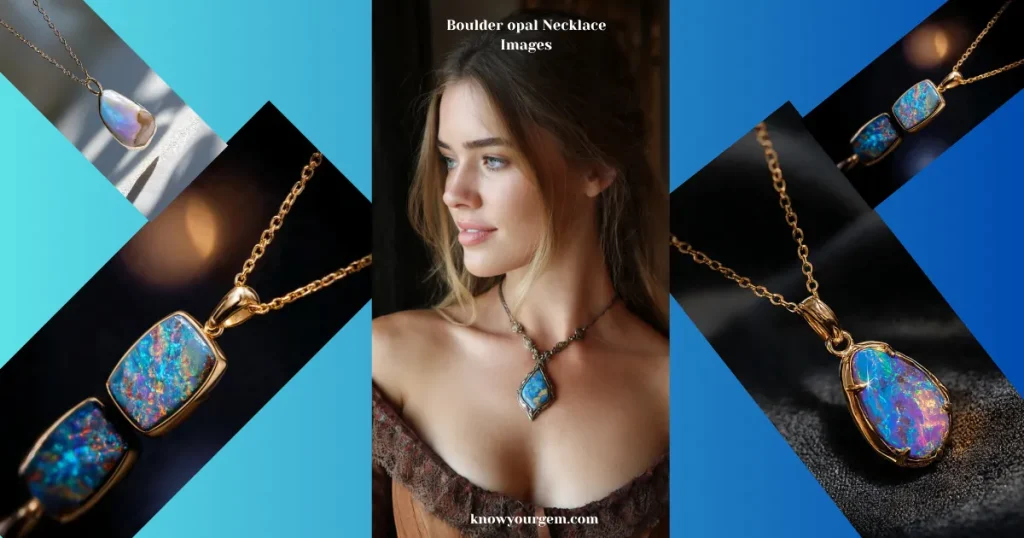
Pendants and earrings are good choices. A pendant on fabric will rarely come into contact with a hard surface, and an earring receives a minimal bump. Both can display the stone’s face to its full extent with much less risk than a ring.
How Do You Care for Boulder Opal?
Gently, and with a certain amount of respect for the fact that it is softer and more sensitive than most gems.
Cleaning. Light soapy water, warm water, gently scrub with soft brush to remove dust, rinse thoroughly so you are left with no soap film, and wipe dry with soft cloth.
Do not use ultrasonic, steam, bleach, or solvent, as all can loosen the stone. The ironstone helps to some extent but the real opal is sensitive to both heat and stress.
What you should not do. Since Opal contains water, prolonged exposure to heat, sunlight or dry atmospheres will dehydrate the Opal, leading to drying, cracking or crazing.
GIA suggests taking it out of extreme light and dryness. Don’t soak for an extended period but rinsing it for a few seconds is okay. Don’t wear in a hot tub or sauna.
Storage. Depending on hardness, around 5.5 to 6.5 for most other gemstones – it can scratch many other stones. Place the item in a soft tissue or alone, don’t overlap with any other jewelry, or loose in a drawer or bag. In extremely dry climates, store it in a location that isn’t pro.
Does Boulder Opal Have a Meaning?
All the content here is vibrational and belief-based. Opal: October (also tourmaline on other lists). In the world of crystal healing, boulder opal is believed to help with emotional grounding and inspiration. Because of the combination of rock and glitter, the ironstone is read as a grounding and stabilizing influence.
If you find that meaning appealing, it’s worth having. But it’s a story people attach to the stone, and it shouldn’t change how much you pay.
Who Should Buy Boulder Opal?
Appeals to collectors and buyers who are drawn to the incomparable qualities of natural artistry and abstract visual character. Each piece is distinctive; no two stones are the same – unique as the combination of opal pattern and host rock.
Those seeking a gemstone with a tangible, geological origin and wearers seeking an alternative to mass market jewellery have plenty of compelling reasons to choose it.
It’s not as good if you really want them as standardised across the other stones. GIA itself states that when you are buying high-quality opals, you are more buying art than buying a commodity.
All stones will have to be assessed on their own merit, and your own visual impression will be very relevant. If comparability is your priority, then ruby or sapphire with proven origin and treatment is a better framework.
Mistakes Buyers Make:
The most common is assuming a stone is solid without checking the side. Others include judging color under one light, paying a “solid” price for a doublet, ignoring crazing, choosing a ring setting for looks and not for protection, and cleaning in an ultrasonic machine.
Final Verdict: Is Boulder Opal Worth Buying?
Absolutely, if you are the right person. It’s a very natural gem, the precious opal forming inside dark ironstone in a process that can’t be replicated or mass produced, and no two stones are the same.
It’s great for people who value visual appeal, originality, and personality more than grading papers or even providing maximum everyday durability. So you have to be comfortable with light use, gentle treatment, and a little bit of time to absorb color and pattern.
In the end, that all translates into four habits. Every time, demand clear side-on shots to observe the opal in the ironstone. Demand honesty as to whether the stones are solid or constructed.
Measure brightness and face-up color in different lights. And buy from those who’re willing to answer any questions you have. If you do these things, boulder opal can be one of the most personal and satisfying gem selections at nearly every price point.
Key Takeaways:
- Boulder opal is natural opal with some of the host ironstone attached.
- The dark ironstone backing makes the play of color look vivid.
- It’s about 5.5 to 6.5 on the Mohs scale, so it needs protective settings and gentle care.
- Always confirm in writing that it’s a solid stone and not a doublet or triplet.
- It is essential to consider that spiritual meanings are cultural belief-based; they can prove as scientific searches do.
Sources:
GIA (Gemological Institute of America) for the opal information and the types & care, and the mining and trading locations for the Queensland fields.
FAQs:
1. What is boulder opal?
Good boulder opal will fetch high prices, and the best in the world from Koroit or Yowah are also expensive. Prices will vary according to brightness, play of color, pattern, and the size of face-up color.
2. Is boulder opal real opal?
Yes. The opal layer is genuine hydrated silica with real play of color. It’s natural, though you should still ask whether any treatment has been used.
3. Is boulder opal a doublet?
No. A solid boulder opal is one natural piece with no glue. A doublet is an assembled stone, so always ask which one you’re buying.
4. Is boulder opal valuable?
Good boulder opal can be, and top material from fields like Koroit or Yowah can be costly. Price depends on brightness, pattern, and the amount of color visible face-up.
5. Can boulder opal be worn every day?
It can, with some safeguards and mindful behavior. They are softer than the majority of ring stones, at 5.5 – 6.5 on Mohs scale of hardness, so pendants and earrings are a good idea.
6. How can you tell if an opal is solid, a doublet or a triplet?
Take a side view of the stone, either in the flesh or a good photograph. Check for a clean, straight joint that extends to the edge of the opal slice at the point where it joins the backing.
7. What is the difference between opal and boulder opal?
Boulder opal is a type of opal. It differs from all other types of opal in that, unlike the rest of the opal species, the opal is still connected to the ironstone stone that gives it shape and color contrast.
8. What is the difference between boulder opal and black opal?
Black opal is a solid piece of opal with a dark body tone. Australian boulder opal exhibits a dark base, which is provided by the ironstone embedded beneath the opal.
9. Can boulder opal get wet?
A quick swill in warm water is ideal. No soaking for too long, nor keep in hot environment, nor in dry air.
10. How do I clean boulder opal?
Gentle dish soap and warm water (or what is commonly referred to as “lukewarm”). A soft-bristled toothbrush and soft cloth. Don’t try ultrasonic cleaners, steam cleaners, or harsh chemicals to clean this stone because they can be harmful this stone.
11. What is the spiritual meaning of boulder opal?
It is frequently linked with feelings of stability and grounding, even creativity. These are just beliefs – not proven effects.
This content is published by Gemstone Expert and Enthusiast KamilHussain.

Welcome to KnowYourGem.com! your ultimate destination for uncovering the fascinating world of gems and their secrets! I'm Kamil Hussain, a passionate blogger with a Master’s degree in Economics, dedicated to bringing you insightful, well researched content that blends the beauty of gemstones with the art of storytelling. With a keen analytical mind and a love for discovering hidden treasures, I created this platform to help you explore the brilliance, history, and value of every gem.


[…] misrepresented. Opal’s play of color looks and works […]