


Quickview:
A Zambian emerald is a gemstone basically relates the beryl family. This stone is primarily found in in Zambia, Africa, and it is mostly valued for its deep bluish-green color, superior clarity, and ethical sourcing credentials. Since Zambia is now the world’s largest emerald producer at meaningfully more accessible price, that makes them most compelling gemstones value proportion currently.
Green emeralds are generally known as the rarest gemstones on the earth know regular emerald, meaning, symbolism, chakra connection, jewelry and pricing guide.

The histogram is tracking all four quality tiers from 2020 through 2026, with the red trend line cutting across to showcase the entire upward trajectory at glance. Few things stand clearly in data:
- An exceptional tier has been the most explosive, nearly doubling from $5,200 to $15,000 per carat for more than six years (89%). This reflects genuine scarcity at the top end: demand from Asian and middle eastern collectors are growing quicker than supply for no-oil, vivid -color material can keep up.
- The premium tier is not far behind at + 61% which is where most serious investors are active, large enough to feel the demand pressure, accessible enough to still move at auction.
- Even commercial grade has claimed steadily at +38%, that tells us rising tide is lifting the entire market, not just the top.
Why Zambian emeralds are commanding global attention currently?
Because a quiet shift is taking place in emerald world. For generations emeralds were dominated in the market. Their Mining centers like, Muzo, Chivor, and Coscuez have built a legendary reputation among collectors and traders.
That reputation remains strong, however market has evolved. In current condition Zambia is the world’s largest emerald producer. And the renowned Kegem Mine supplies a large share of the global emerald market.
Since the valuable Kegem Mine supplies large share of the global emerald market. Whether Zambia is also valued for producing stone with clarity, consistent quality, and richer green color.
What is Zambian emerald?
Zambian emerald is so called a gemstone found in Zambia below is the detailed guide for it:
Definition and mineral identity:
Zambian emeralds are natural belong to beryl group, and such stone contains chemical formula which Be₃Al₂Si₆O₁₈a beryllium aluminum cyclosilicate.
Although, they grow in hexagonal crystal structure, and get their signature green from other beryl varieties like, aquamarine, Morganite etc.
The “Zambian” label points straight to their ethical origin. It is mined in Zambia, southern Africa, this stone carries a unique geological backstory, trace elements, and physical traits that labs trained gemologists can pinpoint.
Geological formation: How Zambian emeralds are born
Zambian emeralds are forming through a rare geological process. Since, Beryllium-rich pegmatites interact with chromium and vanadium-bearing schists, that create the conditions that are needed for emerald formation.
These two environments never encounter each other. Zambia’s Copperbelt is one of the rare places on the earth where they do, and have done so on a massive scale.
The process unfolds more than hundreds of millions of years. Beryllium rich fluids from cooling pegmatitic magma migrate along fractures and contracts into the surrounding schist where emeralds interact to chromium and vanadium bearing zones within the schist.
Then the process of heat, pressure, time and precise chemistry of the rock determine whether crystals grow larger enough to yield gemstone quality material, and whether their color reaches the vivid saturation that defines a fine emerald.
Zambia’s Copperbelt geology produces this convergence on scale matched nowhere else. The result is not just volume but it is consistent, distinctive gemstone character that sets zambian material apart from every other origin.
The Three Trace Elements That Define Zambian Emerald:
Three elements interact within the Zambian emerald to produce its specific color signature:
Chromium:
It is the preeminent colorant in all fine emeralds. It replaces aluminum in the beryl lattice and absorbs red and yellow light, that transmits green.
Since, all emeralds with having chromium as the dominant colorant display the richest, most saturated green tones. Whether stones carry meaningful chromium concentrations, that anchors their color firmly in the green range.
Vanadium :
It works alongside chromium to deepen and enrich the green. In some origins, vanadium is the sole colorant, geologically purist definitions debate whether vanadium only green beryls qualify as emeralds.
Since the trade universally accepts them. In Zambian material, vanadium reinforces and complements chromium’s contribution.
Iron:
It is the element that most distinctly marks Zambian emeralds. Present in higher concentrations than in Colombian material, iron introduces a blue secondary color that shifts the entire color toward the cooler, bluish-green end of the spectrum.
Iron helps to identify Zambian emeralds. It also gives them a cool blue to green color. Some collectors prefer this look, while others favor the warmer green of Colombian emeralds.
The Kagem emerald mine: The world’s largest
No discussion of Zambian emeralds is completed without the Kagem Mine. As it is located in Zambia’s Copperbelt Province, it is the world’s biggest emerald mine by production.
Kagem is operating as a joint venture between Gemfields and Zambia’s Industrial Development Corporation. It is a part of the mine’s revenue that supports local communities and development projects.
The mine uses open pit mining and regularly holds transparent international emerald auctions. Such auctions help to establish market prices and make Kagem one of the most transparent emerald source worldwide.
Other important Zambian emerald mines include the Grizzly Mine and Twamipani Mine, both located within the productive Copperbelt region.
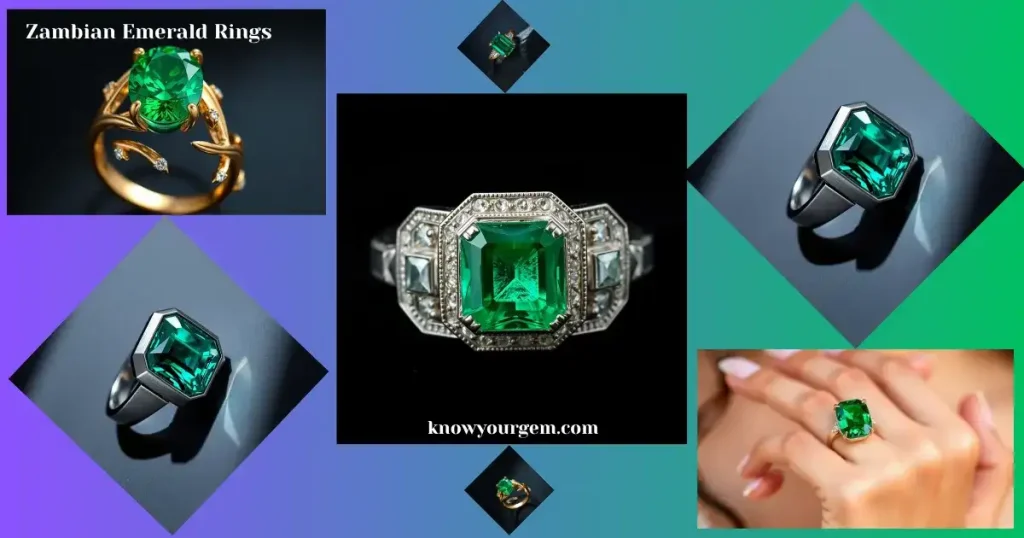
Zambian emerald color:
Zambian emeralds pop with cool, vivid bluish to green color that is magnetic think deep ocean vibes that meet forest intensity, setting them worlds apart from warmer greens.
Understanding the distinctive bluish-green hue:
Color the single essential impact-able quality characteristic in each colored gemstone, and in Zambian emeralds, it is where the story begins and ends.
When a first time buyer encounters, a fine Zambian emerald in good light, the reaction is almost universally the same: an immediate sense of depth, coolness, and intensity that is complicated to articulate but impossible to miss.
The color of a Zambian emerald can be described along three axes that gemological laboratories use to formally grade colored stones:
Hue:
It refers to the dominant color and any secondary modifies. The ideal Zambian emerald color is a medium to medium dark green with having a blue secondary component that is described formally as bluish-green.
Stones with having no blue component look more like Colombian material and can in fact be from a different deposit. The optical range vivid green with having a cool blue whisper is the hallmark of the finest Zambian material.
Tone:
It refers to the light or dark color which is existing in. While having a scale from very light to very dark, Zambian emeralds place for themselves at their most desirable sit in the medium to medium-dark range.
Since, stones that are too light appear watery and lack in low light lose brilliance and appear opaque.
Saturation:
It refers to the intensity or purity of the color that how free it is from gray or brown mask toning. A stone with having strong saturation appears vivid and pure in its green.
Whether a stone with having weak saturation even if the color and tone are appropriate appears dull, muted, or muddy. Saturation is arguably the hardest characteristic to achieve at the high levels and the most essential of price at the premium tier.
Zambian emerald color chart:
| Color Grade | Description | Market Position |
| Exceptional | Vivid bluish-green with having strong saturation like medium to dark tone, no gray or brown modifier | Top 1–2% of production; investment grade |
| Fine | Strong bluish to green with having good saturation; medium tone; negligible secondary modifiers | Premium retail; fine jewelry |
| Good | Medium bluish-green; moderate saturation; slight gray possible | Commercial fine; everyday jewelry |
| Commercial | Light to medium green with having low-moderate saturation like gray or brown modifiers present | Mass market jewelry |
| Below Commercial | Pale, grayish, or brownish green; weak saturation | Industrial or fashion use only |
How Zambian emerald color compares to colombian:
The top emerald color debates Zambian vs. Colombian. Differences are clear cut and consistent, each with fierce fans. Since Colombians from Muzo glow with having warm, pure green, a yellowish tint that shines in incandescent light, evokes Mughal and Victorian legends.
It is the classic many picture. Whether Zambians deliver cool, electric blue-green; with having vivid in daylight, room stealing, and photo-perfect. They hold warm light, but can be paired with modern metals.
Not clear winner, Colombian warmth fits tradition and yellow gold; Zambian cool suits contemporary vibes. Top stones from either stun.
Zambian emerald Vs other origins:
Given below the comparison table of Zambian emerald vs other origins you can check below:
Complete origin comparison:
| Feature | Zambian | Colombian | Brazilian | Zimbabwean | Afghan |
| Color | Deep bluish-green | Warm pure green | Light to medium green | Vivid medium green | Intense blue-green |
| Clarity | Superior | More included | Variable | Generally clean | Variable |
| Iron Content | High | Low | Moderate | Low | Low-moderate |
| Volume | Very high | Moderate | High | Low | Very low |
| Prestige | Rising | Highest | Moderate | Moderate | Collector niche |
| Price Relativity | Moderate-high | Highest | Lowest | Moderate | Moderate-high |
| Ethical Sourcing | Excellent (Kagem) | Variable | Variable | Good | Challenging |
Zambian vs. Colombian: The definitive assessment
Colombia’s premium endures, are rooted in centuries of hype, true scarcity, and its iconic warm green is generally considered as the luxury benchmark. A Muzo stone with having a top lab report purchases history, rightly priced higher.
However, it often overvalues mediocrity: Since $4k/ct Colombia (moderate color, heavy oil) lags behind $2.8k/ct Zambian (vivid blue green, light oil).
Origin certs inflate the former, prestige gaps undervalue the later. So, smart buyers usually prioritize merits snag Zambian value. Tradition seekers (gifts, resale, legacy) gladly pay up.
Zambian vs. Brazilian emerald:
Brazilian emeralds embodies the third mandatory origin and are the most abundant emerald producing source worldwide by sheer geological extent.
However, Brazilian material entirely tends to run lighter in color, more variable in quality, and lower in overall gem quality yield than Zambian production.
The finest Brazilian stone particularly from the Santa Terezinha and Belmont deposits can be beautiful, however they rarely achieve the vivid saturation and clarity combination that top Zambian material produces.
Whether Brazilian emeralds are considered as most affordable in gem market they are widely used in commercial jewelry production worldwide. So, Zambian emeralds consistently get outperform Brazilian material in color saturation, clarity, and investment potential at equivalent price points.
Zambian emerald Properties:
| Property | Value |
| Mineral Family | Zambian emerald belongs to Beryl family |
| Crystal System | The stone forms hexagonal crystal system |
| Mohs Hardness | Zambian emerald owns 7.5 to 8.0 mohs scale of hardness |
| Refractive Index | It is calculated with the refractive index like 1.565 – 1.602 |
| Specific Gravity | It has 2.67 to 2.78 of specific gravity |
| Luster | Vitreous |
| Fluorescence | Generally inert to weak |
| Primary Colorants | Chromium, Vanadium |
| Secondary Colorant | Iron (blue modifier) |
Durability and care:
While having 7.5-8.0 Mohs scale, Zambian emerald is durable enough for daily wear jewelry like ring bracelet and earring. However, natural internal fractures can create vulnerability to chip under direct hard impact. For rings, bezel or halo settings provide the best protection.
- Care rules: Use warm clean water, with mild soap for cleaning and brush it with soft brush only. Don’t apply ultrasonic cleaners, steam, or harsh chemicals and also degrade oil treatment which can cause permanent damage.
Treatments: What you must know before buying
Nearly all natural emeralds undergo oiling, filling surface fractures with cedar oil or synthetic resin to improve apparent clarity. This is fully accepted in the trade. You should know what matters the level.
| Treatment Level | Definition | Price vs. No-Oil |
| None (No Oil) | Entirely natural clarity; no filling | 100% — highest value |
| Minor | Negligible traces; essentially natural | 70–85% |
| Moderate | Noticeable improvement from treatment | 40–60% |
| Significant | Heavy filling; dramatically altered appearance | 20–35% |
- The rule: GIA or IGI certificate is always recommendable that explicitly states the treatment level. A no-oil verses significantly-oiled stone can vary in price by 200% whether appearing an identical to an untrained eye. The certificate is not optional, it is the document that tells you what you are actually looking for or buying.
Zambian Emerald Price Per Carat (2026):
Prices have risen from 15 to 25% at the premium tiers over the past three years, which are driven by rising Asian and Middle Eastern demand and constrained supply of fine material.
| Quality Tier | Price Per Carat | Description |
| Commercial | $500 to $1,200 | Stone with having light color, visible inclusions, standard cut |
| Fine | $1,200 to $4,500 | Stone with having strong color, minor treatment, competent cut |
| Premium | $4,500 to $9,000 | Stone with having vivid color, high clarity, expert cut; investment-worthy |
| Exceptional / No-Oil | $10,000 plus | Stone with having no oil treatment; museum grade clarity; auction material |
The four value drivers:
- Color accounts for 50 to 60% of value. Since a vivid color stone with having some inclusions can beat a pale, eye clean stone every time. Never sacrifice color significantly for clarity in an emerald.
- Clarity matters more in Zambian stones than in other origins because the market has come to expect and reward Zambia’s relative clarity advantage. Eye clean stones can command meaningful premiums.
- Treatment level is the most consequential technical factor. It refers to the treatment table above and the price difference between no-oil and significant is not marginal, it is transformative.
- Carat weight follows an exceptional curve more than 2 carats. A single fine 3 carat Zambian stone can dramatically more pricier per carat and in total than three comparable 1 carat stone, because large, clean , with having vivid color genuinely scare.
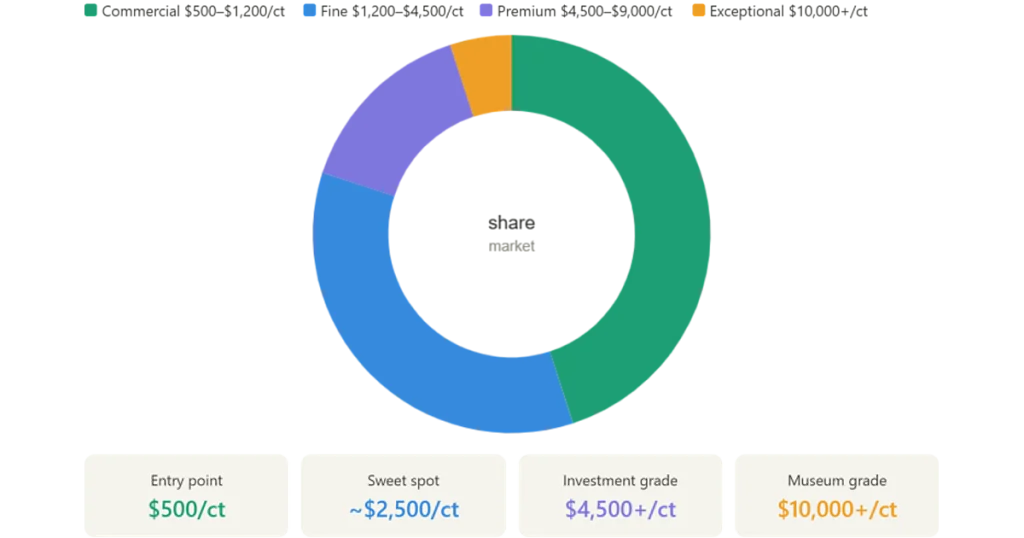
The doughnut chart showcases an approximate market share distribution across the four Zambian emerald prices. Since, commercial grade dominates at 45% of the total market volume, that’s what the most buyers encounter whether exceptional, no-oil stones make up just 5%that is exactly why they command $10,000+ per carat.
Zambian emerald in Jewelry:
Zambian emerald can be well fit in jewelry because of having superior clarity, vibrant green-blue colors, and affordability over Colombian stones that offer versatile cuts for everyday or statement pieces.
Emerald Rings:
It is the most popular format. For daily wear, bezel or halo settings protect the stone from chipping. Since, emerald cut and oval maximize face-up color. The Zambian stone’s clarity advantage is most visible in the open table of an emerald cut.
Emerald Necklaces:
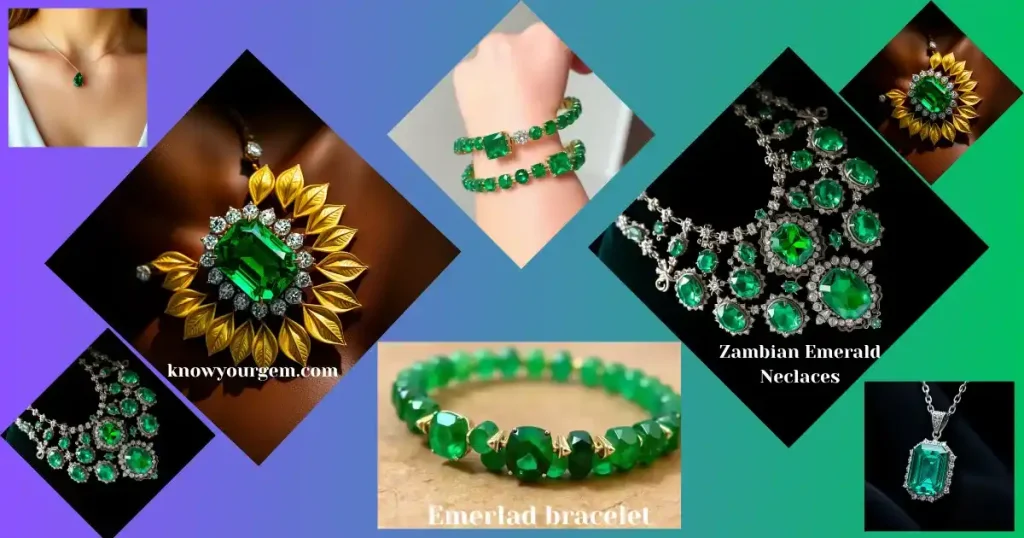
It is the safest format for the larger stones. Since, Solitaire pendants in yellow gold warmth; white gold or platinum intensifies the cool blue-green. Since, drop necklaces with surrounding diamonds are a perennial luxury favorite.
Emerald Earrings:
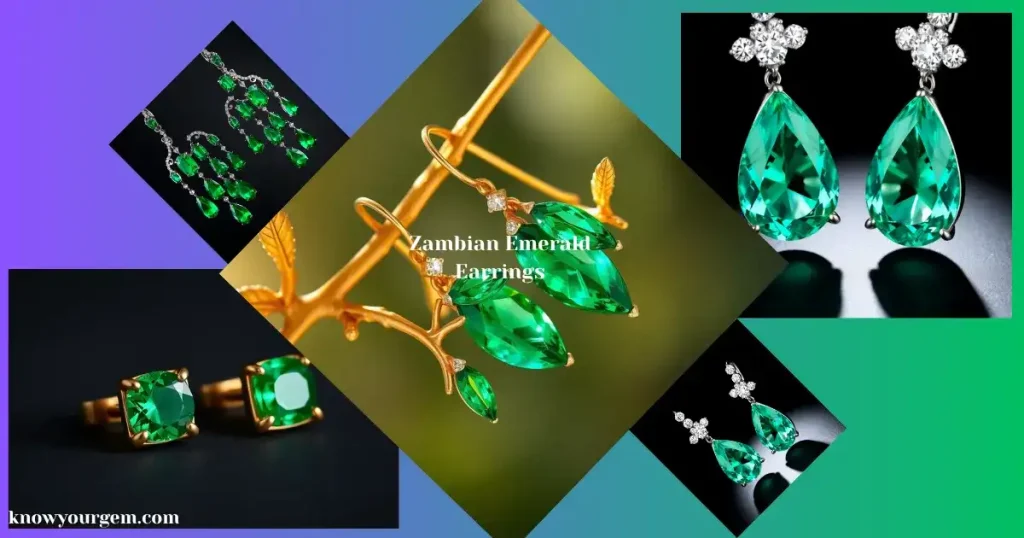
Any setting that works earrings face no impact risk. Matched certified pairs that command premiums. Drop earrings in pear or oval cut suit formal occasions; stud bezels suit everyday wear.
Emerald Bracelets:
Tennis bracelets and bezel-set line bracelets feature multiple Zambian emeralds that can create cohesive color at accessible cost as compared to a single large stone.
Emerald Best cuts:
| Cut | Best Application | Why |
| Emerald (Step) | Rings, pendants | Classic; maximizes color display |
| Oval | Engagement rings, earrings | Flatters the finger; retains weight |
| Cushion | Vintage rings | Romantic; excellent brilliance |
| Pear | Drop earrings, pendants | Elegant; appears larger than carat weight |
| Round Brilliant | Accent stones, bracelets | Maximum brilliance |
| Asscher | Art deco settings | Geometric precision |
Benefits, meaning & healing properties:
Zambian emerald weaves ancient magic into the modern life, that sparkles intellect, love, and clarity whether offering an ethical luxury from Africa’s heart.
Historical significance:
Emeralds have been among the most coveted gems in history across major civilization. An ancient Egyptians have associated these gemstones with fertility and eternal life. Since, Mughal emperors have commissioned extraordinary carved emerald objects.
Renaissance Europe has linked these gemstone to the faith, hope, and renewal. So, Zambian emeralds carry this full symbolic inheritance alongside a modern story of an African heritage and ethical luxury.
Vedic astrology (Panna):
In astrological calendar, emerald is tied to the planet mercury, and is also known to boost smartness in wearer, enhance communication skills, and business vibes. Zambian stones stand out with their deep, rich color and super clear quality.
Traditionally cited benefits:
- Sharpened communication and analytical thinking
- Enhanced memory and concentration
- Business clarity and commercial success
- Reduced anxiety and mental restlessness
- Creative and academic achievement
Mostly this gemstone is recommended for Virgo ascendant. So, it is must to consult with a qualified Vedic astrologer before purchasing for astrological use, and insist on a certified, natural untreated stone.
Crystal healing tradition:
In crystal healing tradition emerald is associated with heart chakra, and also known to make strong love relationship, compassion, and emotional balance for wearer.
Zambian emeralds bring a special cool blue to green vibe that sharpens emotional insight, sparkles renewal, and boosts vitality.
Must note: Astrological and metaphysical properties believe cultural and spiritual traditions. They are scientifically proven.
Zambian Emerald As Investment Potential:
Zambian emeralds make a savvy pick for collectors, who want rare, ethical gemstones which could held strong value even when markets get shaky.
The case for:
- Top-tier scarcity is real. While having vivid color, no-oil , eye clean Zambian emeralds more than 2 carats are genuinely rare their supply doesn’t scale with demand.
- Structural demand growth. Rising wealth in Asia, India, and the Middle East drive a sustained long term demand for fine colored gemstones.
- Ethical premium building. Kagem’s transparency is becoming a purchasing criterion. This premium is not yet fully priced in .
- Auction track record. Chrisite’s and Sotheby’s have recorded strong, consistent results for the top Zambian material over the past five years.
- Uncorrelated asset. Physical gemstone move independently of equity and bond markets useful portfolio diversification
What to buy for investment;
A certified by GIA OR IGI Zambian origin confirms, no-oil or minor treatment only having vivid color with having fine exceptional grade, minimum 2 carats, eye clean or very slightly included. Nothing below these criteria belongs in an investment portfolio.
Caveats:
Gemstones are iliquied. Transaction costs through auction or dealer resale run 20-40% combined. Since, time horizons should be long, five years minimum. Don’t invest in uncertified significantly treated, or commercial-grade material.
Complete buyer’s guide:
Be alert yourself with these seven straightforward steps to confidently select a Zambian emerald that matches your goals, budget, and lifestyle that avoids common pitfalls along the way.
- Step 1: know your objective like daily jewelry, occasional jewelry, gifting and investment each prioritize different quality factors. Decide before you look at any stone.
- Step 2: Set a realistic budget like use the price table above. Calibrate expectations to the market honestly.
- Step 3: insist on certification by GIA or IGI minimum for any purchase that more than $1,000. Gübelin or AGL for investment-grade pieces. The certificate must state origin, treatment level, carat weight, and color/clarity assessment explicitly.
- Step 4: Evaluate color in multiple lights and view in natural daylight and warm incandescent Since, a fine Zambian emerald holds its character across both stones that only perform under jeweler’s spotlight’s are telling you something.
- Step 5: Read the treatment grade, since minor and significant are not the same thing. Price difference before committing.
- Step 6: Choose the right setting. Daily-wear ring demands a protective setting. Communicate intended use to your jeweler before discussing designs.
- Step 7: Source carefully. Estabilished dealers with having transparent certification policies, clear return guarantees and verifiable industry credentials. Research independently before any significant purchase.
FAQS:
1.What is a Zambian emerald?
Zambian emeralds are dazzling green gems majorly mined from Zambia’s Kagem site, which is the world’s top producer by volume. The stones dazzle with a rich bluish-green color from traces of chromium, vanadium, and iron, plus better clarity than many other which make them hot, ethical pick.
2. Why are Zambian emeralds cheaper than Colombian?
Higher production volume can reduce scarcity. The combination of stones additionally hold centuries-old prestige priced into the market regardless of individual stone quality. At equivalent objective quality, Zambian stones offer 20-50% better vale per carat.
3. Are Zambian emeralds real?
Yes, completely. Same mineral species as any other emerald worldwide. Zambian refers only to geographic origin. A GIA or IGI certificate confirms both natural status and Zambian origin.
4. Which stone is better Zambian or Colombian?
Neither universally. However Colombian with having warmer pure green, maximum prestige, higher price. Whether Zambian with having cooler bluish-green, superior clarity, can have better value. So choice depends on color preference and whether you are praying for heritage or for the stone itself.
5. How does Zambian color compare to Colombian?
Zambian is cooler and more bluish-green due to have elevated iron. Whether, Colombian is warmly in incandescent light. Both are beautiful the preference is genuinely personal.
6. What treatments do Zambian emeralds undergo?
Standard oiling cedar oil or resin fills surface fractures to improve apparent clarity. Accepted industry practice. Levels range from non to significant. Since treatment level is stated on the certificate and directly affects price.
7. How much does a Zambian emerald cost in 2026?
Commercial stones command prices from $500-$1,200/ per carat, whether fine stones can be pricier can command $1,200-$4,500 per carat, and premium qualitative stone can exceed price from $4,500-$9,000 per carat, and exceptional no-oil pieces command top price like $10,000 plus per carat. Prices are climbing steadily due to surging demand and tight top-tier supply.
8. Is Zambian emerald good quality?
Yes it is among the world’s finest gemstones. It is consistently recognized for clarity surpassing other major at equivalent prices. Since, Top Kagem material is investment-grade and performs strongly at international auction.
9. Where to buy a Zambian emerald?
It is established by online dealers with having GIA/IGI certification and clear return policies, specialist colored stone dealers, reputable fine jewelry retailers, and major auction houses for investment-grade pieces. Always verify certification, treatment disclosure, and dealer reputation independently.
End view:
Zambian emerald is not only a budget substitute for Colombian. It is a world class gemstone with having a distinctive personality, cool, deep, vivid, and increasingly coveted that delivers objectively better value per dollar at every quality tier, stronger ethical credentials than any competing origin, and genuine investment potential for correctly selected stones.
This guide is for informational and educational purposes only. Gemstone prices reflect 2026 market conditions. Astrological properties embodies cultural tradition, not scientific claims. So,, it is best to always consult with qualified independent gemologist before significant purchases.
This comprehensive guide is written by gemstone enthusiast KamilHussian!

Welcome to KnowYourGem.com! your ultimate destination for uncovering the fascinating world of gems and their secrets! I'm Kamil Hussain, a passionate blogger with a Master’s degree in Economics, dedicated to bringing you insightful, well researched content that blends the beauty of gemstones with the art of storytelling. With a keen analytical mind and a love for discovering hidden treasures, I created this platform to help you explore the brilliance, history, and value of every gem.


[…] stone has a similar glow to emerald with the same species, but their colors are produced by different trace-element […]
[…] Emerald (7.5-8 hardness): It is just hard enough, but is very brittle due to internal fractures. […]
[…] comes from its structure, its mineral roots, and the rare geological process that usually forms it. Emeralds are generally timeless; their chemistry, rarity, and origin make these stones both classic and […]