
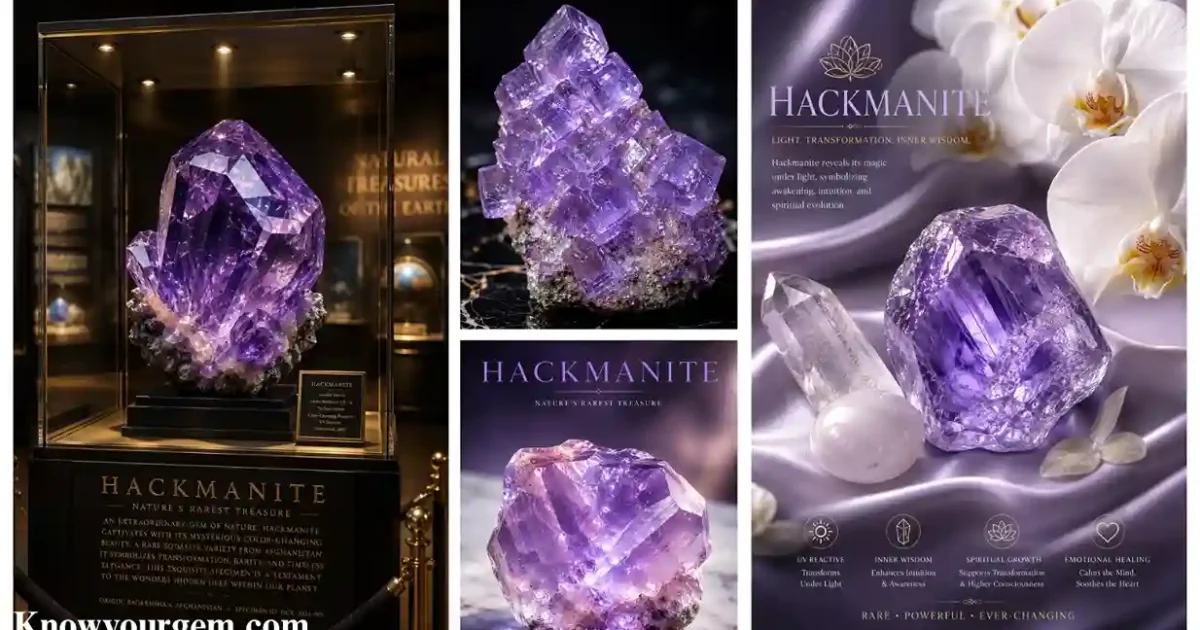

Hackmanite is a rare tenebrescent solidate which reversibly fluctuates color as like, pale vivid violet/pink/orange, under sunlight or UV and then fades back. The effect comes from related defects and trapped electrons, and the stone also fluoresces strongly under UV. Value hinges on color change intensity, clarity, cut, and size while testing it with UV, sunlight. So, for buying purpose enthusiasts must request a lab report for high value pieces.
Amethyst is the stone that similar to this gem in purple color, know the complete guide about amethyst different types benefits, and chakra connections.
What Is Hackmanite?
Hackmanite is a solidite means a feldspathoid that showcases tenebrescence, a color change triggered by light. Chemically it is nearly the similar as regular solidite, however tiny amounts of sulfur substitute for chlorine in the structure. That sulfur substitution creates the color centers responsible for the light driven color shift.
How It Looks Before and After Light Exposure?
Hackmanite is recognized for its remarkable color changing ability. Under normal light it often appears pale gray, white, or soft lavendar. However the stone it exposed to strong sunlight or UV light, it will display deep vivid violet or blue to its tenebrescence.
Place this stone back in the dark or under regular indoor light, its color will slowly fade to its original tone. Some stones can repeat this cycle many times without any permanent change, that make it truly unique and captivating mineral.
Collector Stone, Not a Mainstream Gem:
Gemologists used to classify hackmanite as a semi precious, collector grade mineral rather than a mainstream precious gemstone.
Since, the stone is value for its rarity and optical behavior rather than its classical brilliance of clarity. Hamanite is mostly translucent to opaque, so fully transparent, facet grade material is unusual.
Hackmanite Meaning:
Victor Axel Hackman, has named the stone firstly. He was a Finnish geologist who first described the mineral in the early 1900s. Although, it was discovered on the Kola Peninsula, and finding in Russia now, that make it fairly mineralogical find.
The name itself holds no ancient mythology, that is not like ruby or sapphire.
Modern Symbolic Meaning:
According to crystal healing communities, hackmanite has picked up meaning that is tied to its physical behavior.
Because the stone is visibly shifting and then returns to its original state, many people associate it with transformation and self awareness. Such associations belong to cultural and personal ideology rather than scientific, and developed alongside the modern crystal movement.
History and Origins Of Hackmanite:
Hackmanite has identified and established in 1901, that makes the stone most recently classified solidite group mineral.
Mostly the twentieth century, it stayed a curiosity for mineral collectors and academic mineralogists.
The Afghan Discovery That Changed Everything:
Its history changed after larger, gem quality deposits were found in Afghanistan during early 1990s and 2000. Since, Afghan hackmanite showcased stronger, more dramatic tenebrescence than earlier material from Canada or Greenland.
This discovery moved hackmanite from a niche specimen toward a legitimate, if still uncommon, gemstone.
Where Hackmanite Is Found?
Qualitative hackmanite gem comes from a small number of locations, which directly drives its rarity and price.
Afghanistan:
Afghanistan produces the most commercially significant hackmanite currently, majorly it comes from Badakhshan region.
Afghanistan material generally showcases the most vivid and reliable color change on the market.
Canada:
Canada has two historically essential sources like, Bancroft, Ontario, and Mont Saint-Halire, Quebec.
As Canadian hackmanite tends to appear more often as a mineral specimen than a cut gemstone.
Greenland, Myanmar, Pakistan, and Russia:
Greenland produces hackmanite from the Ilímaussaq complex, alongside other rare sodalite-group minerals.
Whether Myanmar and Pakistan have smaller, less consistent deposits which supply this stone to market often less.
And Russia’s Kola Peninsula, where the mineral was first described, still yields specimens usually for mineralogical study.
Chemical Formula and Mineral Composition:
Its chemical formula Na₈Al₆Si₆O₂₄Cl₂, is based in sodalite which is a sodium aluminosilicate containing chlorine.
The stone stands out because sulfur takes the place of some chlorine atoms in the structure. This swap creates tiny defects in the crystal lattice, and its defects are giving the it a remarkable color changing ability.
Why Sulfur Causes the Color Change?
The color changing of hackmanite comes from sulfur detects in its crystal structure. UV or sunlight shifting electrons at these sites, alter how the stone absorbs and reflects light which make the stone darken.
As well as once light is removed, the electrons reset and the color fades back. This natural tenebrescence process is genuine, not an artificial treatment.
Physical Properties of Hackman:
Following physical properties for this stone explains color variation, hardness crystal system and cleavage, flourescence and tenebrescence, transparency and luster, specific gravity all in depth:
Color:
Hackmanite’s natural colors are white and pale gray to soft pink. When it is exposed too light, its shifts into deeper shades of purple, violet, or blue violet with Afghan stones that showcase the richest saturation.
Hardness:
The stone measures 5.5 to 6 on the Mohs scale of hardness, means similar to the standard sodalite.
That is below quartz and well below sapphire, so it scratches more easily and needs careful handling.
Crystal System and Cleavage:
Hackman starts to get its form as like crystal in isometric system with poor to distinct multiple directions.
And the stone owns moderate hardness, that makes it prone to chipping if struck against a harder surface.
Fluorescence and Tenebrescence:
This sulfur rich variety typically fluoresces bright orange, pink or yellow under UV light, and sulfur impurities cause it.
Fluorescence and tenebrescence are related but both separately effects to a stone.
Transparency and Luster:
Mostly this hackmanite is found translucent to opaque; fully transparent, facet grade material and is uncommon and more valuable the other common stone.
Its luster runs vitreous to slightly greasy, a texture common across the soladite group.
Specific Gravity:
Hackman gem has a specific gravity of about 2.1 to 2.4 , that makes it notably light for its size. This is a useful, simple clue during informal identification.
Hackmanite Healing Properties:
The claims below relate to the crystal healing beliefs, not scientific findings. Since, the stone’s healing properties should never replace medical or mental health care.
Mental Clarity and Intuition:
Practitioners also associated hackman with mental clarity, intuition, and emotional insight. Many people connect this stone symbolically to the stone’s that own visible transformation under light.
Protection and Grounding:
Hackman gem is often associated with protection and grounding in modern crystal practices. But some people believe that its shifting colors help people to recognize behavioral patterns, that mirrors the stone’s physical transformation.
Such ideal usually come from the broader crystal healing movement and are belief based traditions, not scientifically proven.
Spiritual Benefits and Chakra Associations:
In chakra based traditions, this rich sulfur variety links to the third eye chakra, and also associates with intuition and perception.
It is some times associated to the crown chakra as well carries symbols like, higher awareness and spiritual connection.
Practitioners can place hackmanite near the forehead during meditation or keep it closer during quiet reflect. These associations come from modern crystal healing practices rather than ancient documented traditions.
Hackmanite Jewelry Designs guide:
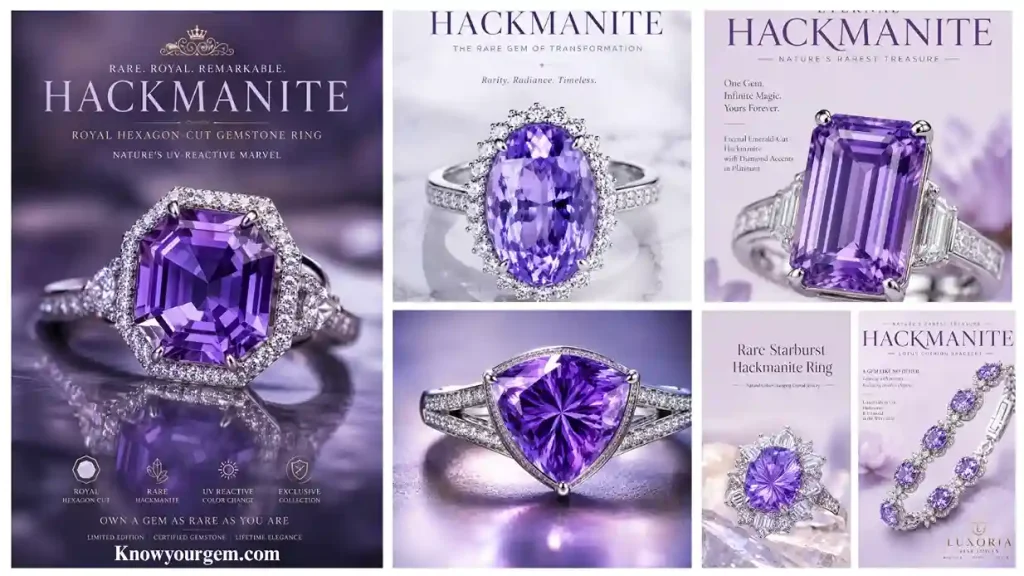
Hackmanite is appearing majorly as cabochon, bead, and occasional faceted stones, since, it lacks facet grade transparency.
Cabochon cuts suit the stone well, as the stone lets light interact with the surface to highlight color zoning.
Rings:
To wear hackmanite as ring requires protective setting like bezel, that give the stone’s moderate hardness and cleavage tendencies.
While wearing this stone daily as ring with a prong setting can affect negatively to the stone. Because the gem is exposed, constant wear it can increase chances of chipping over times.
Bracelets, Necklaces, Earrings, and Pendants:
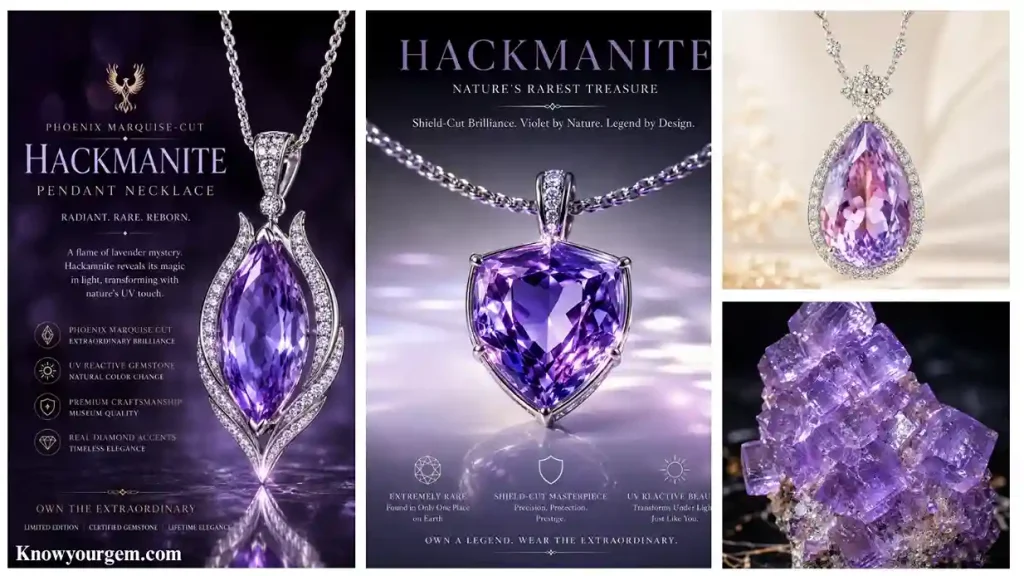
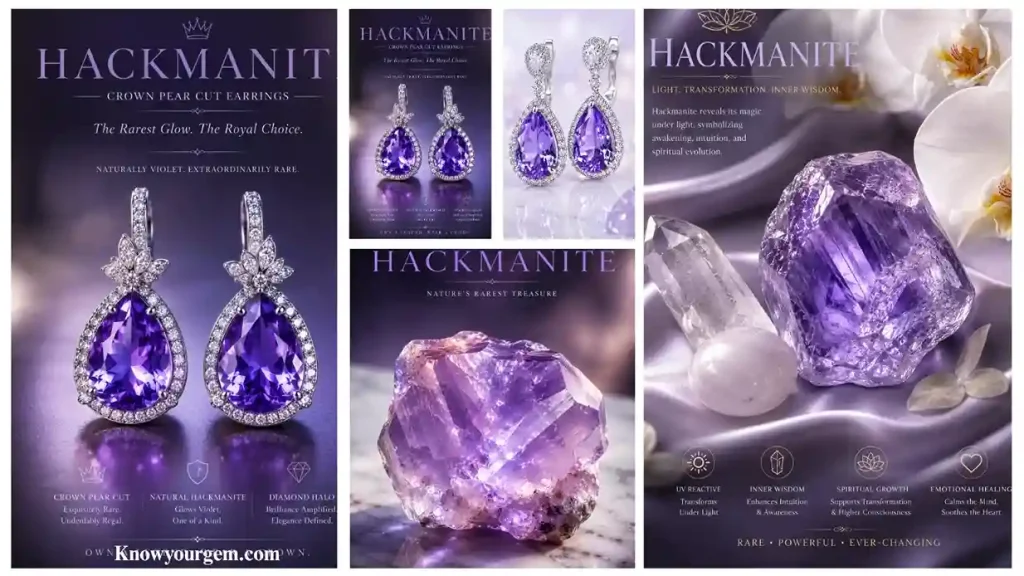
Hackmanite works perfectly in jewelry that gets steady light exposure. Since bracelet and beaded necklace keep its color shifting active throughout the day, however earring and pendant also get benefit from ambient and natural light.
As qualitative rough gems are limited, most pieces are handmade or small batch rather than mass produced, adding to their uniqueness.
Hackmanite Price and Value:
The price of this stone hinges on the key factors like, color intensity, transparency, and strength of its tenebrescent reaction. Since, rough and cabochon grade materials sit at the lower end, while transparent faceted pieces command the highest prices.
Hackmanite Price Guide: (Per Carat, USD)
| Quality Grade | Description | Approximate Price Per Carat |
| Low grade | These stones own Opaque, weak or inconsistent color reaction and command prices like | $1-$5 |
| Mid grade | These stones carry translucent, moderate color change, typical cabochon material can command | $5-$20 |
| High grade | These are Afghan cabochon material, own vivid violet reaction can command | $20-$50 |
| Rare / faceted | These are transparent, well structured stones own strong tenebrescence and command prices | $50-$100plus |
Prices are approximately market estimations. Hackmanite has no standardized pricing index, so figure of pricing can vary and depends on size and regions.
What Drives the Price Higher?
Larger stones with having strong, consistent color usually carry premium prices.
Size and dramatic tenebrescence rarely showcase together in the same piece, that pushes rare examples higher.
How Hackmanite Compares to Mainstream Gems:
As compared to sapphire or emerald, hackman remains an affordable specialty overall. And its value comes from rarity and novelty, not from an established, liquid resale market.
How to Identify Real vs Fake Hackmanite?
Authentic hackman can be confirmed through tenebrescent reaction, UV fluorescence, hardness, and weight.
Test the Color Change:
Shine a UV slashlight or use direct sunlight for various minutes on the stone.
A realistic hackman should be visibly dark toward violet or purple, then gradually fade once it is removed from light.
Check Fluorescence:
Check the stone under UV lamp, because the stone typically glows orange, pink, or yellow coloration. And ordinary sodalite reacts far less dramatically, or not at all, under the same light.
Test Hardness and Weight:
Test the stone’s hardness carefully, as realistic gem scratches easily and carries low hardness like 5.5-6 steel point behaves inconsistently with the realistic hackmanite.
Check its weight while holding it in your hand, since real hackman has lower specific gravity that makes it feel lighter than glass imitations.
Buying Safely:
Be cautious of dyed sodalite or glass that are sold as realistic hackman, since dye will not replicate tenebrenscence. Ask if a reputable dealer agree to demonstrate the color change reaction before buying it.
A gemological lab report adds an extra certainty for higher value purchase.
Hackmanite vs Amethyst:
The look of both stones can similar in purple form, however they are different completely in composition and behavior.
Key Differences:
Amethyst relates to quartz group, and carries 7 mohs hardness, fully transparent,with having permanent purple color.
Whether Hackmanite is a sodium aluminosilicate, carries soft hardness like 5.5-7, mohs hardness usually translucent to opaque, with color that shifts and fades.
Amethyst is also far more available and affordable at the larger sizes than hackmanite.
Hackmanite vs Sodalite:
Hackman is technically a variety of solidate, that shares the same base formula and crystal structure.
What Actually Sets Them Apart?
Standard sodalite carries a consistent, stable deep blue color and showcases no tenebrescence. Whereas hackmanite contains sulfur impurities which sodalite typically lacks, and enable its light triggered color change and stronger fluorescence.
Sodalite is valued for color consistency; and hackman is valued due to having inconsistent color, totally inverse to soldalite.
Care and Cleaning:
In depth cleaning guide below instructs how to clean and maintain this softer stone:
Cleaning Method:
Clean this stone while using soft cloth and mild soapy water, and keeping away ultrasonic or steam cleaner as they are harmful for softer stones.
After that wash the stone thoroughly and pat dry it with a soft cloth rather than near direct heat.
Storage:
Keep this softer stone separately from harder stone like, quartz, topaz, for scratch resistance. Wrap it in a soft cloth or keep it in a padded compartment.
Light Exposure:
While storing this stone in total darkness for long periods can fade it to its palest state.
We recommend highly daylight exposure which keeps the tenebrescent affect visibly, active, not same as stone like, amethyst which fade under UV.
Key Takeaways
- Hackmanite is rare stone which changes its color and glow under UV light
- Its value hinges on key factors like, color change, clarity, cut, and size.
- The main origin is producing its finest quality.
- While having 5.5-6 Mohs hardness this stone needs careful handling.
- Realistic hackmanite showcases natural tenebrescence and UV fluorescence.
- Its healing properties are based on traditional and cultural beliefs not scientifically proven.
- Clean it with with mild soapy water and avoiding ultrasonic cleaners is best practices.
- Enthusiasts should always buy it from most reputable sellers who don’t hesitate showcase its certification also can clearly answers questions related this gem.
Frequently Asked Questions:
1. What is hackmanite?
Hackmanite is seldom variety belongs to sodalite and known for tenebrescence, since a change from light exposure. Its shifts from the pale gray toward, the gradually fades back.
2. Is hackmanite rare?
Yes, qualitative gem material comes from only a handful of location like, Afghanistan, Canada, and Greenland. Whether facet grade transparent stones are especially rare.
3. Is hackmanite valuable?
Value of this gems hinges on its key factors like, color saturation, transparency, and reaction strength. It prices start from few dollars per carat to more than $100, for rare, transparent stones.
4. What is hackmanite good for?
Beyond jewelry and collecting, it is used in crystal healing for meditation and intuition work. It also serves as a strong educational specimen for tenebrescence.
5. What are hackmanite’s healing properties?
Traditionally it is linked to mental clarity, intuition, and emotional insight, and it is often tied to symbolically to its color shift. Such are belief based associations can’t compete scientific claims.
6. Does hackmanite really change color?
Yes, this is a documented mineralogical process , as sulfur impurities react to UV light the color creates. It is a real physical phenomenon, not a dye or illusion.
7. Why does hackmanite glow under UV light?
The same sulfur related defects that cause tenebrescence and also cause fluorescence. It typically glows colors like, orange, pink, or yellow under UV light.
8. Can hackmanite be worn every day?
Yes, it is suitable to wear as earring, pendant, or bracelet. As daily wear rings require protective bezel setting because the stone has moderate hardness and cleavage.
9. What chakra is hackmanite associated with?
This crystal quality is commonly linked to third eye chakra, and sometimes the crown chakra. Both relate to intuition and awareness in belief based practice.
10. Where is hackmanite found?
Its premium quality is majorly found in Afghanistan, Canada, and Greenland, its smaller deposits are existing in Myanmar, Pakistan, and Russia. However, Afghan material showcases the strongest color change reaction.
11. How can you tell if hackmanite is real?
To check if the stone’s authenticity, expose it to sunlight or UV light and also look for violet shift that fades over time. It should also fluoresce under UV and feel light for its size.
12. Can hackmanite go in water?
Prolonged water exposure during cleaning is fine. But It is best to avoid prolonged soaking or ultrasonic cleaning due to its cleavage and hardness.
14. How do you clean hackmanite?
To clean this stone, use soft cloth and mild soapy lukewarm water, then pat dry it with soft cloth.
15. Is hackmanite good for meditation?
Yes traditionally this stone it good for meditation when it is often placed near the forehead for third eye work. Since, this a belief based practice, and its results are subjective.
Most reputable labs like GIA, IGI, IGS can confirm authenticity, origin, rarity, refractive index, specific gravity, color but We highly recommend gem enthusiasts to verify their gem with top rated lab Gemological Institute of America always best confirmations. Gem Enthusiast KamilHussain!

Welcome to KnowYourGem.com! your ultimate destination for uncovering the fascinating world of gems and their secrets! I'm Kamil Hussain, a passionate blogger with a Master’s degree in Economics, dedicated to bringing you insightful, well researched content that blends the beauty of gemstones with the art of storytelling. With a keen analytical mind and a love for discovering hidden treasures, I created this platform to help you explore the brilliance, history, and value of every gem.


[…] Hackmanite: Color Changing […]