

What is Sodalite?
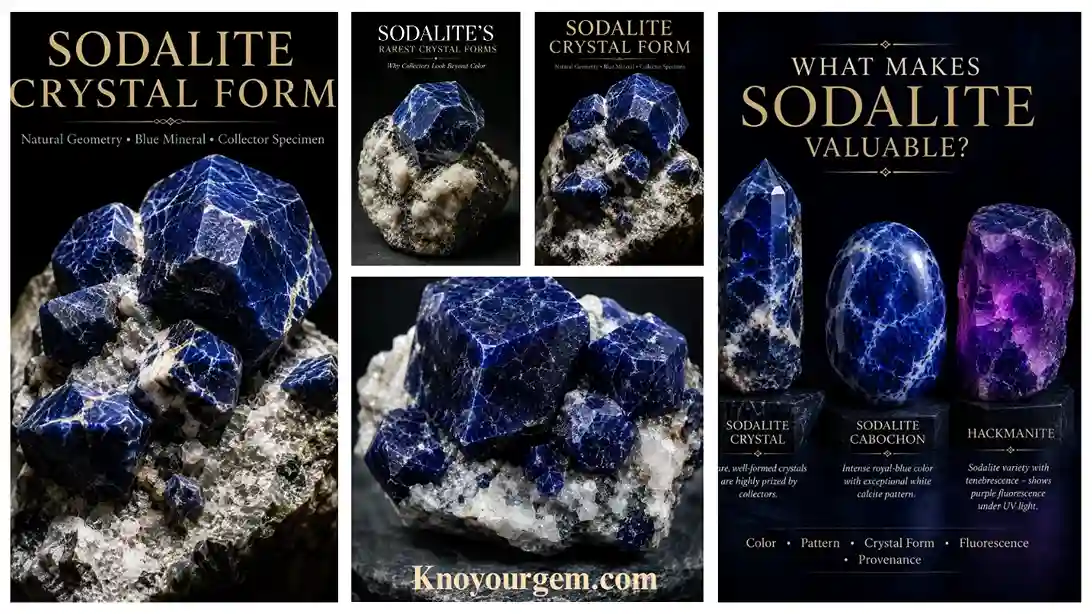
Sodalite is a natural blue mineral a part of feldspathoid group; do not confuse it as lapis lazuli. The stone has rich royal-blue color, with a mixture of white streaks of calcite, and sometimes it even glows under UV light.
The stone forms in certain kinds of volcanic rocks with low silica. Especially nepheline syenite and phonolite. Enthusiasts love to see it on their jewelry and it is also popular among collectors who desire to own it as decorative stonework.
Sodalite is a mineral species Na₄(Al₃Si₃O₁₂)Cl. Sodalite is not the name of the rock lazurite, which consists predominantly of lazurite and other minerals.
It totally depends on its colors, condition, origin, fluorescence, and crystal that together form a piece of sodalite can either be a cost-less jewelry object. So a significant geological mineral specimen, or a valuable collectable.
A Brief Overview:
| Property | Sodalite facts |
|---|---|
| Mineral group | Feldspathoid; sodalite group |
| Mineral class | Tectosilicate |
| Formula | Na₄(Al₃Si₃O₁₂)Cl |
| Trace elements | Sodium, aluminum, silicon, oxygen, chlorine |
| Crystal structure | Cubic |
| Habits | Massive, granular, compact; rare dodecahedral crystals |
| Color variations | It displays colors like Blue, violet blue, gray blue, white, grayish, greenish, yellowish |
| Mohs Scale | 5.5–6 |
| Refractive Index | About 1.48 |
| Specific Gravity | About 2.14–2.40 |
| Luster | Vitreous to greasy |
| Transparency | The stone is transparent to opaque but commonly it is found as translucent to opaque |
| Cleavage | Poor to indistinct |
| Fracture | The stone carries uneven to conchoidal fractures. |
| Fluorescence | Variable; some specimens glow orange under UV |
| Notable variety | Hackmanite, a color-changing sodalite variety |
| Main uses | Jewelry, carvings, decorative stone, mineral specimens |
Sodalite is named for its composition – the sodium. It can form rare crystals with a dodecahedral form due to its cubic structure; however, lapidary material usually exists as massive blue mineral intergrown with calcite, nepheline, feldspar, or other associated minerals.
Properties, Composition & Formation:
Mineral Classification:
A feldspathoid’s family member Sodalite forms in silica-deficient environments, and therefore it is found in igneous rocks which don’t carry quartz.
Feldspathoids are rarely grown as like feldspars in structure, but they generally result from high-magma with insufficient silica to produce quartz.
The diagram is used for identification. “Sodalitic blue quartz” is a commercial name that can refer to a mixture of decoration material, but not a formal sodalite. This mineral and quartz rarely crystallize at the same silica-saturated igneous conditions.
Chemical Composition:
The stone is chemically composed as Na₄(Al₃Si₃O₁₂)Cl. It means that the stone contains sodium, aluminum, silicon, oxygen, and chlorine.
Since small amounts of other elements or impurities can generally change the look of this stone and affect its color that the stone glows under UV light. And the way it appears with other minerals is also reasonable.
The blue crystal is considered as one of a number of related luzurite-hauyne-nosean minerals, which belong to other sodalite-group minerals. Though sometimes quite similar in appearance, they can differ widely in chemistry, geology, and value to the collector.
Physical and Optical Properties
Sodalite is 5.5 6Mohs, softer than quartz and not as durable for daily rough use. It has poor cleavage, uneven to conchoidal fracture, a refractive index of approximately 1.48, and relatively low density.
Polishing the stone is very good, but it will show scratches over time, and it will chip at thin edges. Rounded cabochons, beads, earrings, and pendants are generally better to exposure to rings.
How Sodalite Forms?
As we said, the stone occurs in sodium-rich and silica-poor alkaline rocks like nepheline syenite or phonolite. It can also possible that the stone can be found in metasomatic rocks where chemically active fluids have altered the composition.
Moreover, nepheline syenite is considered as the most significant rock this stone. And the occurrence of this stone generally indicates silica undersaturation of the magma, which is totally different from granitic or quartz-rich pegmatitic rocks.
Appearance, Crystal Form & Colors:
What Is Sodalite Like?
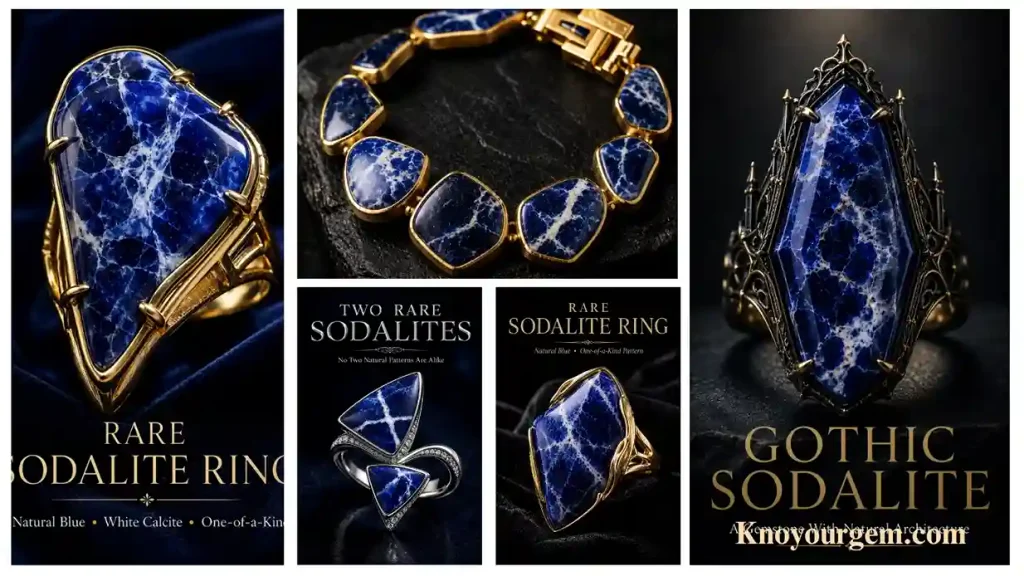
Light-colored sodalite exists in medium to dark blue with random veins, clouds or patches of white calcite. But occasionally the stone looks in violet-blue, gray-blue, white, gray, greenish, yellowish, or colorless.
It usually well suits jewelry material because in jewelry the stone will look more dazzling with its blue color under normal light outside, which is structurally stable and easy to polish. Its dark pieces almost appearing as black in typical indoor light; however, very pale material can look washed out or gray.
Blue, Violet-Blue and White-Veined Sodalite:
Blue shades of sodalite from denim to royal and navy blue. Violet-blue material may have an underlying purple hue. White veining is mostly calcite. Other minerals may accompany.
A white matrix is not necessarily a defect. Uniform blue is to be desired in beads and matched jewelry, and can be attractive in cabochons, carvings, spheres, and web slabs.
Massive Sodalite and Crystals:
The stone is mostly found as massive or granular, but its crystals are found in a dodecahedral form. Its massive material is used for beads, cabochons, carvings, and other decorative stone.
Its crystals appreciable for their value, which exceeds the jewelry material. Collectors can prefer a crystal of certain form with sharp faces, matrix, fluorescence, localities, and provenance over a uniformly blue color.
Why is sodalite blue?
Due to the presence of related color centers and structural features, the stone usually glows blue. And its intensity of blue can generally be different but depends on the composition, presence of defects, natural inclusions, and the light under which this stone is viewed.
Its blue color doesn’t individually prove its identity because the stone also looks like Lapis lazuli, dyestuff of howlite or magnesite, blue glass, blue topaz, dumortierite-studded cluster of quartz, or other decorative material.
Locations and Princess Sodalite Mine:
Sodalite has been found in alkaline igneous deposits in many localities globally: Canada, Brazil, Greenland, Afghanistan, Russia, Namibia, Myanmar, and the United States.
Different compositions of either massive material, crystal material, fluorescent material, or associated minerals could be found from any of the localities.
Particularly, Canadian stones are most famous and look very beautiful compared to other origins. Decorative sodalite native to the Bancroft area of Ontario. Such kind of blue stone is characterized for carving, lapidary, decorative stone, and educational collections.
Princess Mine:
The name for this stone is usually taken from the name of Princess Sodalite Mine. It was a source of this stone in the Bancroft-area deposits in Ontario, Canada. Its significance occurs in the alkaline silica-deficient nepheline syenite of this area, which offered the proper chemical conditions for considerable deposits of the mineral to be developed.
Princess Sodalite: This material was well known as a blue decorative and lapidary material, not as a source of well-formed large isolated crystals. An asserted mine source should be accompanied by a label, invoice, older collection record, or other documentation from a reputable seller.
Sodalite Varieties, Fluorescence & Hackmanite:
Blue Sodalite and Trade Names:
“Blue sodalite” is a descriptive trade name, and it is possible that sunset sodalite is a trade label for mixed-colour material. Sunset sodalite can contain varying combinations of orange, peach, pink, yellow, grey and blue patches, but it is not a well-defined mineral variety.
Use of the terms “sodalitic blue quartz” and “sodalite-bearing blue granite” should also be regarded as material definitions and not specific mineral names; ask what minerals are really there.
Is Sodalite Luminous?
Some of its pieces glow orange or pink under UV light, but many pieces glow only a little or not at all. Since this glow hinges on the tiny elements that together make the stone.
Collectors usually use fluorescence as extra information; however, it is not an exact way to identify sodalite. Sometimes its glow comes from other minerals like calcite; white real sodalite from another place can’t glow at all.
Hackmanite: Color Changing
It is a special kind of sodalite that changes its color when it is exposed to UV light. Some of its pieces generally shift to violet, purple, blue, or pink shades, but the effect is usually not very strong. After exposure to UV light, its colors fade to black.
Tenebrescence is different from fluorescence. Fluorescence is a glow that occurs when the UV light is on, whereas tenebrescence is a color change that remains after the UV light is turned off. Not every fluorescent sodalite is hackmanite. Not every blue sodalite glows.
What makes a collector want it: response strength, reversibility, crystal form, locality, state of preservation, fluorescence, documentation. In addition to displaying a bank of stock images, a seller should always show the actual specimen in its pre- and post-exposure conditions and post-fade.
How to Identify Sodalite?
Sodalite identification is much more than just a blue stone with white veining. To make a proper evaluation, an integrated approach using visual, physical, and optical properties, as well as microscopical, UV, mineral inclusions, and collecting lab results is needed.
Practical Identification Checklist:
- Search for naturally occurring blue, violet-blue, gray-blue, and white calcite-rich patterning.
- Note unsymmetrical mineral grain texture, no uniformly glassy nature.
- Observe the white calcite veins and indicate whether no metallic pyrite or metallic pyrite exists.
- Expect hardness below quartz; do not scratch the finished jewelry.
- For example, sodalite has a low 1.48;
- Look at its relatively low specific gravity weight, close to 2.14- 2.40;
- Only rely on UV fluorescence as corroborative evidence.
- Inspect drill holes and cracks for concentrated dye.
- Ask if it is either a pure sodalite or sodalite-bearing rock.
- Send for professional testing if costly, unusual, or in dispute materials.
Laboratory Identification:
Gem experts identify this stone while testing their refractive index, specific gravity, microscopy, spectroscopy, Raman spectroscopy, and X-ray diffraction. But the choice depends on whether the sample is a cabochon, bead, crystal, or hackmanite.
Testing can be justifiable if the seller asserts a unique locality origin, untreated natural color, extraordinary fluorescence, or a possible hackmanite Tenebrescence. These testing methods can also help if a blue material can be lapis lazuli, dye, glass, or a mineral.
Natural Sodalite, Imitations & Treatments:
Common Imitations:
Types of common sodalite mimics: dyed howlite, dyed magnesite, blue glass, blue jasper, dyed quartz stones, and other blue stones. Copycats are not necessarily bad, but should never be offered as untreated sodalite.
Dye may be very brightly contrasted in pores, breaks, drill holes, or surface crazing. Blue glass may have a very even appearance and, when viewed with a magnifier, is often seen to have bubbles or flowing bands of colour.
Treatments and Enhancements
The stone may be dyed, stabilized with resin, surface-coated, filled or repaired in order to enhance color, polish or durability. Although most material may be untreated, an image of untreated material cannot be relied upon unless identified by the seller.
What was pale or porous material can often be made to look richer blue using dye. Stabilization of weak rough for cutting will sometimes strengthen the stone, but it alters the natural state and affects handling requirements.
Treated pieces may be worth less to collectors but can make relatively inexpensive material more ready for use in jewelry.
Inclusions, Veins & Matrix:
White calcite veins, native matrix, grain boundaries, and associated minerals are typical in sodalite, and these may enhance or detract value depending on the purpose.
Collectors can generally appreciate its unusual matrix and mineral combinations. Jewelry purchasing becomes more interesting for stable material that lacks open fractures, feeble chalky seams, or unstable margins. So surface cracks of the stone can retain dirt and be more prone to chip.
Sodalite vs Lapis Lazuli:
Both are two different varieties. Sodalite is a mineral species, whereas lazurite is a rock. Lapis lazuli typically carries lazurite as its major component and comes with some calcite, pyrite, diopside, mica, and other minerals.
| Feature | Sodalite | Lapis lazuli |
|---|---|---|
| Material type | Mineral species | Rock |
| Main blue component | Sodalite | Lazurite |
| Normal pattern | Blue with white calcite veins; | Blue with calcite and formation of possibly pyrite. |
| Pyritic metal | Usually absent pile of rectangular fragments, not quite rectangular and not quite natural. | Often present, but not always. |
| Main setting | Alkaline silica-poor igneous rocks; | metamorphosed carbonate-rich rocks |
| Standard market position | Generally cheaper | Fine material is generally more expensive. |
| Hardness | About 5.5-6; varies | Generally around 5-5.5 |
The most obvious visual marker is the white calcite present in sodalite, and the metallic pyrite seen on lapis lazuli. It is, however, not a definitive indicator of purity or imitation for poorer or heavily veined material.
It is also exclusive of blue calcite, as the latter is softer; blue quartz, which is harder; dumortierite-containing quartz, where the host mineral is quartz; and finally lazurite, as it is the principal blue mineral of lapis lazuli.
Sodalite Value, Price & Quality
What is a Sodalite Worth?
Sodalite pricing structures are not generally set as per carat but they depend on whether the stone is sold in rough condition, beads style, cabochons and carvings, collectors stone, specimens, or a final piece of jewelry.
The price is dependent upon color, saturation, pattern, size, polish, transparency, condition, origin, locality, provenance, fluorescence, treatment, craftsmanship, and other variable factors.
| Material type | Major value factors |
|---|---|
| Rough | Color, soundness, size, locality |
| Tumbled stones | Polish, color, design, size |
| Beads | Color matching, the quality of the drills used, disclosure of treatment |
| Cabochons | Blue saturation, polish, stability, patterns |
| Carvings | Stone quality, design, finish, condition |
| Jewelry | Metal, workmanship, protection of setting, quality of gemstones |
| Mineral | Crystal in shape, the groundmass, sample locality, light on fluorescing areas or samples provenance |
| Hackmanite | Teneberscence (photolonization variations and response strength): condition of the tenebrescent state. |
Value vs Price
Mineral value, gemstone value, specimen value, retail price, wholesale price, jewelry price, collector value. These are not interchangeable; a polished pendant can have low mineral value but high retail value due to the silver, designer, labor, and luxury branding.
Some exceptional sodalites will be desirable to collectors but may have little utility for jewelry purposes. It’s better to compare like with like when comparing material- for example, a bead bracelet cannot be used as a comparison for a fluorescent piece of documented material.
KnowYourGem Quality Framework:
| Grade | Characteristics |
|---|---|
| Outstanding | Dazzling color or unique crystal shape; pristine; remarkable provenance, fluorescence, or hackmanite reaction |
| Fine | Beautiful blue or design; stable material heavier than fine or poorer grade; good polish; appropriate for quality jewelry or collection |
| Commercial | Moderate color or readily apparent veining; serviceable polish; common beads, carvings, and cabochons |
| Low grade | Dull, heavily fractured, unstable, badly polished material, overdyed material, or material insufficiently disclosed. |
Gem-quality stone is the most appropriate material for its purpose. A stable medium blue cabochon may be more suitable for a ring than an unstable rich blue one, and a pale responsive hackmanite crystal is a more important addition to a collection than an otherwise uninteresting dark blue rough.
Sodalite Jewelry & Buying Advice:
Jewelry Suitability:
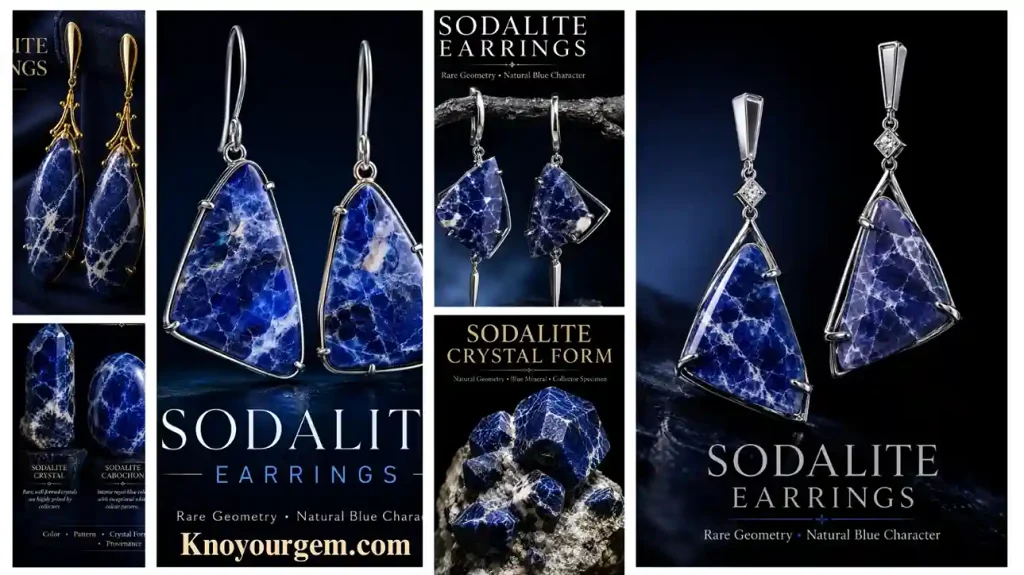
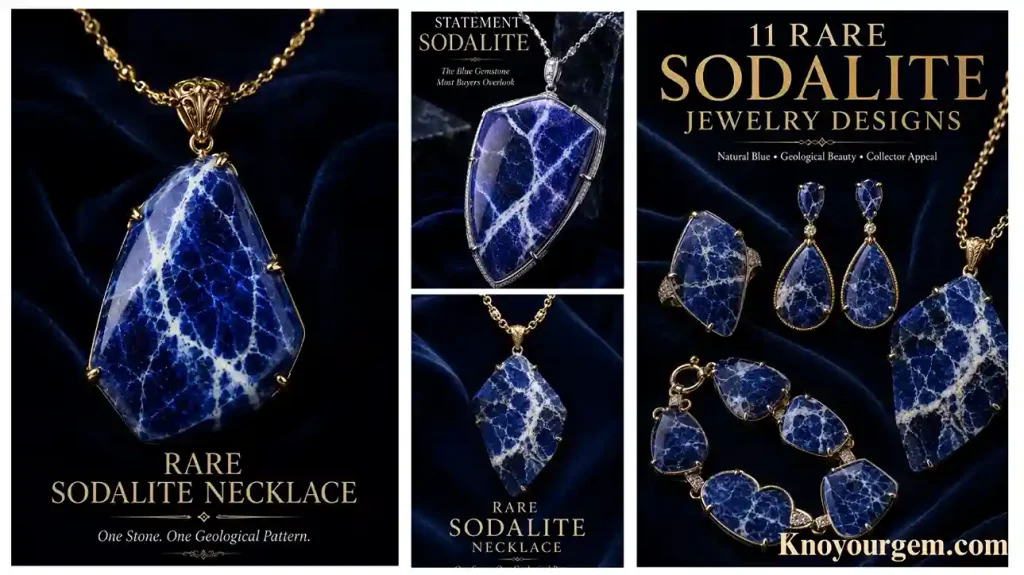
The stone is well-suited to be worn as earrings, pendants, necklaces, brooches, beads, and occasional-wear rings, not suitable for daily-wear jewelry. It has 5.5-6 Mohs scale, which makes it softer and prone to chip or scratching quickly.
Jewelry wearers should use bezel, recessed, or lower-profile settings for everyday-usable rings. Sodalite engagement rings are not commonly appropriate for daily wear because polish can be dulled, or the stone can be damaged or chipped during normal hand wear.
Choosing Sodalite:
Soundness, Color, Use of polish & disclosure of treatment, appropriateness for designed use. Assessment of whether the stone is worn as a jewelry piece or in the natural light for open fractures, weak seams, chalky patches, and fine thin edges.
Beads inspect drill holes for cracks and dye concentrations. Cabochons – inspect for a carefully balanced pattern, even polish, and a stable dome. Collectors – look for features such as locality, crystal form, fluorescence, response of hackmanite, matrix, condition, and documentation.
Questions to Ask a Seller:
- Is this sodalite in its natural state, rock containing sodalite, or something else blue?
- Was it dyed, stabilized, coated, filled, or patch repaired?
- Which place, which locality, do we say is appropriate?
- Is there evidence to the extent that the locality is suited for that task?
- Is it the exact sample that fluoresces, or tenebresces?
- Are the white veins calcite or any other minerals?
- Do any surface-reaching cracks or fractures exist in the stone?
- Do you have any daylight shots and a return policy?
Sodalite Care And Maintenance:
- The stone generally needs to be cleaned with lukewarm water; for dust removal, you will need of a soft brush, and for patting dry, it needs to be done with a soft cloth.
- Keep away harsh chemicals and steam cleaners from the stone, as they can dull or chip softer stones.
- Keep away this stone from prolonged soaking in saltwater; don’t apply perfumes, avoid ultrasonic cleaners, or bleach exposure because they are harmful to soft minerals.
- The stone should be stored separately from other harder stones. A padded or lined compartment is recommended.
Sodalite Meaning & Spiritual Symbolism:
Spiritual practitioners link this stone with open communication, peaceful thought, truth, intuition, and expression. This blue mineral is usually attributed to the throat chakra, while others predict the third eye chakra.
These are not effects recognized by medicine, but beliefs held by reputable sources in alternative medicine, or by the individual. This blue specimen has no recognized diagnostic, therapeutic, or preventative qualities with respect to physical or mental health.
Sodalite: Some of individuals are believed to use it during meditation, writing in a diary, preparing for public speaking, or reflecting. An easy one-liner affirmation: ‘I speak truth, I listen attentively, I decide with a clear mind’.
Modern guides often refer to sodalite as being associated with Aries or its corresponding sign in the zodiac; however, it is not a registered birthstone. Associations between the properties of various crystals, such as amethyst, tiger’s eye, citrine, black tourmaline or clear quartz, are based on artistic symbols and are not based on proven energetic pairings.
Mining, Provenance & Collecting:
Sodalite is obtained from deposits in sodalite-bearing alkaline rocks by quarrying/mining techniques appropriate to the deposit. Environmental & ethical issues include site disturbance and waste rock; water management; worker health & safety; legality of extraction; costs of transportation and rehabilitation.
Provenance is most critical to collectors and for high-value specimens. Well-documented specimens will have country, mine or district, date of purchase, labels, collecting history, UV, photographs, invoices, treatment information, and lab reports if applicable.
Sodalite is a great collectible, and using fair commercial material as an investment should be avoided, other than outstanding hackmanite, unusual crystals, noted historical material, vivid fluorescence, superb matrix, and sound provenance.
Quick Questions Answers:
1. Is sodalite rare?
Although Sodalite is not that uncommon, it appears to be confined to certain alkaline geology. Good specimens of fine bluish material, usable hackmanite, and noted crystal specimens are more desirable than normal massive rough.
2. Is sodalite expensive?
Much of sodalite is inexpensive. It is more likely to be expensive if it is rare hackmanite, a fine crystal specimen, has excellent fluorescence, has the best provenance, or is expertly made designer jewelry.
3. Does Sodalite glow?
A small amount of this stone glows in orange or pink under UV light, but most specimens do not showcase any glow in the dark.
4. What is hackmanite?
Hackmanite is a kind of sodalite that generally fluctuates its color when it is exposed to UV light. It is totally different from normal fluorescent sodalite; its color-changing property can stay visible even after the UV lamp is removed.
5. Is sodalite durable enough for everyday wear?
Sodalite would be more appropriate in a pair of everyday earrings and maybe a protected pendant. I do not think Sodalite would be the best choice for a high-impact ring or bracelet, as it could scratch or chip easily.
6. As you learned in your lesson, can sodalite go in water?
Light rinsing with water is fine for solid untreated sodalite. Do not soak for long periods in water; do not soak in salt water or use aggressive chemicals or hot water.
7. How can I tell if a sodalite is genuine?
You should compare the natural mineral texture and white calcite across transparency and veins. Although its hardness is less than quartz, it has low RI, LOW SG, and possible UV response.
8. Is the sodalite the same as the lapis lazuli?
No. Both are different minerals; lapis lazuli is a rock group that generally contains predominant lazurite. But sodalite is a mineral with higher white calcite veining rather than pyrite, which lapis carries.
9. Is sodalite a recognized birthstone?
No. Sodalite is not an official modern birthstone but could be included on an alternative crystal or zodiac birthstone list. Common sodalite is not a good investment. Do not buy it 10. Marine. It is one of the least wanted species.
10. Is sodalite a safe bet?
Ordinary sodalite is not a ‘good’ investment. Instead, buy it for its loveliness, geology, jewelry uses, or collecting.
Sources & Expert Review:
Mineralogical Sources
- Sodalite classification according to Mindat for chemical formula and mineralogical context. mindat Academic and Museum Sources.
- University of Waterloo Earth Sciences Museum information on sodalite name, its formation in nepheline syenite, and the Canadian Bancroft-area setting. Gemological and Collector Standards.
- Methods for measuring refractive index, specific gravity, and assessing the stone microscopically, treatment disclosure, UV response, durability, and laboratory identification are as follows:
Original Evaluation Framework:
Identification checklist in series with all others: the heading should be the recipient identification, and for any request for any series with all others, add the sender identification on the second line and the name and telephone number of the sender on the third line.
For all other series, add the sender identification in the sender reference box and the name and telephone number of the sender on the third line.
Always verify this Gem with trusted Labs like GIA, IGS, SSEF for authenticity, RI, SG, and Mohs:
KamilHussain{Gem Enthusiast}

Welcome to KnowYourGem.com! your ultimate destination for uncovering the fascinating world of gems and their secrets! I'm Kamil Hussain, a passionate blogger with a Master’s degree in Economics, dedicated to bringing you insightful, well researched content that blends the beauty of gemstones with the art of storytelling. With a keen analytical mind and a love for discovering hidden treasures, I created this platform to help you explore the brilliance, history, and value of every gem.

