
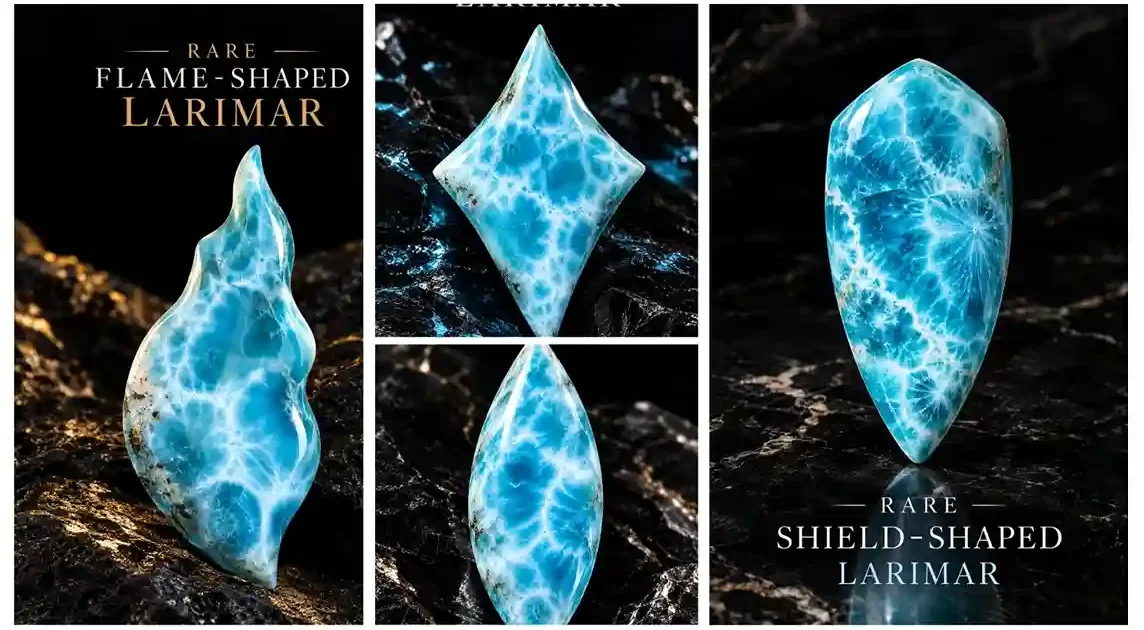

QuickPick:
Larimar crystal advantages can all be summed up into a select group of old notions such as tranquility, emotional stability, more efficient expression of oneself, and meditative concentration being linked to its soothing blue tones. None of that is medically established.
It’s tradition, not evidence, and I’ll say that plainly throughout rather than blur the line the way most crystal content does.
Larimar, by the way, is a rare blue variety of the calcium-rich mineral pectolite, and virtually all of it originates from a single volcanic pocket in the Dominican Republic. For starters, before we get into the meanings and metaphysics, it’s good to know exactly what you’re working with:
What Is Larimar Stone?
Larimar: a commercial name for a pale to sky-blue turquoise variety of pectolite (NaCa 2 Si 3 O 8 (OH). Plain pectolite shows up white or gray in volcanic rock all over the world and nobody looks at it twice.
The blue color that made Larimar a name in its own right comes from copper stepping in for calcium in the mineral’s structure, and that particular substitution shows up in gem quantity in exactly one place.
Is Larimar a Crystal or a Stone?
Both terms are used interchangeably in the trade, and neither is necessarily correct. Larimar is a mineral species of pectolite, and in use in jewelry, the terms “crystal” and “stone” are solely sales terms, not mineralogical classifications.
Its actual crystal habit, for what it’s worth, is fibrous and radiating. Not the big clean single crystal people picture when they hear the word.
Is Larimar Quartz?
No. Larimar is not quartz. It’s a blue variety of pectolite has different species, different composition, different everything.
Why Is Larimar Called a Crystal?
Mineral describes the chemistry and structure. Crystal describes the atomic arrangement (Larimar’s is triclinic). Gemstone describes material once it’s cut for ornamental use. Larimar checks all three boxes depending on which one you’re asking about.
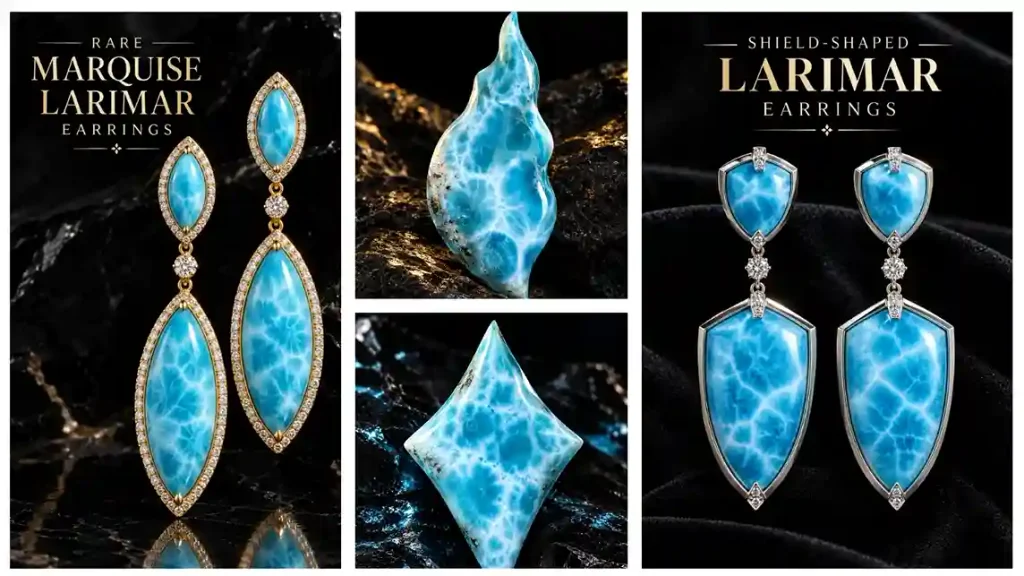
Larimar Crystal Benefits:
Everything below traces back to color, and to what people have projected onto that color over the past fifty years.
None of it is documented. It’s belief, carried through crystal-healing practice that is worth knowing about, not worth mistaking for fact.
1. Calmness and Relaxatio: The pale, oceanic blue reads as calming, the same way blue tones generally do across design and color psychology.
2. Emotional Balance: Said to steady emotional swings, especially during stressful stretches.
3. Communication and Self-Expression: Associated with the throat chakra in traditions that have it. It is said to facilitate clearer, more confident speaking.
4. Meditation and Mindfulness: Its cool tone and semi-translucent quality makes it a common object to have in meditation.
5. Spiritual Reflection: Loosely connected to the “Atlantis stone” nickname is more on that below.
6. Compassion and Emotional Openness: Believed to soften emotional guardedness.
7. Inner Peace: The one you’ll see repeated most across crystal-healing writing. General, and vague on purpose.
8. Intentional Daily Practice: Wearing or carrying it as a physical nudge to pause and return to an intention.
What Are Larimar Benefits According to Crystal Traditions?
Here’s the part most competing articles skip: these eight are beliefs, full stop. Presenting them as facts is misleading.
Presenting them as a long-running belief system that plenty of buyers find genuinely meaningful stones that are accurate, and that are the frame this whole article sticks to.
Larimar Healing Properties: What Science Says
Does Larimar Have Healing Properties?
No scientifically demonstrated healing properties. The “healing stone” reputation comes entirely from crystal-healing tradition, which is a belief system rather than a body of clinical evidence.
Is Larimar a Healing Stone?
“Healing stone” describes how a stone is used within crystal practice. It isn’t a medical category. No scientific or regulatory body classifies gems by healing capability, and Larimar isn’t an exception to that.
Larimar Crystal Health Benefits: What Is Actually Known?
Nothing. Larimar hasn’t been shown to have any therapeutic effect on any condition or illness. If holding it makes someone feel more relaxed than if they weren’t holding it, I think that’s much more likely to be due to the same effect you’d expect from any similarly mindful ritual object, rather than anything specific to this mineral.
Does Larimar Have Side Effects?
The stone itself, none. The real practical concerns aren’t medical:
- Skin contact is generally fine, so check the metal setting for sensitivities, not the stone.
- Physical care matters more than people expect, because of the cleavage issue covered below.
- Substitution risk is the one caution worth taking seriously: don’t let crystal practice replace actual medical care for a real condition.
Larimar Benefits and Meaning:
What Does Larimar Symbolize?
The sea, mostly. Its color range starts from pale sky blue through deep volcanic blue, laced with white veining that reads like shallow Caribbean water, and that’s exactly the association people reach for.
Why Is Larimar Associated With Peace?
Partly visual, partly cultural. Cooler blues are broadly linked to calm across color psychology and crystal tradition alike, and Larimar leans into that harder than almost any other blue gemstone because it looks so much like ocean water.
Larimar and the Ocean:
Coming from a Caribbean-bordered country doesn’t hurt the association, and the patterning that wave-like white webbing against blue does a lot of the work on its own.
Larimar’s “Atlantis Stone” Association:
Sometimes sold as the “Atlantis Stone,” with claims tying it to the lost city. That’s modern spiritual marketing, not documented history or geology. The real story is a Caribbean volcanic deposit rediscovered in the 1970s that doesn’t need the embellishment.
Larimar Crystal Astrology & Zodiac:
Which Zodiac Sign Is Larimar Associated With?
There isn’t a definitive answer to this. The zodiac signs most frequently associated with the last decan of Aquarius are Pisces, with a sign of other potential influences varying depending on your source (Aquarius, Cancer, and even Leo all showing up at times). This is just a matter of weighing different beliefs, not based on three-dimensional clarity.
Larimar and Pisces:
In modern astrology, where Pisces is associated with Neptune, the water sign is paired most compatibly due to the color, and the pair’s historical association with intuition and emotional receptivity.
Larimar and Aquarius:
Other traditions pair it with Aquarius instead, framed as bringing calm to a sign known for restlessness.
Larimar in Astrology and Birth Charts:
Not a recognized traditional birthstone, and it has no fixed slot in classical Western birthstone charts. Any zodiac pairing you find reflects one author’s system, not a standard.
How to Choose Larimar According to Your Zodiac Sign?
If you’re just selecting it for a zodiacal link, as I said before, that it is just personal or symbolic, as people keep ruby as their birthstone, and that is not a scientific fact.
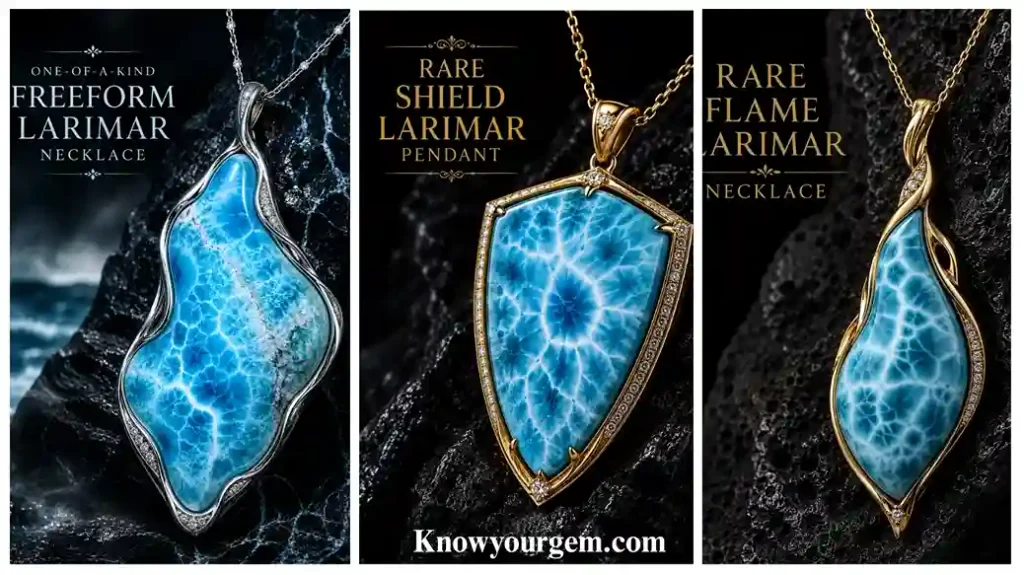
Larimar Crystal Energy:
What Does “Crystal Energy” Mean?
A metaphysical term describing a stone’s believed vibrational or symbolic quality. Not measurable. Not the scientific use of the word “energy.”
Larimar Energy in Crystal Traditions:
Within that framework, Larimar carries a “cooling” or “calming” energy-consistent with the color associations already covered.
How People Use Larimar for Intention Setting:
Usually holding the stone briefly while stating an intention, wearing it during something specific (meditation, a hard conversation), or just keeping it somewhere visible as a reminder.
Larimar Bracelet & Jewelry Benefits:
Larimar Crystal Bracelet Benefits:
Bracelets dominate Larimar jewelry for a practical reason as much as a symbolic one: the wrist takes fewer direct hits than a finger.
Benefits of Wearing Larimar:
Within crystal practice, wearing it rather than just owning a specimen is about proximity and consistency. A convenience argument, not a physiological one.
Can Larimar Be Worn Every Day?
Yes. If you get it right. Larimar is about 4.5 to 5 on the Mohs scale, softer than quartz and much less hard than sapphire or diamond.
That alone would call for some care. But the bigger factor is one people miss entirely: perfect cleavage in two directions. Cleavage means the stone can split cleanly along specific internal planes if it’s hit at the wrong angle, a structural risk that has nothing to do with overall hardness.
I’ve sourced enough of this material to say the failure pattern is predictable. A Larimar ring in an open prong setting gets knocked against a countertop, a car door, a gym weight- exactly the edge-on impacts that trigger cleavage damage and the stone splits.
For everyday wear, a bezel setting (metal wraps around the girdle) or a halo (raised metalwork surrounds it) is ideal. Both eliminate almost all direct contact, and if you’re going to wear it regularly as a ring, have the jeweler specify one of those settings. Don’t just assume they’ll provide it.
Larimar Bracelet vs Pendant vs Ring:
| Format | Practical durability | Best for |
|---|---|---|
| Bracelet | Moderate knock exposure | Everyday wear, normal care |
| Pendant | Lowest impact exposure | Safest option for daily wear |
| Ring (open setting) | Highest risk zone | Occasional wear only |
| Ring (bezel/halo) | Risk meaningfully reduced | Daily wear, done right |
Is Larimar Crystal Rare?
Where Is Larimar Found?
One deposit: Los Chupaderos in the Sierra de Bahoruco near Barahona, Dominican Republic.
Why Is Larimar Associated With the Dominican Republic?
Not a branding choice but is a geological one. The blue, copper-colored pectolite that qualifies as trade-name Larimar has only been found in commercial quantity at this one location.
There are occasional reports of similar blue pectolite turning up elsewhere, but by trade convention, material from outside this deposit doesn’t carry the Larimar name.
Is Larimar Found Anywhere Else?
Plain white or gray pectolite, yes, worldwide. The blue gem-quality variety, no, commercially, it’s single-source.
Why Is High-Quality Larimar Difficult to Find?
Most rough comes out pale, heavily included, or drowned in white webbing that kills the color. Rough with even, saturated blue clean enough to actually facet, not just cab, is genuinely scarce.
In my own sourcing, I’d put well-saturated facet-grade Larimar among the hardest facetable materials to find clean; by my own working ranking, I’d call it roughly the third-hardest facet-grade material I deal with, behind a couple of other notoriously scarce colored stones.
That’s a personal trade benchmark from sourcing experience, not an official industry ranking take it as one buyer’s read on the market, not gospel.
Why Is Larimar Crystal So Expensive?
What Determines Larimar Value?
Color is where most buyers stop looking, and that’s the mistake. A real evaluation weighs:
- Color saturation and hue: Deep, even volcanic blue over pale or grayish tones
- Pattern: Attractive wave-like white webbing adds value; muddy or chaotic patterning takes it away
- Clarity and inclusions: Fewer disruptive cracks
- Cut quality: Precision cabbing, and rare, skillful faceting where the rough allows it
- Size: Larger clean pieces are scarcer than the size difference alone would suggest
- Hardness and cleavage risk: Denser, more compact rough handles cutting and wear better
- Treatment status: The majority of Larimar is untreated, but softer or porous material can generally be wax or resin stablished and should be disclosed.
- Ethical sourcing and documentation: These are traceabilities back to the single Dominican source
- All of the above together: No single factor confirms fair value or authenticity on its own
Is Dark Blue Larimar More Valuable?
Usually, yes, but evenness and pattern matter alongside depth of color, not instead of it.
Are White Patterns Good or Bad?
Depends entirely on execution. Attractive, wave-like white against blue adds value. Blotchy white that swallows the blue takes it away.
Is Larimar a Good Investment?
Not in the conventional sense, and nobody should buy a gemstone on a promise it’ll appreciate. My own view, for what it’s worth: well-cut, well-saturated faceted Larimar sits in a different category from typical cabochon material genuinely rare, hard to source, collectible in a way commercial-grade stones aren’t.
I’d call faceted pieces a reasonable collectible alternative for buyers who already understand gemstone collecting. Not a guaranteed return. Buy it for the stone.
Current Larimar Price Guide:
| Grade / form | Typical price range | Notes |
|---|---|---|
| Commercial cabochon (pale–medium blue) | $10–$35/ct | Most common jewelry-grade material |
| Fine cabochon (saturated, strong pattern) | $35–$80/ct | Premium color and pattern |
| Rough, mixed grade | Varies widely by lot | Auction and wholesale pricing fluctuates |
| Faceted, gem-quality | Priced per stone, often at a real premium over cabochon material | Scarce enough to be negotiated individually |
| Finished jewelry (bracelet/pendant/ring) | $120–$1,200+ | Reflects type of metal, setting, and stone grade. |
| Independent lab certification | $40–$200 | Provides documentation, does not guarantee value |
These are general reference ranges, not fixed quotes, check current listings before any significant purchase.
What Is Larimar Good For?
| Purpose | Traditional use |
|---|---|
| Meditation | Focus object for reflection and intention |
| Communication | Throat-chakra symbolism |
| Relaxation | Calm-associated color and ritual |
| Spiritual practice | Meditation, personal ritual |
| Jewelry | Wearable symbolism, daily reminder |
| Mindfulness | Physical touchpoint for intention |
Is Larimar Good for Sleep?
Can You Sleep With Larimar?
Sure. No physical reason not to, beyond the usual jewelry caution about rings or bracelets catching or pressing overnight.
Where to Place Larimar for Sleep?
Certain customs involve placing a small piece on the night table or under the pillow at bedtime.
What Does Science Say?
Nothing clinical supports Larimar affecting sleep quality. Any reported benefit tracks with the placebo and ritual effect of a calming bedtime routine generally not anything specific to this stone.
Larimar Crystal Pairings:
- Larimar + Aquamarine: Both pale, oceanic blues; paired as a “deepen the calm” combination.
- Larimar + Amethyst: Combines Larimar’s calm association with amethyst’s traditional link to clarity.
- Larimar + Moonstone: Both tied to intuitive, reflective practice, popular for meditation work.
- Larimar + Clear Quartz: Quartz added as a “clarifying” or “amplifying” stone in tradition.
How to Choose a Larimar Crystal Pairing?
Pick based on the intention you’re building around, not on any claimed synergy between minerals. These are practice combinations within a belief system, not tested interactions.
Wearing it is the obvious one, and rings need protective settings as covered above. Beyond that: held during meditation as a tactile focus point, kept nearby while journaling as a ritual cue, displayed somewhere visible as a daily reminder, or held briefly while stating a specific intention. None of this is complicated and the value, if there is any, is in the consistency of the habit, not the mechanics of the stone.
Larimar Care, Cleansing & Charging:
How to Clean Larimar:
Lukewarm water, mild soap, soft cloth. Skip ultrasonic and steam cleaners entirely. The fibrous structure and cleavage planes make this stone genuinely vulnerable to vibration and heat stress.
Can Larimar Go in Water?
Brief exposure is fine. Long soaking isn’t recommended, especially on wax- or resin-stabilized material.
Can Larimar Go in Salt Water?
No. Skip salt-water cleansing rituals, salt is abrasive and can corrode surface polish and any preservative coating/fluid over time.
Can Larimar Go in Sunlight?
Brief exposure, fine. Prolonged heat and UV, no heat stresses a cleavage-prone stone, and in rare cases can contribute to fading.
How to Charge Larimar?
Nothing (such as moonlight exposure, intention-setting) was found to have any measurable impact on the mineral. No attempt should be made to attribute some sort of technical impact to such touches can consider it all a matter of personal practice.
How to Store Larimar Jewelry?
Individually from harder precious stones that can scratch it, possibly in a soft bag or lined compartment, out of the way of impacts received on it repeatedly.
Larimar Crystal Properties:
| Property | Value | What it means for buyers |
|---|---|---|
| Mineral species | Pectolite | (Larimar is a variety not a species) |
| Chemistry | NaCa 2 Si 3 O 8(OH) | The sodium calcium silicate hydroxide. |
| Independent of the crystal system; | Triclinic | This explains the fibrous, radiating habit |
| Mohs hardness | 4.5–5 | Softer than quartz needs protective settings matter, especially in rings |
| Cleavage | Perfect, two directions | The real durability risk is splitting on impact, not scratching |
| Luster | Silky to subvitreous | Typical of its fibrous internal structure |
| Transparency | Translucent to opaque | Fully transparent material is exceptional |
| Specific gravity | ~2.7–2.9 | Relevant for lab ID, not something buyers check directly |
| Refractive index | ~1.59–1.64 | Confirms species identity in testing |
| Formation | Hydrothermal cavities in volcanic basalt | Explains the nodule habit rather than large crystal masses |
| Origin | Single deposit, Dominican Republic | The direct driver of its scarcity and pricing |
Real versus fake: the most popular fakes are dyed howlite and dyed magnesite, often sold as Larimar to novices. Dyed material has a tendency to gloop color in fissures and surface depressions, and appear brighter and more uniformly glossy (ie soft entry to plastics) than Larimar does.
Larimar and blue howlite: Howlite is softer (around 3.5Mohs) and accepts the dye lazily, and often the dye is showing through another color like white or gray.
Larimar versus turquoise: Turquoise is tougher (6-), is more matte/waxy, and does not contain the white veining characteristic of Larimar.
Larimar vs chrysocolla: More banded/botryoidal structure in chrysocolla, has a more blue-greenish appearance.
Can a photo prove it’s genuine? Not reliably. A photo can flag likely red flags, but confirming authenticity on anything valuable really needs an in-hand look from an experienced gemologist, or lab testing. Useful for a first check, not a substitute for verification.
The Biggest Buyer Misconception:
The injustice I witness most often is when buyers compare Larimar on the basis of darkness or saturation of the blue and assume the darkest stone is best or most expensive. Color does matter, but on its own it says very little about a fair price.
A dark blue stone, heavily fractured internally, unclear, or unidentified, or not documented whatsoever, can very quickly be a much worse buy than a lighter, clearer, more well-documented stone.
Rarity of color, clarity, cut, adequate setting, disclosures of treatment, origin, and documentation all provide undeniable proof of value. Color is just one factor, not the only one, and those consumers who focus solely on depth of color are only those consumers who end up paying top dollar for stones they will regret in the end.
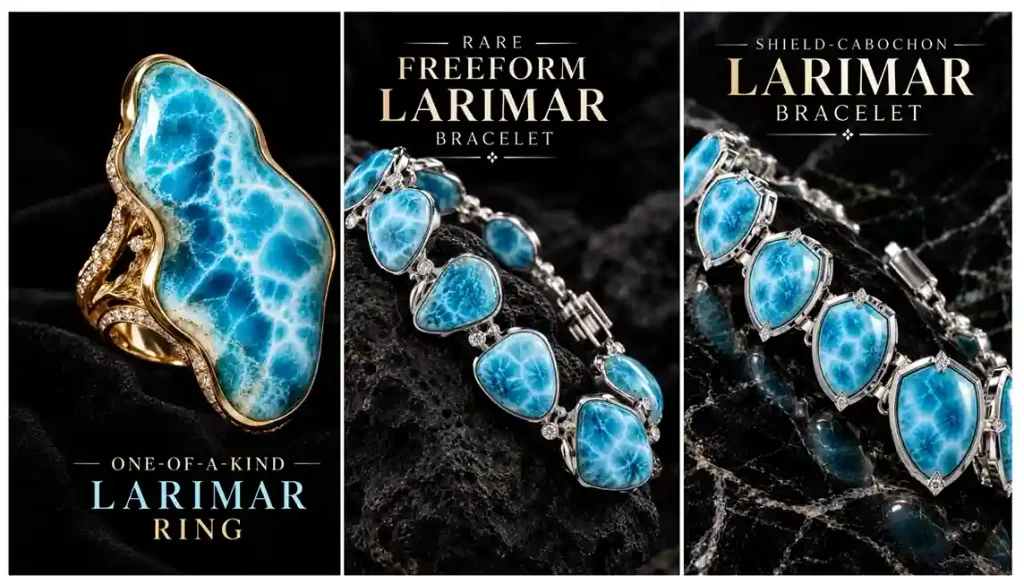
Buyer Checklist:
- Confirm it’s genuine Larimar (pectolite), not dyed howlite or another imitation.
- Weigh color, pattern, and clarity together never color alone.
- Ask directly whether the stone has been wax- or resin-stabilized, and get it in writing.
- Check the setting rings need bezel or halo protection given the 4.5–5 hardness and perfect cleavage.
- Request documentation or certification on any significant purchase.
- Confirm sourcing back to the Dominican Republic deposit.
- Compare price against the current per-carat ranges for the grade you are purchasing.
- Avoid skipping ultrasonic cleaning or exposing to extended sunlight, heat or salt water after purchase.
1. What are the main Larimar crystal benefits?
Commonly associated with calm, emotive consensus, communication, and meditative focus, belief-based, not medically established.
2. Does Larimar have healing properties?
No published, scientifically proven healing properties. Carried over from the crystal healing tradition.
3. Is Larimar a healing stone?
A metaphysical classification in the use of crystals, not a medical term.
4. What is Larimar good for?
Meditation, symbolism of communication, relaxation rituals, and jewelry with individual significance.
5. Can Larimar be worn every day?
Yes, in a nice chain as a pendant or in a nice chain as a bracelet; rings need having a bezel or a halo setting because of the hardness and cleavage.
6. Is Larimar rare?
Yes. One is a deposit in the Dominican Republic, and clean, well-saturated facetable material is extremely rare.
7. Why is Larimar expensive?
Color, pattern, clarity, cut, size, treatment condition, and recorded place of origin all are known never is it just one.
8. Is Larimar a crystal or a stone?
Terms are loosely used; geologically speaking it is a form of pectolite with a triclinic structure.
9. Is Larimar quartz?
No, a completely different mineral pectolite.
10. What zodiac sign is Larimar?
Generally Pisces, with Aquarius and Cancer appearing in certain traditions. No definite nor tenable answer.
11. Is Larimar good for sleep?
There is no scientific evidence that it affects sleep; some use it as part of a calming bedtime ritual.
12. What crystals work well with Larimar?
These cover the base materials used more regularly; aquamarine, amethyst, moonstone, and clear quartz.
13. Can you sleep with Larimar?
Yes, perhaps with basic jewelry precautions.
14. Where does Larimar come from?
Very similar sample to; Lost Chupaderos deposit, nearly fully developed close to Barahona, Dominican Republic.
15. What is Larimar made of?
Sodium calcium silicate hydroxide(pectolite), exhibiting a blue coloration as a result of copper substitutions.
16. Is Larimar valuable?
Good-color, well-documented material, especially faceted stones, can be truly worth something; commercial cabochons are extremely cheap.
17. What are Larimar bracelet benefits?
The accustomed calming and communicating symbolism, and entirely real pragmatic durability edge over the rings.
18. Can Larimar go in water?
Brief water exposure is normal, but soaking it in salt water for long-time, and using ultrasonic cleaners are usually considered bad.
19. How do you clean Larimar?
Use lukewarm tap water with a mild soap and a soft cloth. Never use ultrasonic or steam.
20. Is Larimar scientifically proven to heal?
No. There is no scientific evidence that supports any healing claims for Larimar or any other Crystal.
Verify such rare gemstones with trusted labs like GIA, IGI and IGS for authenticity! Gemstone Expert and Enthusiast KamilHussain!

Welcome to KnowYourGem.com! your ultimate destination for uncovering the fascinating world of gems and their secrets! I'm Kamil Hussain, a passionate blogger with a Master’s degree in Economics, dedicated to bringing you insightful, well researched content that blends the beauty of gemstones with the art of storytelling. With a keen analytical mind and a love for discovering hidden treasures, I created this platform to help you explore the brilliance, history, and value of every gem.

