


Quick View: Orange gemstones are naturally occurring minerals and organic Orange materials which display warm hues from pale tangerine to the deep reddish to orange. Trace elements like manganese, iron,, and chromium create these colors. Top examples include Spessartine Garnet, Orange sapphire, fire opal and Citrine. Primarily these gems range from affordable to investment grade, with Padparadscha sapphire that command the highest prices.
Most popular orange gemstones:
The world of orange colored gemstones are more diverse than most buyers t realize. From deep burnt Amber to electric tangerine, these gemstones span multiple mineral families, hardness levels, and price points. Given below the breakdown of every major variety you should explore.
1. Spessartine Garnet:
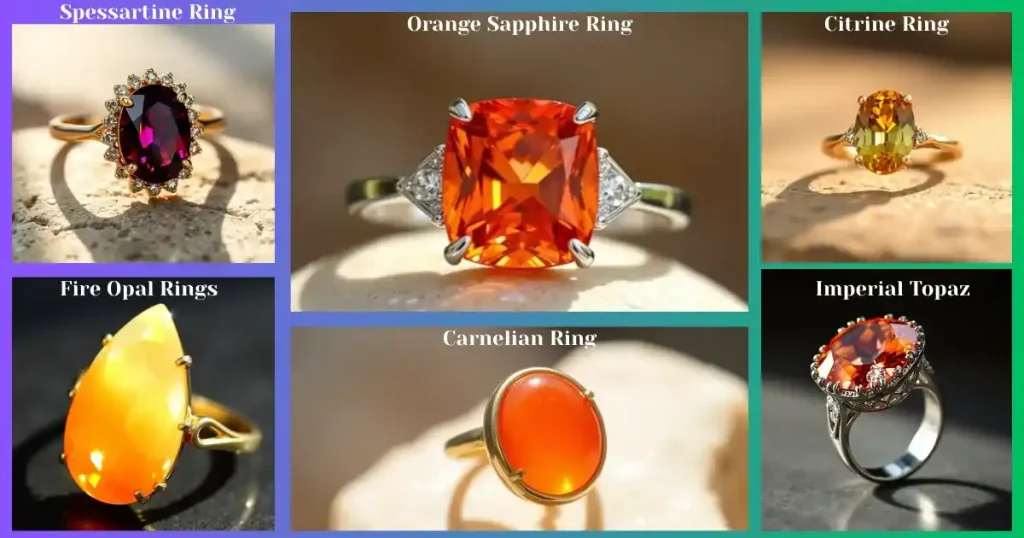
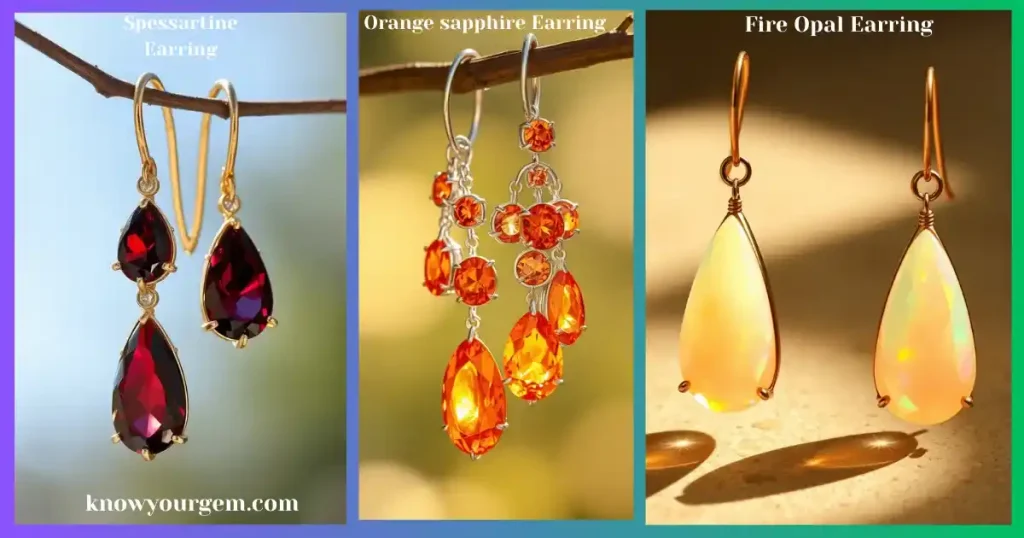
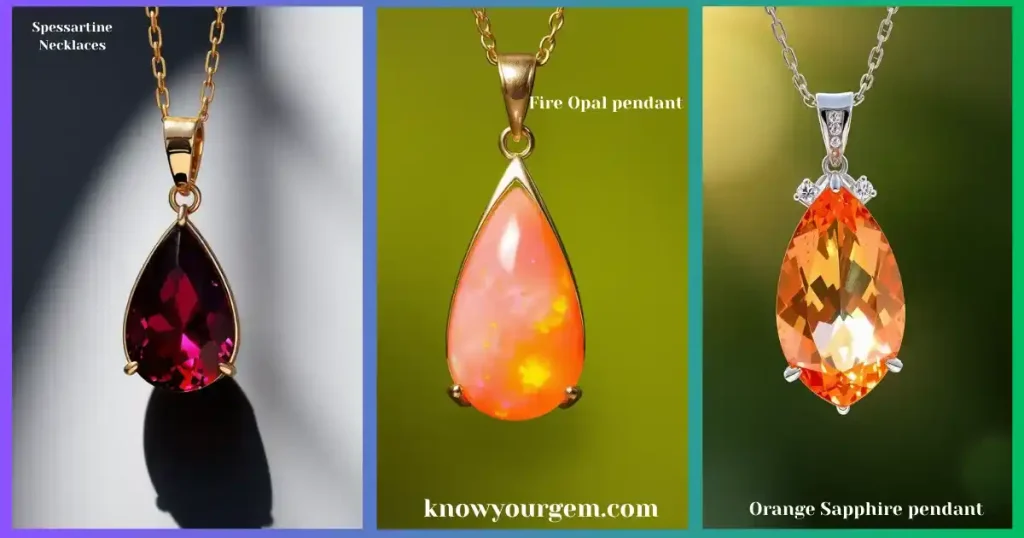
Spessartine Garnet is often called orange garnet which relates to the garnet group with having chemical formula Mn₃Al₂(SiO₄)₃. Its signature warm to vivid orange color comes directly from manganese, that’s why gemologists often describe it as a manganese rich garnet. Spessartine garnet owns 7-7.5 mohs scale of hardness which tells us that it is durable enough for daily rings, pendants, and bracelets with the reasonable care.
Key properties:
- The stone owns refractive index like, 1.79-1.81
- Its primary ethical sources are Namibia, Nigeria, Madagascar, Sri Lanka
- The transparency is eye clean transparent to slightly included
- The treatment status of the gem is almost always untreated, that adds to its appeal
Vivid orange Spessartine from Namibia, sometimes called “Mandarin garnet” commands strong collector demand. Investment potential ranks medium to high for fine well saturated specimens more than 3 carats. An orange garnet gemstone with no visible inclusions and deep tangerine saturation is considered a serious collector piece.
2. Orange Sapphire:
Orange sapphire relates to the corundum family as like ruby and blue sapphire belong to the same. The stone owns 9 mohs scale of hardness which tells us that orange sapphire gemstone is durable enough for daily wear jewelry and also more tougher than other orange gemstones. Since orange color sapphire results from the combination of iron and chromium that interacts within the crystal lattice.
Since, Padparascha sapphire is the rarest and most valuable variety of sapphire. It is named after the Sinhalese word like, lotus blossom. The stones showcases a delicate mixture of orange and pink because of its rarity and beauty, it commands very high prices at auctions, with authenticity which is certified by institutions like GIA SSEF.
Key properties:
- Orange sapphire own the same hardness 9 mohs scale which regular sapphire own
- Its ethical origins are Sri Lanka, Madagascar, Tanzania
- Heat treatment is common and acceptable if it is disclosed.
- The gem owns highly graded investment, especially for unheated, certified stone.
An orange sapphire gemstone in an engagement setting offers outstanding daily wear durability, and its rarity relative to the blue sapphire that makes it increasingly attractive to collectors who are seeking for distinctive pieces.
3. Fire Opal:
Fire Opal is translucent to transparent variety of opal. It is valued for its vivid body color like, yellow-orange to deep red-orange. The stone is not same as the precious gemstones because it doesn’t always display play of color, but its value often comes from its pure , saturated body tone alone. The gem composes of amorphous hydrated silica, which it lacks a crystalline structure.
The source Mexico dominates world fire opal production, particularly the states of Querétaro and Jalisco. Whether Australian fire opal also exists but remains rare and commands different price. An opaque orange gemstone version exists in the lower grade material, but the most valuable fire opals are transparent with a rich tangerine glow.
Key properties:
- Fire opal own 5.5-6.5 mohs scale of hardness
- Water content: 6–10%
- Transparency: Translucent to transparent
- Sensitivity: Heat, low humidity, and harsh chemicals can damage it
Fire opal jewelry whether set as an orange gemstone necklace or pendant which requires protective settings due to its relative softness and sensitivity to dehydration.
4. Citrine:
Citrine is a variety of Quartz which displays colors range from pale yellow to the deep brownish orange. Thus, natural Cirtine gets its color from iron impurities within the silicon dioxide crystal structure because truly natural deep orange citrine is rare, much of commercial supply is produced by heat treated Amethyst or smoky quartz, a standard industry practice that must be disclosed.
Citrine is one of the most commercially available orange semi precious stones on the market, that makes it an accessible choice for orange gemstone jewelry at entry level price. Despite being a commercial stone, fine natural Citrine with deep reddish orange color has legitimate collector interest.
Key properties:
- Citrine owns 7 mohs scale of hardness
- Its refractive index is like, 1.544-1.553
- The stone is frequently heat treated
- Its primary sources are Brazil, Spain, Madagascar, USA
5. Imperial Topaz:
Imperial topaz is mostly treasured variety of topaz, which showcases rich orange to orange-red colors with pink or golden highlights. It is found almost exclusively in Brazil’s Ouro Preto mines, it has been treasured for various centuries. Not same as common blue topaz, fine imperial topaz with having vivid saturation is rare, highly sought after by collectors, and often at major auction houses.
Key properties:
- Imperial topaz ranks 8 on the mohs scale of hardness
- It has refractive index of 1.619-1.627
- The stone is ethically originated from Brazil
- Some stones are coated, untreated stones command premium prices.
6. Orange Spinel:
Orange spinel the most underappreciated stone among expensive orange gemstone. It offers an exceptional brilliance due to its isometric crystal structure and single refraction, which produces a clean, bright appearance free of the double effect which is seen in many other gemstones. It makes fine orange spinel especially desirable is its typical absence of treatment, most spinel reaches the market in its natural state.
Mahenge spinel from Tanzania produces some of the most saturated reddish orange material available anywhere. As buyer awareness grows, top quality orange spinel continues to appreciate in value.
Key properties:
- Orange Spinels rank 8 on the mohs scale of hardnes
- It is generally not treated
- Its primary sources are Tanzania, Myanmar, SriLanka
- It investment trajectory is rising rapidly
7. Carnelian:
Orange carnelian is a chalcedony colored by iron oxide, that showcases warm shades from peach-orange to the deep reddish-brown. It was used since, ancient Egypt for jewelry and amulets, it is valued for both beauty and ease of carving. Not like many gems, carnelian is consistently translucent to opaque with a soft waxy luster.
Key properties:
- Carnelian owns 6.5-7 mohs scale of hardness
- Its color cause, iron oxide
- It is translucent to opaque
- Its value is decorative and affordable
Carnelian has became a favorite in orange gemstone jewelry, it is often featured in artisan bracelets and pendants. Its warm, earthy glow makes it especially popular in bohemian inspired designs.
8. Additional notable orange gemstones:
Several other stones deserve recognition in any complete orange gemstones list:
- Orange Tourmaline: It is a member of complex boron silicate group, orange tourmaline is rare as compared to pink or green varieties. Its color results from iron and manganese interactions and its pleochroism gives its shifting visual depth that depends on viewing angle.
- Orange Moonstone: It is a feldspar variety that displays adularescene, orange moonstone produces a glowing inner light in warm peachy-orange tones. Stones from India and Madagascar dominate supply.
- Orange Zoisite: While zoisite is well recognized for tanzanite, its orange-tuned varieties that exist and are valued in collector circles, particularity from East African deposits.
- Orange Coral Gemstone: Coral, is born from tiny marine polyps, and is polished into beads and cabochons that carry deep cultural meaning. It has long been valued in Tibetan, Italian, and Native American jewelry, but today, ethical source is vital to protect both the ocean and the tradition which is tied to this precious material.
- Orange Diamond: It is among the rarest and most priced orange gemstones. It derives its color from nitrogen related structural anomalies within the carbon lattice. The “Pumpkin Diamond,” a 5.54 carat fancy vivid orange diamond, is sold for millions at auction and remains one of the most famous colored diamonds ever certified.
- Orange and white Gemstone Combinations: Certain stone naturally showcase orange and white banding or zoning. These include agate, some jasper varieties, and occasional fancy sapphires. This combination of orange and white gemstone is famous in cabochon cutting for rings and pendants.
- Green and Orange Gemstone Varieties: Bi-color tourmaline and other garnets can also showcase green and orange simultaneously.
- Blue and Orange Gemstone Pairings: Blue and orange gemstones often appear together in a jewelry because of having beautiful colors which complement each other. Since, designers might pair a cool blue sapphire or topaz with the warm glow of orange spessartine or citrine, that create striking pieces full of contrast and balance.
What makes gemstones Orange?
While understanding the science behind the orange color in gemstones can help you to judge their quality and authenticity with the greater confidence. That vibrant glow isn’t random but it comes from mix of physical and chemical processes that are working together inside the stone.
Trace elements:
Orange color in gemstones born from the quiet work of infinitesimal elements within their crystal lattice. Manganese ignites the fiery brilliance of Spessartine garnet, whether ferric iron breathes golden orange into the Citrine, Carnelian, and certain sapphires. When chromium joins iron, it enriches corundum with a warm glow. The true depth of color lies in the balance, concentration and oxidation state shaping how vivid or subtle the orange becomes.
Crystal lattice defects:
Some orange gemstones develop color nor from foreign elements but from structural irregularities within their crystal lattice. These defects are recognized as color centers absorb certain wavelengths of visible light, that causes the stone to appear orange to the human eye. Irradiated topaz develops color through this mechanism.
Color centers:
Color centers are electron-vacancy pairs which are trapped within the crystal structure that selectively absorb light. In some orange diamonds, a combination of nitrogen aggregates and structural defects creates color responsible for the stone’s rare color. This mechanism is also relevant in some irradiation treated gemstones.
Optical Phenomena:
Various orange gemstones owe their visual appeal not to the bulk color but to optical phenomena. Since, fire opal’s brilliance comes partly from light interaction with its internal silica sphere structure. Whether, orange moonstone produces adularescene, a floating, billowing glow, through light scatter between feldspar layers. Aventurescene, the glittery metallic shimmer seen in some orange aventurine feldspar, results from light that reflect off aligned platelet inclusions.
Nitrogen in diamonds:
In orange diamonds, nitrogen atoms are grouped in specific configurations within the carbon lattice absorb blue and green light, that leaves orange wavelengths dominant. The particular arrangement of nitrogen atoms, rather than their mere presence determines whether a diamond appears yellow, orange, or brownish.
Orange gemstones comparison chart:
Orange gemstones use to glow with the heat, they get their colors from infinitesimal elements and crystal patterns that make them stunning. Collectors now value them for their beauty and their fascinating stories that are hidden in their chemistry.
| Gemstone | Mohs scale | Transparency | Primary Color Cause | Investment Grade |
| Orange Sapphire | 9 | Transparent | Iron plus Chromium | High |
| Padparadscha Sapphire | 9 | Transparent | Iron plus Chromium | Very High |
| Orange Diamond | 10 | Transparent | Nitrogen aggregates | Exceptional |
| Imperial Topaz | 8 | Transparent | Iron | High |
| Orange Spinel | 8 | Transparent | Chromium plus Iron | Medium-High |
| Spessartine Garnet | 7–7.5 | Transparent | Manganese | Medium-High |
| Orange Tourmaline | 7–7.5 | Transparent | Iron plus Manganese | Medium |
| Citrine | 7 | Transparent | Iron | Commercial |
| Carnelian | 6.5–7 | Translucent | Iron Oxide | Decorative |
| Fire Opal | 5.5–6.5 | Translucent | Internal structure | Medium |
| Orange Moonstone | 6–6.5 | Translucent | Adularescence | Low-Medium |
| Orange Coral | 3–4 | Opaque | Organic pigment | Cultural |
Natural vs. treated orange gemstones:
Treatment status directly affects value, and purchasers must have to understand what has and hasn’t been done to a stone before purchasing.
Heat treatment:
Heat treatment is the most common enhancement applied to orange colored minerals. Since, Citrine, in most commercial cases, begins life as Amethyst or smoky quartz and demands its orange color through controlled heating. Orange sapphire is frequently heat treated to improve color saturation and reduce inclusions. When it is properly disclosed , heat treatment is accepted by the trade however unheated stones always command significant premiums, especially in sapphire.
Irradiation:
Irradiation uses neutron, gamma, or election bombardment to alter an election states within a crystal, that produces or intensifies color. Some orange topaz derives its color through irradiation followed by heat stabilization. Lab induced color changes must always be disclosed, and certain irradiated colors are considered unstable under prolonged light exposure.
Diffusion treatment:
Lattice diffusion pushes infinitesimal elements, typically beryllium or titanium into the surface layers of a stone under extreme heat. Diffusion treated orange sapphires can showcase vivid color but the treatment layer is shallow. Standard gemological testing can detect diffusion, and buyers should always request certification from the GIA or equivalent ab.
Fracture filling:
Some stones with having surface reaching fractures are filled with the glass, resin, or oil to improve apparent clarity. This treatment is less common in orange stones than in emeralds, but occurs in lower grade fire opal and sapphire material.
Certification standards:
Any investment grade orange gemstone should carry a laboratory report from a recognized institution, the Gemological Institute of America Laboratories (AGL), Gübelin Gem Lab, or SSEF. These reports confirm identity, treatment status, and for top stones, geographic origin.
Orange gemstone price per carat:
Prices fluctuate with the market conditions, however the following ranges reflect current retail and wholesale benchmarks.
Entry level orange gemstones:
Citrine and orange carnelian embody the most affordable entry points, with quality Citrine which demands price from $10-$50 per carat at the retail and carnelian priced even lower for standard material. These stones suit budget conscious buyers who are seeking for orange gemstones jewelry without significant investment.
Mid range collector stones:
Fire opal from Mexico command prices from $50-$500 per carat which hinges on body color transparency and saturation. Whether, orange tourmaline commands prices like $100 to $800 per carat for clean, well colored material. Orange moonstone runs $30 to $300 per carat that hinges on adularescene intensity. However orange garnet commands $100-$1000 per carat for vivid Mandarin grade from Namibia.
High investment grade stones:
Imperial topaz from Brazil commonly commands prices from $500 to $3,000 per carat, orange, while orange spinal from Tanzania can command prices from $500 to $5,000 per carat if unheated, and orange sapphire touch prices from #300 to $3,000 per carat with premiums for natural, certified stones. In short, all three are valuable, whether spinel often commands the highest prices.
Auction grade stones:
Padparadscha sapphire embodies the pinnacle of the orange sapphire market, with the top unheated, certified stones from Sri Lanka commands prices like, $5,000 to $30,000+ per carat at the major auctions. By contrast, fine natural orange diamonds especially those who have graded “Fancy Vivid Orange” by GIA have reached more than $1000,000 per carat at Christie’s and Sotheby’s, that makes orange diamonds the most valuable gemstone category by weight.
What is the rarest orange gemstone?
Padparadscha sapphire is the rarest orange gem which can easily be found on market, its specific pinkish orange color and limited supply from Sri Lanka. Natural vivid orange diamonds are even rarer, but they exist extremely tiny numbers. Meanwhile unheated vivid orange spinel from Mahenge, Tanzania, is also an exceptional rare and highly valued.
Move forward these, certain orangish gem varieties including gem quality orange zoisite and orange grandite garnet, appear so infrequently in the market that they lack standard price benchmarks entirely.
Orange gemstone meaning & symbolism:
Orange gemstones own deep meaning from various cultures and centuries. You can explore the guide below that reflects to the traditional, historical, and metaphysical associations that offer for insight and inspiration, not as a medical or therapeutic claims.
Connection with sacral chakra:
The Hindu and yogic traditions says that the sacral chakra is associated with the creativity, emotions, and vitality. Since orange gemstones are often seen helpful to make you active and balance this energy center. That’s why stones like Carnelilan, Citrine, and Spessartine garnet are usually used in the crystal practices and they are connected to the sacral chakra.
Cultural and historical uses:
From various cultures and centuries, orange gemstones have carried powerful meaning. In ancient Across cultures and centuries, orange gemstones have carried powerful meaning. In ancient Egypt, carnelian had carved into amulets and scarabs, and people have believed that it offers courage and protection on both the living and the dead. Roman soldiers have worn carnelian signet rings engraved with a battle symbols, they were tying this stone to the strength and victory. In South Asia, orange gemstones hold astrological significance orange sapphire and hessonite garnet are central in Vedic traditions, they have thought to influence the moon’s nodes.
Symbolism of vitality and creativity:
Orange gemstones from various cultures symbolized with enthusiasm, warmth, confidence, and energy. Their warm solar hues connect them symbolically to the fire, the harvest, and life fore. An imperial topaz was historically called the “gem of the sun” in Brazilian indigenous traditions. Orange gemstone benefits in the traditional lore center on energizing, motivating, and supporting emotional resilience.
How to buy high quality orange gemstones:
Whether you are purchasing looking for an orange gemstone engagement ring, a collector piece, or simply a beautiful pendant, follow these steps to buy with the confidence.
1. Verify Origin Geographic origin significantly affects value in the sapphire, spinel, garnet. Sri Lanka sapphire and Namibian Spessartine command premium prices over material from lesser regraded sources. Request origin documentation for investment purchases.
2. Check Treatment Disclosure Always ask directly if a stone has been heated, irradiated, diffusion treated, or filled. Since reputable dealers disclose treatments proactively. Undisclosed treatment grounds for return.
3. Request Lab Certification For any stone which is pricier above $500 per carat, that require a certificate from GIA, AGL, Gübelin, or SSEF. Certificates from those sources confirm identity, treatment status, and for premium material, origin.
4. Evaluate Color Saturation In orange gemstones, color is the preeminent value driver. So, always look for vivid, evenly distributed color without brown or gray masking. The finest material displays a “pure” orange or reddish orange with no muddy undertone.
5. Consider Transparency and Cut For faceted stones like, sapphire, spinel, and garnet, own eye clean transparency significantly increases value. Cut quality affects brilliance and a well proportioned stone maximizes ligth return and color display.
6. Match Hardness to Intended Use An orange gemstone ring is worn on daily basis hardness of at least 7 mohs. Sapphire 9, spinel 8, and topaz 8 suit daily wear jewelry. Whether fire opal 5.5 to 6.5 and coral 3.4 demand protective settings or occasional wear use only.
7. Source Ethically For organic stones like range coral gemstone, confirms the seller complies with CITES regulations that govern protected coral species. For all stones, ask about supply chain transparency and conflict free sourcing.
Care & maintenance:
While taking good gentle care of orange gemstone jewelry can help to keep its beautiful lasting for future generations.
Cleaning guidelines by stone type:
Hardest orange gemstones like, sapphire, spinel, topaz, garnet, citrine and tourmaline need a gentle care, you you have to clean them with warm soapy water and with a soft brush. Ultrasonic cleaners are safe for sapphire, spinel, and clean garnet, but for stones with having inclusions.
Fire opal requires an extra care, so wipe it gently with a damp cloth and room temperature water only. It is must to keep away ultrasonic or steam cleaner, because heat can damage it. Orange coral also requires soft cleaning with cloth and it can get scratches if acids, perfumes be applied on it.
Orange moonstone should be cleaned with mild soapy water only and avoid ultrasonic cleaners because they can damage it internally and externally both.
Storage Advice:
Keep stored orange gemstones separately in fabric lined compartments or individual pouches to resist harder stones from scratch softer ones. Keep opals and coral away from the low humidity environments that sealed containers or storage alongside a small moisture absorbing silica packet can help to sustain stable conditions.
Protecting settings
Prong settings in orange gemstone rings and orange gemstone earrings should be inspected by a jeweler annually. Orange gemstones in bezel or tension settings demand less frequent checks. Remove orange gemstones jewelry before swimming, grading, or engaging in contact sports.
Recommendation:
Orange gemstones are captivating and vibrant choice for anyone who are looking to get warmth, energy, and creativity to their jewelry collection. You can see wider range of orange gemstones like, beautiful sunny citrine, stunning garnet, and dazzling orange sapphire, all these gems offer soothing for every style and budget. Their rich color is symbolized with passion, vitality, and emotional balance, that make them visually captivating and meaningful. Whether a set in rings, necklaces, or earrings of orange gemstones are looking beautiful with the integration of warm metals like gold and rose gold, creating pieces that truly give a unique look. We recommend these jewels for those people who are seeking for both beauty and symbolism.
Disclaimer:
The information that we have brought here related orange gemstones generally for informational and educational purposes. Whether, your efforts can score more better accuracy, we are giving any guarantees regarding the completeness, accuracy, or suitability of the content which is related to gemstones, their properties, treatments, or metaphysical meanings however for your satisfaction you can consult with trustable gem sources like, GIA, IGI for more convenient information which can enhance your confidence to make any purchasing decision.
FAQS:
1. Which gemstone is orange?
The popular Orange gemstones like, fire opal, spessartine garnet, citrine, orange sapphire, Padparadscha sapphire, sunstone, orange tourmaline, carnelian, orange zircon, and hessonite garnet. These gems are usually getting an orange color shade and also offering for those who are willing to get diversified jewelry with the addition of warmth and vibrancy to their jewelry collection.
2. What is an orange birthstone?
Fire opal is orange birthstone with having a vibrant color which exudes passion and creativity. While having its fiery color ranging from bright orange to red orange it is a popular choice of people to wear it on everyday.
3. What rock is orange in color?
Orange rocks are used to find in nature and are often caused by the presence of minerals like iron oxide, which gives them their distinctive color. Sandstone, Carnelian, and Orange Calcite are also considered as rock orange gemstones. Therefore, these rocks can be related to shade and intensity of orange, which are depending on the specific mineral composition and conditions under which they formed.
4. What is the most expensive orange gem?
Padparadscha sapphire is one of the most expensive gemstone worldwidely. While having a mixed unique pink color Padparadscha sapphire is looking brilliant and its exceptional beauty and rarity making it a high costly among the other gems.
5. What is the rarest orange crystal?
Orange River Quartz is generally considered to be the rarest orange gemstones or crystals producer. Thus, Miners are finding this unique crystal in the remote and rugged regions of the Orange River in South Africa. Hence Collectors and crystal enthusiasts give high value to Orange River Quartz for its vibrant orange color and exceptional clarity.
6. What is the most expensive orange gemstone?
Natural fancy vivid orange diamonds command the huge prices per carat from $1,000,000 per carat at auction. Padparadscha is the most expensive stone among various orange gemstones. It is commercially sold out in $30,000 plus per carat for certified, unheated Sri Lanka material.
7. What are the orange gemstone that are commonly used in jewelry?
Orange gemstones you will often see in jewelry suppose, citrine garnet, and carnelian, that are bright and popular choices. For something rarer, designers love orange sapphire and fire opal, with sapphire being especially used for engagement rings.
8. What are the orange gemstones names for everyday jewelry use?
For everyday jewelry. Some of the best orange gemstones are orange sapphire, orange spinel, imperial topaz, spessartine garnet citrine. Since each of these stones own 7 mohs scale of hardness which means that they are durable enough to handle daily whether still offer vibrant, eye catching color.
9. What is the orange gemstone meaning most commonly cited?
From several traditions, orange gemstones most consistently vitality, creativity, courage, and warmth. In Vedic astrology, specific orange gemstone astrology associations connect vary stones to planetary influences that affect confidence and prosperity.
10. Are orange gemstones good for engagement rings?
Orange sapphire and orange spinel make an excellent orange gemstone engagement ring choices because they own good hardness and durability. Orange garnet and citrine can work protective settings. Since, Orange garnet and citrine can work in the protective settings. Fire opal and moonstone demand careful mounting occasional wear consideration.
11. What is orange tourmaline, and how rare is it?
Orange tourmaline is a boron silicate gemstone which showcases orange colors because of iron and manganese interaction. It is rarer than pink or green tourmaline and commands mid rang of $100 to $800plus carat for fine material.
12. Is orange coral gemstone ethically available?
Ethical sources of orange coral gemstone demands CITES compliance, because many coral species are protected. Buyers must have to verify provenance and purchase only from dealers who provide documentation of legal harvest or confirmed vintage materiel.
13. What is the difference between orange garnet and hessonite garnet?
Both are garnet varieties, but orange garnet typically refers to Spessartine , whether hessonite is a grossular garnet with a warmer, more brownish orange tone. Hessonite features prominently in orange gemstone astrology within Vedic traditions as a stone that assocaites with Rahu.
14. Where can I find orange gemstones in Australia?
Orange gemstones from Australlian sources like, South Australia, and Western Australia. Australian opal fields produce some fire opal material, since, Mexican fire remains dominant globally.
15. What is the name of orange and white gem which is commonly seen in jewelry?
Agate and certain banded jasper varieties naturally produce orange and white gemstone patterns and are hugely used in canbochon jewelry. Some orange sapphires display color zoning with near colorless areas, that create a natural orange and white effect in certain cuts.

Welcome to KnowYourGem.com! your ultimate destination for uncovering the fascinating world of gems and their secrets! I'm Kamil Hussain, a passionate blogger with a Master’s degree in Economics, dedicated to bringing you insightful, well researched content that blends the beauty of gemstones with the art of storytelling. With a keen analytical mind and a love for discovering hidden treasures, I created this platform to help you explore the brilliance, history, and value of every gem.


