

Abstract:
“Green gemstone” is just a color. Each is its own different stone – emerald, peridot, jadeite, nephrite, green tourmaline, tsavorite, and chrysoprase – with its own advantages and challenges. And we’ve got a comparison of 35 green stones that can help you make the right choice and steer clear of the wrong one.
Quick picks: for a ring you’ll wear daily, look at green sapphire, tsavorite or good tourmaline. On a small budget, peridot, chrome diopside and green tourmaline give the most color for the money. For the classic look, buy emerald, but get a gemological report with it.
What Are Green Gemstones Called?
Each one goes by its own mineral or variety name, such as emerald or peridot. If a seller only says “green gemstone”, ask for the exact name, because the color alone tells you nothing about what you’re buying.
Gemstone, Mineral And Variety:
The terms trip people up, so here’s the short version. What is a mineral? A mineral is a natural crystal with a specific chemical formula, e.g., beryl. What is a gemstone? A gemstone is a mineral (or a rock) that has been cut and polished for use in jewelry.
What is a variety? A variety is a color (or type) which was given a different name (e.g., emerald for green beryl, aquamarine for blue beryl). “Jade” is odder still, since it’s a trade name covering two different minerals, jadeite and nephrite.
Why Stones Turn Green?
The reason is chemistry, and it’s less dramatic than you’d expect. A few stray atoms inside the crystal soak up some of the light passing through, and what’s left is what your eye reads as green. Chromium and vanadium do that job in emerald, tsavorite and chrome diopside.
For peridot, green sapphire and much of the green tourmaline it’s iron, but for malachite it’s copper – quite a different shade of green entirely. Change those atoms for other ones and suddenly you’ve got a whole new colour range: beryls, for example, could be emeralds in one stone and aquamarine in the next.
Natural, lab-grown and imitation:
Lab-grown emeralds are known for being perplexing to buyers, so make sure you understand what you’re getting. Lab-created emeralds are almost identical to natural emeralds in terms of chemical composition and crystal formation.
It’s true that the stone is an emerald, but since it’s a laboratory creation, vendors should disclose this fact and value the stone accordingly, lesser than a natural stone, and you can identify it through a gemologist.
Fakes are another matter. The usual suspects are green glass, dyed quartz, dyed chalcedony and doublets (two pieces glued together). Under the scope glass can have round bubbles and swirl marks, and a flat line at the edge for a doublet. Natural stones will have crystals, fingerprints or feathers; learning what to look for is worth the effort.
Green Gemstone Names: 35 Types to Know
We counted mineral species and varieties only, and left trade names out, so one material doesn’t get counted three times. Hardness is on the Mohs scale, given as a range because sources differ a little.
The popular ones. These are the stones most people mean when they say “green gem”.
- Emerald (beryl, 7.5–8): The classic. Usually included, and often oiled or resin treated.
- Peridot (gem olivine, 6.5–7): Olive to lime green, doubled back facets
- Jadeite (pyroxene, 6.5–7): The fine, translucent type of jade.
- Nephrite (amphibole, 6–6.5): The other jade, and very tough.
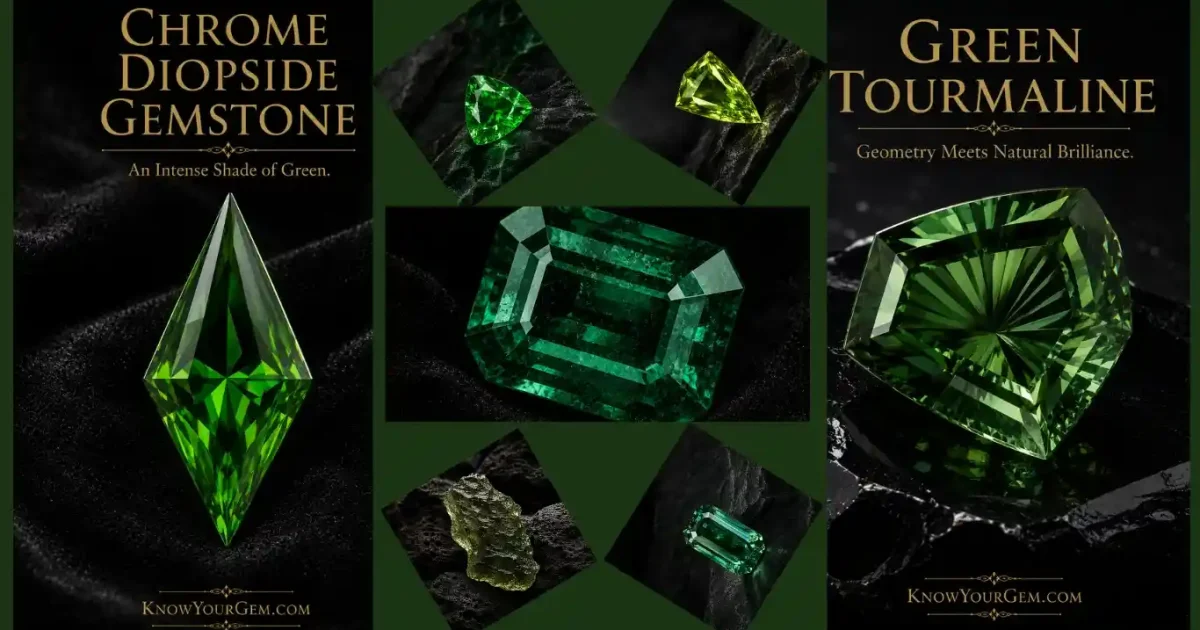
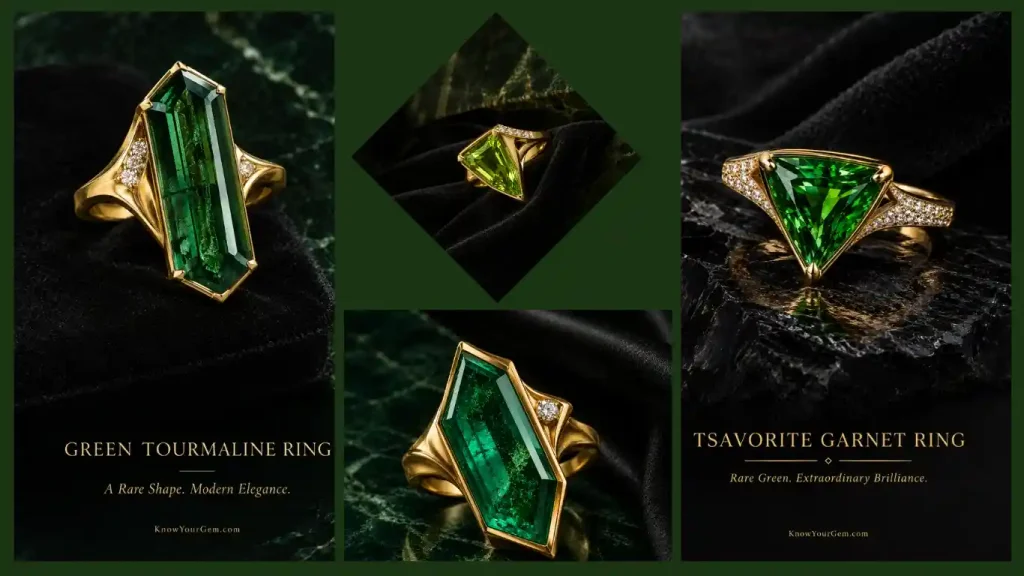
- Green tourmaline (elbaite, 7–7.5): There’s a broad range of green hues, but the deepest and most intense is chrome or vanadium green.
- Chrysoprase (chalcedony, 6.5–7): Apple-green hue from nickel, from opaque to translucent.
Rare and collector stones. Buyers usually find these after the popular ones stop satisfying them.
- Tsavorite (grossular garnet, 7–7.5): Intense green from Kenya & Tanzania, scarcely treated.
- Demantoid (andradite garnet, 6.5–7): Very high fire; often occurs with “horsetail” inclusions.
- Chrome diopside (5.5–6): Deep green, but it has cleavage.
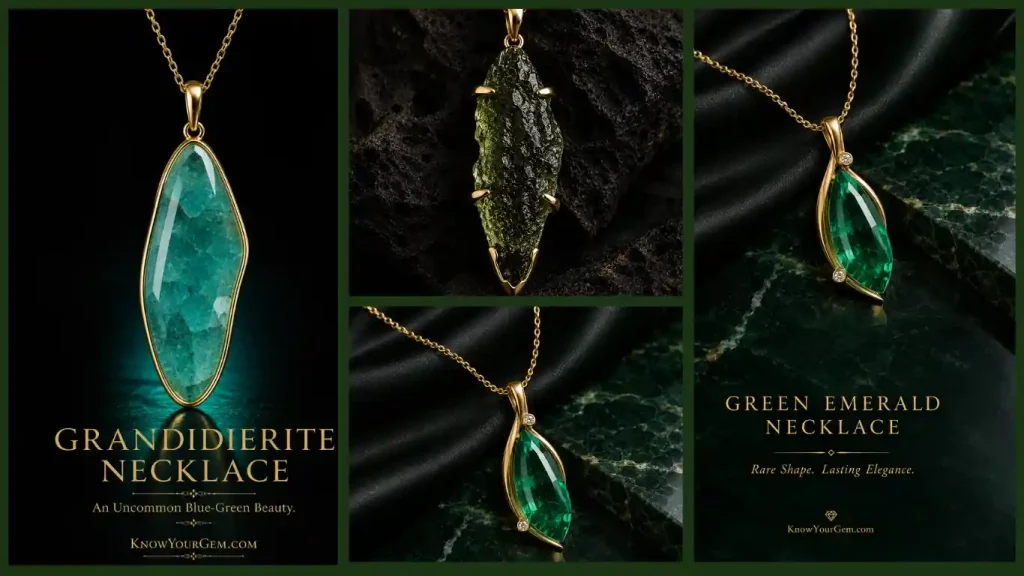
- Grandidierite (7.5): Usually bluish green, and very rare as a gem.
- Hiddenite (green spodumene, 6.5–7): Pale to medium green. Perfect cleavage means it can chip.
Affordable stones. These cost little, and a few of them are better than their price suggests.
- Green aventurine (quartz with mica, 6.5–7): Glittery and translucent.
- Serpentine (about 2.5–5.5): Soft, and sometimes sold as “new jade”, which is a misleading name.
- Prehnite (6–6.5): Translucent, quite soft yellow-green.
- Moss agate (chalcedony, 6.5–7): Transparent base with mossy green inclusions.
- Green jasper (6.5–7): Opaque, inexpensive, and tough.
Opaque stones. Light doesn’t pass through these, so their appeal is color and pattern.
- Malachite 3.5–4: Banded copper carbonate, soft, sensitive to acids.
- Variscite (3.5–5): A phosphate, and often confused with turquoise.
- Green turquoise (5–6): Generally stabilized or dyed.
- Bloodstone (chalcedony, 6.5–7): Dark green, red spots of iron-oxide.
Clear gems. Now we’re getting somewhere. This is how light travels through a stone so now cut and clarity come into play.
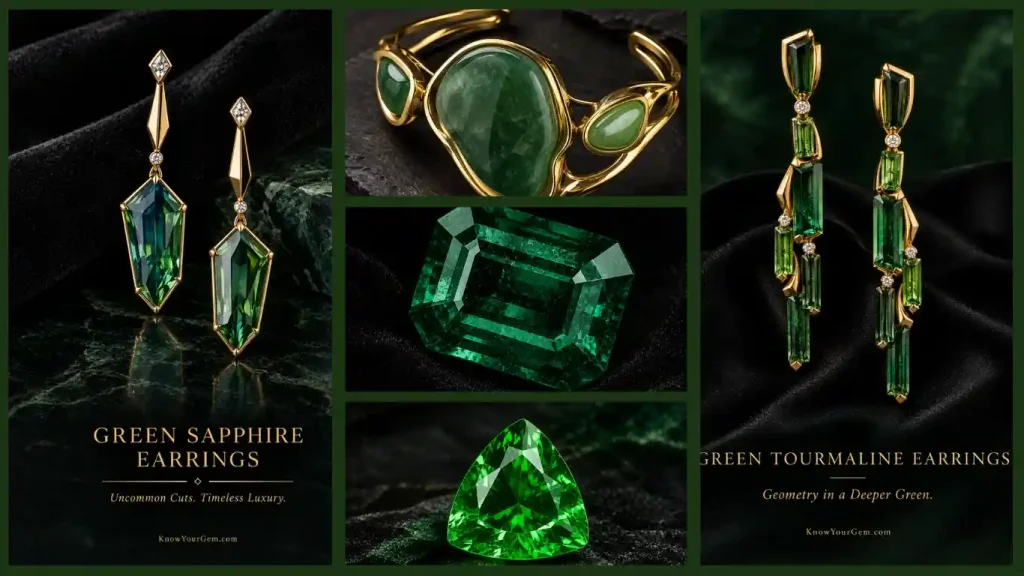
- Green sapphire (corundum, 9): Colored by iron. Coarse, rough and in many cases, heated.
- Prasiolite (quartz, 7): Green quartz that has been routinely heated to turn it from amethyst.
- Green apatite (5): Bright color, but soft.
- Green fluorite (4): Perfect cleavage, so it’s a collector stone rather than a ring stone.
- Green zircon (about 6–7.5): Hardness varies with natural radiation damage.
- Green beryl (7.5–8): Lighter than emerald and often cleaner.
Worth knowing. To make the 35 complete, these are less common but will be discussed.
- Alexandrite (chrysoberyl, 8.5): Green in the daylight, but red in incandescent light.
- Amazonite (feldspar, 6-6.5): A turquoise color of blue-green, cleavage.
- Dioptase (5): Strong green crystals that are very fragile.
- Chrysocolla (2–4): A soft blue-green copper mineral.
- Titanite or sphene (5–5.5): High fire, low hardness.
- Epidote (6–7): Dark pistachio green.
- Vesuvianite (6–7): Yellowish to olive green.
- Fuchsite (green mica, about 2–3): Usually sold as mica-rich quartzite.
- Maw sit sit (about 6.5–7): A jadeite-based rock with black patches.
What Do Green Gemstones Mean?
Across most cultures, green also means growth, renewal and luck, and none of that is based on any kind of science. That’s just custom – but it’s a good one.
The logic is simple. Leaves, forests and spring are green, so the color became a sign of life coming back, and plenty of languages use “green” for something fresh or young. The connection appears in places that never interacted – which is an indication of how natural it actually feels.
Particular stones picked up their own stories along the way. Emerald is associated with love, rebirth, and status, and ancient Egypt had emerald mines, often called Cleopatra’s mines, before royal collections later included some very large stones.
In China, jade has symbolized kindness and protection for thousands of years, and Māori pounamu or Māori jade – which is nephrite – was an important heirloom. Mesoamerican cultures prized jadeite. Peridot is linked with the sun and light because Egyptians mined it on Zabargad island, and in modern crystal circles, green tourmaline is considered a ‘heart stone’ while aventurine is known as the luck stone.
Gemology can measure hardness, refractive index, density and chemistry. It cannot measure healing or luck because the meanings are the stories people add to a stone. Revere them as culture don’t buy a healing story.
What is the best gift to give? The big milestones – emerald for anniversaries, peridot or green tourmaline for friends and birthdays, jade for family and longevity gifts.
Every culture has its own meaning for the color green, for instance Ireland where green is lucky and a prominent color, and Islamic culture where it is also very important (but read the culture first!). Mostly it comes down to the shade and story that matter to the wearer, and then making sure the stone can handle how it’ll be worn.
Which Green Gemstones Are Birthstones?
The regular May birthstone is emerald and the regular August one is peridot. Some lists add chrysoprase as another May option, and in 2016 the American Gem Society and Jewelers of America added spinel as an August alternative, with sardonyx as the older choice.
There are other options as well for if you would like something different. Garnet is for January and those which are green (rhodolite, tsavorite and demantoid) are also garnets.
Bloodstone for March, tourmaline for October, and June’s stone alexandrite is green in natural light. If you want to follow tradition give the official stone and if you want something more durable, cheap or different than give an alternative stone and inform the seller which list you are using.
Affordable Green Gemstones: Which Offer the Best Value?
Peridot, chrome diopside and green tourmaline Are the best choice for a more affordable green. Prehnite and green aventurine also sell at modest prices, and chrysoprase and moss agate cost even less, though they’re opaque.
To find a good emerald alternative my choice is tsavorite, as it is a lively green and normally cleaner. If you want more options, then green tourmaline, chrome diopside (deep green colour) and green sapphire (higher durability) are all good options. Each one echoes emerald in some way, whether in color, price or availability, but none matches it in every way, and that’s worth accepting going in.
Price comes down to a few things, and color leads. A rich, medium-dark, pure green gets the most. What about the clarity? They are less critical in an emerald than other stones, because inclusions are commonplace. Price is reduced if heavily treated, a big clean stone costs several times more per carat, and only origin might increase it when documented by a lab.
Indicative price comparison:
Method: These figures were collected on 29 October 2026 from published retailer and dealer price guides. They’re in US dollars per carat for faceted, mostly eye-clean stones of about 1–3 carats with good color. They’re asking prices, not sale prices or appraisals. There’s a range in each number because sources disagree, and retail prices vary.
| Peridot | 20–400 | Large premium stones can go above 1,000 |
| Chrome diopside | 10–150 | Larger fine stones are scarce |
| Green tourmaline | 40–500 | Chrome or vanadium types often 100–1,500 |
| Tsavorite | 500–8,000 | Rises sharply over 3 ct |
| Emerald (commercial) | 100–500 | Visible inclusions, usually treated |
| Emerald (good to fine) | 1,000 and up | Exceptional stones reach tens of thousands |
| Lab-grown emerald | 50–1,500 | By quality, much lower than natural |
| Jadeite (high grade) | 1,000–10,000 | Often priced by piece, not carat |
We didn’t find reliable public prices for demantoid, green sapphire or grandidierite, so we didn’t guess. Ask the seller for a current quote with a report.
If two stones appear identical, mount them under identical light – initially under daylight, and then under a jeweler’s lamp – and examine their identity, their handling, their weight in carats, their cut and their report. Two gems which look identical on a phone screen may prove to be far from similar when held in your hand.
Before you buy anything inexpensive, ask the seller for the exact gemstone name, whether it’s natural or synthetic and whether it’s treated, what documentation exists (get a gemological report on anything of real value), what the return policy is, and how the stone looks in more than one light.
Which Green Gemstones Are the Most Expensive?
Does any green gemstone always cost more than any other? No. Fine emerald, fine demantoid, rare green diamond and top-quality jadeite can all command high prices for their size and quality.
For emeralds, the drivers are color, tone, transparency, level of treatment and size, so an unblemished bright stone with limited treatment fetches far more than a bleached and heavily filled one.
Demantoids are prized for their fire and horsetail inclusions, tsavorites for their eye-popping color and scarcity of treatment, so one or the other can often sell for more than a very clear, average-sized emerald. Buyers want the rare stones with the best color and clarity, which don’t often appear together.
Rarity doesn’t guarantee resale value, though. A rare stone can have very few buyers, selling a niche stone can take a long time, and dealers pay well below retail. No gemstone is a guaranteed investment.
Natural untreated stones with reports are generally valued highest, followed by treated natural stones. Lab-grown stones are much less expensive and have minimal resale value. All three types can be attractive if accurately described by the seller.
Green Gemstones for Jewelry
Of all the ring stones, green sapphire, tsavorite and tourmaline are the hardest, while more delicate stones can be used for pendants and earrings. The reason is simple: a ring takes knocks all day, and a pendant hardly takes any.
Why Not Wear It? Green sapphire (9), tsavorite (7–7.5), tourmaline (7–7.5) and nephrite (extremely hard) make ideal everyday ring wearers, and emerald can be wearable if given a protective setting. For engagement rings, emerald is the romantic choice, but requires a bezel or a low profile setting as well as gentle treatment while green sapphire and tsavorite are practical options.
Bracelets are subject to knocks, so jade, aventurine and beads are good and delicate faceted stones such as fluorite or dioptase won’t be.
Pendants don’t undergo any knocks, so emerald, peridot, malachite and demantoid all work here and earrings aren’t really likely to take any knocks, making them a good way to wear peridot, chrome diopside or emerald. Bezel and halo settings protect edges and corners, while prongs reveal them – so fragile or cleaved stones need to be set low and covered.
| Daily ring | Green sapphire, tsavorite, tourmaline | Knocks, scratches | Soapy water, check prongs | Medium to high |
| Occasional ring | Emerald, peridot, demantoid | Chipping, fractures | Gentle cleaning, bezel | Medium to high |
| Pendant | Emerald, malachite, chrysoprase | Heat and chemicals | Dry cloth, store apart | Low to high |
| Earrings | Peridot, chrome diopside | Low risk | Light cleaning | Low to medium |
| Bracelet | Jade, aventurine | Frequent impact | Wipe, store apart | Low to medium |
Which Green Gemstones Are Best for Everyday Wear?
It’s starting with green sapphire, tsavorite, green tourmaline, nephrite. It’s not even a question of Mohs hardness, which most people are very surprised to hear.
Hardness is tested by scratch resistance and toughness by impact resistance. Emerald is hard (7.5-8) but often internally fissured and can be broken by a hearty tap. Nephrite is softer (6-6.5) but because of its very tight fibrous structure it is more resistant to breakage. That’s why green sapphire, tsavorite (no cleavage)
Best in Pearls & Pendants Peridot, emerald, demantoid, malachite, and chrysoprase are enhanced by these protected settings, while chrome diopside, hiddenite, fluorite, dioptase, apatite, malachite, and serpentine require special care and should not be worn in rings due to their cleavage, softness or fragile nature.
Clean with warm water, gentle soap and a soft brush. Don’t use ultrasonic or steam cleaners with emeralds because it may loosen the filler. Avoid putting malachite and turquoise in acid, perfume or water, and keep stones separately so that the harder ones do not scratch the softer ones.
How Do You Identify Green Gemstones?
Green stones don’t have any way to identify their color without a doubt. Looks can help, laboratory tests can tell the truth, so just take the following as a loose starting point.
Sure signs of the material: Start with transparency: clear, translucent or opaque. Curved bands show malachite, sparkles for aventurine, intense fire for demantoid or sphene, and a garden of tiny inclusions for emerald.
| Emerald | Jardin inclusions, three-phase inclusions | Refractive index about 1.57–1.58, lab report |
| Green tourmaline | Strong pleochroism, often cleaner | Refractive index about 1.62–1.64 |
| Jadeite | Granular, translucent glow | Density about 3.3 |
| Nephrite | Fibrous, waxy | Density about 2.9–3.0 |
| Tsavorite | Vivid, bright, no doubling | Single refractive index about 1.74 |
| Peridot | The stone is visible doubled back facets | Refractive index about 1.65–1.69 |
That table lists possible matches, not a final diagnosis.
There are a few pairs commonly confused. Emerald usually has more inclusions and a softer more bluish green, with bluer color on the table, while tourmaline is often clearer with a more distinct color change on rotation; a refractometer can tell them apart easily.
Jadeite is a granular pyroxene (density about 3.3) and nephrite is a fibrous amphibole (density 2.9–3.0) – only a test can distinguish, and both can be dyed or treated.
Malachite has distinct concentric and irregular curved bands, and is quite soft (3.5–4), so a steel knife can scratch it, while jasper is very hard, can be banded or no pattern, and does not scratch; natural chrysoprase has soft even apple-green color, while dyed chalcedony may be too bright or have color sinking in cracks, which can be confirmed by the lab.
Can a photo identify a green gemstone? No. Photos change with light and camera settings, and software can only suggest matches because it can’t measure density or refractive index. Get a report when the stone is valuable, when the seller says it’s untreated, or when origin is part of the price. GIA, SSEF, Gübelin and similar labs are common choices.
The biggest buyer mistake:
The second biggest mistake is calling all green stone an emerald or jade: Buyers confuse an emerald with a fine jade or compare an unknown green on the stone rack with the emerald in the case and don’t know that the jade, in particular, isn’t the same, nor a good jewelry stone.
Determine treatment, durability and provenance claims, don’t accept the seller’s word alone. The colour green cannot determine identity or value: treatment, clarity, colour quality, durability and proven identity are what count much more than the rarity colour label.
Beginners make a related mistake. They like the color, so they buy, and they skip clarity, treatment status and documentation. Hardness, refractive index and specific gravity should be confirmed by a lab and not assumed.
We learned this with our own stone. We bought eye-clean emerald rough from Swat, Pakistan. “Eye-clean” means gem-quality material, and this piece looked different from other emeralds.
We cut and polished it and set it in men’s rings, and after polishing, it looked fully transparent. We still wear it. The lesson was that lighting, inclusions, color zoning, and transparency can alter the way a stone look, compared to the specs.
Which of These Is Green: Lapis, Pearl or Malachite?
Malachite. Lapis is dark blue, and pearls are multi-colored in a non green way.
Both malachite and lapis are available as cut stones, so the gemstone versions is the more traditional choice. Malachite is banded with concentric layers of green, and on a cut stone, it appears as rings of dark and light green.
Lapis is a deep blue, in fact it is really a rock (not a mineral) that is primarily lazurite with white calcite and specks of pyrite (fool’s gold). Pearl can have a green overtone (some natural Tahitian pearls display a peacock overtone), but an actual green body color is very rare and green-colored pearls are dyed, so enquire about treatment.
What Gemstones Glow Green Under UV Light?
Emeralds of gem quality do not have a consistent green glow. There are a few other substances which do, including hyalite opal and uranium glass.
Certain impurities and/or inclusions in the gemstone absorb the UV radiation and emit the radiation as visible light (fluorescence). The color depends on the makeup, trace elements and the wavelength of the UV radiation.
The green color from the chromium has a weak red fluorescence while the iron silences emerald’s fluorescence and so most emeralds have none. Fluorescence can be altered by treatment and does not occur in all stones; it will cease once the UV source is removed and the glow can persist as phosphorescence.
So that’s why UV isn’t conclusive in determining a stone’s authenticity: lots of fakes fluoresce, and lots of real stones don’t. Use it as a prompt to send to a laboratory rather than as definitive proof to a buyer. If you test it yourself, do so with a long-wave lamp and UV safety glasses, don’t use a short-wave lamp unless you’ve had training, and don’t stare into the light or hold it on your skin.
How Many Green Gemstones Are There?
It is just not possible to come up with a consistent total as some lists count minerals, some count varieties and others count trade names. And of course each way adds up to a different total.
Over 6000 minerals species are approved but very few are utilised as gemstones and as many varieties there are more names. For beryl, its colour may be green like an emerald, blue for an aquamarine or pink for a morganite, therefore its colour depends on the trace elements rather than on its species.
Trade names inflate counts further, since terms like “Colombian-style” or “new jade” make one material look like several. That’s why our count of 35 uses mineral and variety names only.
Frequently Asked Questions About Green Gemstones:
1. What is the most popular green gemstone?
Emerald has the most name recognition. Peridot and green tourmaline are often used in more everyday jewelry.
2. What is the cheapest natural green gemstone?
Lower cost typically occurs with green jasper, green aventurine, and serpentine.
3. Which green gemstone looks most like emerald?
While the diopside, the chrome tourmaline, and the Tsavorite are closest to matching in color, their hardness levels and prices can be different.
4. Are green gemstones always natural?
Lab-grown, dyed, and imitation stones are available for sale. Request written confirmation of the stone’s identity and any treatments.
5. Which green gemstone is hardest?
Green diamond is hardest (10), but rare. For the most durable options in commonly used gems, green sapphire (9) is the hardest.
6. Can green gemstones fade in sunlight?
Most natural green stones are stable. There are some other kinds such as fluorite and dyed or treated stones which may fade when heat or strong light is applied.
7. How should green gemstones be cleaned?
Soak and brush water, mild detergent, soft brush. Avoid ultrasonic and steam cleaning of Emerald.
8. Is a dark green gemstone more valuable than a light green one?
Not necessarily. An average to slightly dark, vibrant green is what we are generally after. Extremely dark or pale stones tend to turn dull and colorless.
This content is published by Gemstones Expert and Enthusiast KamilHussain.

Welcome to KnowYourGem.com! your ultimate destination for uncovering the fascinating world of gems and their secrets! I'm Kamil Hussain, a passionate blogger with a Master’s degree in Economics, dedicated to bringing you insightful, well researched content that blends the beauty of gemstones with the art of storytelling. With a keen analytical mind and a love for discovering hidden treasures, I created this platform to help you explore the brilliance, history, and value of every gem.


[…] daylight spectrum contains many blue-green rays, so the stone looks green. The spectrum of an incandescent light contains many red-yellow rays, which gives the same stone […]