

Overview:
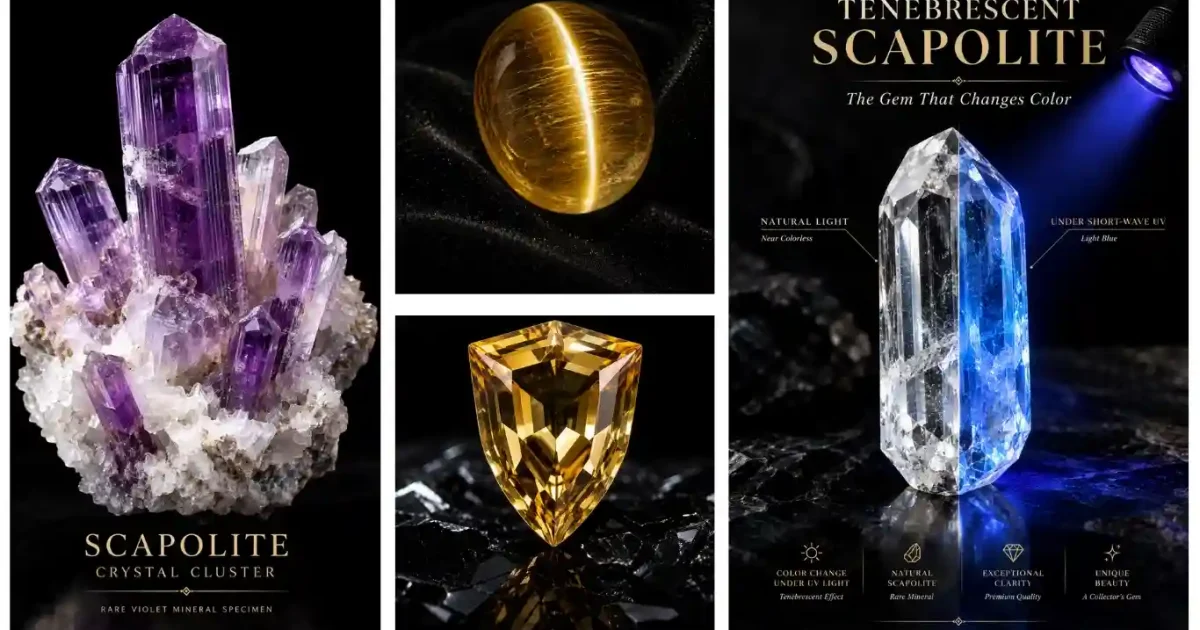
Scapolite is a tetragonal gem mineral, and yes, it’s a legitimate gemstone in its own right, not a trade name, not a treated stand-in for something better known.
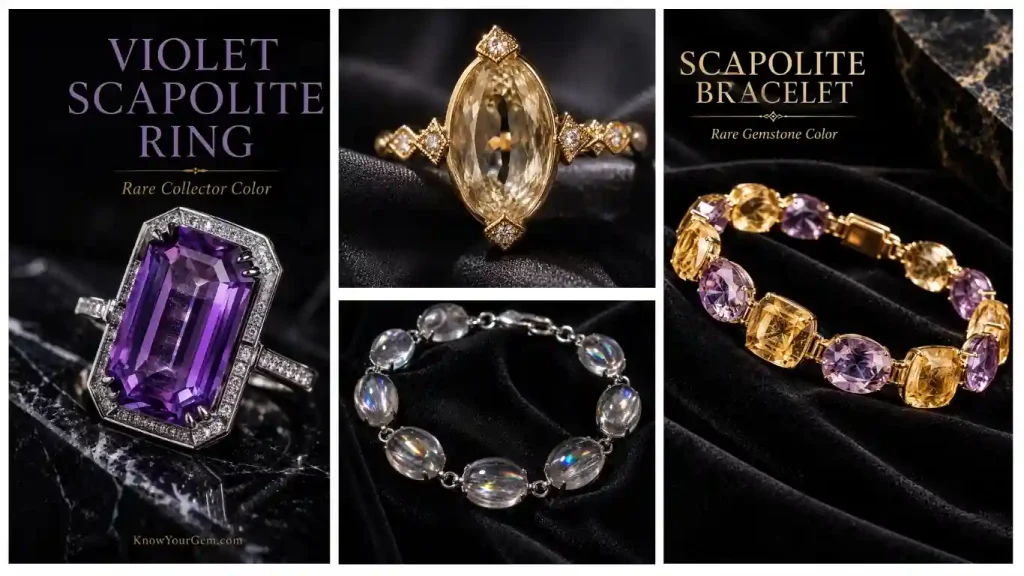
You’ll find it in yellow, violet, pink, and orange, with colorless and the occasional blue or green turning up less often. Hardness runs around 5.5 to 6 on the Mohs scale, which puts it in the “handle thoughtfully” category rather than the “wear it and forget it” category.
What keeps Scapolite gemstone on serious collectors’ radar isn’t just the color range. It’s that a single mineral group can produce a cat’s-eye effect in one piece and a genuine light-triggered color change in another, two phenomena that almost never show up together in the same species. None of that has anything to do with quartz or feldspar chemistry, despite how often Scapolite gets called one or the other on sight.
Scapolite gemstone at a Glance:
| Property | Quick answer |
| Mineral group | Scapolite |
| Crystal structure | Tetragonal |
| Mohs | ~5.5–6 |
| Main colors | Yellow, violet, pink, orange, colorless, occasional blue/green |
| Refractive index | Depends on compositioin |
| Birefringence | Depends on composition |
| Notable phenomena | Cat’s-eye, fluorescence, tenebrescence |
| Main sources | Tanzania, Myanmar, Pakistan, Afghanistan, Madagascar, Sri Lanka, Brazil, Canada |
| Jewelry suitability | Best with careful wear |
| Best known for | Rare colors, optical effects, and collector appeal |
A few things about Scapolite gemstone that don’t come up in most gem guides: it isn’t one fixed chemical compound but a series that slides between two end members, which is why lab reports on it read like ranges instead of single numbers.
Afghan material in particular can shift color under short-wave UV and then fade back on its own no treatment involved, just physics. Violet Scapolite fools people into thinking they’re looking at amethyst often enough that I’d call it the most common misID in the whole family. And despite decades of collector attention, it’s never made an official birthstone list.
What Is Scapolite?
Here’s the thing that trips people up first: “Scapolite Gemstone” isn’t a single mineral. It’s a group name, the way “garnet” covers pyrope, almandine, and several other species under one umbrella. Two stones can both be correctly labeled Scapolite Gemstone and still read differently on a refractometer, because the group is a continuous chemical series rather than a fixed formula.
This series falls between two end members, marialite and meionite. Pure specimens of either end member aren’t at all common in nature, and most gem-quality rough in fact falls somewhere in the middle of the series, combining properties of both sides.
This is precisely the reason why Scapolite gemstone charts look at ranges of values, not single ones. If you’ve handled some older estate pieces, you may have noticed the word wernerite written on the tag of one. It belongs to this same mineral group but under an aging nomenclature no longer strongly referenced in modern gemological circles.
Worth separating clearly: Scapolite as a mineral is not scarce. You’ll find specimen-grade crystals in plenty of mineral collections without much trouble. Gem-quality material clean enough, well-colored enough, and large enough to facet is a different story entirely.
That gap between “common as a mineral” and “scarce as a gem” is most of the reason fine faceted Scapolite carries real value despite the species not being geologically rare.
Scapolite Gemstone Chemical Formula & Composition:
Rather than reaching for one formula, it’s more accurate to describe Scapolite as a solid-solution series running between:
- Marialite: Na₄Al₃Si₉O₂₄Cl
- Meionite: Ca₄Al₆Si₆O₂₄CO₃
As sodium and calcium trade off across that series, the stone’s optical behavior shifts with its refractive index, birefringence, and specific-gravity, all of it moves along the same continuum. So when two labs report slightly different numbers for two different Scapolite gemstones, that’s not measurement error. It’s two different points on the same compositional spectrum.
Why Is Scapolite Called Scapolite?
Simple etymology: the name comes from the Greek skapos, meaning ‘rod’ or ‘shaft’. This refers to the quality of the crystals, which usually have a prismatic, columnar habit. There’s no references to where it’s from or to anyone who discovered it in its name.
Is Scapolite Gemstone a Quartz?
No. Full stop. The confusion traces almost entirely to one color violet Scapolite can sit close enough to amethyst in hue and clarity that I’ve seen even experienced dealers hesitate without an instrument in hand. Structurally and chemically, though, the two minerals share nothing.
Scapolite vs Quartz:
| Property | Scapolite | Quartz |
| Mineral group | Scapolite (marialite–meionite series) | Silicon dioxide |
| Crystal system | Tetragonal | Trigonal |
| Typical appearance | Yellow, violet, pink, orange, colorless | Wide range, including amethyst violet and citrine yellow |
| Hardness | ~5.5–6 | 7 |
| Refractive index | Composition-dependent | 1.544–1.553 |
| Common confusion point | Violet Scapolite vs amethyst | — |
Hardness alone settles a lot of casual disputes, quartz at 7 takes scratches Scapolite simply can’t survive. But for anything beyond a quick field check, refractive index is the real tiebreaker, since the two ranges don’t overlap.
Can Scapolite Look Like Amethyst?
It can, and this is the identification mix-up I’d flag first for anyone new to the material. Violet Scapolite’s saturation and tone can land close enough to commercial-grade amethyst that eyeballing it under normal light isn’t a safe bet either way.
Refractive index, birefringence, and specific gravity all separate the two cleanly the eye just isn’t equipped to do that job on its own.
Is Scapolite Gemstone a Feldspar?
No, and this one comes from a different direction than the quartz mix-up. Some yellow-to-orange Scapolite gets marketed as “Sunstone Scapolite Gemstone” a name borrowed from actual sunstone feldspar, mostly because the color range overlaps and “sunstone” is simply the more recognizable name to buyers.
Feldspar is its own mineral group entirely, built on aluminosilicates of potassium, sodium, and calcium in a structural framework unrelated to Scapolite’s tetragonal system and marialite–meionite chemistry.
Color and luster alone, even the schiller effect seen in some feldspar, won’t tell the two apart reliably. If you come across a listing that uses “sunstone” language on a stone also described as Scapolite, it’s worth asking the seller to clarify which mineral is actually in hand, since durability and value differ between the two.
Scapolite Gemstone Properties & Gemological Specifications:
| Property | Typical/range |
| Crystal system | Tetragonal |
| Mohs hardness | ~5.5–6 |
| Specific gravity | ~2.50–2.78 |
| Refractive index | Composition-dependent |
| Birefringence | Composition-dependent |
| Optic character | Uniaxial |
| Luster | Vitreous |
| Cleavage | Distinct to perfect |
| Transparency | Transparent to opaque |
| Dispersion | Low to moderate |
| Pleochroism | Can occur, strength varies by color and origin |
| Fluorescence | Variety- and locality-dependent |
I’ll repeat the composition point here because it matters for anyone actually testing a stone: values shift with Scapolite’s exact chemistry and locality, so a single published number can mislead more than help.
Test a Tanzanian yellow stone and an Afghan tenebrescent stone side by side, and you may get meaningfully different RI and specific gravity readings from both and both, readings would be correct for their respective material.
The cleavage line deserves its own mention, separate from the hardness figure. A stone can sit comfortably in the mid-5s to 6 on Mohs and still chip along a cleavage plane from a knock that a harder, cleavage-free stone would shrug off. That’s a setting consideration as much as a durability one.
Scapolite Gemstone Colors: From Yellow to Violet:
Yellow Scapolite:
Yellow is most often the initial shade encountered by buyers, due mostly to Tanzania’s remarkably steady production of bright, clean, well-saturated material.
The range of tones is from pale straw to a deep honey-gold. The most intense, brightly-saturated stones of good clarity represent the high end of the value range for this color, while the much more numerous examples that are somewhat paler or greener are lower in price.
Violet & Purple Scapolite:
Violet gets the most attention, for the amethyst-adjacent reasons already covered, and genuinely fine violet material with strong, even saturation isn’t easy to source.
East African and South Asian localities have historically supplied most of what reaches the market. Given how easily it’s confused with amethyst, I’d treat any violet stone sold without documentation as worth extra scrutiny before buying.
Pink Scapolite Gemstone:
Mica Pink shades tend to be softer and more pastel than the saturation of some other pink gems. Pink material that is clean and well saturated isn’t as abundant, so even small sizes of this color retain collector appeal.
Orange Scapolite Gemstone:
Orange stones sometimes drifting into that “Sunstone Scapolite” naming again range from pale peach through a deeper burnt orange. As with the other colors, saturation and clarity do most of the work in determining value.
Blue Scapolite Gemstone:
Blue is one of the rarer colors in the whole family, appearing occasionally from a limited number of localities. Because it’s uncommon, blue material draws attention out of proportion to its typical size but supply is inconsistent enough that you can’t count on sourcing it reliably.
Green Scapolite Gemstone:
Green exists, but it shows up on the gem market less often than yellow, violet, or pink. Tone usually runs pale to moderate rather than vivid, and clean faceted examples are genuinely hard to find.
Colorless Scapolite Gemstonoe:
Colorless material earns its interest through clarity rather than color a clean, eye-flawless colorless stone puts the mineral’s optical properties, birefringence especially, on full display without color getting in the way. Madagascar has been a solid source of lighter, cleaner rough.
Black or Very Dark Scapolite:
Almost all black, opaque material belongs more in specimens or cabochon jewelry than faceted stones. Once you cut that black stone for brilliance, saturation can be so heavy that it prevents much light return. Therefore, you’ll find this character far more often in mineral art than in a jeweler’s store.
Not all colors are equally prevalent, and even within those colors, the distribution of value is not uniform. Yellow and violet are by far the most common gems; blue, green, and fine pink are much rarer, and all clean, highly saturated examples are similarly priced.
What Does Scapolite Gemstone Look Like?
Prismatic, columnar crystals that’s the habit you’ll see most consistent with the tetragonal structure underneath. Luster reads vitreous, glassy rather than waxy, and transparency spans the full range from gem-clear down to opaque specimen rock.
Inclusions vary by source and sometimes take the form of fine, needle-like formations, which in the right orientation are exactly what produces the cat’s-eye effect covered further down.
Scapolite Gemstone Rough vs Faceted:
Unfinished material frequently appears dull or grey beside a finished stone – surface weathering and a lack of polish masks the clarity and depth of colour which are only evident once the stone is cut.
The true saturation must be displayed from faceting, and in transparent stones it’s even possible to see its effects by directly measuring birefringence, look at the back-facet on a well-cut stone, and you might see it.
What Does Gem-Quality Scapolite Gemstone Look Like?
Even color should be fully saturated, but it doesn’t has apparent eye-visible clarity issues. So, a clean polish that allows the vitreous luster to shine through, and, when present, a good picture centered well within the stone.
Cut quality is more important with Scapolite than some of the harder gems, as a poorly proportioned cut can make otherwise good rough appear flat and dull.
Scapolite Gemstone Birefringence Explained:
Birefringence is the gap between a mineral’s two refractive indices, and Scapolite gemstone has it because its tetragonal structure splits incoming light into two rays traveling at different speeds.
In practical terms, light exits the stone at two slightly different angles, and in a birefringent-enough stone viewed at the right angle, that shows up as a visible doubling of facet edges on the far side.
Because the marialite–meionite composition shifts stone to stone, birefringence shifts right along with it. There’s no single “correct” number here, only a range tied to where a given piece sits on that chemical spectrum.
Gemologists measure it with a refractometer, taking readings along multiple crystal directions and calculating the difference between the two. It’s one of the more dependable tools for separating Scapolite from its lookalikes, since its birefringence range doesn’t line up neatly with quartz or most feldspars.
Scapolite Gemstone Under a Polariscope:
Run transparent Scapolite through a polariscope and you’ll typically see the interference pattern expected of a uniaxial mineral useful confirmation to pair with refractometer readings, and especially handy when a stone’s size or cut makes a clean RI reading difficult to obtain through standard methods.
Does Scapolite Fluoresce?
Often, yes, though response varies considerably depending on locality and where a given stone falls on the marialite–meionite spectrum.
Scapolite Under Long-Wave UV:
Under long-wave UV, some material glows weakly to moderately, commonly in yellow or orange tones. Response is inconsistent enough across the species that I wouldn’t lean on it as a stand-alone identification test.
Scapolite Under Short-Wave UV:
Short-wave is where things get more interesting, since it’s the trigger wavelength behind tenebrescence in certain materials. A separate phenomenon covered in full below, but closely tied to fluorescence behavior in the same stones.
Why Some Scapolite Fluoresces Differently?
Trace element content and exact position along the marialite–meionite series both drive fluorescence response, which explains why two stones of similar color and origin can still behave differently side by side under the same lamp.
Scapolite Fluorescence by Color & Locality:
| Color/Locality | Typical long-wave response | Typical short-wave response |
| Tanzanian yellow | Weak to moderate | Variable |
| Afghan tenebrescent material | Weak | Often triggers color change |
| Colorless (Madagascar) | Often inert to weak | Variable |
| Violet | Variable | Variable |
Read that table as a general pattern rather than a guarantee. Fluorescence is a supporting clue in Scapolite identification, not a conclusive test on its own.
Tenebrescent Scapolite: The Color-Changing Phenomenon
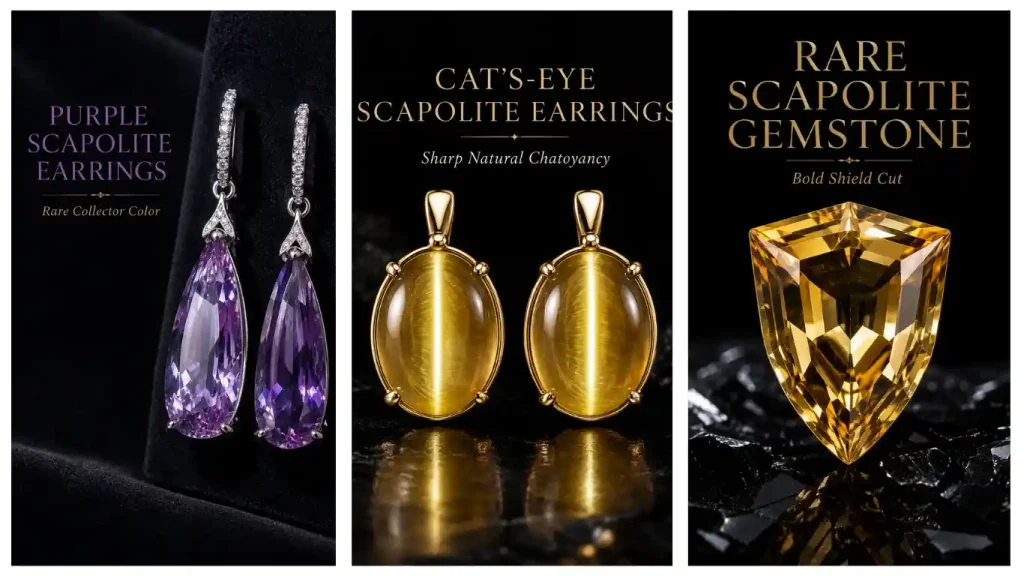
Some Scapolite gemstone temporarily changes color after exposure to short-wave ultraviolet light. Out of everything covered in this guide, this is the phenomenon that pulls serious collectors toward the species specifically.
What Does Tenebrescence Mean?
A reversible color change triggered by specific light wavelengths short-wave UV, in Scapolite’s case, followed by a gradual fade back toward the original color over time, sometimes sped along by exposure to visible light or heat.
How Does Tenebrescent Scapolite Change Color?
Affected stones typically deepen or shift hue after UV exposure, with the exact direction of the shift depending on the individual stone’s trace element makeup.
Underneath it, electrons within the crystal structure get displaced by the UV energy, a mechanism shared conceptually with tenebrescent hackmanite, if you’ve come across that material before.
How Long Does the Color Change Last?
It depends on the stone. Some material fades back within minutes to hours under normal light, while other pieces hold the induced color longer when kept in low light. Either way, this isn’t a permanent treatment it’s a repeatable, reversible property built into the stone itself.
Where Is Tenebrescent Scapolite Found?
Afghanistan is the locality most tightly linked to tenebrescent material reaching the gem market, though the phenomenon isn’t strictly confined to that one source.
Is Tenebrescent Scapolite Rare?
Yes, relative to Scapolite gemstone as a whole. Most Scapolite you’ll come across doesn’t show pronounced tenebrescence it’s a property of specific material rather than something you’d expect across the entire species, which is a big part of why confirmed examples draw premium collector interest.
Tenebrescence vs Photochromism
The two terms get used interchangeably in casual conversation, but they’re not quite the same thing. Photochromism is the broader umbrella any light-triggered, reversible color change.
Tenebrescence more specifically describes changes triggered by UV or X-ray exposure that shift or darken a stone’s color and then fade back under visible light, which is the term that applies most precisely to what happens in Scapolite and hackmanite.
Cat’s-Eye Scapolite Gemstone & Chatoyancy:
What Causes the Cat’s-Eye Effect?
Parallel, needle-like inclusions running through the crystal are behind Scapolite’s chatoyancy. Cut correctly as a cabochon, with the dome oriented relative to the inclusion direction, light reflecting off those needles concentrates into a single bright line that appears to travel across the surface as the stone turns the same optical principle behind cat’s-eye chrysoberyl, just produced by a completely different internal structure.
How to Identify Cat’s-Eye Scapolite:
A well-cut eye reads as a single, sharp, centered line under a point light source, gliding smoothly as you rotate the stone. Weak, off-center, or lighting-dependent effects generally point to lower-quality chatoyant material.
Cat’s-Eye Scapolite Value:
Eye strength and centering, together with base color and transparency of surrounding material, determine value here more than carat weight alone. A smaller stone with a strong, well-centered eye will usually outrank a larger stone with a weak or wandering line.
Best Cuts for Chatoyant Scapolite:
Cabochon cutting is the standard here, faceting would break up the very inclusion structure the effect depends on. Dome height and orientation relative to the inclusions both shape how well-defined the finished eye turns out.
Where Is Scapolite Gemstone Found?
| Country/Region | Known material/features |
| Tanzania | Gem-quality yellow and violet material |
| Myanmar | Various colors and phenomenal material |
| Pakistan | Notable gem-quality specimens |
| Afghanistan | Tenebrescent material |
| Madagascar | Colorless and light-toned material |
| Sri Lanka | Cat’s-eye material |
| Brazil | Gem-quality material |
| Canada | Mineral specimens and some gem material |
Scapolite Gemstone From Tanzania:
Tanzania has been one of the more dependable sources of gem-grade Scapolite Gemstone, particularly in yellow and violet, keeping a reasonably steady supply of well-saturated faceting rough in the market compared to some other origins.
Scapolite Gemstone From Pakistan:
Pakistani production has turned up specimens valued by both mineral collectors and cutters, adding to the broader South Asian supply alongside material coming out of Afghanistan.
Scapolite Gemstone From Afghanistan:
Afghanistan’s real significance in this market is tenebrescence-most of the color-changing Scapolite reaching collectors traces back here, which makes origin a genuinely meaningful factor for anyone specifically shopping for that effect.
Scapolite Gemstone From Myanmar:
Myanmar has produced Scapolite across a spread of colors, with occasional phenomenal material, adding one more thread to the country’s reputation as a source of varied gem material beyond its better-known ruby and jade.
Scapolite Gemstone Price & Value:
How Much Does Scapolite Cost?
Prices fluctuate greatly depending on the color, clarity, and size, and whether or not chatoyancy/tenberescence is occurring. No one stand-alone number is representative of the species.
Scapolite Gemstone Price Per Carat:
Pale or heavily included commercial-grade material sits at the low end. Fine color, good clarity, larger sizes, and especially confirmed phenomenal material push prices considerably higher. I’d treat any flat “price per carat” figure quoted for Scapolite with real skepticism unless it’s tied to a specific, described stone in front of you.
What Makes Scapolite More Valuable?
While value does not “build off” one factor, it “builds cumulatively” off of: the saturation and evenness of color, clarity, carat weight, cut, whether there is a phenomenon, and origin-Afghan is important either for tenebrescent claims or to establish if the color is natural or enhanced.
Scapolite Gemstone Value by Quality:
| Quality | Characteristics | Relative market position |
| Commercial | Pale or common color, visible inclusions | Lower |
| Fine | Attractive, even color with good transparency | Higher |
| Rare | Strong saturation, larger size, uncommon color | Higher |
| Phenomenal | Confirmed cat’s-eye or tenebrescence | Collector market |
Is Scapolite Gemstone Expensive?
Everyday commercial material is moderately priced compared to well-known gemstones. Fine-color and phenomenal stones, though, can reach prices that catch buyers off guard if they assume an unfamiliar name means a bargain.
Is Scapolite a Good Investment?
Scarcity by itself doesn’t guarantee resale performance. Scapolite has a small, specialized collector base rather than the broad, established secondary market that supports investment-grade pricing in something like fine sapphire or emerald.
Buying it because you love the stone is a reasonable call. Buying it purely as a financial play carries more uncertainty than its rarity alone would suggest.
Natural vs Treated Scapolite Gemstone:
Most Scapolite Gemstone in the market stays in its natural color, but heat treatment does occur in the broader gem trade, and buyers shouldn’t assume either way without asking.
Where treatment happens, it’s typically aimed at improving or shifting color, and a reputable seller should disclose it up front. Undisclosed treatment isn’t just an ethics issue it affects resale value directly, since natural-color material generally commands a premium over its treated equivalent in collector circles.
How to Buy Untreated Scapolite Gemstone:
Inquire from the seller if the stone has been treated. If it involves real money, require documentation, and for higher-priced pieces, a lab report from a reputable gemological laboratory should be considered (should be of treatment status, not identification).
How to Identify Scapolite Gemstone?
- Step 1: Read the Color & the Luster. Is it vitreous? What is its most general faint? This will eliminate many options but not everything.
- Step 2: Investigate with a Loupe: Search for needle sets, cleavage signs, and clarity features in line with the species.
- Step 3: Verify optical properties: Under the polariscope, is it uniaxial?
- Step 4: Refractive index measurement: Obtain the reading on the refractometer. The compositional variation of scapolite means that it still doesn’t quite fall into the same range as quartz.
- Step 5: Check Birefringence: Calculate the gap between the two indices. This step alone separates Scapolite from several lookalikes with similar single RI readings.
- Step 6: Consider Specific Gravity: A hydrostatic or heavy-liquid SG test adds another data point, particularly useful when RI readings sit ambiguously.
- Step 7: UV Examination: Test under both long-wave and short-wave, watching specifically for any tenebrescent reaction under short-wave exposure.
- Step 8: Authenticity at a respected Lab: For any real value, send it to an accepted lab for a definitive report. Dealing with identified treatments, geographical origin claims that are impacting the value.
Scapolite Gemstone Identification: Quick Decision Tree
- Violet stone with a quartz-like look? Compare refractive index and optic character against known amethyst values.
- Shows a cat’s-eye effect? Examine inclusion orientation and how well the eye centers under a point light.
- Reacts to UV? Record the exact wavelength and whether any color shift reverses under visible light.
- High-value stone on the table? Get professional lab confirmation before you finalize anything.
Scapolite vs Similar Gemstones:
Scapolite vs Quartz:
Already covered above in detail-hardness (quartz at 7 versus Scapolite’s 5.5–6) and refractive index are the two separators that never overlap between the pair.
Scapolite vs Amethyst:
Amethyst is quartz’s violet variety, so this comparison inherits the same separators as Scapolite vs quartz. Generally, violet Scapolite is simply the specific color most likely to cause a mix-up in the first place.
| Property | Scapolite (violet) | Amethyst |
| Hardness | ~5.5–6 | 7 |
| Crystal system | Tetragonal | Trigonal |
| RI | Composition-dependent | 1.544–1.553 |
Scapolite vs Feldspar:
Already covered above, the chemistry and crystal systems differ completely; this confusion is driven by naming (“Sunstone Scapolite”) rather than genuine visual overlap.
Scapolite vs Diopside:
Diopside is a pyroxene with its own distinct chemistry and generally higher birefringence than most Scapolite, plus different hardness and specific gravity ranges. Instrumental testing separates the two without much trouble.
Scapolite vs Spodumene:
Spodumene kunzite included sits in a different crystal system and runs harder than Scapolite, with distinct pleochroism showing up in its colored varieties. Instrumental separation here is fairly clean.
Scapolite vs Sillimanite:
Sillimanite can look somewhat similar in certain colors, but crystal system, hardness, and optical constants all differ. As with most of these comparisons, instruments should make the call, not the eye.
Scapolite vs Chrysoberyl:
The overlap here is the cat’s-eye effect, not color or general look. Chrysoberyl runs significantly harder at 8.5 on Mohs and carries different optical constants, so chatoyant material from the two species separates easily under basic testing despite sharing the phenomenon.
Scapolite Jewelry Guide:
Scapolite Rings:
Rings take the most daily wear of any jewelry category, which matters given Scapolite’s moderate hardness and cleavage. A protective setting style and a bit of mindfulness during daily wear go a long way here.
Scapolite Engagement Rings:
It’s not a traditional engagement stone choice, given how its durability compares to sapphire or diamond, but collectors drawn specifically to its color range and phenomena do sometimes choose it deliberately, usually paired with a setting designed to shield the stone.
Scapolite Earrings:
Earrings see far less impact risk than rings, which makes them a comfortable everyday option for this material.
Scapolite Bracelets:
Bracelets carry meaningful impact risk similar to rings, so the same durability considerations apply here as well.
Scapolite Beads:
Beads, often cut from lower-clarity or more included rough, offer an accessible way to enjoy Scapolite’s color range without paying fine-faceted-stone prices.
Scapolite Pendants:
Like earrings, pendants see relatively low impact exposure day to day, which suits Scapolite well for regular wear.
Faceted Scapolite:
Faceted cuts display the color, clarity, and birefringence of Scapolite gemstone most clearly, and so receive the most recommendations for collectors concerned more with the optical character of the stone than with a specific phenomenon.
Is Scapolite suitable for everyday jewelry? With reasonable care, yes, though its hardness and cleavage mean it holds up better in earrings and pendants than in a ring worn daily through manual work. Any setting should protect the girdle and culet from direct knocks.
How to Clean & Care for Scapolite Gemstone:
- Safe: Warm soapy water – Soft cloth for wiping – Gentle brushing with a soft-bristled brush for detailing areas
- Do not: Use ultrasonic cleaners – Steam clean – Hit or bang – Use abrasives – Rapidly change from hot to cold.
- Are Scapolite Jewelry pieces that wear well on a daily basis: The most suitable pieces are earrings and pendants for daily wear, followed by bracelets, then rings.
Scapolite Gemstone Meaning, Benefits & Symbolism:
These meanings come from traditional and metaphysical practices and are not scientifically established effects.
Scapolite Crystal Meaning:
In a metaphysical context, Scapolite gemstone is said to relate to clear intention and individual motivation.
Scapolite Gemstone Benefits:
Practitioners of crystal healing traditions attribute a range of emotional and energetic benefits to the stone, though none of these claims carry scientific support. They’re best understood as belief-based rather than medical or therapeutic.
Scapolite Gemstone Spiritual Meaning:
Spiritual and metaphysical communities sometimes link Scapolite to self-discipline and goal-setting practices.
What Scapolite Symbolizes?
Symbolic associations shift by tradition and source. Anyone drawn to this side of the stone should treat these meanings as cultural and personal rather than factual claims about the mineral itself.
Is Scapolite a Birthstone?
No. Scapolite is not an officially designated contemporary birthstone and does not feature on the commonly used lists of the birthstones maintained by the major jewelry trade associations.
There are various informal associations claimed by some retail sources, attributing scapolite to a particular zodiac sign or birth month as a tribute or back-up stone, but that is marketing and tradition talking, not an official label worth keeping clear when shopping.
What Is Scapolite Used For?
| Use | Explanation |
| Jewelry | Faceted stones and cabochons in rings, earrings, pendants, and bracelets |
| Collector gems | Sought after for rare colors and phenomena like tenebrescence and chatoyancy |
| Mineral specimens | Crystals and locality pieces valued by mineral collectors |
| Gemological study | Used to illustrate optical and mineralogical principles like birefringence and solid-solution series |
| Beads | Decorative strands, often cut from more included material |
How to Buy Scapolite Gemstone:
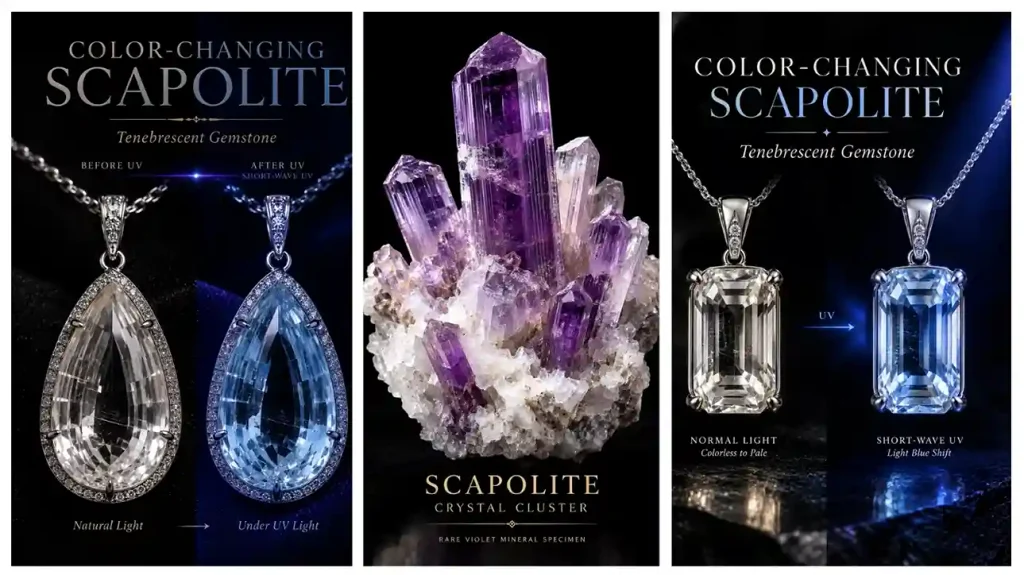
What to Check Before Buying?
- Color: Saturation and evenness
- Transparency: Clarity under normal lighting
- Clarity: How visible any inclusions are
- Cut: How well it showcases color and any phenomenon
- Carat weight: Relative to overall quality, not in isolation
- Phenomenon: Confirmed presence of chatoyancy or tenebrescence, if claimed
- Treatment: Natural color or enhanced
- Origin: Especially relevant for tenebrescent claims
- Seller disclosure: Clear, direct answers about treatment and origin
- Lab report: Worth requesting for higher-value purchases
Questions to Ask a Scapolite Gemstone Seller:
- Is this stone’s color natural or treated?
- What’s the stone’s country of origin?
- If it’s described as tenebrescent or cat’s-eye, can you demonstrate the effect?
- Is a gemological lab report available for this stone?
- What’s your return policy if the stone doesn’t match its description?
FAQs:
1. Is Scapolite a quartz?
No. It’s a separate tetragonal mineral group with different hardness and optical properties than quartz, though violet Scapolite can resemble amethyst closely enough to need instrumental testing.
2. Is Scapolite a feldspar?
No. It has its own distinct chemistry and crystal system, the “Sunstone Scapolite” name used for some yellow-orange material is a marketing overlap, not a mineralogical one.
3. Is Scapolite rare?
High-quality clean and colorful material of gemstone quality is genuinely becoming more and more rare, though the mineral name itself is not really rare in a wide geological context.
4. Is Scapolite expensive?
Commercial-grade stones are moderately priced. Fine-color and phenomenal examples can run considerably higher.
5. Does Scapolite fluoresce?
Many specimens do, with response varying by locality and composition. Short-wave UV also happens to be the trigger for tenebrescence in certain material.
6. What does Scapolite look like?
Usually prismatic and columnar in habit, with a vitreous luster and a yellow, violet, pink, and orange color spectrum through colorless, with less common blue and green.
7. What is Scapolite used for?
Mainly faceted and cabochon jewelry (rings and pendants), also mineral specimens and gemological research.
8. Where is Scapolite found?
Some important sources have been identified as: Tanzania, Myanmar, Pakistan, Afghanistan, Madagascar, Sri Lanka, Brazil, and Canada.
9. Is Scapolite a birthstone?
Unfortunately not, although it is available at some jewelry stores as an alternative.
10. Can Scapolite change color?
Some materials are tenebrescent, that are defined as changing color temporarily after exposure to short-wave UV light, gradually returning to normal over a period of time the best example being Afghan stones.
11. Is Scapolite good for jewelry?
Yes, with some protection. Great for earrings and pendants, though rings and bracelets require more protective settings than some other precious metals because of its fair hardness and cleavage.
12. How hard is Scapolite?
Roughly 5.5 to 6 on the Mohs scale.
13. How can you tell if Scapolite is real?
Instrumental testing of the specific gravity rather than the eye alone, as fits and gaps in between would be difficult to distinguish since it can look so much like varieties of quartz and feldspar that it could deceive the eye.
Scapolite Gemstone Buying Checklist:
Before buying:
- Natural or treated?
- Exact variety/composition confirmed?
- Origin disclosed?
- Weight confirmed?
- Refractive index available?
- Phenomenon verified, if claimed?
- Treatment disclosed?
- Return policy in place?
- Lab report available for high-value material?
Verify these gems with GIA, IGS and SSEF like established labs for Authenticity.
Gem Enthusiast and Expert KamilHussain!

Welcome to KnowYourGem.com! your ultimate destination for uncovering the fascinating world of gems and their secrets! I'm Kamil Hussain, a passionate blogger with a Master’s degree in Economics, dedicated to bringing you insightful, well researched content that blends the beauty of gemstones with the art of storytelling. With a keen analytical mind and a love for discovering hidden treasures, I created this platform to help you explore the brilliance, history, and value of every gem.

