
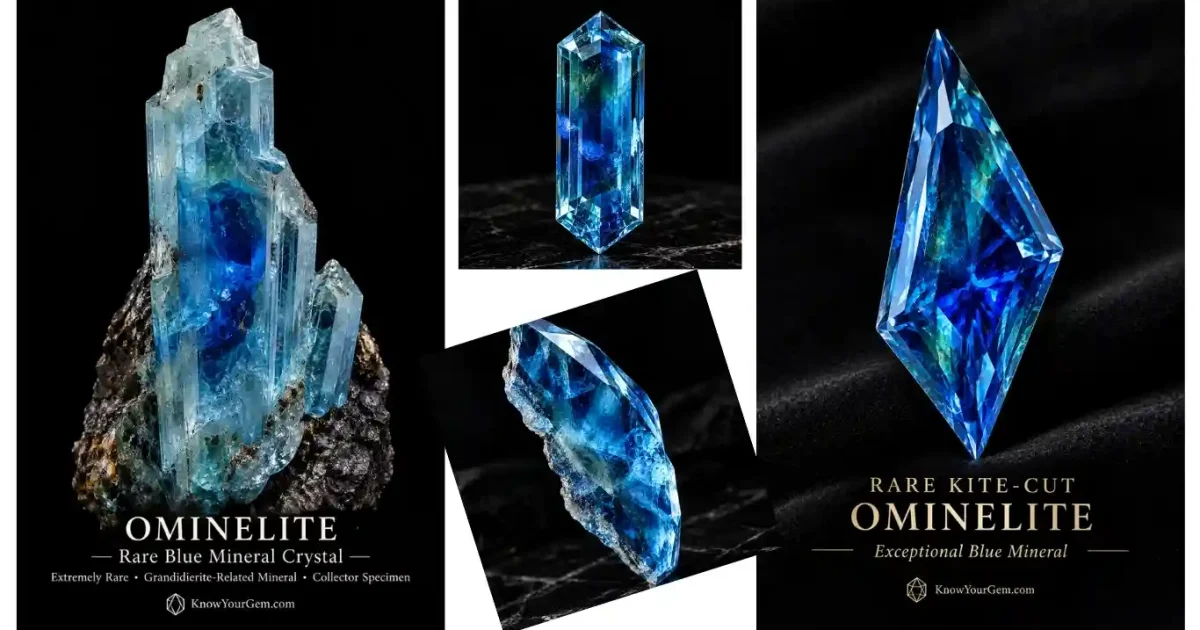

Ominelite is an exceptionally rare blue borosilicate mineral and the iron-dominant member of the grandidierite–ominelite series. It appears to be intimately associated with the grandidierite, but iron takes up the major divalent-cation position, in which magnesium is more prevalent in the grandidierite.
This mineral is of more interest to collectors or mineralogists than to the general jewelry trade. It is only known in the form of microscopic grains and small crystals thus there is no market for faceted ominelite.
What Is Ominelite?
Ominelite is an orthorhombic borosilicate mineral with the formula (Fe,Mg)Al3BSiO9(Fe,Mg)Al_3BSiO_9(Fe,Mg)Al3BSiO9. In simplified structural terms, it may also be represented as Fe2+Al3O2(BO3)(SiO4)Fe^{2+}Al_3O_2(BO_3)(SiO_4)Fe2+Al3O2(BO3)(SiO4).
It is the Fe2+Fe^{2+}Fe2+ Equivalent to Grandiderite. The structure of these two minerals is quite similar, but they are named after the dominant divalent cation:
- O is iron-dominant.
- Grandidierite is magnesium-dominant.
Omine stone was first recognized as a mineral in 2002. The mineral name is from the Omine Mountains, Nara Prefecture, Japan, where type material was discovered in the Misen pluton. The first account of the ominelite states that it occurs as an accessory mineral in porphyritic granite:
While individual grains of “blue, transparent and vitreous” can be formed, these may be very different from commercial gemstone grades and apply only at the premium end of the scale. Most of these known materials will be microscopic in size and too rare for general cutter and jewelers production.
Ominelite Properties:
| Mineral group | Borosilicate; nesosilicate with borate groups |
| Chemical formula | (Fe,Mg)Al3BSiO9(Fe,Mg)Al_3BSiO_9(Fe,Mg)Al3BSiO9 |
| Crystal system | Orthorhombic |
| Space group | Pbnm |
| Color | Blue |
| Streak | Pale blue |
| Luster | Vitreous |
| Transparency | Transparent in small grains |
| Hardness | About 7, estimated |
| Calculated density | 3.169 g/cm³ |
| Cleavage | None observed |
| Tenacity | Brittle |
| Optical character | Biaxial negative |
| Refractive indices | α=1.631α = 1.631α=1.631, β=1.654β = 1.654β=1.654, γ=1.656γ = 1.656γ=1.656 |
| Birefringence is | Around 0.025 |
| Pleochroism is | Pale blue-green in two directions; colorless in the third |
The refractive indices were measured at 589 nm in the original description. The calculated density should not be equated with the specific gravity measured by hydrostatic weighing of a large, homogeneous sample because ominelite is invariably encountered as tiny grains rather than large crystals.
The parameters for the methods were obtained by measuring the refractive index at 589 nm, in the earlier description. The estimated density, however, should not be compared with the specific gravity determined using hydrostatic weighing of a large, uniform sample, since ominelite is always seen in the form of small grains rather than as a large crystal.
What Does Ominelite Look Like?
Ominelite is a blue color with a pale blue streak. It has a vitreous luster, and smaller grains can be transparent. Under polarized lightamine can show potential pleochroism in which it appears as pale blue-green in two directions and transparent in a third.
The key practical point, however, is its size, at the Japanese type locality, ominelite occurs as elongated, euhedral to equant or anhedral grains up to around 0.5 mm in size. Other reported habits are lenticular, skeletal, rhombic-prismatic, and needle-shaped.
These are the dimensions of material that is examined by thin section or mounted as a microscopic specimen. They do not measure that rough is suitable for a normal lapidary cut. The limited size of the crystals is the main factor preventing this deep-blue gemstone from becoming a known gemstone.
Chemical Composition:
This blue stone takes in iron, aluminum, boron, silicon, and oxygen, with relatively lower contents of magnesium and manganese. It is the variable composition of iron that characterises the chemical distinctiveness between the ominelite and the magnesium-rich grandidierite.
- 48.85 wt% aluminum oxide
- 19.37 wt% iron(II) oxide
- 19.34 wt% silicon dioxide
- 10.91 wt% boron trioxide
Small quantities of magnesium oxide and manganese oxide were also detected. The use of (Fe,Mg)(Fe,Mg)(Fe,Mg) in the formula reflects the fact that natural ominelite is not necessarily composed of iron alone at that structural site.
The Grandidierite–Ominelite Series:
This blue stone and grandidierite are both part of a solid-solution series. A solid solution can be defined as ‘chemical elements which are related to each other and are capable of replacing one another within the same crystal structure’. Here these elements are iron and magnesium.
It is considered a grandidierite if magnesium is the dominant component. Where the dominant component is iron, it is considered to be ominelite. It is possible for compositions to be intermediate between the end members and therefore not display the visual consequences of either end member. This is where chemistry is a better guide.
The overall relationship can also account for the difficulty in aesthetically separating the two minerals. A. Blue-green crystal thought to be grandidierite cannot be misidentified as ominelite without the analytical confirmation of the iron enrichment and the structure.
Ominelite vs. Grandidierite:
| Dominant divalent cation | Fe²⁺ | Mg |
| Crystal structure | Orthorhombic | Orthorhombic |
| Typical color | Blue | Cyan, turquoise or bluish green |
| Reported hardness | About 7, estimated | About 7.5 |
| Cleavage | None observed in described material | Good |
| Refractive indices | 1.631–1.656 | Approximately 1.583–1.639 |
| Market status | No established gem trade | Rare faceted stones exist |
| Reliable separation is | Chemical and structural analysis | Chemical and structural analysis |
Since the published values for grandidierite are inconsistent from source to source, its ranges of hardness and refractive indices should be taken as characteristic rather than definitive. The distinction between the two minerals is essentially a chemical one and not a visual one.
Optical Properties:
This blue-green stone is biaxial negative. The original description gives the following refractive indices at 589 nm:
α=1.631,β=1.654,γ=1.656α = 1.631,\quad β = 1.654,\quad γ = 1.656α=1.631,β=1.654,γ=1.656
Subtracting the lowest index from the highest gives a birefringence of approximately 0.025. This value is calculated from the published indices rather than quoted as a separate measurement in the source.
The optical axial angle 2 V 2 V 2 V measured was approximately 31.5°. This blue stone is also pleochroic, observe the pale blue-green (less intense than on the other two directions) in (direction indicator) and a near-colorless look on the third.
Standard gem refraction device could be nearly impossible to use on any ominelite of the size that would fit with this equipment, as the known material probably is to small, uneven, or set. Even if a larger piece were encountered, confirmation by chemical and structural fingerprinting would still be needed.
Hardness and Durability:
Ominelite hardness is about 7 reported but estimated. It is hard enough to prevent everyday household dusters from scratching it, but it doesn‘t make the mineral invulnerable. For something of a comparable hardness like Quartz, it can still be scratched by harder substances.
Durability is not only scratch-proof. An Ominelit sample was considered to be brittle, but it did not have the cleavage of one grain point when it was very tiny, so this did not mean that a larger crystal would survive setting, polishing, or even wear.
No documented faceted ominelite of meaningful jewelry size exists. Consequently, we have no reliable practical history of how the mineral performs mounted in a ring, pendant, or bracelet. If a greater size crystal were ever cut, a protective setting such as a bezel would be logical, rather than an exposed bezel mount.
Where Is Ominelite Found?
The Omine Mountains in Japan remain the type locality. Mindat lists the following documented localities:
| Japan | Misen River, Omine Mountains, Tenkawa Village, Yoshino District, Nara Prefecture |
| Czech Republic | Horní Bory quarry, Vysočina Region |
| Norway | Almgjotheii, Flatestøl, Rogaland |
The Japanese occurrence is the locality accompanying the protologue. Before publishing, the locality records of the available locality data should be checked again, since mineral data bases may have increased their records once more analytical reports have been added.
The limited record of localities in itself does not imply that all blue grains from these are always ominelite. Locality merely proves to be valuable supporting evidence, but compositional and structural identification still remains.
Geological Origin and Crystal Habit:
At the type locality, ominelite occurs as an accessory mineral in high-alumina, porphyritic granite of Miocene age. It is associated with sekaninaite, an iron-rich variety of cordierite, as well as numerous other minerals, including:
- Garnet
- Biotite
- Andalusite
- Topaz
- Alkali feldspar
- Plagioclase
- Muscovite
- Quartz
- Dumortierite
- Schorl
- Zircon
- Ilmenite
- Apatite
- Monazite
- Pyrite
The authors originally proposed formation temperatures of less than ca. 700 °C and P of less than ca. 4 kbar. In addition, they record the aluminum-rich mineral association as indicative of either a magmatic or restricted origin.
Ominelite crystals may be needle-like, lenticular, or skeletal. These habits, together with the mineral’s microscopic grain size, are more relevant to mineralogical study than to lapidary use.
How Was Ominelite Discovered?
Ominelite was designated from the analysis of odd iron rich granite of Misen pluton area, which was located in the Omina mountains. The research have been carried out by Yoshikuni Hiroi and was also published as the American Mineralogist Journal on January 2002.
This paper was published in February 2001 and accepted in August 2001 so some of the references will have 2001. However most of the mineral databases give 2002 as the year it was discovered/named. This mineral hasbeen confirmed using optical data, chemical data and the crystallography data. This confirmation didn’t rely solely on the color.
How Rare Is Ominelite?
Ominelite is genuinely rare, but its rarity should be described in geological rather than commercial terms.
Several factors contribute to its scarcity:
- It has only a small number of documented localities.
- Known grains at the type locality are generally microscopic.
- It forms in a specialized, iron-rich and aluminum-rich granite environment.
- No established supply of facetable material has been documented.
- There is no wide commercial production or common gem trade.
Rarity does not necessarily mean high price. A mineral can be very rare in the ground but low value if the samples are too small to cut or display, if they are not in demand, or if they are hard to identify.
Is Ominelite a Gemstone?
Ominelite is a mineral species, but not an established commercial gemstone.
This is where the distinction is so important. A mineral may be transparent, attractive and colorful and not evolve into a jewelry material. A commercial gemstone always requires an assured availability of appropriately sized rough, predictable durability, cutting qualities and a marketplace always ready to purchase the finished stones.
Ominelite doesn‘t meet those practical needs at present. The published deposits are generally too small for everyday faceting and no established market value is present for cut material.
Ominelite was sold for several years as a blue or blue-green faceted gem. Buyers should be cautious when dealing with stones sold as ominelite as a more commonly available blue mineral such as grandidierite or blue tourmaline will be a more probable choice.
How to Identify Ominelite?
Identifying ominelite is not simply by color. A determined identification of its reliable combination of chemical component analysis and crystallographic or structural evidence.
Useful characteristics include:
- Natural stone displays a blue body color and a pale blue streak.
- Estimated hardness near 7.
- The stone’s calculated density is 3.169 g/cm³.
- Natural stone’s refractive indices is approximately 1.631, 1.654 and 1.656.
- Biaxial negative optic character.
- Its pleochorism should be from pale blue-green to colorless.
- Authentic stone has an orthorhombic structure with space group Pbnm.
- It is iron-dominant at the relevant divalent-cation site.
Electron microprobe can establish the Fe: Mg ratio. X-ray diffraction can establish the crystal structure. Raman spectroscopy and/or other types of analysis on the specimen, to size and state of specimen, can give multiple evidences.
A scratch test is not recommended for a valuable or irreplaceable specimen. It can damage the sample and would not prove that the material is ominelite.
Ominelite Compared With Other Blue Minerals:
Blue tourmaline:
Indicolite, the blue form of tourmaline, is a trigonal borosilicate and is much more prevalent on the jewelry market. It usually has a hardness of 7 to 7.5. It is often cut as a cabochon.
This stone is orthorhombic in crystal structure, but tourmaline is trigonal. Thus their optical properties are different, as is their crystal structure, which may not be easy to tell apart visually.
Aquamarine:
Aquamarine is a blue-green variety of beryl. On the Mohs scale of hardness, it is generally harder than ominelite, rated at around 7.5 8 (as opposed to 6-7 for ominelite). Its RI is about 1.57 to 1.58, again much lower than the published index for ominelite.
Using a refractometer often enables separation from the ominelite in the presence of a good facet or clean surface. The main difficulty with ominelite is not the theoretical distinction but the tiny size and irregular form of known material.
Blue spinel:
Blue spinel is singly refractive and normally approximately 1.71-1.72, with a hardness of about 8. Ominelite is biaxial and has much lower indices.
They can be differentiated with a polariscope, a refractometer, or even with a laboratory examination. In reality, however, blue spinel is also far more likely to be encountered as a commercially traded, cuttable gemstone, and so the difference can often be quite simply be made by eye.
Ominelite Price and Value:
There is no standardized per-carat price for ominelite. No established market benchmark could be verified for faceted material, and assigning a precise price would create a false impression of market certainty.
Any value attached to a specimen depends on factors such as:
- Confirmed mineral identity.
- Locality and geological significance.
- Crystal size and visibility.
- Condition of the specimen.
- Quality of the associated matrix.
- Provenance and collection history.
- Laboratory documentation.
- Rarity within the collector market.
Asking prices should not be confused with realized prices. A seller’s listing shows what the seller hopes to receive, not necessarily what a buyer has paid.
If faceted ominelite ever appears in the market, it would most reasonably be viewed as a specialist collector stone rather than a conventional investment gemstone. Its resale potential would depend on a very small buyer base and exceptionally strong documentation.
The same applies to the healing and any metaphysical claims concerning ominelite. There is no scientific data to back up any healing or metaphysical claims regarding ominelite it has virtually no tradition as a gemstone. Consequently, they should be regarded as promotional rather than mineralogical facts.
Is Ominelite Available for Sale?
Ominelite is sometimes available as a mineral specimen, microscopic mount, or research material, but general-purpose commercial availability has not been reported.
Before purchasing a specimen represented as ominelite, ask the seller for:
- Exact locality information.
- Provenance or collection history.
- The method used for identification.
- Chemical or crystallographic documentation.
- An explanation of how ominelite was distinguished from grandidierite.
A seller offering just a color photograph and a locality claim has failed to prove that the specimen is ominelite. Analytical proof is far more significant than appearance for a mineral this rare.
Frequently Asked Questions:
1. What is ominelite?
Ominelite is a rare blue orthorhombic borosilicate mineral and the iron-dominant analogue of grandidierite.
2. Is ominelite a gemstone
A species of mineral, not a recognized commercial gemstone. Material known, as a rule, is too small and too rare to be used for normal faceting.
3. Is ominelite rare?
Yes. There are very few reported occurrences locally, and it is usually encountered as tiny grains or crystals.
4. What color is ominelite?
Ominelite is blue and may show pale blue-green pleochroism. Its streak is pale blue.
5. What is ominelite’s hardness?
Its hardness is about 7, but rather an estimate than a confirmed fact by an exhaustive test.
6. What is the formula of ominelite?
Its formula is (Fe, Mg) Al 3BSi O 9 (Fe, Mg) Al 3BSi O 9 (Fe, Mg) Al 3BSi O 9. Iron is the dominant metal in true ominelite over magnesium.
7. Where is ominelite found?
The type locality is stated to be in the Omine Mountains, Nara Pref., Japan. There are also Canadian occurrences listed, as well as those in the Czech Republic and Norway.
8. What is the difference between ominelite and grandidierite?
While Ominelite is iron-dominant, grandidierite is magnesium-dominant. They are similar in that they both have the same basic orthorhombic structure (Beattie et al. 2001; LePage et al. 1954) but differ in terms of composition and the physical properties that are often listed.
9. Can ominelite be faceted?
No confirmed instance of a commercially significant faceted ominelite could be confirmed. Confirmed samples appear to be on the microscopic scale, with the material at the type locality known to extent (at best) to ~0.5 mm.
10. How is ominelite identified?
Identifying samples with any degree of confidence must be determined by chemical analysis, especially the ratio Fe/Mg,. This result must then be established by crystallographic or structural analysis.
11. How much is ominelite worth?
There is no standardized market price. Specimen value depends on confirmed identity, locality, size, appearance, provenance and documentation.
12. Is ominelite available for sale?
Rarely. It may appear as a mineral specimen or micro-mount, but there is no evidence of a broad commercial supply.
Editorial Note on Sources:
Please verify the scientific information before publication (original description of Hiroi at all. Present entry of Mindat, Webmineral and other specialist mineralogical databases). Reference values of the grandidierite comparison figures can change depending on sources.
The comparisons for the blue tourmaline, aquamarine and blue spinel should be checked with an up to date gemological reference, such as GIA or Gem-A if the exact number ranges are kept.
This content is written and published by gemstone expert and enthusiast! KamilHussain.

Welcome to KnowYourGem.com! your ultimate destination for uncovering the fascinating world of gems and their secrets! I'm Kamil Hussain, a passionate blogger with a Master’s degree in Economics, dedicated to bringing you insightful, well researched content that blends the beauty of gemstones with the art of storytelling. With a keen analytical mind and a love for discovering hidden treasures, I created this platform to help you explore the brilliance, history, and value of every gem.

