
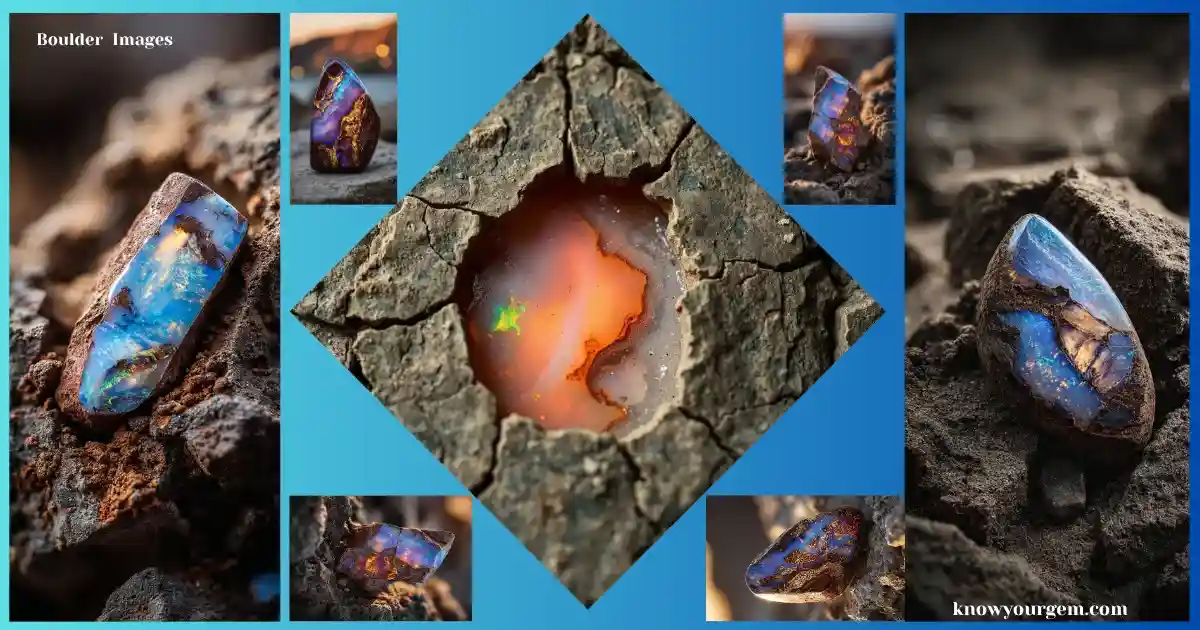

Overviews: Boulder opal is a natural precious opal left attached to its ironstone or sandstone host rock, that creates a gemstone with naturally dark backing that intensifies play of color. Nearly all come from Queensland, Australia. Buyers have to evaluate this stone by play of color, brightness, pattern, face-up coverage, and whether the stone is a solid boulder opal or an assembled doublet or triplet.

What is boulder opal?
Boulder opal is a fascinating gemstone because it naturally forms in thin seams or patches within ironstone or sandstone, and the finished gem that host as a part of its structure. This is not a flaw, it is actually what makes boulder opal unique.
The Gemological Institute of America (GIA) classifies it as a natural opal type 2, means it is a genuine opal with having natural backing, not an assembled stone with man made layers. That host rock is integral to the gem’s identity, that gives it strength and character. It is not a treatment, not a defect , and certainly not sign of lower quality it is part of the beauty and authenticity of boulder opal.
Because the opal layer sits directly against dark ironstone, boulder opal often displays stronger contrast and more vivid play of color than lighter-bodied white opals of comparable grade. That natural backing does the same work as the dark adhesive layer in an opal doublet but here, everything is entirely natural and undivided.
Why it looks different from other opals:
Most white or crystal opal s sit oppositely a pale background, which can make their colors look delicate or diffused. In boulder opal, the dark ironstone behind the opal layer that absorbs light which would otherwise scatter, pushing the spectral colors forward. The result is contrast that can make even a modest color bar look punchy and vivid.
The ironstone itself also produces the irregular, landscape-like shapes that make boulder opal instantly recognizable. Not two stones share the similar outline. The veins, swirls, and patchwork of the host rock become a part of the gem’s visual identity that something many collectors prize as much as the opal color itself.
Where boulder opal comes from:
The three essential mining regions are:
- Koroit — Produces matrix-rich with intricate, swirling color patterns are embedded in dark ironstone. Koroit opal is often boldly patterned and highly collectible.
- Yowah — It is famous for “Yowah nuts,” small ironstone concretions that sometimes contain a core of precious opal. Yowah material tends to be compact and can showcase tight, brilliant color.
- Quilpie — It is the broader southwest Queensland opal country, that produces large volumes of boulder material across a wide quality range.
Ethical origin matters commercially. Most reputable dealers disclose it, when a listing says “Australian opal” without specifies the field, ask for clarification.
How boulder opal forms:
Opal starts to form in silica-rich percolates through rock into cracks, voids, and porous cavities. As the water gradually evaporates more than millions of years, it leaves behind hardened hydrated silica. When the silica spheres arrange themselves in a regular, orderly grid, they diffract visible light that produces the play of color which defines precious opal.
In Queensland, silica-rich solution infiltrated ironstone formation during intense weathering periods. Hence, the result opal grow in thin seams sometimes just a millimeter or two thick within the host rock rather than forming large deposits.
Why the host rock stays attached:
Because opal seams in Queensland ironstone that is often too thin to survive cutting as freestanding stone, skilled cutter deliberately leave the host rock in place. Since, the ironstone provides structural support that resists cracks during and after cutting it, and adds the dark backing that creates visual contrast. Since, removing would destroy both the stone’s stability and much of its visual appeal. While retaining it not a compromise it is the correct lapidary decision for this material.
Ironstone, sandstone, and “Yowah nuts”
Most of Queensland’s boulder opals are found in ironstone, a dense, dark -brown sedimentary rock rich in iron oxide. This ironstone backing gives a striking contrast of boulder opal like, play of color against the matrix that makes the gem especially vivid.
Yowah nuts are small, rounded ironstone concretions roughly walnut to tennis ball size that are found near Yowah in southwest Queensland. When it is cracked open, some contain a karnel of precious opal at the center. Not yet every nut is opal-bearing, and the ones that can display some of the most concentrated and brilliantly colored opal found anywhere in Australia.
Boulder opal vs other opal types:
Recognizing the difference between opal types well matter practically, not just academically. The distinctions affect value, care and what you are actually buying.
Boulder opal vs black opal:
Black opal and boulder are nearly look similar in identical in pictures both showcase dazzling, fiery play of color against a dark background. Since, the key difference is, black opal is a single solid piece, and its darkness comes from within the opal sitting on the top of its host rock, so the dark “backing” you can see comes from the rock, not the opal.
Fine black opal from Lighting Ridge, New South Wales, is generally the most valuable opal type in the market. Since, top boulder opal can approach comparable prices for an exceptional material, but the two are structurally and geographically distinct. A reputable seller always identifies which type you are buying.
Boulder opal vs matrix opal:
- Matrix opal: The opal is spread throughout the host rock because the tiny dots or thin streaks. There’s no clear seam just little flashes of color mixed into the stone.
- Boulder opal: The opal forms in distinct patches or seams to sit on or within the rock. These sections usually showcase stronger, cleaner color play.
Solid boulder opal vs doublet vs triplet:
A solid boulder opal is the continuous piece of the natural material, opal plus ironstone with having no adhesive layers or added components. A doublet is an assembled stone in which a thin slice of opal is glued to a dark backing, often ironstone or black plastic, to mimic the appearance of boulder or black opal. A triplet adds a clear protective dome usually quartz glass on the top of the opal slice.
Doublets and triples are legitimate products when it is clearly identified and priced accordingly. Since, GIA notes they are assembled sold without disclosure as though they were solid naturals. Always request a side view photo or video that reveals whether the stone has visible layers at the girdle.
How to judge boulder opal quality:
Boulder opal doesn’t own universally standardized grading system equivalent to the diamond’s 4Cs, but GIA identifies play-of-color, intensity, and pattern as the primary value factors for precious opal. Here are seven factor framework that are used experienced buyers.
- Play-of-Color: This is the star of any precious opal: those magical rainbow shifts you to see as turn it reds, oranges, greens, and blues, and violets dancing as light splits through tiny silica spheres. Broad flash is super rare and expensive. Pin-fire sparkles in scattered dots. Directional color only pops from certain angles, so it feels a bit limited.
2. Brightness: Just imagine how alive colors glow like vibrant fire, not flat paint. Since, a simple-pattern opal with killer brightness always beats a fancy one that is dull. Test it under daylight, incandescent, and LED lights see the realistic magic.
3. Pattern: It is all about how the color lays out. Rolling sheets are tier rare. Harlequin (mosaic blocks) is unicorn-level scarce. You will hear terms like rolling fire, flagstone, or writing in the trade. GIA calls it part art buy your taste matters.
4. Face–Up Coverage and Cut: How much of the top showcases actual opal versus rock? Full opal face wins over skinny streaks in ironstone. Boulder rectangles? Rare, since the rough doesn’t play nice.
5. Host Rock Contrast: That dark ironstone back amps up saturation, makes colors pop but don’t want mostly rock with a thin opal stripe aim for harmony where they team up visually, not one seating the show.
6. Transparency, Inclusions, and Stability: A translucent layer adds dreamy depth. Since stability trumps all no cracks, crazing, or sandy bits. Crazing (those fine surface fissures) is a deal breaker. Opal is not like faceted gems; inclusions are fine if they don’t mess with the play or hold.
7. Size and Carat Weight: Bigger grabs eyes and pays more, but only with quality. Carats including rock, so focus on the length x width dimensions for fair apples to apples.
How much is boulder opal worth?
Boulder opal doesn’t carry universal price chart. Each is unique in pattern, color and dimensions, that make per carat pricing ranges illustrative rather than precise. A rough stone from a minor filed and a large vivid Koroit specimen can vary by a factor of 50 or more in per carat value.
What drives price the most:
GIA identifies play of color, intensity, and pattern as the principle value factors for precious opal. In practice, the value stack runs in roughly this order: play of color brightness third, cut quality fourth, size fifth, and origin sixth. A stone that ranks highly on the first three factors will always command more than a large stone that ranks poorly on them. Whether the stone is solid, doublet, or triplet affects price dramatically. A Since, a solid boulder opal is worth significantly more than a similarly appearing doublet, that’s why disclosure matters so much.
When a boulder opal becomes premium:
A boulder opal owns premium price when it is combined with several strong factors simultaneously: vivid full-face play of color covers most of the face, high brightness visible under multiple light sources, a memorable broad or rolling pattern, a well-shaped cabochon or free-form cut with having no dead spots, and strong ironstone contrast that frames rather than dominates the stone.
When certification or appraisal helps:
For higher-value purchases, a GIA identification report confirms whether a stone is natural, lab-grown, or treated. Since, GIA reports identify detectable treatments and confirm the opal type. For insurance purposes, an independent appraisal from a credentialed gemologist like GIA Graduate Gemologist or Gem-A Follow, establishes replacement value. For stones under few hundred dollars, certification cost can exceed the stone’s value; use judgment accordingly.
How to buy boulder opal online without overpaying:
Most boulder opals are sold at online stores, and the medium creates real information asymmetry between seller and buyer. The stones look different in photographs than in person, lighting can be manipulated, and dimensions can mislead without a reference object. A systematic approach protects you.
Ask for these 7 things before buying:
- Side-view photographs or video — It is essential for checking solid vs doublet/triplet. A doublet showcases a visible seam at the girdle.
- Video in different lighting conditions — At minimum, daylight and artificial light, play of color can be strong in one light and flat in another.
- Exact dimensions in millimeters and carat weight — Face dimentions are the better size indicators since carat weight includes host rock.
- Treatment disclosure — Always ask explicitly whether the stone has been smoked, dyed, or stabilized.
- Solid vs assembled confirmation — A clear written statement that the stone is a natural solid boulder opal, not a doublet or triplet.
- Return policy — Reputable dealers offer return windows, which take 7-14 days, for stones that misrepresent in person.
- Origin details — Ideally the specific field (Koroit, Yowah, Quilpie) rather than just “Queensland” or “Australia.”
Red flags in listings:
Watch for: not side-profile photo or video; studio lighting that makes every stone vivid regardless of an actual quality; language like “black opal look” without disclosure that it is actually a doublet or boulder opal; prices dramatically below comparable material without explanation; listings that mention “enhanced” “stabilized” without specifying the treatment; refusal to provide dimension or weight information.
Best jewelry settings for everyday wear:
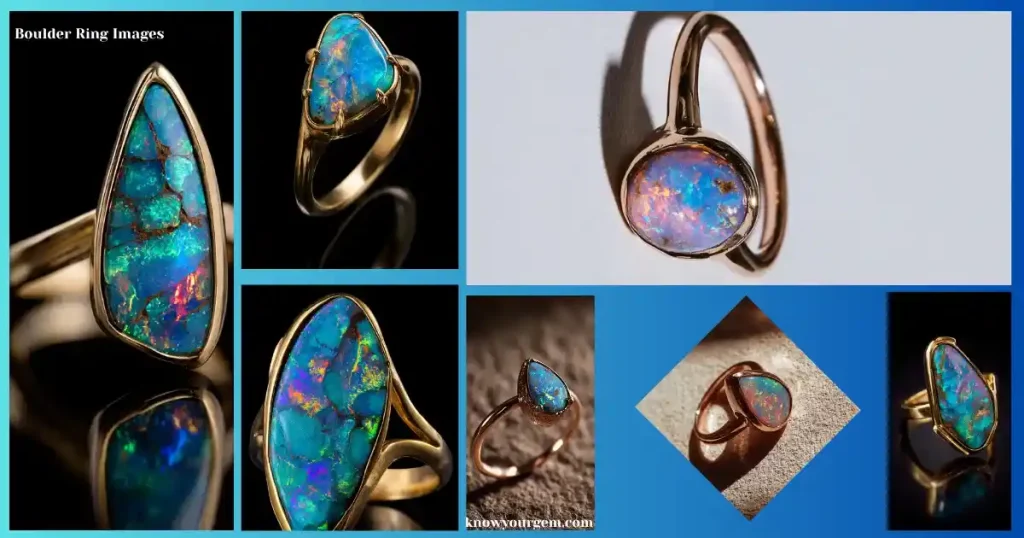
Boulder opal is gorgeous stone, but it is a little softer than several others gems that are usually seem to be in daily wear rings. It owns 5.5-6.5 mohs scale of hardness which means it is not a harder stone as like others who own high mohs scale and this stone can get scratched easily, so it requires gentle care and is not recommendable for daily wear jewelry. Whether protective settings like bezel, halo, or deep set designs are recommended to keep your stone protected.
Is boulder opal good for rings?
Yes with appropriate expectations and the right setting. Boulder opal is suitable for ring wear it when set protectively and when the wearer understands it requires more care than a sapphire or diamond.
Yes, but choose the right setting:
The ironstone backing actually gives boulder opal a slight durability advantage over thin standalone opals, the host rocks adds structural support and reduces chipping risk at the opal layer’s edge. A deep bezel or halo design that wraps metal around the stone’s sides fully exposed, and avoid high-set prong design where the stone can catch on hard surfaces. Although a boulder opal engagement ring is meaningful choice when the wearer understands the softer gemstones can need occasional re-polishing or re-selling over the years.
Better uses for boulder opal if durability is your priority:
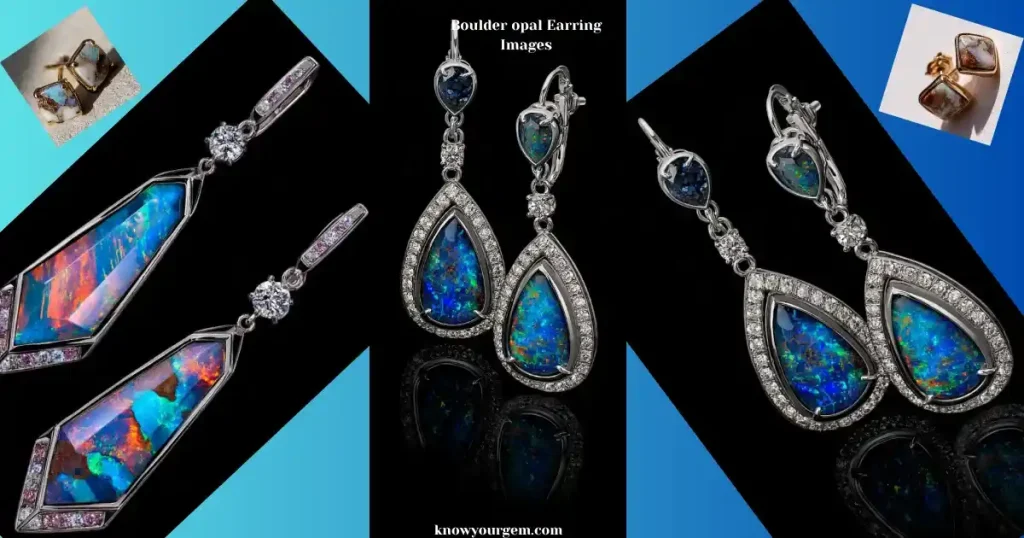
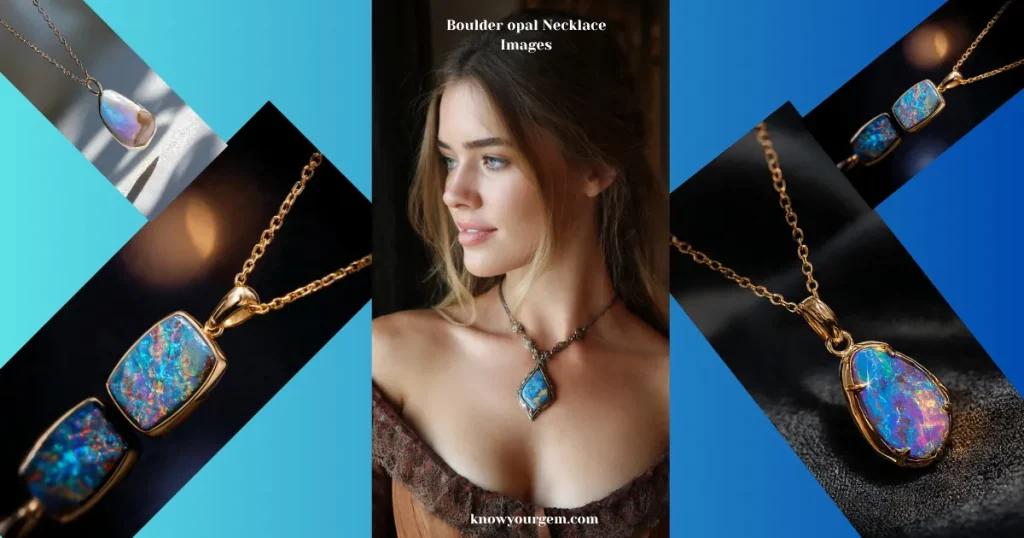
If you want to enjoy boulder opal without managing daily wear risk, pendants and earrings are excellent alternatives. A boulder opal pendant sits against soft fabric and rarely contacts hard surfaces. Earrings have minimal impact exposure. Both formats showcase the stone’s full face with less durability compromise than ring wear.
How to care for boulder opal:
Given below a deep informative guide about how to take care of opal gem you can explore:
Safe cleaning method:
- The safe way to clean boulder opal is using lukewarm soapy water.
- Mix a mild soap with warm water and use soft toothbrush to remove dust on it.
- Wash thoroughly so no soap film remains.
- Using harsh chemical, ultrasonic cleaners, bleach, solvents are strictly restricted since they can damage the stone.
- Soft cloth is recommendable for pat drying.
- Even the ironstone offers some resilience, but the opal layer itself sensitive to heat and stress, so treat it carefully.
What to avoid:
Keep boulder opal away from long spells of heat, exposing it direct strong sunlight, and very dry air can scratch the stone. Opal holds water inside it, and dry it out too much can cause cracks or crazing. Since, GIA recommends avoiding extreme light, heat, or dryness, so think of opal as more delicate than many other gem.
Storage tips:
Boulder opal registers approximately 5.5 to 6.5 on the mohs scale of hardness, whether common minerals own 7 mohs scale and most other gemstone can scratch it. Store boulder opal pieces separately, wrapped in soft cloth or in a dedicated jewelry box compartment. Avoid tossing opal loose in a bag or drawer with other pieces. For long term storage in very dry climates, some collectors place a slightly damp cotton ball in a sealed container with the stone to prevent desiccation, this is rarely necessary for ironstone-backed material kept indoors.
Who should buy boulder opal?
Given below a complete guide which showcase who should buy this stone:
Best for collectors and buyers who want a kind patterning:
Boulder opal is the best that is matched to buyers who respond to uniqueness, natural artistry, and abstract visual character. No two stones are the same. The combination of the opal pattern and ironstone host rock creates a piece that exists nowhere else in the world. Collectors who value that singularity, buyers who want a gemstone with genuine geological narrative, and wearers who want to stand apart from conventional jewelry choices all find strong reasons to choose boulder opal. It also suits buyers who are looking to the October birthstone tradition, opal is one of the two October birthstones.
Less ideal for buyers wanting standardized grading:
Boulder opal is not the right primary purchase for buyers who want the reassurance of a universally comparable grading standard. Since, GIA itself notes that fine opal buying is closer to buying art than buying a standardized commodity. Each stone must be evaluated individually, and personal visual response matters enormously. If standardized comparability is your priority, colored stones like sapphires and rubies with established origin and treatment documentation offer a clearer comparison framework.
Final verdict: is boulder opal worth buying?
Boulder opal can be fantastic buy for the right person. It is genuinely rare: a completely natural gem where precious opal grows up inside the dark ironstone in ways that can’t be copied or mass-produced, creating patterns that are found in no other stone on the earth.
The stone shines mostly for buyers who take care more about visual impact, uniqueness, and natural character than polished grading certificates or maximum everyday toughness. This means accepting that it needs gentle wear, careful handling, and a bit of patience when you are judging its color and pattern. So, for practical buyers:
- Ask for clear side-view photos to see how the opal sits in the ironstone.
- Insist on honesty about whether the stone is solid or an assembled piece.
- Judge brightness and how much color showcases face-up, not just under one perfect light.
- Always buy from sellers who answer questions openly and happily.
Follow that mindset and boulder opal becomes one of the most personal, exciting, and rewarding gem choices you can find, doesn’t matter what is your budget.
FAQs:
1. What is boulder opal?
Boulder opal is the natural precious opal which is still attached to its host rock usually ironstone, leaves that rock as a natural backing. Since, GIA classifies it as “natural opal type 2.” The host rock gives the stone strength, contrast, and much of its unique look, and almost all commercial material comes from Queensland, Australia.
2. Is boulder opal real opal?
Yes, boulder opal is fully natural and precious stone. Since, the opal layer is realistic hydrated silica with genuine play of color. It is not treated, assembled, or enhanced in regular production. GIA recognizes it as its own natural opal type, alongside black, white and crystal opal.
3.Is boulder opal valuable?
Yes good boulder opal is genuinely valuable, and top material from places like Koroit or Yowah can be costly per carat. Since, price majorly hinges on brightness, play of color, pattern, and how much color you see face-up. So, entry level pieces are quite cheaper, whether fine collector-grade stones can be pricier, and every stone is vary, price can also vary.
4. Can boulder opal be worn every day?
It can be as long as you treat it carefully and use a protective setting. Boulder opal is about 5.5-6.5 on the mohs scale of hardness means softer than most ring gemstone. Although GIA recommends protective settings for opal.
5. How can you say whether an opal is solid, doublet, or triplet?
Don’t miss to look at the stone from the side, either in person of in a clear side-view photo. Because doublet shows a straight, clean seam at the edge where the thin opal slice meets its backing.
6. Are boulder opals worth anything?
Yes, good boulder opals genuinely owns more values and command prices that are driven by brightness, color, pattern and how much play of color you see face up.
7. What is the difference between opal and boulder opal?
A big difference between opal and boulder opal is that Opal is a regular stone can be worn used on daily basis with a gentle care whether boulder precious opal is still attached to its ironstone host rock for structure and contrast.
8. What is the spiritual meaning of boulder opal?
It is often seen as a stone of emotional balance, creativity, and grounding, connecting institution with earthy stability.
9. Should boulder opal be kept in water?
No prolonged soaking can weaken opal, whether gentle cleaning with lukewarm water is fine, but don’t store it in water.
This comprehensive guide is written by gemstone enthusiast KamilHussain!

Welcome to KnowYourGem.com! your ultimate destination for uncovering the fascinating world of gems and their secrets! I'm Kamil Hussain, a passionate blogger with a Master’s degree in Economics, dedicated to bringing you insightful, well researched content that blends the beauty of gemstones with the art of storytelling. With a keen analytical mind and a love for discovering hidden treasures, I created this platform to help you explore the brilliance, history, and value of every gem.


