


Labradorite, this feldspar, is famous for labradorescence – that flash of blue, green, gold, or whatever color from within the stone that’s visible when you turn the stone. Labradorite has a hardness between 6 and 6.5 on the Mohs scale and all but a few grades are reasonably priced.
Answer: Labradorite is a feldspar, specifically, a plagioclase, which is a calcium sodium aluminum silicate. Fine pieces flash strongly and widely from several angles, and finish spectrolite is the premium variety. Pendants and earrings suit it best. A ring needs a protective setting.
KnowYourGem has worked with gemstones for over 5 years, and during these years we have experienced many questions from different buyers.They usually asked What is this stone called? Is this a natural gemstone or synthetic? Where does it come from? Does the seller have proper documentation? Is this rare material? What is the price?
Quick Facts About Labradorite:
| Group | Plagioclase feldspar |
| Hardness | About 6 to 6.5 on the Mohs scale |
| Main colors | Gray base with blue, green, gold, orange and red flashes |
| Primary sources | Canada (Labrador), Madagascar, Finland, Russia, Australia |
| Optical effect | Labradorescence (iridescent flash) |
| Typical uses | Rings, necklaces, earrings, carvings, countertops, decorative items |
What Is Labradorite?
Plenty of gems get their looks from transparency or surface brilliance. Labradorite gets its looks from inside. The glow comes from structure within the stone, and that’s why it looks unlike anything else in the tray.
What is the scientific definition of labradorite?
It belongs to the plagioclase feldspar series. Feldspars together make up a big share of the Earth’s crust, and plagioclase is among the most common kinds. Chemically, it’s a sodium-calcium-aluminum silicate with triclinic crystals.
Where does it form?
In igneous rocks, particularly gabbro, basalt, and anorthosite. First defined from the anorthosite of Labrador, Canada. The commonly quoted date for discovery is 1770.
Why does labradorite look iridescent?
This phenomenon is named labradorescence. When light enters the material and strikes the microscopic layers, the waves reflected off those layers interfere with each other. It’s this interference that causes the flashing effect.
It isn’t a surface shine. It exists within the stone, which means this makes it appear and disappear as you turn the stone. Different wavelengths of light will return at different angles so it appears to change colour. Turn the stone the wrong way and you’ll see plain gray rock. That’s normal.
How and Where Does Labradorite Form?
Deep in cooling magma. Where it forms matters, because some deposits give clearer, brighter and broader flashes than others.
How does labradorite form?
Feldspar crystals grow as magma cools slowly. Along the way, the crystal separates into very thin alternating layers of slightly different composition, which is called exsolution. What you’ll have is a bit of a stack of lamellae only a few hundred nanometers thick.
Why do the layers matter?
Labradorescence is the effect of the lamellae. When the lamellae are oriented just right, the stone flashes brightly.
Which are the major labradorite mining locations?
Labrador, in Canada, is the original and most famous source, known for gray stones with strong blue and green flash in broad color zones. Finland gives us spectrolite, the premium variety, found around Ylämaa, and its colors can reach gold, orange, purple and red.
Madagascar is a large supplier. Its stones often have lighter base tones and arrive in quantity, so they’ve become a staple for beads and cabochons. Russia produces quality material on a smaller scale. Australia is reported as a source too, though claims about a distinct “golden flash” from there need checking.
How does origin affect quality?
Origin gives a clue as to what you may pay and may also influence the price. Generally, Finnish spectrolite is best paid for its full spectrum shine. Canadian material has history and the prestige of tradition, Madagascar is decent for jewelry and mainstream pricing. But a good name doesn’t guarantee quality, so see the piece for yourself.
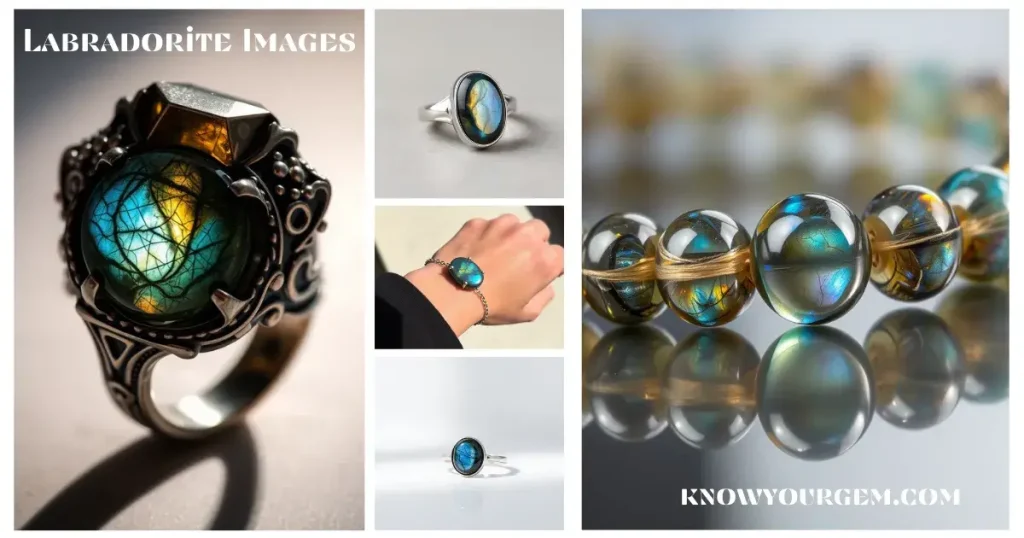
What Does Labradorite Mean?
That, all of it, is tradition, all of it, belief, not demonstrated effect. Labradorite has a long cultural and a modern spiritual following.
What is the historical lore?
According to an Inuit myth, the Northern Lights got stuck in the rocks on the Labrador coast. A warrior smashed the stones with his spear, and while most of the light flew back into the sky, some became frozen inside. That’s the flash.
Legend, not science, says the Inuit had the stone for thousands of years before the Europeans arrived and used it to make tools and jewelry.
What are the modern spiritual associations?
What does labradorite signify? How do those who work with crystals interpret labradorite? Transformation is the meaning of labradorite. It changes color as you turn. Some associate it with intuition and protection, a barrier to unwelcome stimulation. Some associate it as a bridge from everyday consciousness to deep thought.
What are the chakra and zodiac associations?
It is linked by energy workers to the third-eye and crown chakras, which are believed to relate to perception and spiritual connection. Changing astrological associations depending on the system, and sources disagree. Treat both as traditions.
What Is Labradorescence and How Does It Work?
That flash is the most significant attribute of labradorite’s dazzling allure and value. How intensely, how broadly a stone flashes is much more important than it’s color or transparency.
How does the optics work?
When a beam of white light strikes the stone, the many thin layers within, arranged like book pages, reflect some of the light and let some pass through.
Depending on their phase, the returning waves reinforce or cancel each other, and what’s left is a selective color display. It’s wave interference, the same family of effect that makes soap bubbles and oil films shimmer.
What colors can the flash show?
| Blue | Layer spacing is favorable to blue wavelengths (~ 450 to 495 nm). |
| Green | Green appears when the spacing favors green (roughly 495 to 570 nm) |
| Gold and orange | Less common. They depend on a different layer spacing and usually raise the price. |
| Purple | Uncommon, and mostly associated with Finnish material. |
| Red | Scarce, and a prize for collectors. |
| Black (dark-bodied) | Sold as “black labradorite”. The base is charcoal to deep gray, and the flash is strong. |
| Brown | Brown-toned stones can still flash, and they usually cost less than gray-based ones. |
What is the difference between labradorite and spectrolite?
| Origin | Many countries | Finland (Ylämaa) |
| Color range | Mostly blue and green | Wider, with purple, gold, orange and red possible |
| Flash intensity | Moderate to strong | Often very intense |
| Base color | Light to medium gray | Dark gray to black |
| Price | Generally affordable | Usually a premium |
| Availability | Common | Limited |
How Much Is Labradorite Worth?
They range from dirt cheap to wild and its the wide range is down to these qualities you can actually measure. Know them, and you won’t overpay. You’ll also spot a real bargain when one turns up.
What determines labradorite value?
First, consider flash. A stone that flashes from multiple positions will be more expensive than one that flashes from only a single. The next factor is rare color: blue and green are fairly common, while you might pay a premium for gold, orange, purple and red, and a full-spectrum labradorite is going to be more costly than a basic blue.
And within a given color, labradorite’s clarity or perfection may affect the price – flecks of cloudiness and other inclusions and cracks reduce the flash, along with the value.
What are typical price ranges?
I couldn’t verify current per-carat figures, so I left them out. The table shows relative position, and you can add your own dated prices.
| Commercial | Basic blue or green flash, small sizes | Low | $0.30–$3 per carat |
| Mid-quality | Strong flash, good size, clean material | Low to moderate | $3–$8 per carat |
| Premium | Rare colors, large clean stones | Moderate to higher | $8–$20 per carat |
| Spectrolite | Wide color range, intense flash | Higher | $16–$50+ per carat; exceptional collector pieces can reach far higher |
Is labradorite an investment?
Collector-grade pieces with exceptional flash and size can cost much more. Even so, I wouldn’t call any labradorite a financial investment. Buy it because you like it.
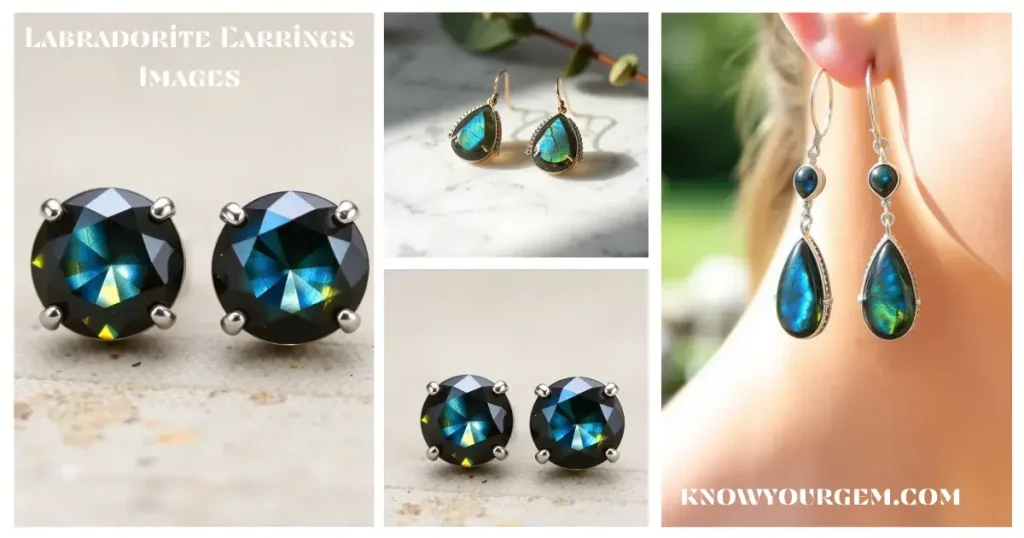
Which Labradorite Jewelry Is Best?
The flash is directional and the hardness is moderate, so setting and cut matter more than usual. Here’s how to match a piece to the stone.
What jewelry uses suit labradorite?
Rings:
Designs are popular in solitaires and fancier settings, with protective settings being the ideal choice.
Some popular labradorite engagement rings are the sterling silver rings that are a bestseller, while other popular choices for engagement rings are labradorite. Freeform cuts tend to reveal the flash very well.
Necklaces and pendants:
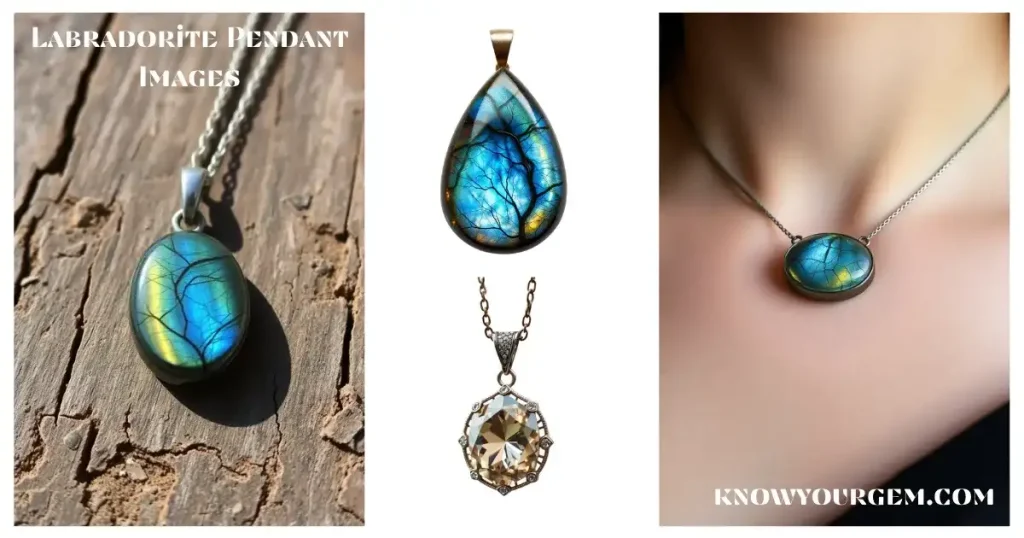
A flash moves with you, so a pendant is always changing. Polished rounds or chips in a necklace create a bohemian style.
Earrings:
Studs and drops both work, and drops add movement.
Bracelets:
Beaded or set styles. “Gelang labradorite” is the Indonesian term for a bracelet made from several stones.
Mixed designs:
Labradorite is often paired with moonstone for a soft, layered effect.
Is labradorite durable enough for daily wear?
6 to 6.5 It’s harder than glass but softer than quartz. Gentle wear is fine, but hold back when you clean everyday jewellery.
Rings get the most bang, bang, so keep them low and protected in a bezel. Pendants and earrings come a lot less in contact. Remove jewelry for anything involving pain or chemicals.
What cuts and shapes are common?
Flat, shiny tops. The best way to maximize flash is a smooth, rounded surface, so a polished cab takes the cake, and cutters have the best angles to direct the flash.
Beads and buttons are good, too, and pay special attention to carved objects like palm stones and pyramids.
How Can You Identify Real Labradorite?
Learn to spot imitations and misdescribed stones. Here are some easy tests, though some will require a lab.
What are the signs of a natural stone?
The flash fades in and out as you turn the stone and appears to be below the surface of the stone, rather than on top of it. The base is usually gray with natural variation.
It appears to be of a reasonable weight for size with a S. G. around 2.68 to 2.72, and has cleavage, which can be seen under magnification.
What are the warning signs?
Surface-only color that doesn’t shift with angle is the first. A perfectly even flash across the whole stone is another. Avoid of over bright, intensely colour on a very inexpensive item or a light, plastic, or resin feel.
What are the common imitations?
Coated glass:
The most common fake. The iridescence is on the surface, and it scratches easily.
Dyed stones:
Low-quality material can be dyed, but dye doesn’t create true labradorescence.
Synthetic opal:
Sometimes misrepresented. Opal’s play of color looks and works differently.
How do professionals confirm it?
A gemologist could work out the refractive index 1.559 – 1.568) and specific gravity, examine the internal structure under a microscope, and with a laboratory you could do some spectroscopy. If it is jewelry, a report can be requested.
How Does Labradorite Compare with Similar Stones?
| Labradorite | Labradorescence (blue, green and more) | 6–6.5 | Gray |
| Moonstone | Adularescence (soft white or blue sheen) | 6–6.5 | White or peach |
| Spectrolite | Intense multi-color labradorescence | 6–6.5 | Dark gray to black |
| Larvikite | Silvery-blue schiller (a rock, not a single mineral) | About 6 | Dark gray |
| Opal | Play of color (full spectrum) | 5.5–6.5 | Varies widely |
What is the difference between moonstone and labradorite?
Both are also feldspar, but the moonstone has that soft, cloudy glow while labradorite is more metallic and bright.
How Do You Care for Labradorite?
If treated well and left in good light, the flash and setting should remain intact. The Lab probably has better cleavage and more moderate hardness and should be gentler than a sapphire or jade.
How do you clean labradorite safely?
1. It is best to use lukewarm water with mild dish soap.
2. You should remove dust with a soft baby toothbrush.
3. Clean it with cold, clean water.
4. Wash it gradually, then dry it with a soft, lint-free cloth.
5. After all pat dry with a soft cloth before putting away.
What should you avoid?
Tearing may be induced by ultrasonic devices. Sonic can be a danger of thermal shock through the steam. Avoid damaging chemical substances, abrasives and extended soak occasions.
Does labradorite fade in the sun?
Natural labradorite will not if it has a flash as the flash is created by structure rather than pigment. It may be dulled by long exposure to very bright light when dyed or coated.
How should you store labradorite?
Dedicated container – (I’m thinking a little soft pouch or a lined box) – away from rougher stones that may scratch it.
What about energetic cleansing?
A lot of people feel stones soak up energy that requires clearing. Typical approaches include taking the stone out in moonlight, sage smoke and singing-bowl sounds, and burying stones in soil – you may damage your stone with the latter method. But none are scientific.
How Do You Buy Labradorite?
Buying well means balancing quality, budget and how you’ll use the stone. Ask the right questions and you won’t overpay for mediocre material.
What should you check before buying?
Start with flash visibility: View the stone from different angles in good light, and the flash should be obvious, not hidden in one position. Then there is coverage, that is to say, how much of the stone has flash, because it is more expensive to cover more.
Take a look at the color quality: There’s a lot of blue and green, and only a handful of each gold, purple, and red. The internal layers of cabochons must be somewhat thick for them to work. Request from your vendor and then observe the surface for scratches, cracks, and the polish quality. For jewelry, look at how well the bezel or the ring had protection for the stone.
What should you ask sellers?
Where was it mined? Has it been treated, enhanced or stabilized? What are the exact dimensions and weight? And Why is it priced at this level?
What are the online buying tips?
Request a video of the stone revolving, as still pictures can’t do labradorescence justice! Find out if daylight LED or studio lights have been used, as this affects the flash. Check the refund policy, reviews mentioning labradorite, and the labradorite report for select pieces.
What Are the Healing and Metaphysical Properties?
Spiritual traditions appreciate labradorite for its association with transformation and inner strength. Although science does not validate these beliefs, they remain important to individuals who incorporate crystals into their wellness routines.
What benefits do traditions claim?
They say it intensifies concentration and helps eliminate foggy thinking, and they wear it as a protection stone against harsh energy. It’s linked to life changes and career shifts. Some people report stronger gut instincts, though that’s personal experience. Your eye on the flash can be relaxing, the same as other Focus Techniques.
How do people use it in practice?
Some have a palm stone during meditation, place one on a desk to concentrate, or keep one beside the bed. Others pair it with affirmations such as “I trust my inner wisdom”. These are personal rituals. If the stone is a prompt that helps you slow down, that’s reason enough to own it.
What are the “magical” properties?
Labradorite is believed by esoteric traditions to awaken psychic power, assist lucid dreaming, tune into guides, and open up knowledge of hidden facts. These beliefs originate from folklore and new age concepts.
What does labradorite actually?
A scientific miracle of its innermost structure sounds about healing or energy aren’t researched, not a replacement for medical or psychological help. If you are havinghealth problems, gethelp from a professional.
What Are the Special Varieties and Related Terms?
Labradorite group is more than a gray stone with a flash of blue. You can identify this as a very special stone by its terms even before the marketing begins.
What is andesine, and is it labradorite?
Andesine is a related type of feldspar and is not a variety of labradorite, although it is often marketed with labradorite. Untreated, natural andesine is priced higher and diffusion-treated material lower, so be sure to inquire about treatment.
Is labradorite a birthstone?
Officially not. Some contemporary schemes associate this month with February or offer it as an option for other months, but these are not grounded in history.
Is labradorite used in countertops and tiles?
Yes. For those who want large slabs but not the soft surface of Caesarstone, the flash creates a strikingly beautiful top. Installations cost much more than jewelry-scale pieces, so get quotes.
What is a labradorite mala?
A mala is a prayer-bead necklace and others have labradorite beads. A traditional mala has 108 beads and a guru bead to use for counting mantras.
What do “labradorita piedra” and “vertus” mean?
Both are foreign-language search terms. “Labradorita” is the Spanish name, and “vertus” comes from French metaphysical writing about the stone’s “virtues”. They help people find information, and they describe the same stone.
Final Thoughts: Is Labradorite Right for You?
Labradorite is inexpensive enough for a novice and fascinating enough to keep a collector returning. The flash is what you’re buying, so judge it in good light, from several angles.
Drawn by the meaning, the look or the story, you’ll follow the same buying rules. Ask about origin and treatment, check the flash yourself, and pick a setting that protects the stone. It’s a stone that has long stood for change, and its color changes as you move it. You don’t need to believe the legend to enjoy that.
Disclaimer: Labradorite’s metaphysical properties come from tradition and personal practice. They aren’t scientifically proven and don’t replace medical, psychological or financial advice. Experiences vary from person to person.
Sources:
Mindat, the Handbook of Mineralogy, GIA and the International Gem Society for properties and identification.
FAQS:
1. Is labradorite expensive?
Generally no. Standard material is affordable, and rare colors in large, clean stones cost more.
2. Is labradorite rare?
This mineral is quite prevalent. Gem-quality material with heavily lameller labradorescence will be uncommon, and purple or red flash in large, clean stones is the rarest.
3. Can labradorite get wet?
A brief rinse is fine. Skip soaking, because water can work into cracks over time.
4. Does labradorite fade?
No, The flash is from structure not pigment. The polish can wear down and dull reducing the flash.
5. Is labradorite good for everyday wear?
With care, yes. At 6 to 6.5, rings need protective settings and shouldn’t be worn for rough activities.
6. What does labradorite symbolize?
In Inuit tradition, it’s linked with the Northern Lights and magic. Modern readings add transformation, intuition and protection.
7. Where is labradorite found?
The majority of deposits are located in Canada (Labrador), Finland (spectrolite), Madagascar, Russia, and Australia. There are smaller deposits located throughout the World.
8. What is labradorite used for?
Rings, pendants, earrings, bracelets and other jewelry items generally made of gold, as well as carvings, decorative objects, and on occasion, countertops and tiles.
9. How do I identify quality labradorite?
Look for a bright flash visible from several angles, good coverage, and rare colors like gold, purple or red.
10. How is spectrolite different from regular labradorite?
Spectrolite is a Finnish variety with a wider color range, often including purple, gold and red. Standard labradorite mostly flashes blue and green.
This content is published by Gemstone Expert and Enthusiast KamilHussain.

Welcome to KnowYourGem.com! your ultimate destination for uncovering the fascinating world of gems and their secrets! I'm Kamil Hussain, a passionate blogger with a Master’s degree in Economics, dedicated to bringing you insightful, well researched content that blends the beauty of gemstones with the art of storytelling. With a keen analytical mind and a love for discovering hidden treasures, I created this platform to help you explore the brilliance, history, and value of every gem.


[…] Labradorite is a feldspar mineral valued for its labradorescence, a flash of iridescent color, usually blue, green, or gold, that flashes only from certain angles. […]