

Abstract:
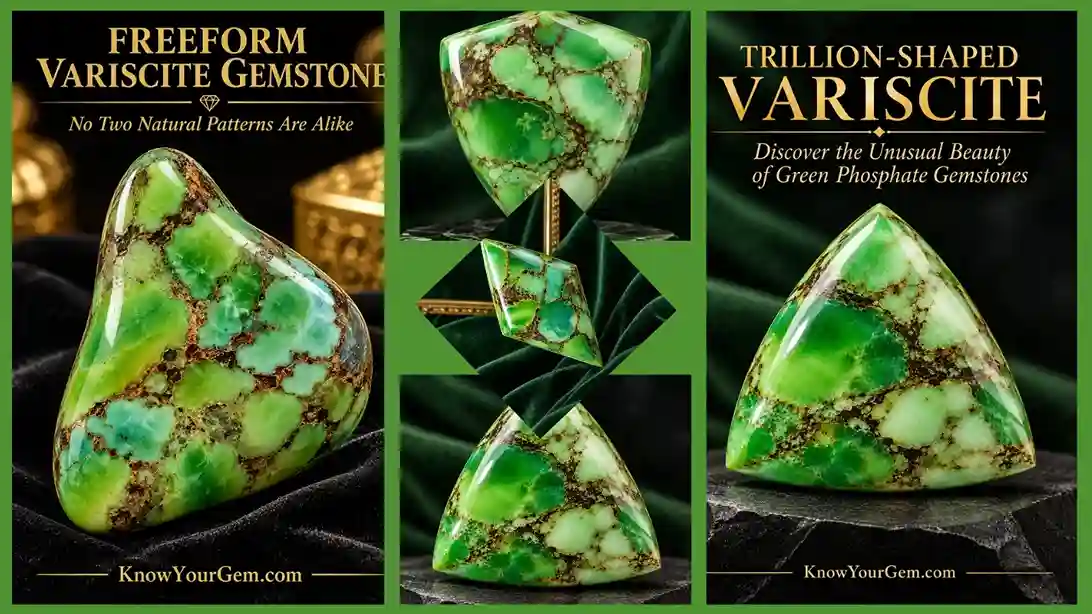
Variscite is a hydrated aluminum phosphate mineral with the formula AlPO₄·2H₂O. It typically appears as green to blue-green cabochons or beads and is often found alongside a brown or black matrix.
Its appearance is very similar to turquoise. Despite this resemblance, variscite is different from turquoise, does not contain copper, and is softer than many buyers expect. Listings frequently mix up these two minerals.
Short answer: A soft (about 3.5 to 4.5), inexpensive phosphate mineral. Usually stabilized or dyed and appropriate for pendants, earrings and gentle use. Don’t purchase for “locality” or “rarity” claims that there’s no way to verify.
Knowyourgem has worked with gemstones for more than 5 years with all gemstones, and most questions raised by buyers are that whether this stone is natural or synthetic?, where it comes from?, what is its treatment status?, Is it rare?, What is its treatment status? and Does seller have proper lab report?. So we recommend that each buyer ask such questions of every seller, if they confidently answer, you should go with.
What Is Variscite?
It’s a mineral, first. It isn’t really a gemstone until you cut it.
Variscite consists of aluminum phosphate with 2 water molecules embedded in its structure. Crystals are rarely seen. Usually what a jeweler may encounter is a dense, fine-grained, waxy material that takes a nice polish.
The mineral is named after Germany’s Vogtland region of the old Latin name variety, Variscia. It was originally written in the 1800s.
What Is Variscite Made Of?
Aluminum, phosphorus, oxygen and water. All that’s in there, but copper isn’t. And that’s the difference between that recipe and turquoise, and the reason we spend more time on identification.
Why Is Variscite Green?
There are also traces of chromium (and in some cases, vanadium) in the field. You may see traces of iron as well, which makes the color slightly yellow-green to brown.
So the same mineral can look pale mint, apple green, deep green or blue-green. It depends on what’s inside and how much.
What Does Natural Variscite Look Like?
They are mostly translucent to semi transparent with a waxy to dull glassy luster. They come in colours from pale green through to rich emerald green, with yellow-green and blue-green being in between.
Most of the stones contain matrix, the host rock or other minerals running through the stone, in shades of brown, black, white or yellow. Some of the cabochons are polished, solid, and smooth. Some appear as green and brown bits in a tiled mosaic.
Neither is a sign of quality or fakery. It’s just how that piece formed.
Is Variscite a Gemstone or a Mineral?
Both. The Gem species variscite becomes a gem when it’s cut as a cabochon, turned into a bead, or carved. But it’s really more of a lapidary collector’s stone than a traditional gem because it’s somewhat soft.
What Is the Difference Between Variscite and Metavariscite?
Same chemical composition but different crystal system. Variscite is orthorhombic, and metavariscite is monoclinic.
Both look the same crystal form and even occur together within the same specimen (no way to visually distinguish them). Must be an outside laboratory, X-ray diffraction to determine the correct crystal system. Most green material offered for sale as variscite is merely that, although some may be partly met variscite.
What Are the Gemological Properties of Variscite?
| Mineral | Variscite |
| Chemical composition | AlPO₄·2H₂O (hydrated aluminum phosphate) |
| Crystal structure | Orthorhombic |
| Habit | Usually massive, fine-grained or nodular |
| Mohs hardness | About 3.5–4.5 |
| Specific gravity | About 2.2–2.6 |
| Refractive index | About 1.55–1.59 (spot reading) |
| Luster | Waxy to vitreous |
| Transparency | Opaque to translucent |
| Fracture | Uneven to conchoidal in massive material |
| UV reaction | The stone looks usually weak or none; varies by specimen |
Some conflict about hardness, specific gravity and refractive index. The rest is variable from stone to stone, and sometimes from point to point on the stone, where matrix, porosity and impurities are different. Read as ranges, not guarantees.
What Is the Mohs Hardness of Variscite?
3.5 to 4.5. Weaker than a knife blade and weaker than glass. Quartz is in everyday dust, and it is a lot harder than variscite, so a polished surface gradually goes dull.
It’s also not a tough stone. A hard knock can chip or crack it.
Why does this matter for jewelry?
Because a ring takes more abuse than any other piece. At this hardness, daily ring wear means visible scratches fairly quickly. It’s the number I’d want buyers to see before they fall for a color.
What Are the Refractive Index and Specific Gravity?
Refractive index is about 1.55 to 1.59, specific gravity about 2.2 to 2.6. On a polished cabochon, the refractive index is a “spot” reading, taken on a tiny contact point, so it’s approximate. Treat it as supporting evidence, not as proof.
Does Variscite Have Any Special Optical Properties?
No. It has no color change, no cat’s eye, and no strong pleochroism in the puffy material. What you are getting is a super-figured, clean, translucent stone with a relatively flat color.
How Is Variscite Formed?
Close to the surface, from water with dissolved phosphorus and aluminum.
What Geological Conditions Create Variscite?
Any of that water passing through fissures and pockets of that aluminum-bearing rock could result in the formation of veins, nodules, and crusts of variscite.
And that phosphate could come from either decomposition of organic material or phosphate mineral-bearing minerals, while the aluminum comes from clay-rich or aluminum-rich beds.
So that implies you’re a geologist. You’re a petrographer before you’ll acknowledge this to be a secondary mineral. The crystal formation takes place in the host rock after it’s been formed in the host rock.
What Minerals Occur with Variscite?
In the vicinity, of course. Quartz, chalcedony, wavellite, crandallite and other substances are all with us, and this mixture affects the appearance of the finished stone.
Rough Versus Polished Variscite:
Rough variscite is dull and frequently covered with clay or host rock, so it’s impossible to tell the color until it has been cut or windowed. Once it is polished, the true color and pattern can be observed, along with the waxy luster of the polish.
Rough is a gamble. A promising nodule can turn out cracked, porous or pale.
Where Is Variscite Found?
In several countries. Gem-quality material is much less widespread than the mineral itself. The table lists localities I’d expect to see named. Treat every row as something to confirm.
| United States | Utah (Fairfield area, Tooele County), Nevada (Lucin area), Arkansas | Green to blue-green, often with brown or black matrix | Confirm each locality with Mindat and published records |
| Germany | Vogtland, Saxony | Type locality area; mostly mineral specimens | Historical; rarely a jewelry source |
| Australia | South Australia (for example, around Wooltana), others | Green with matrix; sold as “Australian variscite” | Provenance and ask for documentation |
| Brazil | Reported in several states | Mostly specimen material | Before describing as a gem source |
| Other | Spain, Austria, Bolivia and elsewhere | Variable | Mostly specimens; confirm each |
What Makes Utah and Nevada Material Different?
Utah and Nevada material is probably the best known in the lapidary trade. It’s usually sold as cabochons and rough, in green and blue-green with matrix.
I wouldn’t say one state’s material beats the other’s. What counts is the piece in front of you, and whether its locality label is documented.
What Is Australian Variscite?
It’s variscite said to come from Australian deposits, sold as cabochons, rough and jewelry, often with strong green color and patterned matrix.
I haven’t verified a specific Australian locality for this article, so I’m not describing any stone as Australian. If a listing says Australian, ask which deposit, and ask what documentation backs it up. A locality on a listing isn’t evidence.
Is Australian variscite rare?
I can’t support that claim, so I won’t repeat it. Fine material from any source can be scarce, but the word “Australian” doesn’t make a stone rarer or better on its own.
What About the Broken Arrow Variscite Mine?
Broken Arrow is a name collectors and sellers use. I haven’t confirmed the mine’s location, ownership, operating status or production history, so I’m not stating any of it.
If a listing cites Broken Arrow, ask how the seller knows. A collection record or purchase invoice is worth far more than the name.
What Types and Colors of Variscite Exist?
Color is a property of the stone. The mineral underneath is still variscite. Trade names blur this, so go slowly.
Colors:
- Green variscite: The standard, from pale to deep green.
- Apple-green: A bright, yellowish shade of green, relatively more highly prized than others.
- Blue-green: Can indicate other mineral inclusions and occasionally turquoise. Look this one over nicely.
- Yellow-green: Often tied to iron, and to brown tones.
Mineral and Pattern Terms:
What is ferrian variscite?
Variscite with iron substituting for some aluminum, which moves it toward the iron phosphate strengite. It’s not always visibly different.
What is metavariscite?
A related mineral with the same formula but a different structure. See the earlier section.
What are spiderweb and matrix patterns?
Green with fine veins of other minerals running through it. They’re a pattern, not a separate mineral.
What is variquoise?
A trade name, not a mineral. It’s usually applied to material containing variscite along with turquoise.
Is Variscite the Same as Turquoise?
No. They’re not the same phosphate minerals that just look alike. They are both blue-green colour with a brown or black matrix that is the most common reason they are confused.
| Their chemistries | Aluminum phosphate, no copper | Copper aluminum phosphate | |
| Thier formulas | AlPO₄·2H₂O | CuAl₆(PO₄)₄(OH)₈·4H₂O | |
| Their crystal systems | Orthorhombic | Triclinic | |
| Their Mohs hardness | About 3.5–4.5 | About 5–6 | |
| Their typical colors | Green to blue-green | Sky blue to blue-green | |
| Color cause | Chromium, sometimes vanadium | Copper (blue) and iron (green) | |
| Usual treatment | Stabilization and dye occur | Stabilization is very common |
The turquoise is the more brittle of the two. Both of them are so soft and porous compared to most other gemstones and both are often stabilized with resin.
Which Is More Expensive?
It depends on the stone, not the name. Quality, treatment and demand for the specific piece decide it. Don’t assume either mineral costs more.
Can Variscite Be Sold Under Misleading Turquoise Names?
Yes. “Utah turquoise” is the classic case. It’s a common label for material that may be variscite, turquoise or a mix, and the name doesn’t settle which one you have. “Variquoise” is another.
Appearance can’t tell you the mineral, and a seller’s description can’t either. A lab can. If the label affects the price, ask for a report.
How Can You Identify Real Variscite and Spot Imitations?
Begin with the seller’s claim and add that no visual test can be conclusive, because variscite, turquoise and many fakes can resemble one another.
Common Lookalikes:
Dyed howlite:
A soft white borate mineral sometimes colored green or blue. The dye can migrate into cracks and abrade off. Some specimens may look like variscite or turquoise.
Chrysoprase:
Apple-green chalcedony, much harder at about 6.5 to 7. It’s translucent and usually has no matrix like variscite.
Chrysocolla:
A blue-green copper mineral, soft and often mixed with quartz. The color can look close.
Reconstituted material, plastic and glass:
Crushed stone bonded with resin can look convincing. Plastic and glass usually look different under magnification.
What Checks Help?
Grain and matrix seen in a loupe. Natural variscite has a uniform fine grain, irregular matrix and veins. Dyed howlite usually shows the dye in cracks and chips and plastic can show bubbles or a plastic look.
The scratch test. A scratch test can be instructive, but it gouges a stone you may have been thinking about buying, so let the expert do it.
What can a gemologist test?
The refractive index and specific gravity are also confirmatory, but the NR is a spot reading on a polished cabochon. To definitively determine an answer, the lab procedure is X-ray diffraction or infrared spectroscopy to identify whether it is variscite or turquoise or other phosphate.
Can Photographs Prove It’s Genuine?
No. A photo shows color and pattern, and those are exactly what imitations copy.
UV isn’t safe either. Usually, variscite is either very faint or non-existent, although a few varieties are reactive due to inclusions, so don’t authenticate a stone with a weak UV reaction.
Treatments:
Stabilization with resin is common in this trade. It hardens porous material, and it’s an accepted practice when disclosed. Dye is different, because it adds color. It should always be disclosed.
Ask directly whether the stone is natural, stabilized, dyed or reconstituted, and get the answer in writing.
I don’t have a verified case of misrepresented variscite to share, so treat this section as guidance on what could go wrong, not a report of what has.
What Is the Biggest Buyer Misconception About Variscite?
Many buyers believe a beautiful pattern or a famous locality proves a stone is genuine, valuable or rare. It doesn’t.
Matrix patterns can be natural, dyed or reproduced. Locality labels are often unverified. And “rare” is a sales word. What you can actually check is the mineral identity, the treatment status and what the piece is worth as a cabochon or jewelry.
The Wear Mistake:
The second misconception is about durability. Plenty of buyers don’t realize how soft variscite is, and they buy a ring for daily wear. A 3.5 to 4.5 stone will scratch and dull quickly. Ask how you will use the stone before you purchase it.
Is Variscite Rare, Valuable or a Good Investment?
The mineral is not rare. It can be found in many locations and run-of-the-mill material is inexpensive. Better quality gem material with good color, no cracks and a high polish is more limited; it does, however, command a higher price if there are certain patterns or localities that collectors seek.
Three Ideas That Get Mixed Up:
- Geological scarcity: The frequency of occurrence of the mineral.
- Selling fine material: The amount of good rough and cut stone available for sale.
- Commercial demand: What buyers will pay.
A stone can be rare and sell for little. Another can be common and still earn a premium for its pattern.
Is Variscite a Good Investment?
I wouldn’t count on it. It’s an affordable, soft stone with no established resale market. Buy it because you like it. Rarity doesn’t guarantee a return.
How Much Is Variscite Worth?
Price will vary depending on the shape of the product (rough, cabochon, beads, or finished jewelry), the color, the matrix and the treatment. Fine, even color and a good polish usually cost more. Stabilized material is generally cheaper than natural, untreated material of similar look, and dyed material is the lowest.
Asking prices aren’t the same as what stones actually sell for, so check completed sales when you can. I haven’t included figures because I haven’t verified current auction or dealer data.
| Rough | Weight, color, cracks, matrix | It is essential to check fractures, pits, excessive matrix and unsual cutting. Also ask for photos |
| Cabochon | Size, color, polish, treatment | Before buying must check color consistency, surface pit scratches and symmetry |
| Beads (strand) | Bead size, color consistency, treatment | You must need to check bead diameter, driling quality, matching color and surface finishes |
| Finished jewelry | Metal, setting, stone quality | You should also verify metal purity, secure stone setting, cabochon condition and treatment disclosure |
Does Australian Variscite Cost More?
I can’t confirm that, and I wouldn’t assume it. When you have a premium, ask what it is for, whether the documentation supports that.
What Is Variscite Used For?
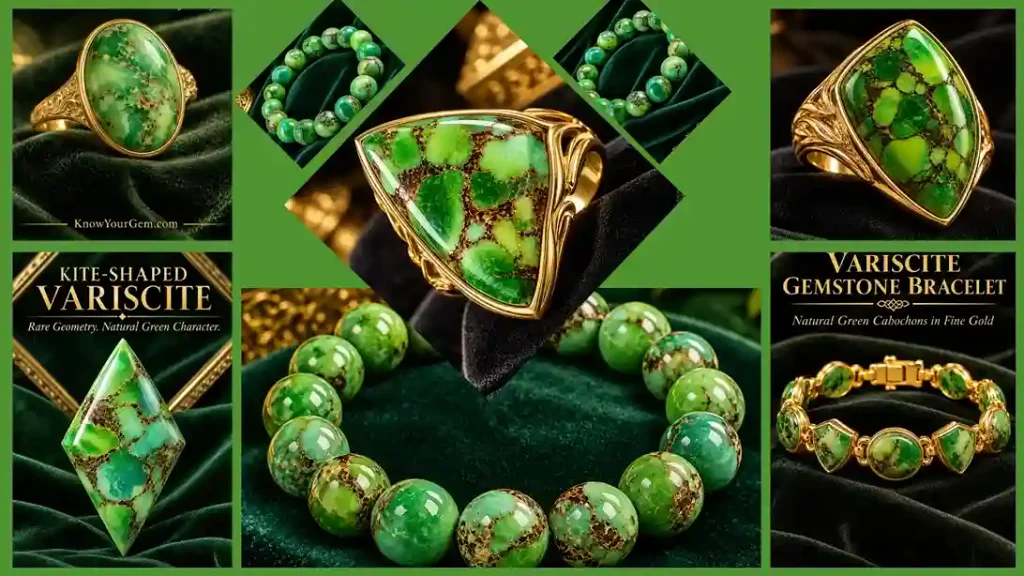
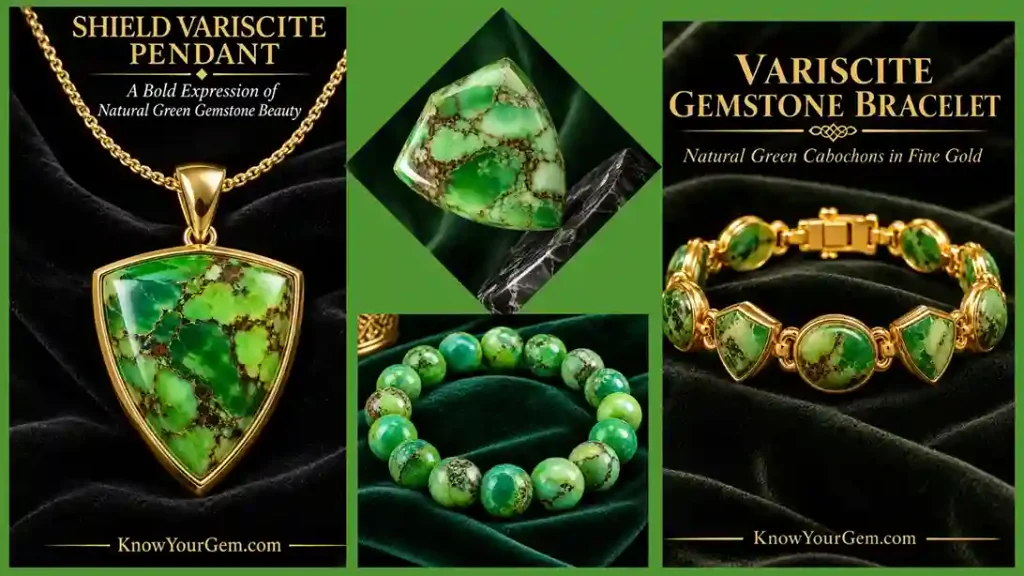
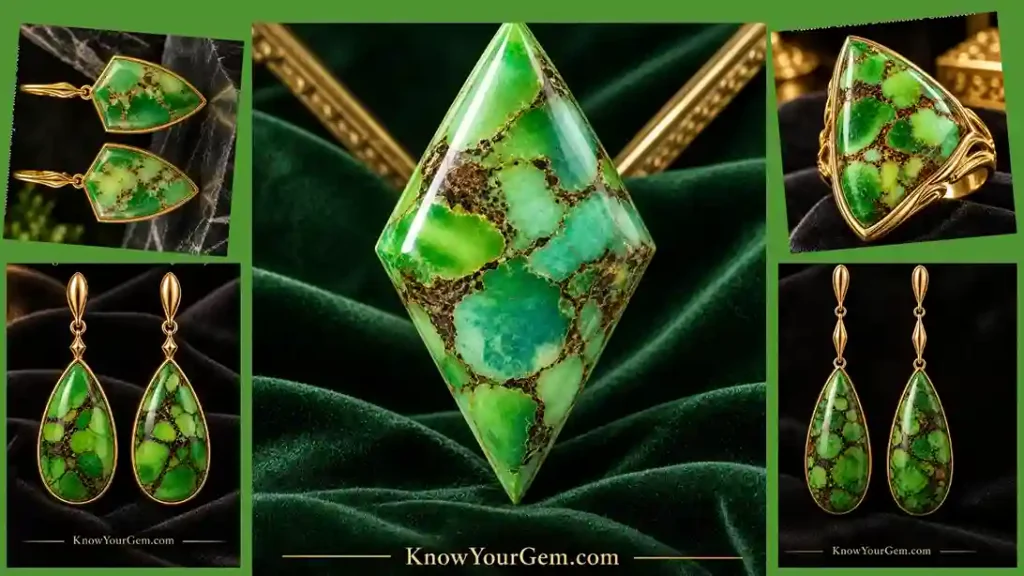
Mostly cabochons, beads and carvings. It takes a good polish and it’s easy to shape, and the colors and patterns make attractive jewelry and decorative pieces.
Which Jewelry Suits Variscite?
At 3.5 to 4.5, protect it.
- Necklace and earrings: The best, because they don’t get a lot of punch.
- Beaded necklaces: Usable
- Bracelets: More dangerous as the wrists slap onto the table and the desks.
- Rings: The toughest on the stone. A ring, especially an engagement ring, isn’t the best for everyday wear. If a ring is what you’re after, opt for a bezel and wear it when you can.
How do you choose a good cabochon?
Seek color consistency, a velvety dome, and no marks or lines across the stone – not pitted and no lines through the stone. The best shape of the stone that will sit flush in the setting is just as important as the color. Review the rough prior to cutting.
Record visible cracks, soft spots, chalky portions, and the lay of the matrix to determine the relative quantity of usable stone in the block.
Cutting and polishing:
Slabs are sawn with standard lapidary saws, surf-sanded, and polished with finer abrasives. Do not apply undue pressure or allow sawing, grinding or polishing to generate heat or become dry to prevent cracking. Suggested polishing compound trust but verify cerium oxide, aluminum oxide.
Why can it crack, pit Or lose its polish?
The inside is soft, porous in some spots, and constantly shifting between unyieldingly hard and soft, open matrix and green. All of those areas can split or deepen pits when subjected to heat and pressure, and chemicals or oils will grow dark over time.
What Do People Believe About Variscite?
Everything here is tradition and belief, not proven effect.
Traditional Meanings:
In the use of crystals, variscite corresponds to peace, calm, the heart chakra and in its green color with rebirth. A few charts associate it with specific zodiac signs and the references are conflicted as to which.
Is There Scientific Evidence?
No. There’s no scientific evidence that variscite heals anything, and it isn’t a substitute for medical care. If the color means something to you, that’s reason enough to own one.
Is Variscite UV Reactive?
Usually only weak or absent. Some specimens fluoresce (generally related to minerals) in some cases and the signal also is different using shortwave and longwave UV. Hence, UV is a curiosity here and not a reliability test.
How Do You Clean and Care for Variscite?
Clean this stone gently while using the methods given below.
Cleaning:
Clean with soft cloth and warm water (a small amount of mild soap is okay) and dry. Avoid ultrasonic or steam cleaners – vibration and heat can damage a soft porous stone.
Can Variscite Get Wet?
A brief rinse is fine. Stains should not be left on for extended periods of time if you have dyed or stabilized stones. Protect your jewelry from harsh chemicals, perfume, oils, and household cleaning agents, as these can cause damage to resin or dyes or damage your jewelry’s polish or luster.
Heat and Storage:
Avoid heat as it can damage stabilization – no car or long time in strong sun. Protect it in its own soft pouch, not alongside harder stones that can scratch it. Remove rings when doing heavy work.
Buyer Checklist
- Enquire in writing about the identity of the mineral.
- Request the specified location and the manner in which the seller knows.
- Ask if it is natural, stabilized, colored or reconstituted.
- Know the precise measurements and weight.
- Ask for close-up photographs of the stone, including damage, the surface, pits, and repairs.
- Compare ask prices to completed transactions.
- Know before you owe.
- Order a third-party gemological report for expensive item.
- Wear earrings or a pendant instead of a ring that you wear all the time.
Key Takeaways:
- Variscite is aluminum phosphate with no copper. Turquoise is a different mineral.
- It’s soft, at about 3.5 to 4.5, so it suits pendants and earrings best.
- Appearance and locality labels don’t prove identity. Only lab testing does.
- Stabilization and dyeing occur in this trade and should be disclosed.
- Rarity and origin claims need documentation, and I wouldn’t treat variscite as an investment.
Sources:
Frequently Asked Questions:
1. How do you pronounce variscite?
Usually “VAR-ih-site”.
2. Is variscite a rare stone?
This isn’t a rare mineral. Gem-quality material in very fine specimens is more difficult to find; this claim to rarity should be substantiated with documentation.
3. Is variscite more valuable than turquoise?
Not typically. It is all a matter of quality, treatment, and demand for a given type of stone, not the mineral name.
4. Can variscite be used in engagement rings?
It’s not quite right. At 3.5 to 4.5, it’s softer, so it will scratch more easily, making it only the best option for some occasional-wear jewellery.
5. Can variscite be used in engagement rings?
It’s not quite right. At 3.5 to 4.5, it’s softer, so it will scratch more easily, making it only the best option for some occasional-wear jewellery.
6. Does variscite change color over time?
Yes, it can. This is more common in dyed, stabilized, or heat, oil, or chemical-treated stones. Most natural, untreated stones are more stable.
7. Can variscite be dyed or stabilized?
Yes, both occurring should be disclosed.
8. Is variscite the same as jade?
No. Jade is jadeite or nephrite, which is far harder and tougher. Variscite is a soft phosphate.
9. Does variscite have a birthstone or zodiac association?
It isn’t a standard birthstone. Some crystal traditions link it to zodiac signs, and sources disagree.
This content is published by Gemstone Expert and Enthusiast KamilHussain.

Welcome to KnowYourGem.com! your ultimate destination for uncovering the fascinating world of gems and their secrets! I'm Kamil Hussain, a passionate blogger with a Master’s degree in Economics, dedicated to bringing you insightful, well researched content that blends the beauty of gemstones with the art of storytelling. With a keen analytical mind and a love for discovering hidden treasures, I created this platform to help you explore the brilliance, history, and value of every gem.

