
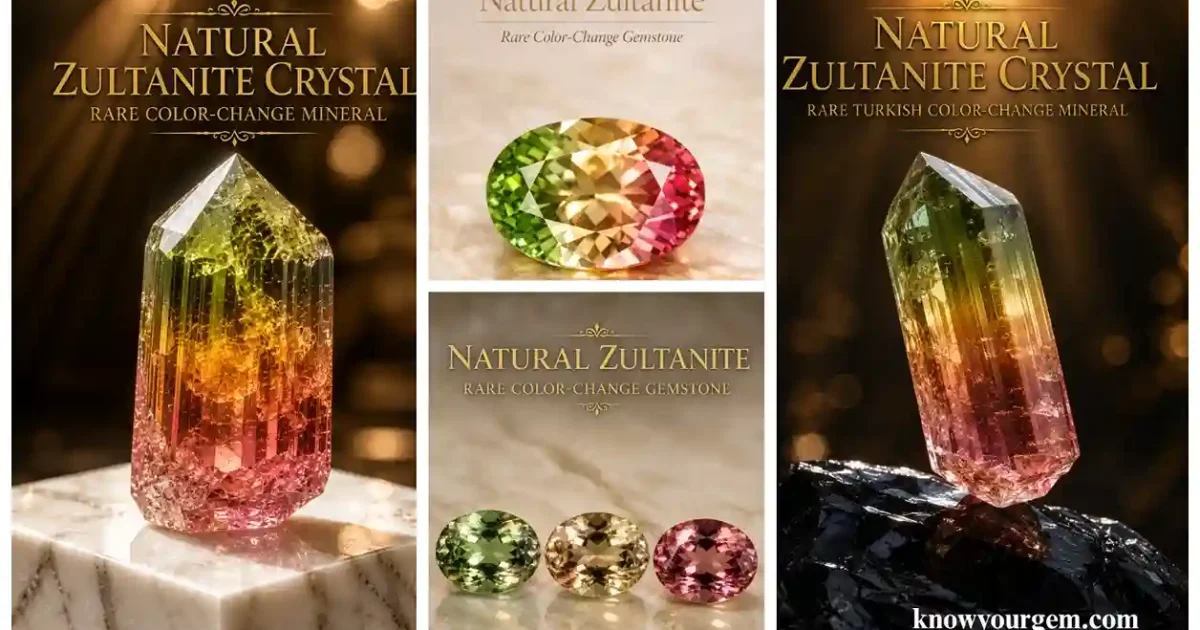

Quick Answer:
Zultanite is primarily the trade name for quality diaspore, it is mined only in Turkey’s Ilbir Mountains. Its color shifts from kiwi or khaki green in daylight to pink, champagne, or raspberry under incandescent light, that creates one of the most dramatic natural color changing effects in this stone.
The stone is valued for, single source origin, and untreated beauty, as genuine zultanite commands price from $200 to more $1,200 per carat. Pricing hinges on size, hardness and color of the stone.
A question is definitely roaming on each enthusiast that how about the 10 facts of most similar color changing stone alexandrite engagement rings as well to gain more knowledge, so you don’t need to go any else where we also published comprehensive guide about it here.
Key Takeaways:
- A single location Ilbir Mountains near Milas, in Turkey supplies this stone.
- Authentic zultanite generally changes its color while depending on the light source, that shift green to pink or champagne tones.
- It owns 6.5 to 7 mohs hardness, means softer than sapphire but still suitable for daily wear jewelry with gentle care.
- It can typically command prices like, $200 to $1,200 plus per carat, with larger size, vivid color changing stones can command premium prices.
- Zultanite is not treated or enhanced, which adds to its collector appeal.
- No commercially available synthetic or lab-created zultanite exists.
Zultanite Quick Facts:
| Property | Detail |
| Mineral | Diaspore |
| Trade Name | Zultanite was kept in 2005 |
| Source | Ilbir Mountains, Muğla Province, Turkey (single source) |
| Chemical Formula | Its chemical formula is AlO(OH) |
| Crystal System | Orthorhombic |
| Mohs Hardness | It owns 6.5 -7 Mohs hardness |
| Refractive Index | The stone has 1.70 -1.75 of refractive index |
| Specific Gravity | 3.3 -3.5 |
| Color Change | It displays Green/khaki to pink/champagne in daylight (incandescent) |
| Treatment Status | Untreated, natural |
| Typical Price | $200 -$1,200plus per carat |
Introduction:
Most color changing gems are available as synthetic in modern world or so, rare that buyers rarely encounter them. Zultanite is totally different, because it is naturally mined from its ethical origin and it is loved for its dramatic shifts in color under vary light.
Collectors and buyers should understand how it stands apart from alexandrite, sapphire or lab grown gems. It exclusive and vivid transformation make it a distinctive in vestment piece with both rarity and beauty.
What Is Zultanite?
The trade zultanite , is gem quality of diaspore mined exclusively in Turkey. While diaspore has been recognized to mineralogist for facet grade crystals, that are suitable for jewelry and are extremely rare, that makes it valuable discovery.
The name was trademarked in the early 2000s to market Turkish diaspore internationally, as some sellers still use the original mineral name. Its purity separates it from ordinary diaspore and makes it very desirable in the gem trade.
The Turkish source is one of the few places on the Earth capable of yielding diaspore with the clarity and quality required for fine jewelry, that give this stone unique prestige among various collectors.
Meaning Of Zultanite:
Zultanite holds symbolic weight that is tied to transformation and adaptability, largely due to having dramatic color changing behavior. Many jewelry buyers associate the stone with personal growth, as it visibly shifts character hinging on its environment.
The name itself evokes a sense of luxury and heritage, is drawing on associations with Ottoman-era Turkish royalty even though the trademarked name is a modern marketing creation. This connection to Turkish culture and history adds a layer of romantic appeal for buyers who are seeking a gem with having distinct origin story.
Enthusiasts often see this stone as balance, it never fully settles into one color. Its constant shift between colors make it symbol of adaptability and transformation, that gives its meaning.
History Of Zultanite:
Diaspore was first introduced in 1801. In that French mineralogist René Just Haüy, has named it after the Greek word meaning “to scatter.” This referred to its tendency to break apart when it is heated, as water escaped from its crystal structure. For nearly two centuries, it remained a mineralogical curiosity, and collector valued it but it is rarely seen in jewelry due to the scarcity of clean, facet grade crystals.
That changed in the late 20th century when high qualitative deposits were discovered in Turkey’s Anatolian region. The stone was recognizing its potential, gem dealers trademarked the Zultanite in 2005, launching this stone as a luxury gemstone brand distict from its scientific identity. This move transformed diaspore from an obscure mineral into a recognized jewel with having cultural and commercial appeal.
Origin Of Zultanite:
Every gem quality of zultanite comes from single source, called Ilbir Mountains that is near to Milas in Muğla Province, southwestern Turkey. No other deposit has produced facet grade diaspore, that give the stone unmatched geographic exclusively in the gem world.
This is the only place that defines its identity and marketing, but not as same as sapphire or emerald that are mined globally. Its remote high elevation site limits production, and heat scarcity keeps zultanite a niche.
Geological Environment:
The gemological story of Zultanite is associated with Menderes Massif in southwestern Turkey, where metamorphosed bauxite deposits provide the aluminum rich chemistry that is needed for diaspore crystallization.
Other alternative stone like, corundum, margarite, and various clays occur alongside gem grade diaspore in the Ilbir deposit. Their presence usually helps geologists outline productive zones, to confirm the unique environment that enables this stone to form with clarity and brilliance.
Formation Zultanite:
The formation this gem is happening deep within the earth through metamorphic processes, where aluminum rich rocks are subjected to intense heat for more than millions of years.
Since, these conditions crystallize aluminum oxide hydroxide into diapore’s orthorhombic structure, and trace elements like chromium and iron create the selective absorption produces its dramatic color change effect.
The Ilbir Mountains in Turkey provide the rare mix of pressure, temperature, and mineral chemistry that that are needed to form transparent, facet grade crystals.
As such environment hasn’t been replicated elsewhere, every qualitative remains exclusive to Turkey, and valued for its rarity, clarity, and brilliance.
Trace Elements Responsible for Color Change:
Chromium is the primary infinitesimal element responsible for zultanite’s pink and raspberry tones, as it absorbs green and blue wavelengths while transmitting re. Iron contributes to the green and Khaki base color is seen in daylight, absorbs different portions of the visible spectrum.
The ratio and distribution of these two elements within an individual crystal determines how strong or subtle the color effect will appear. Crystals with a well balanced chromium to iron ratio produce the most dramatic and commercially desirable color shifts.
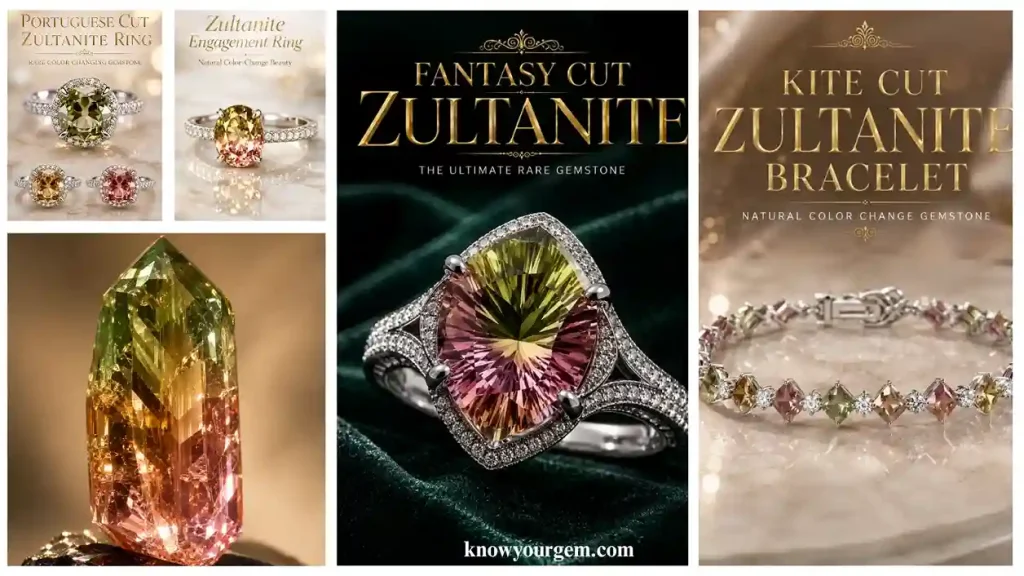
Mining Of Zultanite:
The mining of zultanite demand process has carried out in the remote Ilbir Mountains of Turkey.
As the deposit is small and difficult to access, extraction relies on labor intensive methods rather than larger scale machinery, that keeps the production valumes low as compared to more common gems like amethyst or citrine.
Only a fraction of the crystals are recovered are transparent and clean enough to be faceted, whether the majority were earlier kept as mineral specimens or discarded.
This scarcity, combined with the difficulty of extraction, and also explains why zultanite commands premium price despite its moderate hardness and relative abundance in mineral form.
Market Availability:
Annual production of facet grade zultanite is roughly estimated in range of few thousand carats, a tiny figure as compared too mainstream colored gemstones that mined in tons.
This limited output means finished jewelry grade stones reach the market in relatively small, irregular batches.
Export availability is concentrated among a small number of Turkish dealers and cutting houses that control much of the supply chain from mine to market.
Buyers should expect fewer options and longer wait times for larger or higher grade stones as compared to shopping for more widely available gemstones.
Supply constraints of these gemstones are unlikely to ease significantly, since the deposit’s remote location and modest scale make larger scale industrial expansion impractical.
Crystal Structure & Mineralogy:
This guide showcase zultanite’s physical traits in depth and cover-ups crystal habit, cleavage and fracture, tenacity, streak, diaphaneity, and twinning.
Crystal Habit:
Zultanite often forms like tabular or elongated prismatic crystal, that gives the stone a flattened look along one axis.
This rough rival crystal commonly showcases striations on its face, a typical feature of orthorhombic mineral that is shaped under directional pressure.
Cleavage & Fracture:
Zultanite owns perfect cleavage in one direction and distinct cleavage in a second, that make it more fracture prone than gemstones with having less directional weakness, such as sapphire or spinel.
When cleavage doesn’t control a break, the stone exhibits an uneven to conchoidal fracture pattern.
Tenacity:
The tenacity of zultanite, means its resistance, to breaking , chipping, or is considered brittle.
This is essetial practical distinction from hardness, as a stone it can relatively be hard on the Mohs scale whether still needs gentle care as it can chip.
Streak:
Zultanite produces a white streak when it is scratched against an unglazed porcelain plate, consistent with diaspore’s mineralogical classification.
Streak testing is rarely performed on faceted gemstones, since it damages the spectrum, but it remains a standard refrerence property in mineralogical identification.
Diaphaneity:
Qualitative Zultanite gem ranges from transparent to translucent, with the most valuable faceted stones can be fully transparent and eye clean. Lower clarity material with having heavier inclusions is typically translucent and better suited to cabochon cutting than facing.
Twinning:
Zultanite crystals can exhibit polysynthetic twinning thin crystal layers that are growing in repeated, mirrored orientations. This twinning can influence how light travels through the stone and occasionally contributes subtle optical visible affect under magnification.
Gemological Properties Of Zultanite:
- Chemical composition: The crystal owns chemical formula like Aluminum oxide hydroxide (AlO(OH), with chromium, iron, and manganese that create its color-change effect.
- Crystal system: This stone crystallizes in Orthorhombic crystal system, that gives three unequal axes and strong pleochroism.
- Mohs hardness: It has 6.5-7 Mohs hardness, means durable and suitable for jewelry but require protective setting for daily wear ring.
- Specific gravity: Its 3.3-3.5, specific gravity believed to help gemologists to distinguish it from imitations.
- Refractive index: Zultanie’s 1.70-1.75, refractive index produces moderate brailliance when it is cut in well shaped.
- Density: 3.3-3.5 g/cm³ gives a stone solid feel as compared to lighter gems.
- Luster: Vitreous, with having polished stones showcase a glass like shine.
- Cleavage: A gem carries perfect cleavage in one direction, but requires careful faceting to avoid fractures.
- Transparency: A gem owns transparent to translucent, but eye clean pieces of it are mostly valued.
- Pleochroism: It has strong trichroism like, green, yellow-brown, or pink-red that hinges on angle.
- Optical properties: Biaxial with moderate dispersion, creates layered visual effects.
Gemological Identification:
Given below is the complete guide about how to identify authentic gem:
How gemologists identify zultanite:
Experts use a mixture of test like, refractometer, polariscope, dichroscope, spectroscope, and magnification, since no single property is conclusive.
Refractometer readings:
Zultanite showcases a refractive index of 1.70 with having birefringence approximately 0.048, and its strong biaxial optics which confirm the authenticity.
Polariscope results:
Under polarized light, the stone displays a biaxial interference pattern. This makes it separate from singly refractive gems like glass or garnet.
Dichroscope observation:
A dichroscope discloses vivid pleochroism, and showcases green, yellow-brown, and pink-red coloration. This trichroism is one of the most distinctive markers.
Chelsea filter response:
Through a Chelsea filter, zultanite often showcases a weak pinkish-red reaction. But no definitive, as it supports other optical tests.
Spectroscope features:
Spectroscopy highlights absorption bands from chromium and iron. These features correspond to the wavelengths behind its coloration effect.
UV fluorescence:
Zultanite is weak to inter under UV light, not like strongly fluorescent stones. This is muted response that helps to flag imitations.
Magnification Characteristics:
At 10x-40x, natural growth structures, fractures, and inclusions appear. Since, these internal features distinguish genuine Turkish diaspore from synthetics.
Zultanite Inclusions:
The in depth guide showcase whether the stone contains natural inclusions or not:
Common Inclusions:
It contains needle like or fibrous inclusions that are along with two or three phase fluid pockets. Cleavage related fractures, are often called “feathers,” also appear due to having directional planes.
Eye-clean vs included stones:
Eye clean gems showcases no visible inclusions and can command premium prices. However stones with having visible inclusions remain genuine but usually sell at discounted prices.
Diagnostic Inclusions:
Certain patterns are combined with the growth structures, that help to confirm Turkish origin. Whether no single inclusion is unique, the overall fingerprint supports authenticity.
Value Impact:
Inclusions usually affect both beauty and durability, as fractures can weaken the stone. Buyers always look for lower cost against the long term strength of cleaner material.
Color Chaning Facts:
Zultanite shifts from earthy kiwi green, khaki, and yellowish green in daylight to warm pink, raspberry, or champagne under incandescent light.
Base Colors:
In daylight or fluorescent light, the stone showcases kiwi green, khaki, yellow-green color spectrum. However under warm incandescent light it, shifts to pink, raspberry, or champagne.
Color Change:
A color shift is among the most dramatic in natural gems, that rivals, alexandrite. Since, a fine stone can look green in one room and pink champagne in another within seconds.
Why It Changes?
Chromium and iron absorb light differently that hinges on source. As daylight emphasizes blue-green wavelengths, whether incandescent light highlights red-yellow tones.
Lighting Conditions:
Fluorescent or LED light often produces intermediate hues like, muted greens, golds, or soft pinks.
Color Grading:
Dealers use an informal AAA grade to commercial scale to describe the quality of this gem.
| Grade | Saturation | Color Change Intensity | Description |
| AAA | Vivid | Strong, dramatic shift | This type of stone has distinct green to vivid pink/raspberry, minimal muddiness |
| AA | Moderate to strong | Clear, noticeable shift | This stone is good green to pink transition, slightly less saturated |
| A | Moderate | Visible but subtle shift | This variety owns softer color change, more olive or muted pink tones |
| Commercial | Weak to moderate | Faint shift | Its colors present but transition is subtle or partial |
Hue is the color family like, looks green in daylight, pink or purplish-pink in incandescent light, while tone is the lightness or darkness, with having mid tones preferred for balance and liveliness.
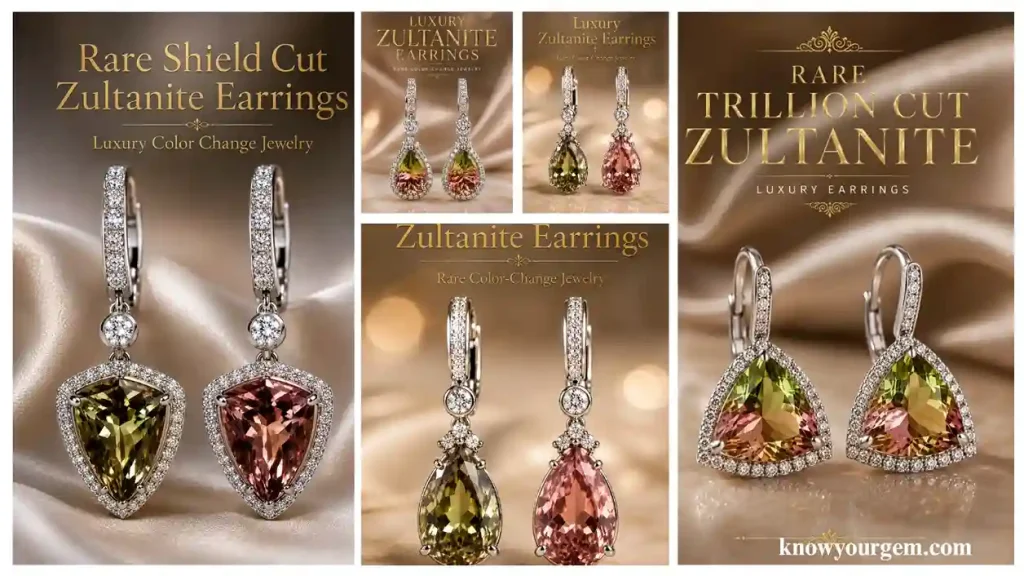
Cut & Shape Guide:
Zultanite is cut into classical shapes such as oval, cushion, pear, emerald, princess, round, and cabochon.
| Cut | Color Change Performance | Notes |
| Oval | Strong | This cut is popular choice in jewelry, as it balances brilliance and color display |
| Cushion | Strong | This is larger facet cut showcases color transitions well |
| Pear | Moderate to Strong | This elegant shaped cut and is good for pendant and drop earring. |
| Emerald Cut | Moderate | It is step cut that shows color in broader zones, less sparkle |
| Trillion | Strong | It is triangular facet cut can intensify color contrast |
| Princess | Moderate | This cut is less common for zultanite because of yield loss from rough |
| Round | Strong | This cut maximizes brilliance, and yields less carat wight from rough |
| Cabochon | Weak to Moderate | This cut is used for included material, and it shows color as broader zones |
Faceted cuts maximize Zultanite’s sharp, dramatic color shifts, while cabochons reveal softer, diffused transitions.
Clarity Grading:
Zultanite’s clarity is described in four practical categories, gemologists and dealers commonly use them instead of formal numeric grading system.
| Clarity Grade | Description |
| Eye Clean | It means that no inclusions are visible to the unaided eye at normal viewing distance |
| Slightly Included | It means minor inclusions are existing only under close inspection or magnification |
| Moderately Included | Means inclusions visible to unaided eye but not significantly affect brilliance |
| Heavily Included | This indicates that inclusions clearly visible and affect transparency or durablity |
Eye clean zultanite is seldom and pricier, with buyers favorite eye clean or slightly included stones for durability, as heavy surface inclusions raise the risk of chipping.
Carat Size Guide:
| Size Category | Carat Range | Market Notes |
| Average | Under 1 carat | It most commonly available size, and is widely used in earring pendant. |
| Rare | 1 – 3 carats | It has less common, noticeable price increase per carat |
| Premium | 3 – 5 carats | It is scarce, typically requires specially dealer sourcing |
| Collector | 5plus carats | It is museum and collector grade significant price premium |
Average sized Zultanite under one carat offers an affordable entry into its full color change effect, whether stones more than five carats are rare from the Ilbir deposit and valued by serious collectors.
Treatments & Enhancements:
- Untreated status: Zultanite is not heat treated, irradiated, fracture filled, or coated stone, not same as many other colored gems. Its natural state is a major selling point and adds to its collector appeal.
- Heat treatment absence: Heating can’t reliably improve color or clarity and risk of damaging cleavage planes. For this reason, it is never used in standard trade practice.
- Other treatments: Irradiation and fracture filling are also absents, that keep this stone distinct from stones like sapphire or aquamarine that often undergo such processes.
- Market caution: Any seller claiming “treated” or “enhanced” zultanite should be approached carefully. These claims often signal misrepresentation or synthetic substitutes.
Price Per Carat Zultanite:
The stone commands prices like $200-$600 per carat for smaller stones, however it is sold for $800-$1,200 plus for premium or larger prices.
| Quality Tier | Carat Size | Approximate Price Per Carat |
| Commercial | Under 1 carat | Can command prices like $150-$350 |
| Fine | 1- 3 carats | Can command price like $350-$700 |
| Premium | 3 -5 carats | Commands prices like $700 -$1,000 |
| Investment-grade | 5plus carats | Can command prices like, $1,000-$2,000plus |
- Color change strength: The intensity and clarity of this stone shift between green and pink is considered as the single most essential factor, that defines whether the stone is exceptional or average.
- Clarity impact: Eye clean stones can command premium price, because they own beauty and durability,since visible inclusions are lower but they still command premium prices.
- Cut quality: A precise cut enhances brilliance and color change, and also adds value without extra weight.
- Carat weight: Larger sized stones are rare, so price per carat climbs with the size.
- Origin and certification: Authentic zultanite only comes from Turkey, and certification builds trust, also help stones sell faster at steadier prices.
- Investment value: Since its 2025 introduction, it has built a niche collector market. Limited mine output and single source rarity drive long term appeal
- Market outlook: Demand grows steadily among designers and collectors, but supply is capped by one district.
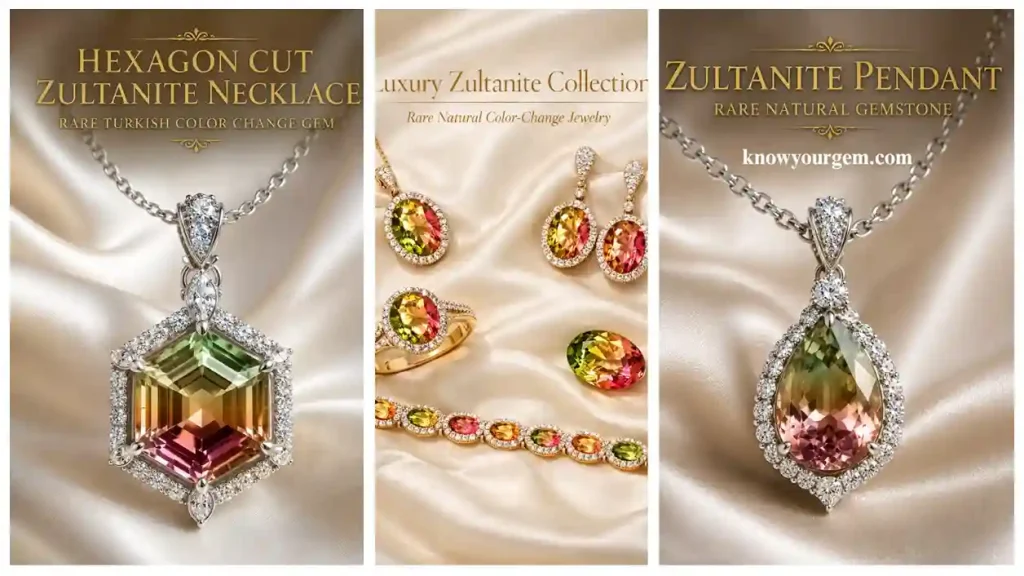
Zultanite Jewelry Guide:
A complete guide shows what jewelry suits to this gem and why:
Ring:
Collectors love to wear zultanite as rings because of its uniqueness, but protective setting like bezel or halo are required to protect the stone from scratches.
Engagement ring:
An engagement ring makes the stone rare and symbolic choice, because the stone owns 6.5-7 Mohs hardness means it needs an extra care and regular inspection for daily wear.
Diamond ring:
Diamond pair beautifully with zultanite’s hues, as it adds sparkle and structural protection through halo or accent designs.
Earrings:
Earrings are safer than rings as they face little impact, that make stud or drop earrings popular to enjoy the color, change effect.
Bracelet:
Bracelets look stunning but they still need caution, as constant knock can damage the protective bezel setting.
Pendant:
Pendants are among the safest settings, as they let larger stones shine freely without heavy contact for showcasing rarity.
Necklace:
Necklaces believed to highlight the color changing factor of the stone near the face, with gold setting it is often chosen to complement both green and pink phases.
Jewelry Suitability:
| Jewelry Type | Durability Rating |
| Ring | Normal |
| Earrings | Excellent |
| Pendant | Excellent |
| Bracelet | low |
| Necklace | Excellent |
Rings rate moderate for impact risk, bracelets lowest for constant knocks, however earring, pendant, and necklace rate it higher due to having minimal contact.
Authenticity:
- Fake vs real: Genuine zultanite is rare, it always comes from Turkey, not from labs. Limitations include synthetic color change sapphire, glass, or mislabeled stones.
- Certification: Independent lab certification can confirm natural diaspore origin. So, buyers should always request documentation, especially for larger or high value gems.
- Authenticity card: Some sellers issue branded cards referencing the trademarked name.
- GIA reports: The GIA identified diaspore but users uses the mineral name, not “zultanite.” Since a GIA report is one of the strongest authenticity proofs available.
- Laboratory reports: Reports list mineral species, refractive index, specific gravity, optical character, and treatment status.
Synthetic & Imitation Guide:
- No synthetics: There is no synthetic diaspore in the jewelry trade, so anything is sold as “lab created zultanite” is red flag for collectors.
- Common substitutes: Sellers usually use synthetic color changing sapphire or color glass.
- Sapphire differences: Synthetic sappphire is harder enough carries 9 Mohs scale however diaspore owns 6.5-7 Mohs hardness means it lacks pleochrism and cleavage.
- Glass clues: Color changing glass is cheaper, often showcases swirls, bubbles, or overly smooth color shifting under magnification.
- Scams: Some dealers mislabel glass or sapphire as “Zultanite,” or sell low grade on Turkish diaspore as premium quality.
- Best protection: Only buy this stone from trusted dealers who own verifiable sourcing and insist on independent certification.
How to Spot Fake Zultanite?
- Visual clues: Realistic stones showcase natural, muted color changing, glass looks too vivid or uniform.
- Color test: Genuine color shifts from green/khaki in daylight to pink/ champagne incandescent light, but fakes often don’t match.
- Refractive index: Authentic refractometer reads 1.70-1.75, anything outside isn’t diaspore.
- Inclusions: Natural growth lines and fractures usually appear in realistic stones, gas bubbles disclose glass.
- Pleochroism: Strong tricroic colors like green, yellow-brown, pink-red are unique, imitations showcase none.
- Weight: Genuine stone carries specific gravity like 3.3-3.5, glass often feels lighter or heavier.
- Hardness: True stones rate 6.5-7 on Mohs hardness.
Healing Properties:
Zultanite’s shifting color are seen as symbols of adaptability and emotional balance, this stone is mostly used in meditation during like changes.
Some traditions associate this stone to the heart and solar plexus for confidence and clarity, as these beliefs relate to spiritual healing can’t compete scientific medicines.
Care and maintenance for the stone:
Clean this stone gently with mild soap, lukewarm water, and a soft brush for remove dust, after that pat dry it with soft cloth.
Keep stored it in a separate pouch and avoid harder gems from this stone.
Care Mistakes to Avoid:
Common mistakes are including usage of ultrasonic or steam cleaners, exposing this stone to chlorine or detergents, sudden heat, or hard impacts are going against surfaces.
Tossing zultanite loosely with other jewelry also risks scratches, so padded, separated storage is essential for this stone.
Buying Guide:
Strong color changing is the top value factor. Stones with shifting clearly between green and pink can command higher prices. Carat weight always matters for authentic stones, as larger clean crystals are rare and prices rise steeply, that make smaller stones good value.
Always check a reputation of seller and request certification, especially online, Since, zultanite only comes from Turkey, buying it from trusted dealers means redusing the risk.
Buying Checklist
- Is the stone certified by an independent gemological laboratory?
- Is it confirmed natural diaspore, not glass or synthetic sapphire?
- Is the stone eye clean, or does the price reflect visible inclusions?
- Does it display a strong, clear color change under two different light sources?
- Is the country of origin confirmed as Turkey?
- Does the seller offer a clear return or authenticity guarantee policy?
Common Mistakes Buyers Make:
While buying the stone without checking the stone in different lights is a general mistake, as weak color change only showcase when it compared side by side.
As well as ignoring certification is the another risk, especially online where you can’t inspect the gem directly.
And choosing size over color strength often disappoints, as vivid shifts matter more than wight.
Ethical Sourcing:
The stone’s mining in Turkey is small scale and artisanal, with terms that are working narrow veins by hand in the Ilbri Mountains. This approach limits an environmental impact as compared to the large industrial gemstone operations.
Collector’s Guide:
Rare diaspores more than five carats with having vivid color change and eye clean clarity are considered as museum quality, and are sold privately. Investment stones showcase strong coloration, size, clarity, fine faceting, and certified provenance.
Expert Opinion:
Dealers say the biggest gap is color changing strength, as photos rarely showcase it well. While seeing zultanite in daylight and incandescent light is the most reliable way to judge.
Collectors generally prefer smaller, eye clean stones with having vivid shifts over larger weak ones.
Comparison with other gems:
The below complete guide compares this gemstone with other similar stones:
Alexandrite vs Zultanite:
Alexandrite and zultanite are generally compared for their color change, however they both own different mineral type, rarity, and price. Alexandrite shifts red-green as chrysoberyl, while zultanite shifts green-pink as diaspore.
| Feature | Alexandrite | Zultanite |
| Mineral Species | Chrysoberyl | Diaspore |
| Mohs Hardness | 8.5 | 6.5 – 7 |
| Primary Color Shift | Red to Green | Green to Pink/Champagne |
| Main Source | Brazil, Sri Lanka, Russia (historical) | Turkey (single source) |
| Typical Price Per Carat | $1,000 -$70,000 plus | $200 – $1,200 plus |
Alexandrite is harder and pricier, especially Russian stones, however zultanie’s more affordable entry into color change gems.
Both are valued for their natural, untreated shifts, that make them appealing alternatives hinging on budget and color preference.
Zultanite vs Color-Change Sapphire:
Color change sapphire is two step harder than zultanite, and shifts blue-purple coloration while zulatnite shift green-pink. Sapphire is suitable for everyday wear, but zultanite is single source rarity appeals to the collectors.
Zultanite vs Hackmanite:
Hackmanite showcases UV-triggered tenebrescence which fades, not same as zultanite’s stable light-dependent shift. Zultanite’s color change repeats consistently, while hackmanite’s temporary and reversible.
Zultanite vs Tanzanite:
Tanzanite owns strong blue-violet pleochroism and is softer owns 6-7 mohs hardness often found as heat treated. Whereas Zultanite is untreated and rarer, gives it natural stone appeal despite tanzanite’s larger market.
Zultanite vs Tourmaline:
Tourmaline lies in many colors worldwide and is harder at Mohs 7-7.5. Whether Zultanite is single source, rarer, and valued specifically for its unique color change behavior.
Common Myths:
- Myth: Zultanite and alexandrite both are the same in rarity, alexandrite is chrysoberyl whether rzultanite is diaspore.
- Myth: All zultanites are treated, however genuine stones are sold untreated with no standard enhancements.
- Myth: Zultanite can be lab created but no synthetic diaspores are existing fro jewelry.
- Myth: Stronger color change alone sets the value, as clarity, cut and carat weight also matter
Did You Know?
Zultanite is mined only in one district that makes it total worldwide supply inherently finite in a way few other gems can claim also.
Expert Tips:
Enthusiasts should always check this stone in daylight and warm incandescent light before buying it.
Pros & Cons:
Pros: Authentically rare single source origin, dramatic natural color change effect, always untreated, distinctive collector appeal, no synthetic competition.
Cons: Moderate hardness needs more careful wear than harder, as well limited availability makes larger stones hard to source.
Conclusion:
Zultanite is a single source, naturally color changing gem with having no synthetic competition and limited annual output. It offers collectors a rare alternative to the alexandrite at lower cost.
Its moderate hardness means it requires protective setting, however with having proper care it suits ring, earring, pendant, and necklace. So, buyers should focus on the strong color change, demand certification, and choose with direct Turkish sourcing.
FAQs:
1. What is zultanite?
Zultanite is a gem quality diaspore from Turkey which shifts green to pink/champagne.
2. Is zultanite natural?
Yes, it is completely natural and untreated
3. Why does zultanite change color?
Because chromium and iron can cause light dependent absorption shifts.
4. Is zultanite rarer than alexandrite?
This stone is found in single source, however Russian alexandrite is more valuable.
5. How much is zultanite worth?
It commands prices from $200-$1,200 per carat, with exceptional stones higher.
6. Can zultanite be lab created?
No synthetic diaspore is existing for jewelry.
7. Is zultanite a good investment?
It is less considered as an investment due to having moderate hardness.
8. Is zultanite suitable for engagement rings?
Yes with having protective setting, and proper care it suits engagement rings.
9. What is the hardness of zultanite?
The stone contains 6.5-7 Mohs hardness.
10. Where is zultanite mined?
It is mined exclusively in the Ilbir Mountains of Turkey.
11. How can you tell if zultanite is real?
Certification from labs like GIA can confirm authenticity, ethical, origin, grade, refractive index, and specific gravity.
12. Does zultanite scratch easily?
Yes this stone can be scratched against harder gems, so handle it carefully.
13. Is zultanite the same as diaspore?
Yes, zultanite is the trade name for Turkish gem quality diaspore.
14. Does zultanite fade over time?
No, its color change effect is stable and permanent.
15. How is zultanite different from hackmanite?
Zultanite’s shift is light source stable while hackmanite hackmanite’s UV tenebrescence is temporary.
Enthusiasts are advised to check their gem with GIA for authenticity, ethical sourcing, refractive index, specific gravity, and grading, as fakes stones are highly roaming around the world! Gem Enthusiast KamilHussian

Welcome to KnowYourGem.com! your ultimate destination for uncovering the fascinating world of gems and their secrets! I'm Kamil Hussain, a passionate blogger with a Master’s degree in Economics, dedicated to bringing you insightful, well researched content that blends the beauty of gemstones with the art of storytelling. With a keen analytical mind and a love for discovering hidden treasures, I created this platform to help you explore the brilliance, history, and value of every gem.


